
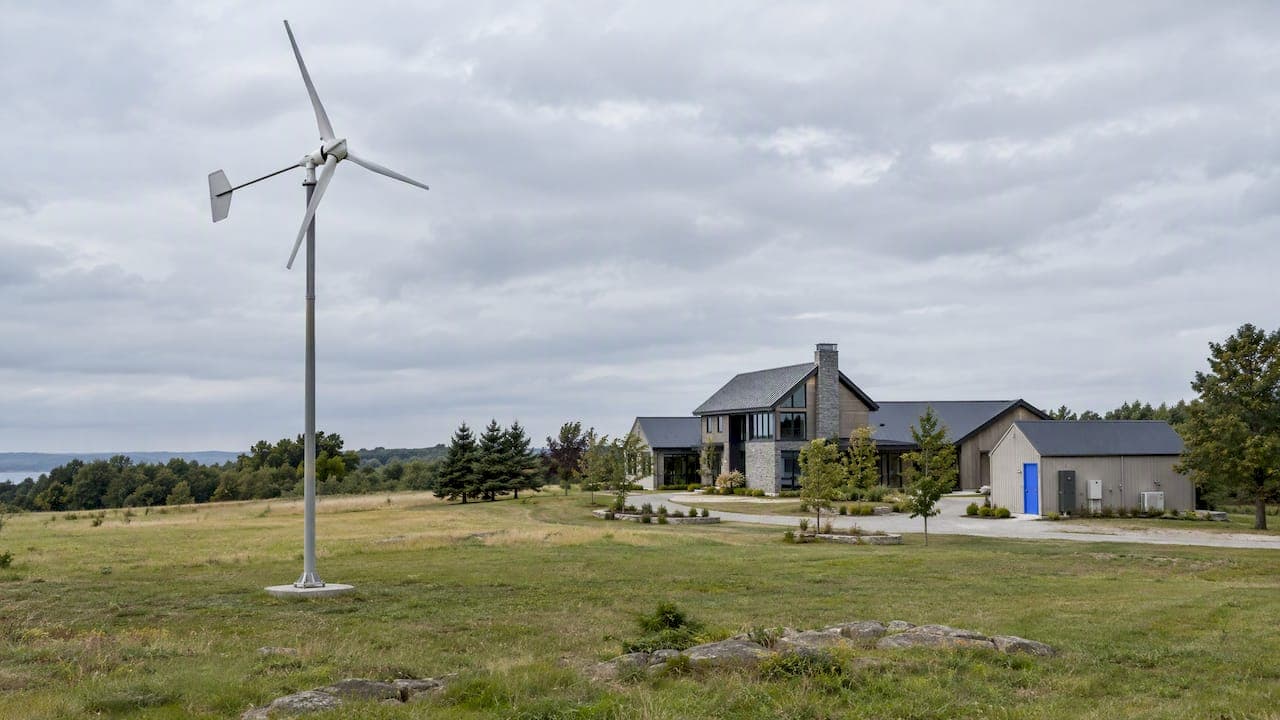
A residential wind turbine can power a home, but only on the right property. You need steady wind at hub height, enough open land, and a zoning board that will allow a tall tower. Most homes that look like good candidates fail on one of those three tests. This guide walks through sizing, cost, siting and permitting with U.S. figures, then shows what to do when wind is not the answer.
TL;DR
- Most homes need a 5 to 15 kW turbine to make a real dent in annual use, according to the Department of Energy's Small Wind Guidebook. Budget roughly $5,000 to $10,000 per kW installed.
- Your site needs an average wind speed of about 8 to 9 MPH or more at hub height. Trees, buildings and a small lot can rule a turbine out.
- Towers often run 90 to 140 feet, while many local codes cap structures near 35 feet. Zoning is the most common point of failure.
- Cut your load first. Efficiency is cheaper than generation and shrinks every component you buy afterward.
- For whole-home resilience, wind works best as one input to a custom microgrid, not a standalone fix.
Table of Contents
- How a residential wind turbine works
- How big a turbine do you need?
- What a residential wind turbine costs
- Does your site qualify?
- Zoning, noise and neighbors
- Cut your load before you buy generation
- Where wind fits in a microgrid
- Our perspective
- Need whole-property power that does not depend on wind?
- A practical path if you are still considering wind
- FAQ
- Sources
How a residential wind turbine works
A turbine converts the motion of wind into rotation, and a generator turns that rotation into electricity. An inverter or controller makes the output compatible with your home's electrical system. The DOE's consumer guide to small wind systems lays out these basics, including the tower, wiring and balance-of-system parts.
Small wind covers a wide range. Per the DOE guidebook, residential turbines run from about 400 watts for small applications up to 100 kW for large properties. That spread matters because the cheap units sold online and the units that actually run a house are different products.
| Class | Typical size | What it realistically does |
|---|---|---|
| Micro turbines | 400 W to 1 kW | Trickle-charges batteries for a cabin, boat or small load |
| Small residential | 1.5 to 5 kW | Offsets part of a modest home's use in a windy spot |
| Full residential | 5 to 15 kW | Can make a significant contribution to a typical home |
| Large property | up to 100 kW | Farms, estates, and commercial sites |
The DOE guidebook gives one useful anchor: a 1.5 kW turbine only covers a home using about 300 kWh a month, and only with a 14 MPH annual average wind speed. Most homes use far more than that.
How big a turbine do you need?
Start with your annual consumption. The guidebook uses an average of roughly 10,649 kWh a year for a U.S. home. Pull your own figure from twelve months of utility bills.
Then work backward:
- Find your annual kWh. Add up twelve months of bills.
- Reduce it. Do an energy audit and fix the biggest loads first (see below).
- Estimate site wind speed. Use a wind map for a first pass, then measure.
- Pick a rotor size that produces your target at that wind speed. Manufacturers publish power curves. Production rises steeply with wind speed, so a site averaging 10 MPH produces far less than one averaging 14 MPH.
- Plan for the gap. No turbine produces at its rated output all year. Plan storage or a generator for calm periods.
Pro tip: Never size a turbine from the nameplate kW alone. Ask for the expected annual kWh at your measured hub-height wind speed. If a seller will not give you that number in writing, keep looking.
What a residential wind turbine costs
The DOE guidebook reports that the capacity-weighted average for small wind projects was $5,120 per kW as of 2021. Individual systems often land between $5,000 and $10,000 per kW, depending on permitting, tower type and interconnection. A system sized to offset a typical 10,000 kWh a year can cost roughly $50,000 before incentives.
What moves the price:
- Tower height and type. Taller towers catch better wind and cost more. Guyed lattice towers are cheaper than freestanding monopoles but need ground space.
- Foundation and trenching. The longer the cable run from tower to house, the higher the cost.
- Utility interconnection. Some utilities add study fees, insurance requirements or equipment rules.
- Permitting. Variances and hearings add time and fees.
Incentives: check before you count on them
The federal residential credit for small wind covered property placed in service before January 1, 2026, according to ENERGY STAR. Because this article is written in October 2026, do not assume you can claim it for a new install. Confirm current federal rules with a tax professional, and check your state and utility for rebates, since those vary by location.
Payback is often longer than expected
Payback on residential wind is frequently slower than homeowners assume. The reason is simple: a turbine's output depends on a wind resource that you cannot control, while its cost is fixed upfront. A turbine in 8 MPH average wind may never pay for itself. One in a consistently windy, open location can.
Does your site qualify?
Siting decides everything. Run through these checks before you spend money on a turbine.
Wind speed at hub height
Plan on a minimum annual average of roughly 8 to 9 MPH at the height of the rotor, per the DOE guidebook. Your feeling that the property is windy is not data. The Farm Energy extension guide warns that personal impressions of a site's windiness are often not accurate, and suggests at least a half acre of open land as a starting point.
The reliable method is an anemometer mounted at or near hub height for a season or longer, compared against a nearby long-term reference. The DOE's site selection page lists the other factors, including wind resource, distance to power lines and environmental impact.

Obstructions and turbulence
Trees and buildings create turbulent, low-quality airflow. That cuts output and increases mechanical wear. The usual guidance is to place the rotor well above any nearby obstruction. For a wooded lot, that can mean a very tall tower, or no turbine at all.
Lot size
A tower is a structure that can fall. Many ordinances require setbacks tied to tower height. If your property is under an acre, setbacks for a 90 to 140 foot tower often make installation legally impossible whatever your wind resource says. Measure your lot against your local code before anything else.
Zoning, noise and neighbors
The DOE guidebook notes that tower heights of 90 to 140 feet are common for effective residential systems. Many residential zoning ordinances cap structures near 35 feet. A turbine therefore usually requires a variance, and that means a public hearing.
Experienced installers say the surprise of a denied permit is usually avoidable. It tends to come from ignoring neighborhood concerns, or from walking into a planning board meeting without data. Do this instead:
- Read your county or township small-wind ordinance first.
- Bring wind data, a site plan and manufacturer sound specifications.
- Talk with neighbors before the hearing, not at it.
- Ask your utility about interconnection rules early.
The objections you will hear are consistent. They include noise (the guidebook cites about 55 dB at 50 feet for a typical 2 kW turbine), shadow flicker, wildlife impact and views. If your project is large or contested, a formal noise assessment for wind projects may be worth requesting so that the board sees objective figures rather than guesses.
This is also why farmers and rural owners are sometimes cautious about turbines. The concerns are practical: a tall structure, a hearing process, and a hardware investment that depends on wind that may not cooperate.
Cut your load before you buy generation
The DOE and extension services agree on one point. The cheapest kilowatt-hour is the one you never use. Efficiency work costs less per kWh saved than any generation costs per kWh produced, and it shrinks the turbine, battery and generator you need.
Good first targets:
- HVAC: tune-ups, duct sealing, insulation, and heat pump upgrades where they make sense.
- Water heating, well pumps and pool pumps. Variable-speed pool pumps are a common win.
- Lighting and always-on loads.
- Load scheduling, so large loads do not run at the same moment.
A professional energy audit gives you the number to design around. If you want to go further, our guide to measuring and sizing a critical loads panel shows how to separate the circuits you must protect in an outage from the ones you can drop.
Where wind fits in a microgrid
A turbine is one generation source. A microgrid combines sources, storage and controls so the whole property stays powered. That matters because wind is variable. A turbine can produce well overnight and in storms, then nothing for days in still weather.
A resilient system typically layers several pieces:
- Generation: solar, a generator, and where the site supports it, wind.
- Battery storage: covers short gaps and smooths production. Our overview of home battery storage benefits explains the basics.
- Backup generator: carries the property through long, low-production stretches.
- Controls: manage loads, switch automatically at an outage, and coordinate with the utility grid.
For most homeowners focused on outages rather than bill savings, solar plus storage, or a hybrid with a generator, gives more predictable reliability than a turbine. Our comparison of microgrids versus generators and the guide to evaluating home backup power options go deeper on those choices.
Quick decision guide
| Your situation | Likely best fit |
|---|---|
| Under 1 acre, suburban, wooded | Solar plus battery, or a generator system. Turbine unlikely to be allowed or productive |
| 2+ acres, open, measured wind above about 9 MPH | Wind worth studying, ideally paired with storage |
| Rural, unreliable utility, large loads | Hybrid system with battery, generator and controls |
| Existing solar, want outage protection | Battery retrofit |
| Coastal, storm exposure | Storm-hardened design (see coastal home microgrids) |
Our perspective
We design power systems around a property's actual electrical demand and site conditions, not around a product we want to sell. That approach changes how we answer the wind question.

Our honest take: wind is a legitimate resource, and on a few properties it earns its place. Those are usually large, open, windy sites with measured data and a friendly permitting environment. On most estates and homes we see, the better answer is a combination of storage, a right-sized generator, and smart load control, with solar where the site supports it. Those systems are simpler to permit, quieter, and more predictable when the grid goes down.
What we would never do is size a system on a hope. If a client brings us a turbine idea, we start with their load data and site conditions, then let the numbers decide. If wind makes sense, it goes in. If it does not, we say so, and we design the layered system that will actually keep the lights on. Every design is reviewed by engineers, and we do not use generic packages or sell client information.
— Prime Microgrid
Need whole-property power that does not depend on wind?
If your goal is resilience, lower utility dependence or a backup system that starts automatically, we can engineer one around your property. Our team handles system design, equipment, installation and commissioning for estates, rural properties and large homes. See the systems we build, or review how we approach custom microgrid design before you talk with us.
A practical path if you are still considering wind
- Confirm your lot size and read your local small-wind ordinance.
- Audit and reduce your electrical load.
- Check wind maps, then measure wind at hub height.
- Get written production estimates for your measured wind speed.
- Price the full installed system, including tower, foundation, interconnection and permitting.
- Compare the result with solar, storage and generator options on cost per kWh and outage performance.
- Check current incentives with your state, utility and a tax professional.
FAQ
How much does a 1 kW wind turbine cost for a home?
Using the DOE's range of about $5,000 to $10,000 per kW installed, a 1 kW system lands in that band, and small units can cost more per kW because fixed costs are spread over less output. Keep in mind that a 1 kW turbine produces little energy for a typical home. Size to your measured wind and load, not to a price tag.
What is the cheapest way to generate electricity at home?
Reducing how much you use is cheaper than generating more. After efficiency work, the lowest-cost generation depends on your site and incentives. Solar is often easier to site and permit than wind, while wind can compete only where winds are strong and steady.
Why are farmers against wind turbines?
Objections generally cover noise, shadow flicker, wildlife, views, and the hearing process when towers exceed local height limits. For individual owners, there is also a financial risk: output depends on wind speed, and payback can be slow in average wind.
What are the typical sizes of wind turbines for a house?
Residential turbines range from about 400 watts to 100 kW. Most homes need a 5 to 15 kW unit to contribute significantly to annual use, according to the DOE. Smaller turbines suit cabins, boats and low-use loads.
Sources
- Small Wind Guidebook, U.S. Department of Energy
- Consumer Guide to Small Wind Energy Systems, U.S. Department of Energy
- Site Selection, U.S. Department of Energy
- Wind Energy for Homeowners, Farmers and Small Businesses, Farm Energy
- Small Wind Turbines (Residential) Tax Credit, ENERGY STAR