
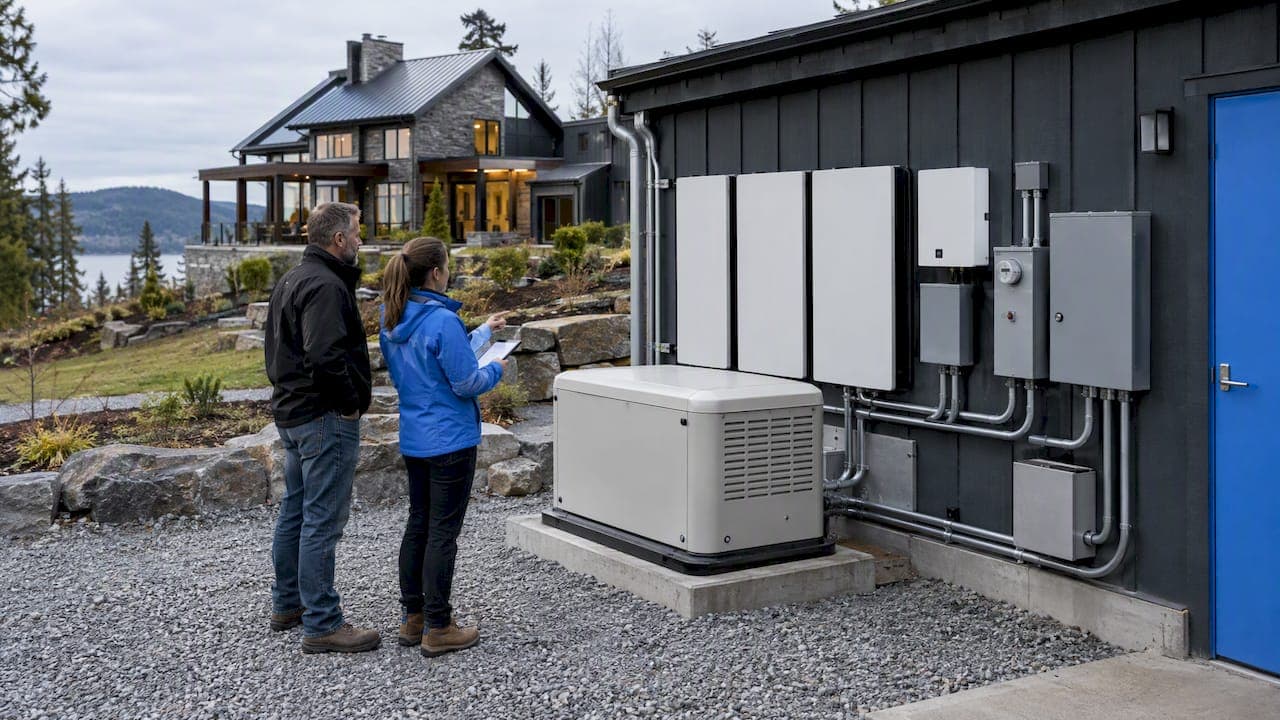
A backup-focused nanogrid typically runs in a range of costs from several thousands to tens of thousands of dollars, whole-home resilience systems can cost in the five to six figures, and estate-scale microgrids can reach into much higher six or multi-million dollar ranges. System scope, meaning how much of the home you want protected and whether you're staying grid-tied or going fully off-grid, is the single biggest driver of that spread. The federal Residential Clean Energy Credit also cuts the out-of-pocket number by 30% when your battery meets the 3 kWh threshold.
TL;DR:
- System scope and complexity greatly influence costs, with critical circuit backups costing in the low five figures and estate-scale microgrids reaching into millions.
- Soft costs such as engineering, permitting, and utility interconnection often account for a significant portion of total expenses, especially on larger or remote systems.
- Incentives like the 30% federal Residential Clean Energy Credit can reduce net costs substantially, provided equipment meets IRS qualification standards.
- Custom-designed microgrids for specific site conditions and resilience goals typically lower lifecycle risk and prevent budget overruns compared to generic solutions.
- Accurate budgeting requires assessing desired resilience level, site conditions, and current or future utility rates, along with conservative assumptions for payback calculations.
Table of Contents
- What each dollar pays for: equipment, installation, controls, and soft costs
- Why two quotes differ: resilience goals, loads, site and integration complexity
- How the Residential Clean Energy Credit and other incentives change the math
- Three homeowner scenarios with ballpark budgets and sizing rules of thumb
- How to run payback and LCOE for a homeowner microgrid and include resilience value
- Prime Microgrid's view on where custom design lowers lifecycle risk
- Practical vendor-RFP and negotiation tips from installers
- How Prime Microgrid can help with your next step
- Sources
- FAQ
What each dollar pays for: equipment, installation, controls, and soft costs
A microgrid quote is really three budgets stacked together: hardware, installation labor, and soft costs. Homeowners who understand this breakdown can compare two very different-looking proposals and see what's actually driving the price gap.
The hardware line covers the battery energy storage system (BESS), the inverter or power conversion system (PCS), any onsite generation such as solar or a generator, and the transfer switchgear that lets the system island from the grid during an outage. Specs worth asking about in any quote include usable kWh capacity, continuous and peak kW output, round-trip efficiency, and the battery chemistry, with LFP (lithium iron phosphate) now the common choice for residential storage because of its cycle life and thermal stability.
- Battery storage (BESS): the single largest line item, priced per kWh of usable capacity.
- Inverter/PCS: converts stored DC power to usable AC and sets the system's peak output ceiling.
- Onsite generation: solar arrays or backup generators that recharge the battery and extend runtime.
- Transfer switchgear and controls: the automatic transfer switch (ATS) and control logic that isolate your home from the grid during a fault.
Soft costs are where quotes diverge most, and homeowners often underestimate them. Engineering design, permitting, utility interconnection applications, commissioning, and project management routinely add a substantial share to the total, even though none of it shows up as a box in your garage. The NREL microgrid cost study breaks these shares out by project type, which is useful context even though its data comes largely from larger commercial and campus microgrids rather than single-family homes.
NREL's normalized data puts larger microgrid projects in the range of roughly $2 million to $5 million per megawatt of capacity, depending on complexity. That figure describes community and campus-scale systems, not a typical house, but it's a useful anchor: it shows why complexity, not just size, moves the needle, and it explains why a simple backup system and a full estate microgrid can differ by an order of magnitude even when both are called "microgrids." The DOE microgrid overview fact sheet echoes that same rule-of-thumb range and lists approximate percent contributions for equipment categories, which homeowners can use to sanity-check whether a quote's hardware-to-soft-cost ratio looks reasonable. If you want a deeper look at how these cost categories play out for residential projects specifically, Prime Microgrid's own microgrid cost guide walks through the same categories at a smaller scale.
Why two quotes differ: resilience goals, loads, site and integration complexity
Two homeowners on the same street can get quotes that differ by a factor of three, and almost none of that gap comes from the installer padding margin. It comes from scope decisions and site conditions that aren't always obvious until you dig in.
The first lever is resilience target. Protecting a handful of critical circuits (refrigerator, well pump, a few outlets, internet) needs only a few kW and a small battery. Whole-home backup that keeps HVAC, the range, and an EV charger running pushes peak demand and storage capacity up sharply. Full off-grid independence, where there's no utility connection to fall back on, requires enough generation and storage to carry the home through multi-day low-sun periods, which multiplies both battery size and system cost again.
- Critical-circuit backup needs the smallest kW and kWh footprint and the simplest switchgear.
- Whole-home backup requires larger inverters and enough storage to ride through a multi-hour or overnight outage.
- Full off-grid operation demands the most generation and storage margin, since there's no utility to lean on when weather or demand spikes.
Site conditions add their own line items. An aging electrical panel may need a service upgrade before any new equipment can connect. Utility interconnection sometimes requires transformer or meter changes that the homeowner didn't budget for. Adding a generator to the mix means synchronizing it with the battery and inverter, which adds control hardware and engineering time.
Control-system complexity is the least visible cost driver and often the most important one. A system that can island automatically, perform a black start after a total outage, or participate in a virtual power plant (VPP) program needs more sophisticated controls than a simple backup box, and that software and integration work shows up in the soft-cost line. The FEMP/DOE battery storage guidance outlines how these control functions, islanding and black start in particular, drive both sizing decisions and ongoing operations requirements.
Logistics risk deserves a mention too: long equipment lead times and slow permitting approvals are common triggers for change orders, which is why a realistic timeline estimate upfront saves money later.
How the Residential Clean Energy Credit and other incentives change the math
The federal Residential Clean Energy Credit offers a 30% tax credit on qualified clean energy property, including battery storage systems with at least 3 kWh of capacity, for systems placed in service through December 31, 2032. This is the single most impactful incentive available to homeowners building a microgrid today, and it applies to much more than just solar panels.
Here's how the math works on a representative project. For example, a whole-home microgrid with battery storage and solar costing a substantial amount installed may see a 30% tax credit reduce the homeowner's net cost accordingly, assuming the equipment meets eligibility requirements. That's a meaningful swing in payback timeline, and it applies whether the project is a modest backup system or a larger estate build.
- Qualifying equipment generally includes solar, battery storage of 3 kWh or more, and certain other clean energy property under IRS guidance.
- Labor and installation costs tied to qualifying equipment can typically be included in the credit basis, but confirm specifics with a tax professional.
- State and utility rebates often stack on top of the federal credit, though program rules and availability vary by location and change frequently.
Because eligibility details matter (what counts as "placed in service," how interconnection costs are treated, whether a battery retrofit on an existing solar system qualifies) it's worth confirming your specific project's qualification with both your installer and a tax professional before finalizing a budget.
Three homeowner scenarios with ballpark budgets and sizing rules of thumb
Sizing a microgrid starts with a simple question: how much of your home's power draw do you want protected, and for how long? The following three scenarios illustrate how that answer moves the budget, using assumptions typical of each tier rather than quotes for any specific property.
- Entry-level nanogrid or partial backup. Sized around a few critical circuits, roughly 3 to 5 kW continuous and 10 to 15 kWh of storage, this tier typically lands in the low five figures installed. After the 30% federal credit, net cost drops proportionally, often into the high single digits to low five figures depending on exact scope.
- Whole-home backup. Sized for 10 to 20 kW peak and 20 to 40 kWh of storage to cover HVAC, kitchen loads, and an EV charger, this tier generally falls in the low-to-mid six figures installed, with the credit reducing net cost by roughly 30%.
- Estate-scale microgrid. Covering multiple structures, larger generation arrays, generator integration, and sophisticated controls, this tier can reach high six to seven figures, with bespoke engineering, not equipment count alone, driving most of the premium. The Galena community-scale solar and battery project illustrates this at a larger scale: a remote 1.5 MW solar and 1.2 MWh battery system came in around $7 million, showing how site logistics and project complexity, not just capacity, set the price.
- Adding solar generation to a battery-only system increases upfront capital but reduces ongoing fuel or utility costs over the system's life.
- Adding a backup generator raises both capital cost and long-term maintenance, since it introduces a second fuel-based system to service.
- Larger systems don't always benefit from economies of scale. Remote sites, custom permitting, and multi-building integration can make a bigger project cost more per kW than a smaller, standardized one.
How to run payback and LCOE for a homeowner microgrid and include resilience value
Running your own payback math doesn't require an engineering degree, just a few honest inputs and a willingness to be conservative.

Start with simple payback: take your post-credit system cost, then divide it by your expected annual savings from avoided utility bills plus any value you place on avoided outage costs (spoiled food, lost remote-work hours, a sump pump that keeps running). Using the whole-home scenario above, a $100,000 pre-credit system becomes $70,000 after the credit. If avoided utility costs and outage-related savings together total $7,000 a year, simple payback lands around ten years, before accounting for battery replacement or rising electricity rates, both of which can shorten that timeline.
Levelized cost of stored energy (LCOE for storage) captures the full lifecycle picture better than simple payback alone. It divides total lifetime cost (purchase price, financing, maintenance, and eventual replacement) by total kWh the battery will discharge over its life. Cycle life and warranty terms matter enormously here: a battery rated for 6,000 cycles under a 10-year warranty delivers a very different lifecycle cost than one rated for half that, even if the sticker price is identical.
- Electricity price sensitivity: run your payback math at both current rates and a higher assumed future rate, since utility prices rarely stay flat for a decade.
- Outage-day sensitivity: model your savings at a conservative low-outage-day estimate and again at a higher one if your area has had frequent grid events.
- Incentive sensitivity: check whether the federal credit, state rebates, or utility programs you're counting on have expiration dates or funding caps.
Pro Tip: Run your payback math with the most conservative numbers you can justify. If the system still pencils out under pessimistic assumptions, you have a real margin of safety rather than a best-case story.
Prime Microgrid's view on where custom design lowers lifecycle risk
Generic, packaged backup systems are built to a spec sheet, not to your house. A site-specific design catches the soft-cost surprises (panel upgrades, interconnection quirks, tight equipment clearances) before they become change orders during installation, which is where budgets usually blow up.
Custom engineering earns its premium most clearly on remote properties, estates with multiple critical loads, and homes integrating a generator alongside battery storage and EV charging, since each of those adds control complexity that a one-size-fits-all package isn't built to handle. The process can be built around engineering each system to the property's actual demand and site conditions, reviewed by engineers rather than assembled from a generic template.
— Prime Microgrid
Practical vendor-RFP and negotiation tips from installers
Insist on a site visit and an engineered scope before signing anything, and ask for line-item pricing so you can compare quotes fairly. Clarify who handles utility interconnection and on what timeline. A bid that's dramatically lower than others often means thinner engineering, not better efficiency, and a phased installation can be a smart way to manage cash flow on a larger project.
How Prime Microgrid can help with your next step
If the numbers above have you thinking about what your own property actually needs, Custom residential microgrid systems can be designed around a home's real electrical demand, rather than a packaged template. Our Estate Microgrid Systems, Battery Retrofit Systems, and Hybrid Generator Systems cover everything from a single-family backup upgrade to a multi-building estate, with system design, installation, and commissioning handled as one engineered process.

If you want to see what a realistic budget looks like for your property, request a preliminary evaluation through our residential microgrid page and we'll walk you through the scope and numbers before you commit to anything.
Sources
- Residential Clean Energy Credit (IRS)
- NREL microgrid cost study (normalized costs and component breakdown)
- DOE microgrid overview fact sheet
FAQ
What is the typical home microgrid cost?
Home microgrid cost ranges widely based on scope: backup-focused systems typically run in the low five figures, whole-home resilience systems fall in the low-to-mid six figures, and estate-scale projects can reach high six to seven figures. The federal tax credit reduces net cost by 30% for qualifying systems with batteries of at least 3 kWh.
Why are people getting rid of their solar panels?
Some homeowners remove or replace solar panels due to aging equipment, declining efficiency over time, or a desire to upgrade to newer panel or inverter technology rather than any inherent flaw in solar generation itself. This is unrelated to microgrid viability, since battery storage and controls, not panel age, usually drive a microgrid's performance and cost.
What is the cheapest way to live off the grid?
The lowest-cost path to living off-grid generally starts with a small nanogrid sized to critical loads only, paired with modest solar generation and a right-sized battery, rather than a full whole-home system. Scaling resilience goals down to just the essentials (refrigeration, well pump, basic lighting) keeps both the kW and kWh requirements, and therefore the budget, as low as possible.
How much does solar cost for a 2,000 square foot home?
Solar costs for a home that size depend heavily on local rates, roof condition, and system size, and this article doesn't carry a sourced figure for that specific case. A solar installer can provide a site-specific quote, and the federal 30% credit applies to qualifying solar equipment the same way it applies to battery storage.
Does battery storage qualify for the federal tax credit?
Yes, battery storage systems with at least 3 kWh of capacity qualify for the 30% Residential Clean Energy Credit through December 31, 2032. This applies to standalone battery retrofits as well as batteries paired with new solar installations, though confirming qualification details with a tax professional is recommended.