

Designing a microgrid for your home or property is not like buying an appliance. The custom microgrid design considerations you work through before a single panel is installed will determine whether your system actually holds up during a three-day outage, or leaves you scrambling for candles. Between load analysis, component selection, regulatory compliance, and future scalability, the decisions stack up fast. This guide breaks down the most critical design factors in plain terms so you can make smarter choices and build a system that performs when you need it most.
Table of Contents
- Key takeaways
- 1. Custom microgrid design considerations: start with load analysis
- 2. Choosing the right generation and storage components
- 3. Planning for scalability and future growth
- 4. Comparing design options: cost, resilience, and sustainability
- 5. Understanding operational modes and smart controls
- 6. Implementation best practices and maintenance planning
- My take on what actually matters in custom microgrid design
- How Primemicrogrid helps you design the right system
- FAQ
Key takeaways
| Point | Details |
|---|---|
| Load analysis comes first | Accurately map continuous and surge loads before sizing any component to avoid costly under or over-builds. |
| Hybrid designs outperform single-source systems | Combining solar, storage, and a generator delivers better reliability and lower fuel costs than any one source alone. |
| Scalability must be designed in from day one | Planning for 15 to 20% additional capacity prevents expensive redesigns as your energy needs grow. |
| Small load curtailments unlock big savings | Accepting 2.5% load curtailment can cut microgrid investment costs nearly in half without sacrificing core reliability. |
| Compliance is non-negotiable | Adherence to NEC, NFPA, and UL standards protects your investment and your home. |
1. Custom microgrid design considerations: start with load analysis
Before you size a battery bank or pick a generator, you need to know exactly what you are powering. A load analysis is the foundation of every good microgrid design. It accounts for two types of power draw: continuous loads, which run steadily like a refrigerator or HVAC system, and surge loads, which spike briefly at startup like a well pump or air conditioner compressor.
Many homeowners underestimate surge loads. A 1,500-watt sump pump can spike to 4,500 watts for half a second at startup. If your microgrid is not sized to handle that, you get tripped breakers or damaged inverters.
Critical load prioritization matters just as much as total load sizing. Not every circuit in your home carries equal weight during an outage. Classify your loads by priority:
- Tier 1 (life-safety): Medical equipment, heating, refrigeration
- Tier 2 (comfort and security): Lighting, communications, security systems
- Tier 3 (convenience): Entertainment, EV charging, secondary HVAC zones
Research on hospital microgrid resilience shows that load prioritization using VOLL can increase survival rates for critical systems by 10 to 18% compared with treating all loads equally. The principle applies directly to residential design.
Pro Tip: Add 15 to 20% to your calculated peak demand when sizing your system. This capacity margin absorbs future load growth like a home EV charger or addition without requiring a full redesign.
2. Choosing the right generation and storage components
Once you know your loads, you can choose the right combination of power sources. Each generation type has a distinct role and trade-off:
- Solar PV: Low operating cost, zero emissions during generation, dependent on sunlight and seasonal variation
- Diesel or propane generator: High reliability, fuel storage required, emissions and noise to manage
- Natural gas generator: Cleaner than diesel, dependent on pipeline access, good for extended outages
- Wind or micro-hydro: Site-specific, not practical for most residential properties but worth considering in rural locations
On the storage side, lithium-ion batteries and hydrogen systems serve different functions. Lithium-ion handles immediate power delivery and short-term cycling. Hydrogen storage addresses seasonal energy gaps where battery banks would be impractically large. For most homeowners, lithium-ion remains the practical choice today.
The real advantage comes from combining sources. Hybrid microgrids that pair solar with batteries and a fuel generator reduce fuel costs, extend generator life, and hold up better during extended grid outages than any single-source system. Solar charges the batteries during daylight, which keeps the generator off unless storage drops below a set threshold.
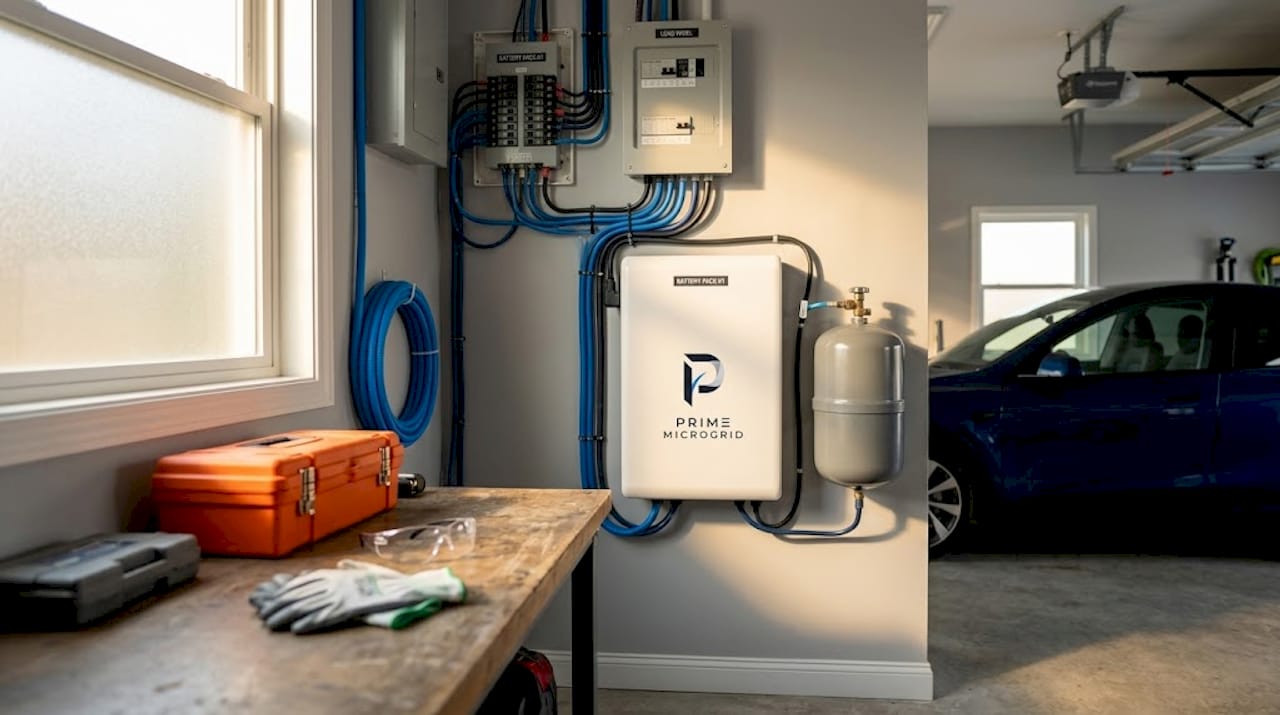
You can explore how these components compare side-by-side in terms of cost and resilience in a microgrid vs generator vs solar breakdown. Coordinating PV and storage scheduling also pays off technically. Co-optimizing PV and ESS dispatch improves renewable utilization by 22 to 37% and reduces battery cycling stress compared to uncoordinated setups.
3. Planning for scalability and future growth
A microgrid that fits your home perfectly today may be undersized by the time you add an EV, a home addition, or a heat pump. Scalability needs to be baked into the design from the beginning, not retrofitted later.
This means specifying inverters and battery enclosures with room to expand, running conduit that can support additional circuits, and selecting a microgrid controller that can handle increased capacity without replacement.
Here are the key scalability decisions to make at the design stage:
- Inverter headroom: Choose an inverter rated 20 to 25% above your current peak load.
- Battery expansion slots: Select a battery system with modular chemistry that allows adding cells without replacing the entire bank.
- Controller capacity: Your energy management system should support additional input sources and load circuits from day one.
- Physical space: Allocate space in your electrical room or outdoor enclosure for future equipment.
Islanded operation (disconnected from the grid) and grid-connected operation each have different control requirements. In islanded mode, your microgrid must regulate its own voltage and frequency. That requires a more sophisticated controller than a grid-tied system that can lean on the utility for frequency reference.
Pro Tip: When evaluating tailored microgrid solutions, ask vendors specifically which components can be expanded in place and which require full replacement. The answer will tell you a lot about the long-term cost of ownership.
4. Comparing design options: cost, resilience, and sustainability
Not all microgrid configurations deliver the same results. Here is how the most common design approaches compare across the metrics that matter most to homeowners and developers:
| Design approach | Upfront cost | Resilience | Sustainability | Best for |
|---|---|---|---|---|
| Solar + battery only | Medium | Moderate | High | Mild climates, short outages |
| Generator only | Low | High | Low | Infrequent outages, rural areas |
| Solar + battery + generator | High | Very high | Medium | Extended outages, critical loads |
| Full renewable + hydrogen storage | Very high | Very high | Very high | Zero-carbon goals, long autonomy |
Oversizing solar PV without matching storage is one of the most common and expensive mistakes in custom microgrid planning. Increasing PV beyond 1.5 times base load offers diminishing returns unless your energy storage is co-sized to absorb the extra generation. Otherwise, you produce power you cannot store or use, and it gets wasted.
Increasing your energy storage capacity to 1.5 times your base load is a more effective investment. Studies show that 1.5x ESS capacity cuts Energy Not Served by up to 40%, which is the core metric for outage resilience.
One design choice that often surprises homeowners is the value of intentional load curtailment. Allowing 2.5% load curtailment in zero-carbon microgrid designs has been shown to reduce total system investment by 46% while eliminating energy spillage entirely. In practice, this means non-critical loads like a hot tub or secondary HVAC zone drop during peak stress periods while everything critical stays on.
5. Understanding operational modes and smart controls
How your microgrid behaves moment-to-moment depends almost entirely on its control system. Advanced microgrid controllers use MILP optimization and predictive algorithms to dynamically balance battery charging, load dispatch, and generator starts based on current conditions and forecasts.
For a homeowner, that translates into a system that decides whether to charge the battery from solar or save capacity for an incoming storm, whether to start the generator or shed a non-critical load, and how to return to normal after the grid comes back.
Grid-connected mode gives you the option to sell excess energy back to the utility or shift loads to off-peak hours to reduce your electricity bill. Islanded mode prioritizes keeping your critical loads running regardless of what happens outside your property. Most well-designed residential microgrids can switch between these modes automatically, often in under 20 milliseconds, which means you never notice the transition.
The control architecture also handles battery thermal management, which is not a feature to skip. Lithium-ion batteries that operate outside their ideal temperature range degrade faster and pose safety risks. Smart battery management systems monitor cell voltage, temperature, and state of charge continuously to keep everything within safe limits.
6. Implementation best practices and maintenance planning
Good microgrid design best practices do not stop at the drawing board. How a system is installed and maintained determines how long it actually performs to spec.
On the compliance side, NEC, NFPA 99, and UL 2200 set the baseline safety and installation standards for microgrid equipment. Skipping permits or using non-listed components may save money upfront but creates serious liability and insurance problems if something goes wrong.
Key implementation and maintenance priorities include:
- Generator placement and vibration control: Mount generators on anti-vibration pads inside a weather-rated enclosure. Improper installation accelerates wear and creates noise issues with neighbors.
- Battery thermal protection: Install battery banks away from direct heat sources. In climates with extreme summer heat, consider climate-controlled enclosures for lithium-ion systems.
- Corrosion protection: Outdoor electrical connections in coastal or humid environments need weatherproof conduit, marine-grade connectors, and regular inspection schedules.
- Routine maintenance schedule: Plan for quarterly visual inspections, annual load testing, fuel system checks, and battery capacity verification.
- Professional integration: The grid interconnection agreement with your utility, protection relay settings, and transfer switch configuration should always be handled by a licensed engineer familiar with microgrid system design.
Maintenance is where many DIY microgrid projects fall apart. A system that runs perfectly for 18 months and then fails during a major storm because no one tested the transfer switch is not a resilient system. Build your maintenance plan before you sign the installation contract.
My take on what actually matters in custom microgrid design
I've seen a lot of microgrid projects, and the gap between a system that delivers and one that disappoints almost always comes down to the same two things: the quality of the load analysis and the honesty of the scalability conversation.
Most homeowners focus on the headline numbers, kilowatts of solar, kilowatt-hours of storage, and generator size. Those numbers matter, but they are downstream of the load analysis. If you do not know your actual surge loads and critical load priorities, every other number is a guess.
What I've found is that people consistently undervalue hybrid designs because they cost more upfront. But a system that lets a generator sit mostly idle because solar and batteries are handling the load pays back that premium quickly. Fuel costs alone justify the math within a few years in most regions.
The other thing I want to be direct about is zero-carbon microgrid claims. A fully zero-carbon residential microgrid with zero curtailment is technically achievable today but financially impractical for most homeowners. The smarter path is a high-renewable design with a propane or natural gas generator for backup, and a curtailment agreement that sheds non-critical loads during stress periods. You get 90% of the sustainability benefit at a fraction of the cost.
Regulatory changes are also coming faster than most people realize. Building in compliance headroom now, rather than retrofitting for new interconnection standards later, is one of the better investments you can make in your design.
— David
How Primemicrogrid helps you design the right system
If you've worked through these considerations and realized the decisions are more interconnected than they first appeared, that is exactly why Primemicrogrid exists.
Primemicrogrid designs tailored microgrid solutions for homes, farms, and commercial properties across the country. Whether you are evaluating your first backup power system or planning a full off-grid home power setup, the team works through every design factor with you, from load analysis and component selection to interconnection and long-term maintenance planning. For homeowners and developers in the Mid-Atlantic region, residential microgrid services are available with local expertise and hands-on support. For Texas property owners, region-specific solutions are offered through Prime Microgrid Texas. Get a consultation and find out what a system designed around your actual needs looks like.
FAQ
What are the most important custom microgrid design considerations?
Load analysis, component selection, scalability, control systems, and regulatory compliance are the five areas that determine whether a custom microgrid performs reliably over its lifetime.
How much battery storage does a residential microgrid need?
Sizing energy storage to 1.5 times your base load reduces Energy Not Served by up to 40%, making it the most effective benchmark for residential microgrid resilience.
Can a solar-only microgrid power a whole home during an outage?
A solar-only system works well in mild climates for short outages, but adding battery storage and a backup generator is necessary for extended outages or homes with critical loads like medical equipment.
Is load curtailment a problem in a custom microgrid?
Controlled load curtailment of non-critical circuits is a legitimate design strategy. Accepting just 2.5% curtailment can reduce total microgrid investment by nearly half while keeping all priority loads protected.
What permits and standards apply to home microgrid installation?
Residential microgrid installations must comply with NEC electrical codes, NFPA 99 where applicable, and UL 2200 generator standards, along with local utility interconnection requirements and any state-specific energy codes.