
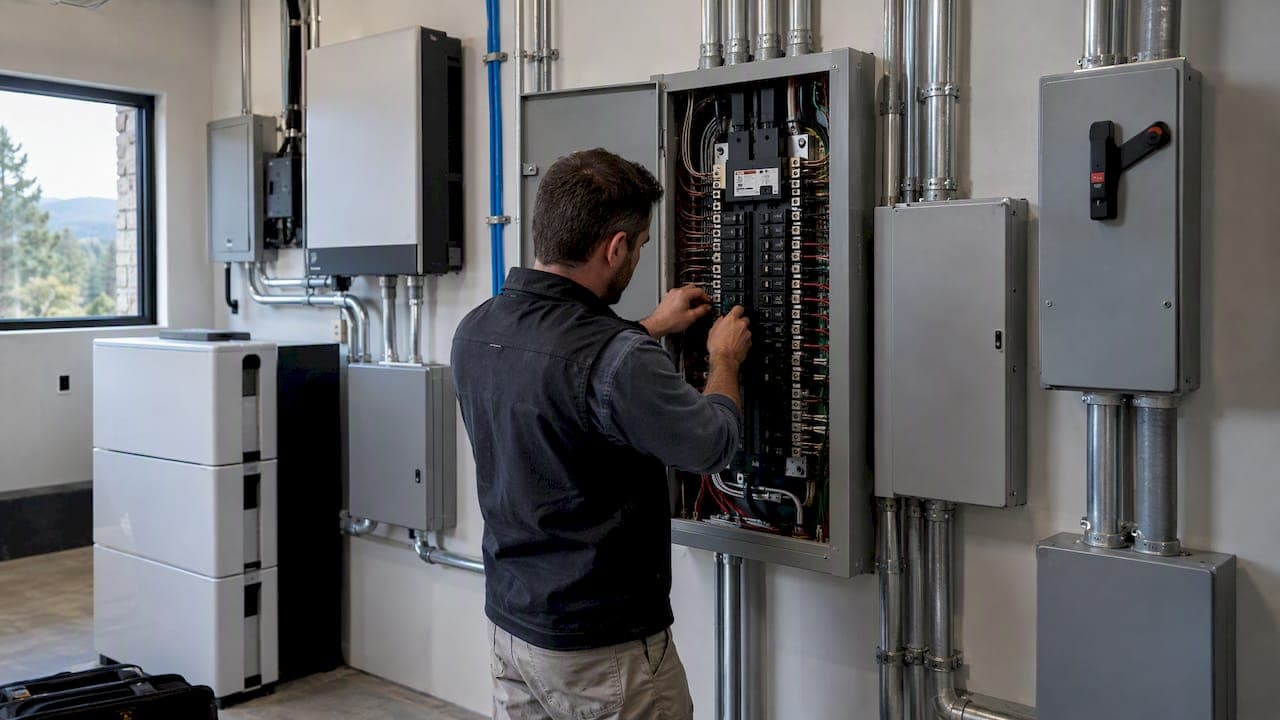
A critical load panel is a dedicated subpanel that routes backup power to the specific circuits you choose, a lower-cost, simpler way to keep essential systems running during an outage. It trades whole-home coverage for simplicity and a smaller price tag. Picking the right one still means sizing it correctly, choosing the right transfer equipment, and pulling the proper permits before you flip a single breaker.
TL;DR:
- Proper sizing of the critical load panel is vital to prevent breaker trips, especially from motor-start surges in appliances like pumps or air conditioners.
- Choosing between manual, automatic, or inverter-based transfer methods affects response time, safety, and compatibility with your backup power source.
- You should verify that your main service can support the additional circuits by conducting a full NEC load calculation, not just relying on available breaker slots.
- Fixed panels offer simplicity but lack flexibility, whereas smart load-management panels and microgrid systems provide dynamic prioritization and longer runtimes at higher costs.
- Professional installation and inspection are essential to ensure safety, proper grounding, and code compliance, especially for larger or complex backup systems.
Table of Contents
- What a critical load panel is and what people call it
- Why homeowners choose a critical load panel, and where it falls short
- How a critical load panel actually works
- Choosing circuits and sizing the panel correctly
- Critical panel vs smart panels vs whole-home backup: which fits your goals
- Safety, code, permits, and what inspectors look for
- When a custom microgrid design beats a DIY critical panel
- A practical checklist before you call anyone
- Where most homeowners get this wrong
- How Prime Microgrid approaches critical and whole-home backup
- Sources
- FAQ
What a critical load panel is and what people call it
A critical load panel is a secondary distribution panel wired to carry backup power only to the circuits you decide matter most during an outage, rather than powering the whole house. The DOE's microgrid guidance describes it as a secondary panel built around life safety, property protection, and continuity of operations, not total square footage.
You will see it called by a few different names, and they all mean roughly the same thing:
- Essential-loads panel
- Backup-loads panel
- Generator subpanel
The panel sits downstream of your main electrical panel. Selected circuits get rewired to feed from it instead, and a transfer device switches the whole subpanel over to a backup source, battery, generator, or both, when the grid drops. Typical homeowner picks include the refrigerator, a sump or well pump, basic lighting circuits, and outlets for medical equipment that cannot tolerate a gap in power.
Why homeowners choose a critical load panel, and where it falls short
The appeal is straightforward: a critical load panel costs less than whole-home backup, it is simpler to install, and you know exactly which circuits stay alive when the power goes out. There is no guessing about what the system is doing.
- Lower upfront cost than whole-home battery or generator systems
- Predictable, fixed list of backed-up circuits
- Simpler wiring and a smaller transfer device to size and maintain
The tradeoffs show up once you look closely at sizing. Your inverter or generator has to handle both the steady draw of everything on the panel and the surge when a motor, like a well pump or an air conditioner compressor, kicks on. Undersize that and you will trip breakers or stall the backup source at the worst possible time. If your priorities change season to season, or you want circuits that can be added or dropped without rewiring, a smart load-management system gives you that flexibility in a way a fixed critical panel cannot.
How a critical load panel actually works
Physically, the critical load panel is a small breaker box mounted near your main panel. An electrician moves the wiring for your chosen circuits from the main panel into this subpanel, so those circuits can be isolated and fed from a backup source independent of everything else in the house.
Three transfer methods are common:
- Manual transfer switch: you flip it by hand when the power goes out.
- Automatic transfer switch (ATS): it senses an outage and switches sources on its own, usually within seconds.
- Inverter-based listed transfer equipment: built into some battery systems, it handles switching internally as part of a listed, code-compliant assembly.
Whichever method you use, the inverter or generator's continuous rating has to cover your running loads, and its surge rating has to cover the highest motor-start spike on the panel, since starting a pump or compressor can briefly demand several times its running wattage. Safety protections matter just as much as sizing. Interlocks and anti-backfeed devices stop power from flowing back into utility lines, which protects utility workers repairing the outage. Grounding and neutral handling have to follow code exactly, since a miswired neutral can create a shock hazard that is not obvious just by looking at the panel.
Pro Tip: Ask your installer to show you the surge rating on paper, not just the continuous wattage. That number is what actually protects your pump and compressor circuits.
Choosing circuits and sizing the panel correctly
Picking circuits starts with three questions: what keeps people safe, what protects the property from damage, and what needs to keep running without interruption. A sump pump protects your basement from flooding. A refrigerator protects your food. A medical device protects a person. Rank your circuits that way before you think about wattage.
Here is a practical sequence to follow:
- List candidate circuits and pull nameplate wattage or amperage from each appliance.
- Measure actual draw with a clamp meter where nameplate data looks inflated or vague.
- Add up running watts, then check the highest single motor-start surge against your proposed inverter or generator's surge rating.
- Compare the total to your main service's capacity, not just to open breaker slots in your panel.
- Call an electrician for a full NEC load calculation if your added circuits approach a meaningful share of your service capacity.
Sizing has a few hard limits worth keeping in mind. DOE's panel upgrade guidance recommends not exceeding 80% of continuous load capacity on a service, and that applies to your critical load panel just as it does to the rest of your electrical system.
Average annual household electricity purchases were about 10,791 kWh in 2022, according to EIA data, which gives you a rough baseline for how much a typical home draws over a year. That figure varies a lot by home size and region, so use your own measured loads, not a national average, when sizing your battery or generator.
An empty breaker slot in your main panel is not proof you have available ampacity. The NEC-based load calculation is what tells you whether your service can actually support the new circuits, and skipping that step is one of the most common mistakes DIYers make.
Critical panel vs smart panels vs whole-home backup: which fits your goals
A fixed critical load panel gives you predictability: the same circuits are backed up every time, with no software deciding what gets power. That predictability is also its limit, since you cannot shift priorities without physically rewiring circuits.
Smart load-management panels take a different approach. The DOE's microgrid framework describes systems that coordinate generation, storage, switching, and controls to serve priority loads dynamically, which means the panel can shed or re-prioritize circuits as battery state of charge or available generation changes. That often preserves more useful runtime than a static arrangement, because the system is not blindly powering every backed-up circuit regardless of conditions.
Whole-home or microgrid-scale designs go further still:
- Fixed critical panel: simple, predictable, inflexible once installed
- Smart load-management panel: dynamic priorities, better runtime efficiency, more upfront cost
- Whole-home or microgrid design: near-seamless operation and longer runtimes, at the highest cost and complexity
The right choice depends on how much you value flexibility and seamless operation against upfront cost and installation complexity.
Safety, code, permits, and what inspectors look for
Transfer equipment, grounding, and disconnects are not places to improvise. NFPA's guidance for electrical inspectors makes clear that generator and transfer-equipment projects should involve a qualified installer and an inspector, because neutral switching and grounding errors create real shock hazards, not just code violations.
Before you start, have these ready for your local authority having jurisdiction:
- A clear wiring diagram showing which circuits move to the subpanel
- Documentation of your transfer device and how it prevents backfeed
- Your load calculation, especially if you are near your service's capacity limit
Pro Tip: If your proposed installation involves anything other than listed, code-compliant transfer equipment, stop and call a licensed electrician before you connect anything.
Red flags that mean you need a professional immediately: any connection that could backfeed the grid, uncertainty about your neutral and ground bonding, or a generator interconnection method that was not designed for your specific panel.
When a custom microgrid design beats a DIY critical panel
A DIY critical panel works well for a modest list of circuits and a single backup source. Larger properties, homes with multiple motor loads, or anyone with medical or business-critical power needs usually outgrow that simplicity fast.
Microgrid building-block research from DOE and Sandia describes modular components that integrate power conversion, control, and communications, allowing a system to segment loads and keep critical circuits running through a wider range of disturbances than a fixed subpanel can handle alone. That kind of coordination is what makes longer runtimes and near-seamless transitions possible, at a higher cost than a basic subpanel retrofit, but with far more resilience for properties where an outage is not just an inconvenience.

A practical checklist before you call anyone
Work through this sequence before you commit to hardware:
- Inventory every candidate circuit and its nameplate rating
- Measure actual draw with a clamp meter on anything uncertain
- Check your main service capacity against your proposed new load
- Choose a transfer method: manual, automatic, or inverter-based
- Size your battery or generator to cover both running watts and the largest motor-start surge
- Schedule your permit and inspection before energizing anything
A professional designer adds things a DIY checklist cannot: coordinated controls that handle motor-start surges automatically, integrated runtime planning based on your actual usage pattern, and a system built to your property's real electrical demand rather than a generic template. Our guide to critical home systems walks through how to prioritize circuits if you want to go deeper before deciding.
Where most homeowners get this wrong
The core tradeoff is cost and simplicity against flexibility and long-term resilience, and most people underestimate how much motor-start surge eats into their margin. The three mistakes I see most: sizing to nameplate wattage instead of measured draw, assuming an empty breaker slot means available capacity, and skipping the permit step because the work looks simple. If you have a short, stable circuit list, a DIY retrofit with a licensed electrician's sign-off is reasonable. If your property has multiple motor loads, medical needs, or you want seamless operation, call an engineer before you buy anything.
— Prime Microgrid
How Prime Microgrid approaches critical and whole-home backup
Prime Microgrid designs systems around your property's actual electrical demand, not a generic package, combining generation, battery storage, generators, and controls into one coordinated system reviewed by engineers.

If your situation involves multiple motor loads, a larger property, or a need for near-seamless backup, a custom-engineered approach handles the coordination a fixed critical panel cannot. Explore Estate Microgrid Systems, Battery Retrofit Systems, and Hybrid Generator Systems to see what a professionally designed system looks like for a property like yours.
Sources
- Microgrid Systems | Office of Electricity (DOE)
- Home Electrification and Electric Panel Upgrades (DOE factsheet)
- Electrical inspectors and generators for existing dwellings | NFPA
- How much electricity does an American home use? - Frequently Asked Questions - U.S. EIA
FAQ
What is a critical load panel?
A critical load panel is a secondary subpanel that carries backup power only to the circuits you select, such as a refrigerator, sump pump, or medical equipment, rather than the whole house. It connects to a transfer device that switches those circuits over to a battery or generator during an outage.
What are critical loads?
Critical loads are the circuits you decide must stay powered during an outage, typically chosen around life safety, property protection, and continuity of operations. Common examples include sump or well pumps, refrigeration, basic lighting, and medical devices.
Why are people getting rid of their solar panels?
This article does not cover reasons homeowners remove solar panels, since that depends on individual circumstances like roof work, system age, or changing energy needs. A licensed solar installer or your utility can walk you through options specific to your system.
What is the 33% rule for solar panels?
Sizing a solar or battery system depends on your measured loads and service capacity, which a load calculation and an electrician can establish for your specific home.