

Getting the size battery storage whole house calculation right is one of the most consequential decisions you will make in your home energy setup. Too small, and you run out of power hours into an outage. Too large, and you have spent tens of thousands of dollars on capacity you will never use. Most homeowners pick a system based on a neighbor's recommendation or a salesperson's pitch, which almost never matches their actual home's needs. This guide walks you through the real math, the right questions, and the practical tradeoffs so you can make a decision you won't regret.
Table of Contents
- Key takeaways
- How to size battery storage for a whole house: kWh vs kW
- Calculating your home's actual battery size needs
- Battery size scenarios by home profile
- Common sizing mistakes to avoid
- Verifying your sizing and choosing the right system
- My honest take on battery sizing for whole-house backup
- How Primemicrogrid helps you get the sizing right
- FAQ
Key takeaways
| Point | Details |
|---|---|
| kWh vs kW both matter | Energy capacity (kWh) tells you how long you last; power output (kW) tells you what you can run at once. |
| Start with a load audit | Identifying critical vs non-essential loads can cut your required battery size by 30 to 50 percent. |
| Whole-house backup costs more | Moderate whole-home systems run $28,000 to $45,000 installed; large homes can exceed $70,000. |
| Surge power trips systems | Motor-driven appliances draw 2 to 4 times their running current at startup, so inverter sizing must account for this. |
| Hybrid systems fill the gap | Batteries paired with solar or a generator handle multi-day outages far better than batteries alone. |
How to size battery storage for a whole house: kWh vs kW
Before you look at any product spec sheet, you need to understand two numbers that control everything: kilowatt-hours (kWh) and kilowatts (kW). They are not the same thing, and mixing them up is how homeowners end up with systems that fail on the first night of an outage.
kWh measures how much total energy a battery can store, like the size of a gas tank. kW measures how much power the system can deliver at any given moment, like the width of the fuel line. A battery with 20 kWh of capacity but only a 3.8 kW inverter cannot run your central air conditioner (typically 3.5 to 5 kW) even though it has plenty of stored energy.
Here is why both metrics must be balanced:
- A battery heavy in kWh but light in kW will run out of simultaneous capacity quickly when multiple appliances run at once.
- A battery with high kW but low kWh will deliver strong power output but die after just a few hours.
- The industry rule of thumb for balanced design is 1 kW of inverter output for every 2 to 3 kWh of usable battery capacity.
Most homeowners focus almost entirely on kWh because that is the number brands advertise most. But power output determines what you can actually run simultaneously. That is the number worth scrutinizing first.
Pro Tip: Before comparing products, write down the wattage of every appliance you plan to run at the same time during an outage. Add those up. That peak load number is your minimum kW requirement, and it shapes everything else.
Calculating your home's actual battery size needs
Here is a step-by-step process that works regardless of your home size or backup goals.
-
Conduct a critical load audit. List every appliance or circuit you need during a power outage. Separate them into must-haves (refrigerator, well pump, lighting, internet, medical devices) and nice-to-haves (electric range, hot tub, EV charger). A thorough load audit typically reveals that 60 to 70 percent of a home's daily consumption is non-essential during an outage. Cutting those loads can slash your battery size requirement by a third or more.
-
Calculate daily usage for your critical loads. Multiply each appliance's wattage by the hours per day you expect to run it. A 500-watt refrigerator running 8 hours a day uses 4 kWh. A 1,200-watt well pump running 2 hours uses 2.4 kWh. Add those numbers together for your daily critical load total.
-
Set your backup duration target. Decide how many hours or days of backup you need. One overnight? Two days without solar recharge? Multiply your daily critical load by the number of days. A home with 15 kWh of daily critical needs running for two days requires at least 30 kWh of usable capacity.
-
Adjust for depth of discharge and efficiency losses. Batteries cannot fully discharge without damage. Most lithium systems allow 80 to 90 percent depth of discharge (DoD), and conversion losses add another layer. You should add a 15 to 25 percent margin on top of your calculated usable need to account for these real-world losses.
-
Factor in solar recharge potential. If you have solar panels, a sunny afternoon can add 10 to 30 kWh back into your batteries depending on system size. This changes your math significantly and may allow a smaller battery with longer effective runtime.
Sizing reference table:
| Backup goal | Typical usable capacity needed | Approximate inverter size |
|---|---|---|
| Essential loads only | 10 to 15 kWh | 5 to 7.6 kW |
| Moderate whole-home | 20 to 40 kWh | 7.6 to 11.4 kW |
| Large or all-electric home | 40 to 60+ kWh | 11.4 to 22+ kW |
A typical U.S. home consumes about 29 kWh per day, which means a single 13.5 kWh battery provides roughly 11 hours of whole-home backup at average usage. That is rarely enough for multi-day outages without solar charging.

Pro Tip: Use your utility bill to find your monthly kWh usage, then divide by 30 for your daily average. This gives you a real baseline to work from instead of guessing.
Battery size scenarios by home profile
Sizing varies dramatically depending on the size of your home, how it is heated and cooled, and how much backup you actually want. Here is how it breaks down in practice.
| Home profile | Backup scope | Usable capacity | Inverter output | Estimated installed cost |
|---|---|---|---|---|
| Small home (1,500 sq ft) | Essential loads | 10 to 15 kWh | 5 to 7.6 kW | $10,000 to $18,000 |
| Medium home (2,500 sq ft) | Whole-home moderate | 20 to 30 kWh | 7.6 to 11.4 kW | $28,000 to $45,000 |
| Large home (4,000+ sq ft) | Full whole-home | 40 to 60 kWh | 11.4 to 22 kW | $45,000 to $70,000+ |
| All-electric home | Full whole-home | 60+ kWh | 22+ kW | $70,000+ |
The cost breakdown for whole-home systems goes beyond hardware. It includes electrical panel upgrades, permit fees, labor, and sometimes a solar array if grid recharge alone is not reliable enough.
Why do large homes need bigger battery systems? The math is simple. More square footage means more circuits, larger HVAC loads, higher baseline consumption, and often more appliances running simultaneously. A 5,000-square-foot home with electric heat, a pool pump, and multiple refrigerators has a peak load profile that a small battery system literally cannot serve. The system would trip within minutes of an outage.
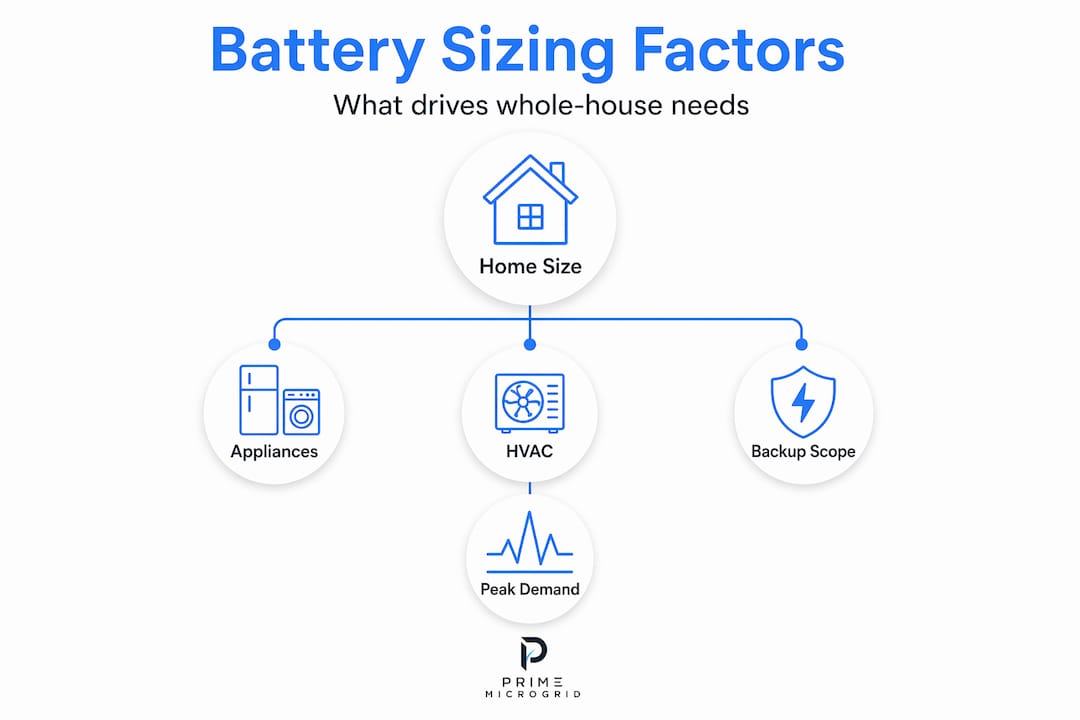
Understanding how battery storage supports large homes requires looking at peak demand, not just average usage. A large home might average 50 kWh per day but spike to 15 kW or more at peak demand periods, and the battery and inverter combination must handle that spike without shutting down.
Common sizing mistakes to avoid
Knowing what goes wrong is just as useful as knowing what to do right.
-
Ignoring surge power. Motor-driven appliances like HVAC compressors, well pumps, and refrigerators draw 2 to 4 times their normal current at startup. If your inverter cannot handle that surge, the system trips and your backup power fails at the worst possible moment. Always verify inverter surge ratings against your highest-startup-load appliances.
-
Confusing nominal with usable capacity. A 15 kWh battery does not deliver 15 kWh of usable energy. After depth of discharge limits and conversion losses, you might get 12 to 13 kWh realistically. Sizing to nominal numbers leaves you short.
-
Undersizing the inverter. Homeowners often buy enough kWh but not enough kW. Matching the battery bank to a too-small inverter creates a bottleneck. Oversize your inverter by about 20 percent above your peak load estimate, but do not exceed 50 percent oversize or you create idle efficiency losses.
-
Planning only for overnight outages. Batteries are designed for short-term bridging, not multi-day outages. Batteries alone cannot reliably replace grid power during extended events without solar recharge or a generator. Plan a hybrid backup approach from the start.
"The most reliable home energy systems combine battery storage with at least one other source. Counting on batteries alone for three days of outage coverage requires a system so large it stops making financial sense for most homes."
Pro Tip: Ask your installer for the surge rating on every inverter they propose. Then compare it to the startup draw of your largest motor-driven appliance. If the surge rating does not exceed that load by at least 20 percent, ask for a different inverter.
Verifying your sizing and choosing the right system
Once you have done the math, bring these numbers to your installer and ask them to verify the design against your actual panel and load data. Here is what to check:
- Inverter specs match your peak and surge loads. Do not accept "it should be fine." Get confirmation in writing against real appliance data.
- Battery design is modular and expandable. The best battery storage for homes allows you to add capacity over time as your needs grow or solar offsets costs. Starting with a 20 kWh system and expanding to 40 kWh two years later is often smarter than oversizing from day one.
- Monitoring is included. Real-time data on state of charge, power draw, and system health helps you catch problems before they matter during an outage.
- Warranties are clear. Lithium battery warranties typically cover 10 years with minimum throughput guarantees. Read those terms. A "10-year warranty" that covers only 60 percent capacity retention at year 10 is not the same as a performance guarantee.
- Solar integration is planned, not an afterthought. Pairing battery storage with solar changes the entire economics of the system. Solar battery integration should be part of the original design, not bolted on later.
My honest take on battery sizing for whole-house backup
I have worked through enough of these projects to know that homeowners almost always come in with one of two problems. They either want to size a battery system that covers everything with no compromises, or they have no idea where to start and default to the smallest system that fits the budget.
Both approaches tend to lead to disappointment. In my experience, the homeowners who end up most satisfied are the ones who get honest about what they actually need during an outage. Not what they want. What they need.
I have seen households cut their required battery capacity in half simply by agreeing to turn off the electric dryer, the second refrigerator, and the pool pump during an outage. That load audit conversation is worth more than any spec sheet.
My other observation: the inverter is the most commonly undersized component in residential battery systems. Installers sometimes push toward lower kW inverters to keep costs down, but that inverter is the ceiling on everything your system can do. I would rather see a homeowner choose a larger inverter with a smaller battery bank than the reverse, because you can always add kWh later. Replacing an undersized inverter is expensive and disruptive.
For homes over 3,500 square feet or with all-electric heating, I think battery backup alone is rarely the full answer. Pairing it with a generator or solar turns a vulnerable system into a genuinely resilient one.
— David
How Primemicrogrid helps you get the sizing right
Sizing a whole-house battery system is not a spreadsheet exercise you want to do alone. At Primemicrogrid, we design residential energy systems that actually match what your home needs, not what a generic calculator suggests.

Whether you are a homeowner in the Mid Atlantic looking at a residential microgrid system, or you want to understand how your options compare across batteries, generators, and solar, Primemicrogrid builds the analysis around your real load data. We work through the critical load audit, verify inverter and battery sizing, and design systems that can expand as your needs change. If you are ready to stop guessing and get a system sized for your home, explore home battery backup options with the Primemicrogrid team.
FAQ
How much battery storage does a whole house need?
Most moderate-sized homes need 20 to 40 kWh of usable battery capacity for 24-hour whole-home backup, while large or all-electric homes typically require 40 to 60+ kWh. The exact number depends on your daily energy consumption, backup duration goals, and which loads you plan to run.
What is the difference between kWh and kW in battery systems?
kWh measures total stored energy (how long your backup lasts), while kW measures how much power the system delivers at once (what you can run simultaneously). Both numbers must be matched to your home's needs for the system to work reliably.
Can one battery back up an entire house?
A single battery unit rarely provides true whole-home backup for more than a few hours. Most whole-home systems use multiple battery modules or large-format units totaling 20 kWh or more, often paired with solar or a generator for extended outage coverage.
Why do large homes need bigger battery systems?
Large homes have higher baseline energy consumption, bigger HVAC systems with higher startup surge demands, and more simultaneous loads. A battery and inverter system sized for a small home would trip or run out within hours when serving a 4,000-square-foot household.
How do I know if my battery is sized correctly?
Have your installer verify the inverter's surge rating against your largest motor-driven appliances, confirm usable capacity accounts for depth of discharge and efficiency losses, and check that the kWh-to-kW ratio follows the 2 to 3 kWh per 1 kW inverter output guideline.