
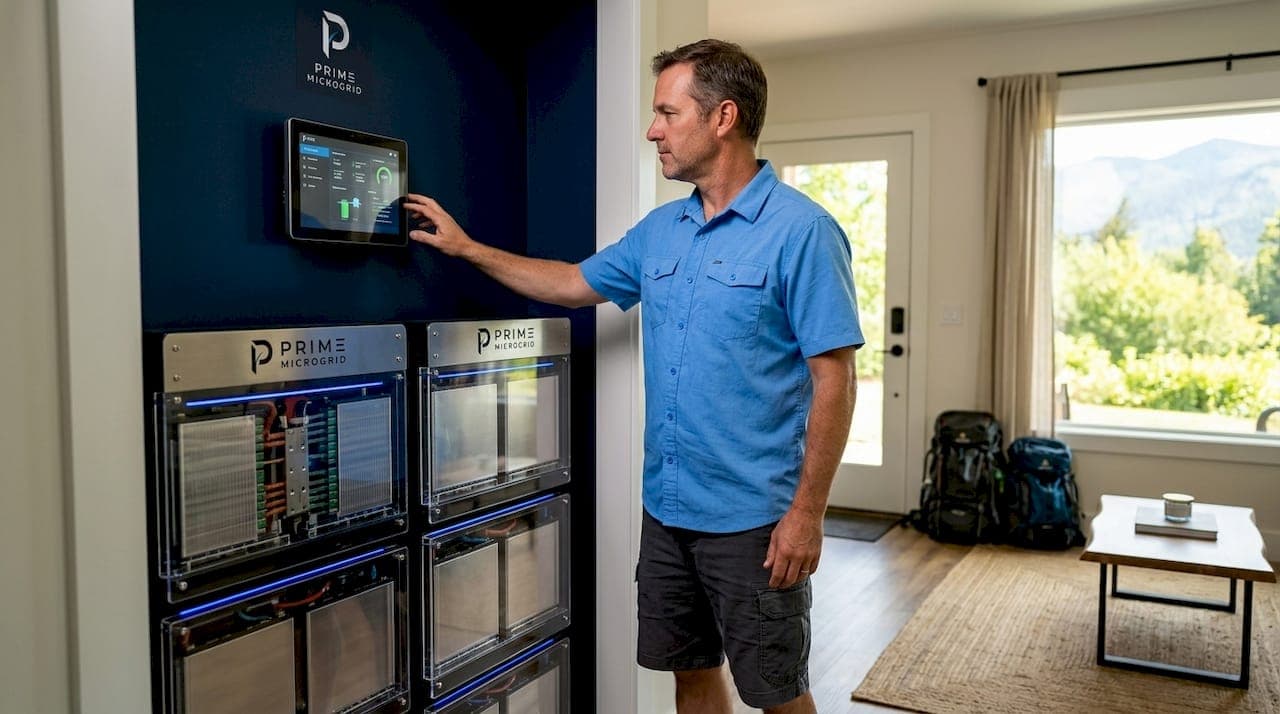
Most people think of battery storage as a backup plan, something that kicks in when the grid goes down and shuts off once power returns. If that's how you've been thinking about batteries for your rural property, you're leaving most of their value on the table. Understanding how battery storage helps remote properties means recognizing that batteries do two jobs at once: they store excess energy when your solar panels or generator produces more than you need, and they deliver that energy exactly when demand is highest. For properties far from reliable grid infrastructure, that double function is what separates genuine energy independence from expensive frustration.
Table of Contents
- The role of battery storage in remote energy systems
- Planning battery storage for multi-day resilience in remote properties
- Comparing battery technologies and storage configurations for remote homes
- Real-world examples: How battery storage improves resilience and lowers costs
- Key considerations and best practices for installing battery storage at remote properties
- Why most remote property battery projects fail and how to succeed
- Get reliable battery storage and microgrid solutions for your remote property
- Frequently asked questions
Key Takeaways
| Point | Details |
|---|---|
| Battery storage roles | Batteries shift solar energy use from high generation times to when power is needed, not just for outage backup. |
| Proper sizing critical | Balancing energy capacity and power output ensures reliable multi-day backup without undersizing risks. |
| Battery technology matters | LiFePO4 batteries offer the best blend of efficiency, lifespan, and low maintenance for remote homes. |
| Real-world benefits | Case studies demonstrate significant resilience gains and electricity cost reductions from solar-battery systems. |
| Avoid common pitfalls | Planning for true resilience requires multi-day autonomy and power consideration beyond typical short-term backups. |
The role of battery storage in remote energy systems
Battery storage is more than a glorified insurance policy. It's an active energy management tool that shapes when power flows, how much is available at any given moment, and how long your property stays operational when supply is interrupted. Battery storage provides resilience by supplying backup power during disruptions and acts as an insurance policy by charging when solar generation is high and dispatching when demand is high.
To use batteries well, you need to understand two numbers: energy capacity (measured in kilowatt-hours, or kWh) and power capacity (measured in kilowatts, or kW). Energy capacity tells you how long the system can run. Power capacity tells you what it can run at once. A battery with 20 kWh of storage but only a 3 kW output can't start your well pump if that pump requires 5 kW at startup, no matter how full the battery is. Both numbers matter equally.
Here's how battery storage functions across different time horizons for remote properties:
- Short-term smoothing: Batteries absorb brief gaps in solar production caused by cloud cover, keeping your loads running without a flicker.
- Daily cycling: Batteries store midday solar surplus and discharge it in the evening when demand peaks but the sun is gone.
- Multi-day resilience: Properly sized systems carry remote properties through multiple cloudy days or storm events without generator use.
- Load shifting: Batteries let you run high-draw equipment like pumps, compressors, or workshop tools at times that don't strain your recharge cycle.
Pairing battery storage with solid home battery backup planning ensures you account for all four of these roles, not just the one that comes to mind during the next outage.
Planning battery storage for multi-day resilience in remote properties
Remote properties don't experience outages the same way suburban neighborhoods do. When a storm rolls through rural land, it's not uncommon to lose power for three to seven days, and in extreme cases, even longer. Your battery system needs to be planned around your worst realistic scenario, not the average one.

The military standard offers a useful benchmark. Military microgrids require storage capacity to support critical loads for a minimum of 14 days, a requirement born from field experience with exactly the kind of isolation that rural property owners face. Most residential systems won't need to hit that mark, but it reframes how seriously you should approach resilience planning.
Follow these steps to plan a battery system built for real-world remote conditions:
- Conduct a full load audit. List every device on your property, its wattage, and how many hours per day it runs. Don't forget well pumps, refrigerators, medical equipment, and heating controls. These are your non-negotiables.
- Separate critical loads from comfort loads. Your refrigerator and water pump need power every day. Your second television does not. This distinction drives your minimum battery size.
- Calculate your daily kWh consumption. Add up all wattages multiplied by daily run hours. This is your baseline daily draw.
- Set an autonomy target. Battery systems for remote properties must be sized around autonomy and recharge availability, balancing energy and power needs. For most rural homes, two to three days of autonomy is a practical minimum. For properties in areas prone to extended cloudy weather or severe storms, five or more days is worth the investment.
- Add a recharge strategy. Solar panels cover most days, but a backup generator fills in when panels can't recharge batteries fast enough. Size your generator to recharge the battery bank within four to six hours if needed.
- Consider staged deployment. Installing batteries in sets allows one bank to charge while another discharges, extending system life and operational continuity without a full shutdown for maintenance.
Pro Tip: When sizing for battery backup, don't calculate based on average daily use. Use your heaviest-use day of the year as the baseline. That's the day your system has to perform perfectly, and it's the one most likely to coincide with a weather-driven outage.
Proper planning also shapes your approach to off-grid home power more broadly, since battery sizing interacts directly with solar array size, generator capacity, and load management settings.
Comparing battery technologies and storage configurations for remote homes
Choosing the right battery chemistry is one of the most consequential decisions in any battery storage project. The wrong choice wastes money, creates maintenance headaches, or leaves you without power at the worst moment.
| Battery type | Usable capacity | Cycle life | Maintenance | Best use case |
|---|---|---|---|---|
| Flooded lead-acid | 50% of rated capacity | 400–700 cycles | Monthly watering required | Budget-conscious, attended properties |
| AGM (absorbed glass mat) | 50–60% of rated capacity | 500–1,000 cycles | Minimal | Seasonal cabins, moderate use |
| LiFePO4 (lithium iron phosphate) | 80–95% of rated capacity | 3,000–4,000+ cycles | None | Full-time residences, demanding loads |

LiFePO4 batteries dominate remote installations due to deeper discharge, longer lifecycle, and lower maintenance compared to flooded lead-acid or AGM batteries. The upfront cost is higher, but the ten-year cost of ownership is typically lower because you're not replacing a bank every four years.
Key factors that should drive your configuration decision:
- Climate: LiFePO4 handles heat and cold better than flooded lead-acid, which loses capacity in low temperatures.
- Maintenance access: If your property is unattended for weeks at a time, flooded lead-acid batteries are a liability. They require monthly watering to avoid permanent damage.
- Load profile: High-draw equipment like motors and compressors needs batteries with strong discharge rates. Not all battery chemistries deliver the same peak power.
- Modularity: LiFePO4 systems are easier to expand in stages, which matters if you plan to add capacity as your energy needs grow.
Pro Tip: If you're evaluating microgrid vs battery options for your property, ask the supplier to model your system at 80% state of charge rather than 100%. That's a more realistic daily operating condition, and the output numbers will be more accurate.
Real-world examples: How battery storage improves resilience and lowers costs
Theory is useful. Real outcomes are more convincing.
In Vieques, Puerto Rico, a mobile solar-powered battery powered a home for three days during outages and supported critical refrigeration for medication and food storage. This wasn't a luxury system. It was a practical deployment proving that even modestly sized battery storage can preserve critical health and food safety functions when the grid fails for extended periods. Vieques is a textbook case of what energy solutions for remote locations look like when executed with clear priorities.
The financial case is just as compelling. One Australian household reduced electricity costs from about A$300 to A$25 per month by installing solar with battery storage, aided by federal subsidies. That's a 91% reduction in monthly energy costs. While subsidy structures differ by region, the underlying math, storing cheap solar power instead of buying expensive grid power, applies anywhere.
"Battery storage doesn't just protect against outages. It changes the economics of energy for rural properties by making locally generated power the primary source rather than the fallback."
Key takeaways from real-world deployments:
- Staged battery systems allow continuous operation during maintenance windows, a critical feature for remote locations where a service call takes days, not hours.
- Solar battery real-world impact tends to exceed projections when load audits are done accurately and recharge sources are properly matched to consumption patterns.
- Federal and state incentive programs in the U.S. can reduce installed costs by 30% or more, improving payback timelines significantly.
- Properties with refrigeration needs (medications, livestock feed, food storage) see the most immediate and measurable benefit from battery backup integration.
Key considerations and best practices for installing battery storage at remote properties
A well-designed system that's slightly undersized will fail you at exactly the wrong moment. These are the most common gaps we see in remote property battery installations.
Proper load assessment, matching battery power and energy capacity with real needs, and accounting for recharge sources are what separate reliable systems from expensive disappointments.
"The single most common mistake in remote battery projects isn't buying cheap batteries. It's buying the right batteries in the wrong quantity."
Best practices for remote property battery installations:
- Do a full load audit before buying anything. Know your actual daily kWh draw and your peak kW demand. Both numbers drive your sizing decision.
- Size for at least two to three days of autonomy. Properties in cloudy climates or hurricane-prone regions should aim for five days.
- Match your battery chemistry to your maintenance reality. Flooded lead-acid batteries require monthly watering, making them a poor fit for seasonal or unattended properties.
- Never undersize your power rating (kW). A battery that can't deliver enough instantaneous power to start your well pump is useless during a water emergency, regardless of how much energy it stores.
- Plan redundant recharge sources. Solar is your primary source. A generator is your backup. Properties that rely on a single recharge method eventually get caught.
- Review your system's behavior during winter. Cold temperatures reduce battery capacity, sometimes by 20 to 30%. Size accordingly.
Pro Tip: Before finalizing any battery storage plan for a remote property, simulate three outage scenarios on paper: a 24-hour outage, a 72-hour outage, and a 7-day outage with no solar. If your proposed system fails the 72-hour test, it's not sized for true resilience.
Why most remote property battery projects fail and how to succeed
After working through the planning fundamentals, the technology comparisons, and the real-world examples, a pattern becomes clear. Most battery storage projects that underdeliver share the same core failure: they were planned for outage backup, not operational resilience.
There's a meaningful difference between those two things. Backup power means the lights stay on for a few hours. Operational resilience means your property functions normally for days, your well pumps water, your refrigerator keeps temperature, and your critical equipment runs without interruption. The gap between those two outcomes is usually not which battery you bought. It's what questions you asked before you bought it.
The most frequent technical failure mode is undersizing energy or power capacity. A property owner buys a system with plenty of kWh on paper but a kW rating that can't handle the startup surge of a pump or an HVAC compressor. The system shuts down under load. Frustration follows. The battery gets blamed when the real culprit was a gap in the planning process.
Another common mistake is treating battery sizing as a one-time decision. Properties evolve. You add a workshop, a second refrigerator, an EV charger. A system that was correctly sized in year one becomes chronically undersized by year four. Staging your battery project from the beginning, with modular expansion built into the design, avoids this trap.
The properties that get this right share one habit: they plan for their worst realistic outage scenario, not their average one. They size for five days of autonomy even though most outages last one. They choose LiFePO4 even though flooded lead-acid costs less upfront. They install a generator recharge path even though they expect solar to handle 95% of recharging. That margin of safety is what power independence with batteries actually looks like in practice.
Get reliable battery storage and microgrid solutions for your remote property
Planning a battery storage system for a remote property is genuinely complex, and the stakes are high when reliable power isn't optional. Prime Microgrid specializes in exactly this kind of work: designing and installing residential microgrid systems built around your specific loads, your location, and your resilience goals.
Our team starts with a detailed load audit, models your autonomy requirements, and designs a system with the right battery chemistry, power rating, and recharge strategy for your property. We also help you navigate the decision between a microgrid vs battery backup approach, since the right answer depends on your property size, load profile, and long-term goals. Whether you need a straightforward solar-plus-battery setup or a full microgrid with generator integration and smart controls, we build systems that perform when it matters. Explore your off-grid power solutions options and get a system designed for real-world resilience, not just favorable weather days.
Frequently asked questions
How long can a battery storage system power a remote home during outages?
Battery systems can be sized to last from minutes to weeks depending on energy capacity and load. Most well-planned remote property systems target two to five days of autonomy for critical loads.
What battery type is best for a full-time remote property?
Lithium iron phosphate (LiFePO4) is the strongest choice for full-time remote use. LiFePO4 cells tolerate deeper discharge, last 3,000 to 4,000 cycles, require no maintenance, and perform reliably across a wide temperature range.
Can battery storage reduce electricity costs for rural homeowners?
Yes, and the savings can be dramatic. One household cut monthly costs from roughly A$300 to A$25 using solar plus battery storage, a 91% reduction driven by storing and using locally generated power instead of buying from the grid.
Is battery backup alone enough for true resilience in remote properties?
Not if it's undersized. Aligning storage duration and power ratings with realistic use cases is what separates functional resilience from a system that fails under real conditions. True resilience requires matching both kWh and kW capacity to your worst-case scenario.