
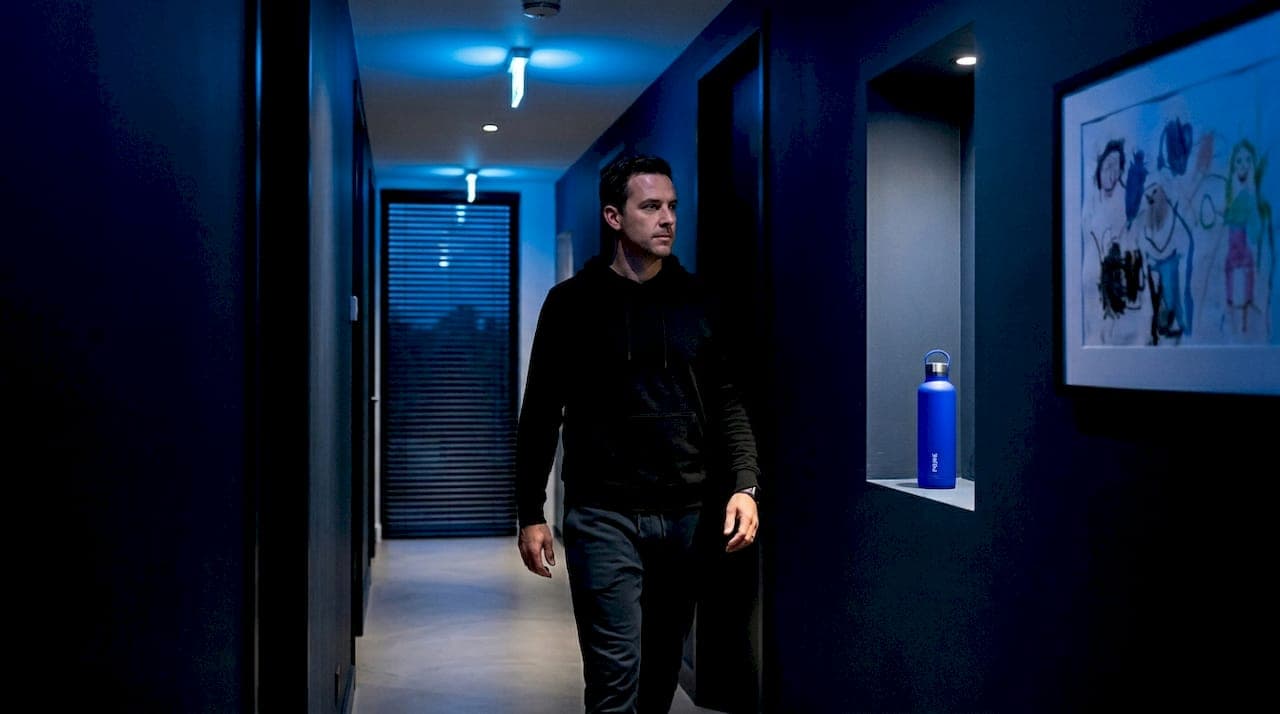
Most people assume emergency lighting is strictly a commercial requirement, something for office buildings, hospitals, and shopping centers. That assumption leaves homeowners dangerously unprepared. Power outages are becoming longer and more frequent across the country, and when the lights go out at 2 a.m., your family needs a clear, illuminated path to safety. Battery backup emergency lighting fills that gap instantly and automatically, with no fumbling for flashlights required. This guide covers how these systems work, what standards apply to homes and managed properties, and how to choose the right setup for your specific situation.
Table of Contents
- What is battery backup emergency lighting and why does it matter?
- How battery backup systems work: Mechanics and essential components
- Safety standards: What homes and properties should know
- Choosing the right battery backup lighting: Types, placement, and batteries
- Testing and maintaining your emergency lighting system
- Why code compliance is just the beginning: Our take on real resilience
- Power your property with next-level backup solutions
- Frequently asked questions
Key Takeaways
| Point | Details |
|---|---|
| Not just for businesses | Battery backup emergency lighting also plays a crucial role in protecting homes during blackouts. |
| 90-minute safety standard | Reliable systems provide at least 90 minutes of illumination to help you evacuate safely. |
| Choose modern batteries | LiFePO4 and self-testing units deliver longer life and greater peace of mind for home use. |
| Routine testing is essential | Monthly and annual test routines prevent surprise failures during real emergencies. |
| Go beyond code | Supplement emergency lights with whole-home backup for comprehensive resilience. |
What is battery backup emergency lighting and why does it matter?
Standard lights in your home depend entirely on grid power. The moment utility power fails, they go dark. Battery backup emergency lighting is fundamentally different because it carries its own internal power source that activates automatically the instant normal power cuts out.
Battery backup emergency lighting automatically switches to internal batteries upon power failure, providing at least 90 minutes of illumination for safe egress. That 90-minute window is not arbitrary. It reflects the time researchers and safety engineers determined is sufficient for occupants to evacuate a building safely, even in complex or multi-story layouts.
For homeowners, this matters in ways that go beyond simple convenience. Consider what actually happens during a sudden blackout:
- Disorientation sets in fast, especially for children, elderly residents, or guests unfamiliar with your home's layout.
- Stairs and hallways become hazards when you cannot see step edges, handrails, or doorways.
- Panic compounds the danger, causing people to move quickly in the wrong direction.
- Smoke or other emergencies may accompany a power failure, making visibility even more critical.
"Safe egress" means more than just getting out. It means getting out without injury, without panic, and without making a dangerous situation worse.
The good news is that battery backup systems handle all of this passively. You do not flip a switch or remember to grab anything. The transfer is automatic, and the lights are on before you even register that the power is gone. For homeowners managing backup power for large homes with multiple floors and complex layouts, this automatic response is especially valuable.
How battery backup systems work: Mechanics and essential components
Understanding the mechanics helps you make smarter purchasing decisions and spot low-quality products before you install them.
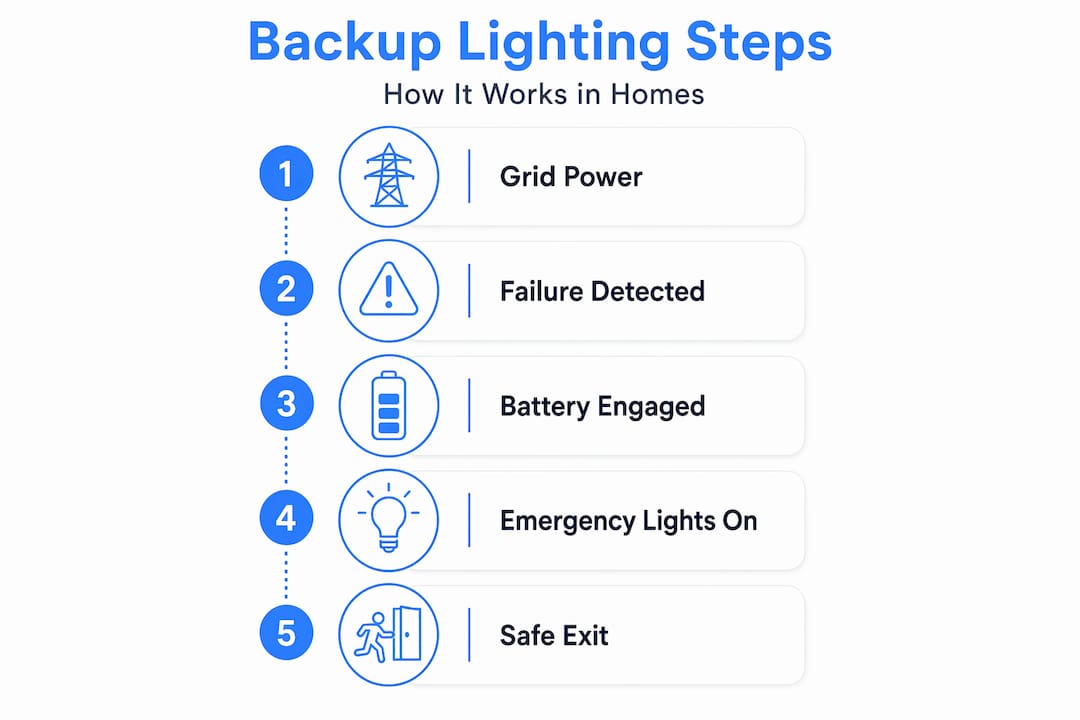
During normal operation, your battery backup emergency lighting system runs on grid power just like any other fixture. The key difference is that it simultaneously trickle-charges an internal battery pack. That battery stays at full capacity, ready to take over at any moment. When grid power drops, the system's transfer switch detects the failure and completes the handoff in under 10 seconds. Most quality units switch over in under half a second.
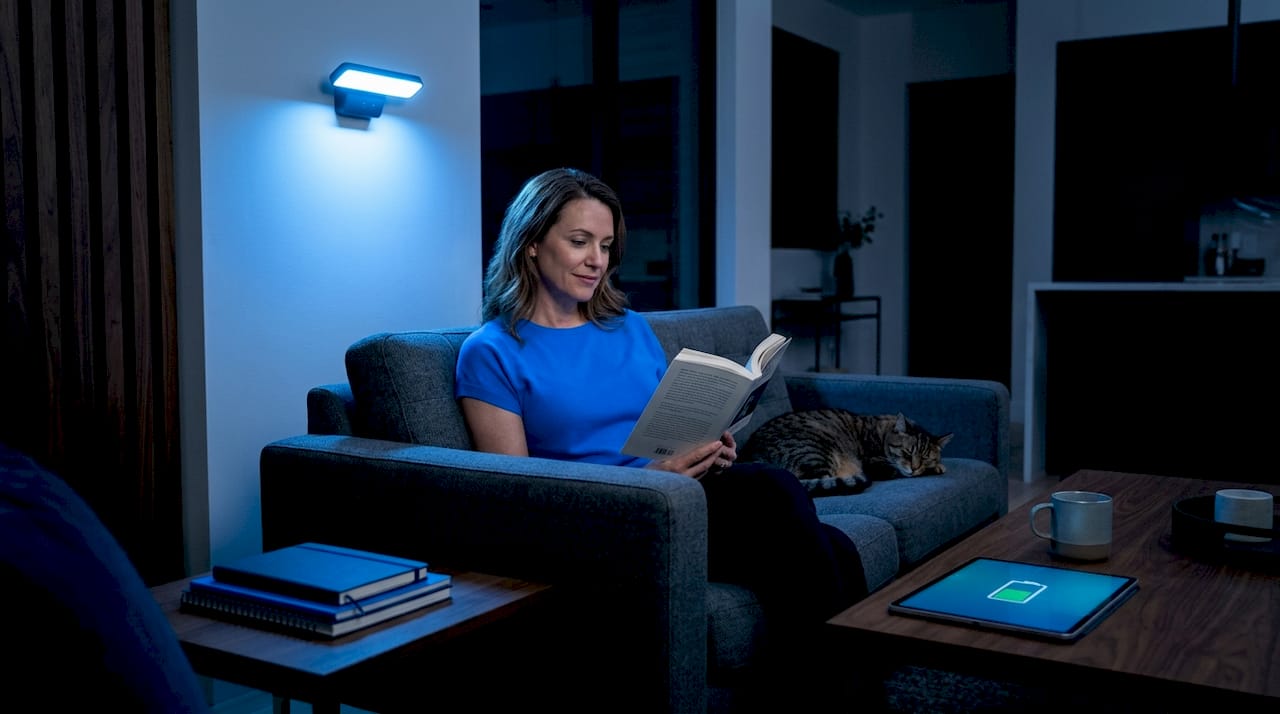
The mechanics of constant charging, instant transfer within 10 seconds, and UL 924 listing ensure the kind of reliability that homeowners and property managers can actually count on. UL 924 is the Underwriters Laboratories standard specifically for emergency lighting equipment. It sets minimum performance thresholds for transfer speed, battery duration, and overall build quality. When you see UL 924 on a product label, you know it has been independently tested and verified.
Here is a quick breakdown of the core components in a typical system:
| Component | Function | What to look for |
|---|---|---|
| Battery pack | Stores energy for emergency use | LiFePO4 for longest life |
| Transfer switch | Detects outage and switches power source | Sub-second response time |
| LED fixture | Provides illumination during outage | High lumens, low power draw |
| Charging circuit | Keeps battery at full capacity | Temperature-compensated charging |
| Test switch | Allows manual and automated testing | Self-test capability preferred |
Pro Tip: When shopping for units, look specifically for the UL 924 listing on the product spec sheet, not just on the packaging. Some manufacturers display the logo loosely. The spec sheet will confirm the listing number and scope.
Integrating these units with home battery backup systems gives you layered protection: dedicated emergency lights for immediate egress, plus whole-home power for extended outages.
Safety standards: What homes and properties should know
This is where many homeowners get confused, because the rules are genuinely different depending on your property type.
For commercial buildings, multi-family housing, and facilities covered by the National Fire Protection Association's NFPA 101 Life Safety Code or the International Building Code (IBC), emergency lighting is legally required. Standards require an average of 1 foot-candle of initial illumination along egress paths, with a minimum of 0.1 foot-candle at any single point. At the 90-minute mark, those figures drop to 0.6 and 0.06 foot-candles respectively, and the maximum-to-minimum ratio cannot exceed 40:1. These numbers ensure even illumination without dangerous dark spots along escape routes.
For single-family homes, the picture is different. Emergency lighting is not typically required by code under NFPA 101 or the IBC, but it is strongly recommended for outage-prone areas to prevent falls and panic. Whole-home UPS kits can power standard lights as an alternative approach.
Here is a side-by-side comparison of what applies to different property types:
| Property type | Code requirement | Recommendation |
|---|---|---|
| Single-family home | Not required | Strongly recommended for stairs, hallways, exits |
| Multi-family (apartments) | Required in common areas | Extend to individual unit corridors |
| Rental properties | Varies by state and local code | Consult local fire marshal |
| Commercial/mixed-use | Fully required, inspected | Full compliance plus self-testing units |
Here is a practical approach for homeowners and property managers who want to go beyond the minimum:
- Map your egress paths first. Identify every route from bedroom to exterior door.
- Prioritize stairs and hallways since these are where most fall injuries occur during blackouts.
- Add lighting at every exterior door so occupants can see locks and handles clearly.
- Consider common areas in rental or multi-family properties as your first priority for compliance.
- Consult your local fire marshal if you manage properties with more than four units, since local codes often exceed state minimums.
Even when code does not require it, the liability and safety case for installing emergency lighting in rental properties is strong. A tenant who falls on an unlit staircase during a blackout creates real legal exposure for property managers. Investing in whole home backup solutions or dedicated emergency fixtures is far less costly than a single injury claim. For properties in remote or rural areas, off-grid home power strategies can integrate emergency lighting into a broader resilience plan.
Choosing the right battery backup lighting: Types, placement, and batteries
Not all battery backup emergency lights are created equal, and the differences matter significantly over a five to ten year ownership period.
Battery chemistry is the single biggest factor in long-term reliability. Here is what you need to know:
- Sealed Lead-Acid (SLA): The traditional option. Inexpensive upfront but heavy, prone to capacity loss from heat, and typically rated for only 300 to 500 charge cycles.
- LiFePO4 (Lithium Iron Phosphate): The modern standard. LiFePO4 batteries offer 2000+ cycles compared to 300 to 500 for SLA, are significantly lighter, and carry a much better safety profile. These are now the preferred choice for quality emergency lighting units.
- NiCd and NiMH: Nickel-based chemistries that perform well in extreme temperatures and are preferred in high-risk environments like tunnels because they carry no thermal runaway risk. Battery capacity decay from heat and cycling is a real concern, and temperatures above 45°C can cut battery life in half. NiCd and NiMH handle these conditions better than lithium options in the most demanding applications.
For most residential and multi-family applications, LiFePO4 is the right call. The longer cycle life means you are not replacing batteries every two or three years, and the safety profile is excellent for indoor use.
Placement strategy matters as much as the hardware itself. Focus on these locations:
- Primary hallways connecting bedrooms to exits
- Top and bottom of every staircase
- Each exterior door, including garage exits
- Common areas in multi-family properties: lobbies, laundry rooms, parking structures
- Any room where vulnerable occupants sleep, including guest rooms used by elderly visitors
Pro Tip: Choose self-testing models whenever possible. These units run their own monthly 30-second tests and annual 90-minute tests automatically, logging results internally. You get the compliance benefit without having to remember to test manually, and you will know immediately if a battery is failing.
Thinking about battery backup longevity across your whole property helps you plan replacement cycles and budget for upgrades before failures occur.
Testing and maintaining your emergency lighting system
Installing the right equipment is only half the job. Emergency lighting that has not been tested is emergency lighting you cannot trust.
The testing schedule is straightforward once you build it into your routine:
- Monthly test: Press the test button (or let a self-testing unit handle it) and confirm the light activates and stays on for at least 30 seconds.
- Annual test: Run the unit on battery power for the full 90-minute duration. Measure light output if possible, or at minimum confirm the light stays on for the full period.
- Visual inspection: Check for physical damage, corrosion on battery terminals, and indicator light status at each monthly test.
- Battery replacement: Follow manufacturer guidance, typically every three to five years for LiFePO4 and every two to three years for SLA.
- Documentation: Keep a simple log of test dates and results. This matters for rental property compliance and insurance purposes.
Monthly 30-second functional tests and annual 90-minute full-duration tests are mandatory for commercial and multi-family properties, and self-testing units significantly reduce the maintenance burden.
The risk of skipping maintenance is not theoretical. Real-world data shows that SLA batteries can degrade to just 35 minutes of runtime after only 18 months of service, far short of the required 90 minutes. Switching to LiFePO4 and adding battery monitoring eliminates this failure mode.
A battery backup light that fails in the first 10 minutes of an outage is worse than no emergency lighting at all, because it creates false confidence.
Self-testing models address this directly by flagging failures automatically. Many modern units have indicator LEDs that change color when the battery drops below acceptable capacity, giving you advance warning before an outage exposes the problem. Consistent monitoring of battery health across your property is the difference between a system that works when you need it and one that only looks like it will.
Why code compliance is just the beginning: Our take on real resilience
Here is an uncomfortable truth that most emergency lighting guides will not tell you: meeting the minimum code is not the same as being safe.
Codes are written to prevent the worst outcomes in typical scenarios. They are not written to protect your specific family, your specific property layout, or the specific outage patterns in your region. A property that passes a code inspection can still leave residents in dangerous darkness if the batteries have quietly degraded, if the fixtures were placed to satisfy an inspector rather than illuminate actual egress paths, or if the system has never been tested since installation.
We have seen this pattern repeatedly. Homeowners and property managers install compliant equipment, check the box, and move on. Then a real outage happens and the system underperforms because no one built a maintenance culture around it.
Our perspective is that true resilience requires treating emergency lighting as part of a living safety system, not a one-time installation. That means pairing dedicated emergency fixtures with broader backup power solutions. A whole home backup strategies approach keeps your refrigerator running and your HVAC online during extended outages, but it also means your standard lighting stays on, reducing reliance on dedicated emergency fixtures for anything beyond immediate egress.
For homeowners and property managers in outage-prone regions, the right approach is to prioritize UL 924 self-contained LED units with LiFePO4 batteries and self-testing for hallways and stairs, then supplement with portable or whole-home UPS systems for broader resilience. That layered approach goes well beyond what any code requires and delivers the kind of confidence that actually holds up during a real emergency.
The technology available today makes it genuinely practical to build a home or property that handles outages gracefully, without panic, without injury, and without dependence on the grid returning quickly. The only thing stopping most homeowners is the assumption that this level of preparation is excessive. It is not. It is simply good planning.
Power your property with next-level backup solutions
Emergency lighting is a critical first layer, but the most resilient properties combine dedicated egress lighting with whole-home backup power that keeps everything running through extended outages.

At Prime Microgrid, we design customized energy systems built around your property's actual needs, whether that means a focused home battery backup solution, a full whole home backup power system, or a scaled approach for larger properties through our backup power for large homes solutions. We work with homeowners and property managers to build practical, reliable systems that perform when the grid does not. Reach out to explore what the right layered backup strategy looks like for your home or property.
Frequently asked questions
How long will my emergency lighting stay on during a blackout?
By law, battery backup emergency lights must provide at least 90 minutes of reliable illumination during a power failure, giving occupants ample time to evacuate safely.
Do I need emergency lighting in my single-family home?
While not required by code for most single-family homes under NFPA 101 or the IBC, emergency lighting is strongly recommended in outage-prone areas to prevent falls and panic during blackouts.
What is the best battery type for emergency lighting?
LiFePO4 batteries are the preferred choice for most modern emergency lighting units because they offer over 2,000 charge cycles, weigh less than SLA alternatives, and carry an excellent safety profile for indoor residential use.
How often should emergency lights be tested?
You should run a 30-second functional test every month and a full 90-minute duration test once per year to confirm your system will perform reliably when a real outage occurs.
Can temperatures or age affect battery backup performance?
Yes, significantly. Temperatures above 45°C can cut battery life in half, and repeated cycling causes gradual capacity loss over time, which is why choosing the right battery chemistry and maintaining a regular testing schedule are both essential.