
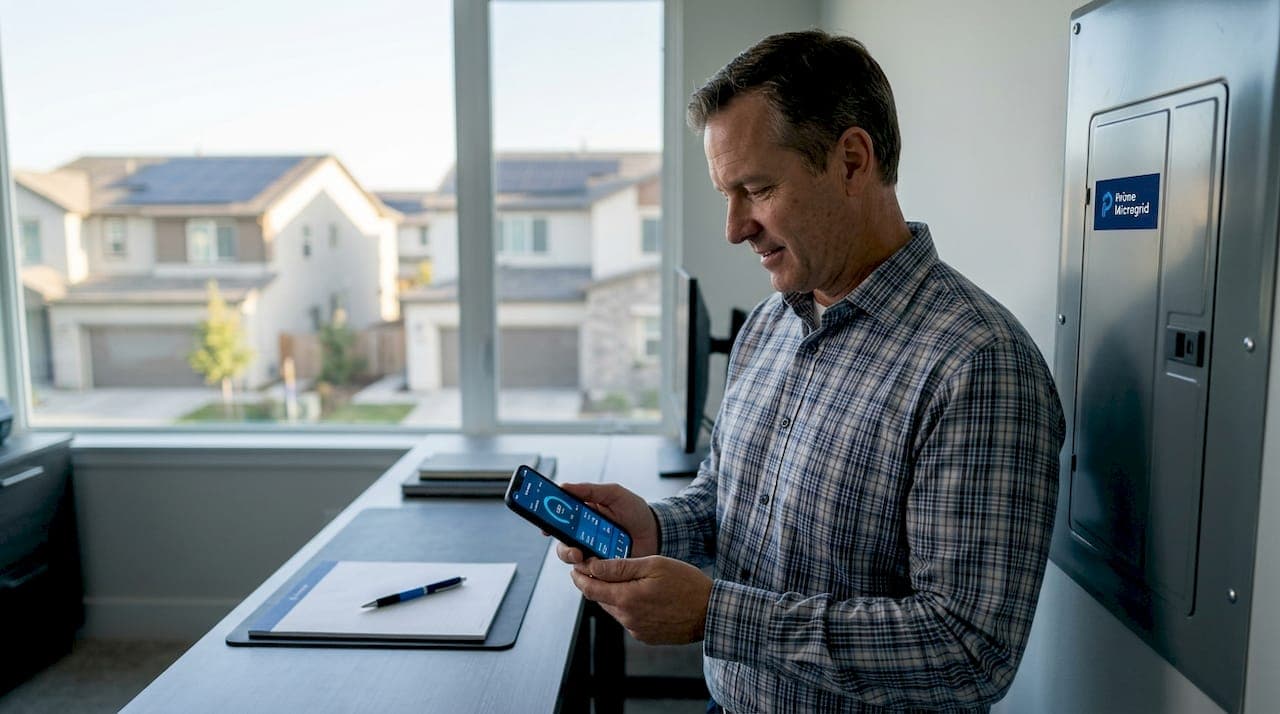
Rural power outages don't follow a schedule. A single storm can knock out grid power for three, five, or even ten days when you're miles from the nearest utility substation. For high-value rural estates, that's not just an inconvenience — it threatens well water, HVAC systems, refrigerated medications, security systems, and everything else your property depends on. Solar battery backup can end that uncertainty, but only when the system is engineered for true whole-home coverage. This guide walks you through every critical decision, from architecture to testing, so your investment actually delivers when the grid goes dark.
Table of Contents
- Understanding whole-home solar battery backup architecture
- Key design decisions: Choosing integration strategies
- Safe installation and compliance: Transitioning to backup mode
- Sizing for resilience and value: Getting it right for your estate
- Common pitfalls and how to verify your system will work
- Expert perspective: Why full-system design pays off for rural estates
- Ready to secure your estate? Get expert guidance
- Frequently asked questions
Key Takeaways
| Point | Details |
|---|---|
| Design for full coverage | Whole-home backup must be engineered for all critical and high-demand loads, not just essentials. |
| Choose the right integration | AC or DC-coupled storage affects retrofit options and long-term efficiency for your estate. |
| Prioritize safety compliance | Certified inverters and transfer hardware are essential for grid isolation and legally safe backup operation. |
| Size for real resilience | Benchmark battery and inverter capacity against your estate’s full needs, including well pumps and HVAC. |
| Verification prevents failure | Test your backup system under real-world conditions—don’t wait for a real outage to learn its limits. |
Understanding whole-home solar battery backup architecture
With the stakes set, let's break down what makes whole-home backup fundamentally different from basic battery add-ons.
Most homeowners assume any solar battery system will keep the lights on during an outage. That's not how it works. There's a meaningful difference between essential-load backup and true whole-home backup, and confusing the two is the most common and costly mistake rural estate owners make.
Essential-load backup powers only a handful of pre-selected circuits, typically a few lights, a refrigerator, and maybe a phone charger. It's designed for apartments and small homes where space and budget are tight. Whole-home backup, by contrast, is engineered to cover your entire estate, including HVAC systems, well pumps, water heaters, security systems, and every other load running in your home. That distinction requires a fundamentally different system design.
The core components of a true whole-home system include:
- Battery bank: Typically 20 to 40 kWh for estate-class homes, with modular units that can be stacked for more capacity
- Hybrid inverter: Converts DC battery power to AC household current while managing grid connection and backup switching
- Transfer switch or islanding hardware: Disconnects your home from the utility grid during outages so you can safely run on battery and solar
- Critical-load subpanel: Allows selective prioritization of loads if battery capacity becomes limited during extended outages
- Solar array: Recharges the battery bank during the day, dramatically extending backup duration
One area that catches rural homeowners off guard is surge loads. Your HVAC compressor, well pump, and deep freezer all draw two to four times their rated running power for a fraction of a second at startup. A system with battery backup limitations on inverter surge capacity will trip offline the moment one of these appliances kicks on. This is why whole-home backup requires careful engineering around islanding capability, critical-load subpanels, and battery and inverter sizing to handle both continuous loads and surge-start loads like HVAC compressors.
| Feature | Essential-load backup | Whole-home backup |
|---|---|---|
| Coverage | Selected circuits only | Entire home |
| Typical battery size | 5 to 13 kWh | 20 to 40+ kWh |
| Inverter rating | 3 to 5 kW | 8 to 12+ kW |
| HVAC support | Rarely | Yes, with proper sizing |
| Well pump support | No | Yes |
| Transfer hardware | Basic | Full islanding capability |
Pro Tip: Never undersize your inverter. Surge capacity matters as much as total battery size. An 8 kW continuous inverter with 16 kW surge capacity handles most estate loads comfortably. A 5 kW unit will fail the moment your well pump starts.
Key design decisions: Choosing integration strategies
Now that you know the must-have components, it's time to choose how your system will be wired and connected.
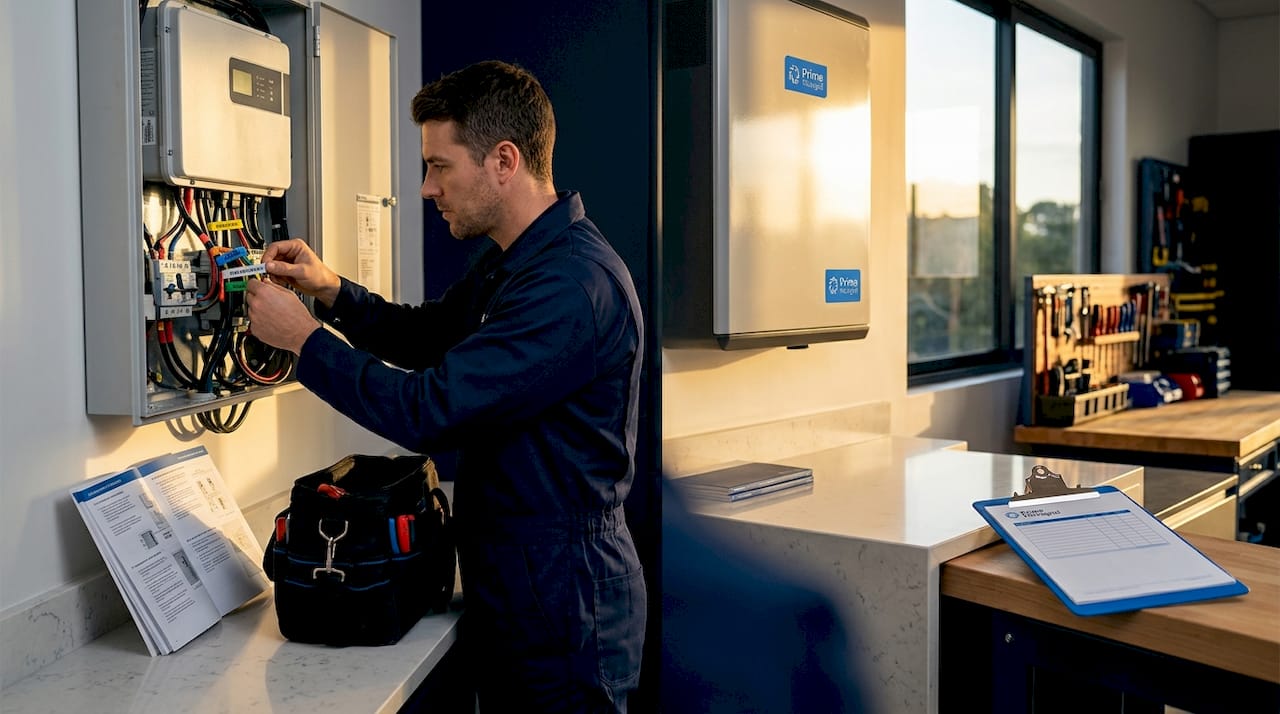
The two primary wiring approaches are AC-coupled and DC-coupled storage architectures. Each has real advantages depending on whether you're building new or retrofitting an existing solar system.
AC coupling connects the battery system to the AC side of your existing solar installation. Your current grid-tied inverter stays in place, and a separate battery inverter handles storage. Solar-plus-battery integration is commonly implemented as either AC-coupled or DC-coupled architectures, and the choice affects retrofit complexity and overall system efficiency. AC coupling is generally the simpler path if you already have solar panels and a functioning inverter.
DC coupling connects the battery directly to the solar array on the DC side, before the main inverter. This approach is typically more efficient because energy doesn't get converted twice, but it usually requires replacing your existing inverter with a hybrid unit that manages both solar and storage in one box.
One important compatibility note: AC-coupled systems can often work with different existing inverters, while some battery ecosystems require compatible PV and inverter configurations. Always confirm platform compatibility before purchasing.
Here's a practical decision checklist for choosing your integration approach:
- Audit your existing solar system. Document your current inverter brand, model, age, and warranty status before making any decisions.
- Determine your backup scope. If you need whole-home coverage, confirm your inverter has backup output capability or plan for replacement.
- Check battery compatibility. Some battery platforms lock you into specific inverter brands. Verify this early.
- Evaluate AC vs. DC coupling. If your existing inverter is less than five years old and still under warranty, AC coupling usually makes more economic sense.
- Plan for estate battery integration from the start. Retrofitting for whole-home backup often requires subpanel work regardless of coupling approach.
- Consider future expansion. DC-coupled systems are often easier to scale if you plan to add more panels or battery capacity later.
For homeowners considering off-grid solar considerations, DC coupling is typically the preferred approach since there's no grid connection to work around and efficiency gains compound over years of operation.
Safe installation and compliance: Transitioning to backup mode
With the right hardware and pairing choices in mind, focus shifts to safe, code-compliant installation.
The concept of islanding is central to safe backup operation. Islanding means your home's solar and battery system is operating as its own isolated power island, completely disconnected from the utility grid. Without proper islanding controls, your system could push electricity back onto the grid during an outage, creating a deadly hazard for utility workers trying to restore power.
Safety warning: Never allow backfeed to the utility grid during an outage. A system without certified anti-islanding protection is not just a code violation — it is a life-safety risk to utility lineworkers and your neighbors.
For safe outage operation, the system must be capable of islanding without backfeeding the utility. This is why backup-rated hybrid inverters and coordinated transfer and islanding hardware with certified anti-islanding behavior are non-negotiable components.
Key safety and compliance requirements include:
- Hybrid or battery inverter with UL 1741 SA certification: This standard verifies that the inverter can safely island and meet modern grid support requirements
- Automatic transfer switch (ATS) or smart transfer relay: Disconnects from the grid and switches to backup mode within milliseconds of detecting an outage
- Anti-islanding protection: Built into most modern hybrid inverters, but must be verified during commissioning
- NEC Article 706 compliance: Governs energy storage systems in the U.S., covering installation, wiring methods, and safety disconnects
- Local utility interconnection agreement: Required before any grid-tied system with storage goes live
- Permit and inspection: Every jurisdiction requires permits for this work. No exceptions.
For outage safety compliance, always use certified installers who are familiar with your local utility's interconnection requirements. A system installed without proper permits can void your homeowner's insurance and create liability issues if something goes wrong.
Sizing for resilience and value: Getting it right for your estate
Once your system is fully code-compliant, it's time to make sure it's sized for real resilience.
Sizing a whole-home backup system for a rural estate is not a guessing game. It requires a structured load analysis that accounts for both continuous power draw and the surge demands of high-powered appliances.
Follow these steps to size your system accurately:
- List all critical loads. Start with must-have systems: well pump, HVAC, refrigerators, medical equipment, security, and lighting.
- Estimate continuous wattage. Add up the running wattage of everything you want to power simultaneously.
- Calculate surge demand. Identify every motor-driven appliance and note its startup surge, typically two to three times running watts.
- Determine backup duration. For rural estates, plan for at least three to five days of autonomy without grid power.
- Size battery capacity. Multiply your daily kWh consumption by the number of backup days, then add a 20 percent buffer for efficiency losses.
- Size inverter capacity. Your inverter's continuous rating must exceed your total simultaneous load, and its surge rating must handle the largest motor startup in your home.
DOE benchmark modeling incorporates PV plus energy storage into cost benchmark planning, treating storage as part of an integrated system rather than a standalone add-on. This integrated approach is exactly how you should think about your estate system.
| Load | Running watts | Surge watts | Priority |
|---|---|---|---|
| Well pump (1.5 HP) | 1,100 | 3,300 | Critical |
| HVAC (3-ton unit) | 3,500 | 10,500 | High |
| Refrigerator | 150 | 600 | Critical |
| Lighting (whole home) | 800 | 800 | High |
| Security system | 100 | 100 | Critical |
| Total | 5,650 | 15,300 |
NREL research confirms that the value of backup power and resilience during outages is a key driver of distributed PV plus storage adoption, alongside battery cost declines. For rural homeowners, that resilience value is concrete: a working well pump means drinking water, a running HVAC means safe temperatures for elderly family members or livestock, and a functioning security system means property protection during extended grid failures.
For microgrid cost modeling, always build in room for growth. Battery technology costs continue to fall, and adding capacity later is far easier when your inverter and wiring were sized for it from the start.
Pro Tip: Always round up on battery and inverter sizing. A system that's 20 percent oversized costs modestly more upfront and performs reliably for a decade. A system that's undersized will frustrate you every time a cloud passes over or a motor starts.
Common pitfalls and how to verify your system will work
With your estate system planned and sized, the final step is making sure it truly performs when you need it most.
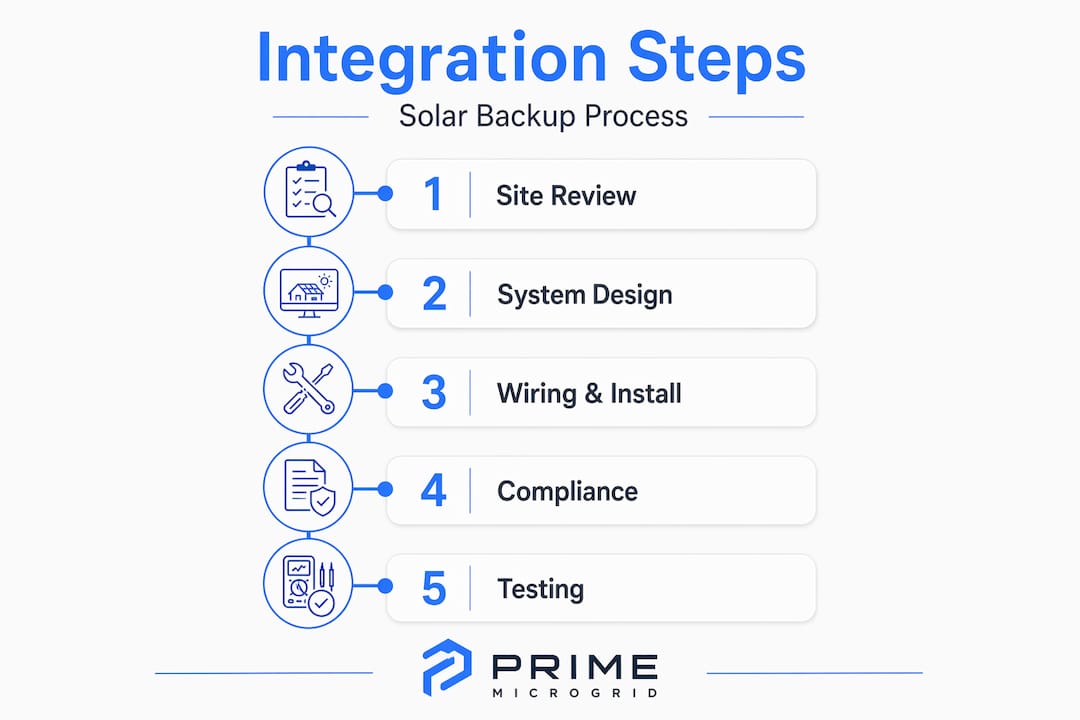
Even well-designed systems can fail in practice if they aren't properly tested. The most failure-prone planning mistakes in whole-home backup are usually electrical: wrong critical-load selection, insufficient inverter continuous power for HVAC, and insufficient surge and start power. These are not battery capacity problems. They're design and verification problems.
Here's how to run a thorough simulated outage test:
- Schedule the test with your installer during daylight hours when your solar array is producing.
- Manually disconnect from the grid using your system's maintenance disconnect or by coordinating with your installer.
- Confirm backup mode activation. Your inverter display should show island or backup mode within seconds.
- Start each major appliance one at a time. Begin with the well pump, then HVAC, then other large loads. Watch for inverter alarms or trips.
- Run all loads simultaneously for at least 30 minutes to verify stable operation under full load.
- Monitor battery state of charge throughout the test to confirm discharge rate matches your planning estimates.
- Reconnect to the grid and verify seamless transition back to grid-tied mode without manual intervention.
Pro Tip: Ask your installer to provide a written test report documenting each step, the loads tested, inverter performance, and battery behavior. This report is invaluable for insurance purposes and future troubleshooting.
Expert perspective: Why full-system design pays off for rural estates
Here's what our field experience reveals that generic guides consistently miss.
Rural estate owners often approach solar battery backup as a product purchase rather than a system design project. They compare battery brands, shop inverter specs, and focus on price per kilowatt-hour. Then they're surprised when the system fails to start their well pump or trips offline during an HVAC cycle. The battery wasn't the problem. The design was.
From our experience working with rural properties, the homes that get the most value from solar battery backup are the ones where the owner treated resilience as a design requirement from day one, not a feature to add later. That means sizing for surge loads, not just continuous loads. It means planning transfer hardware before selecting batteries. It means testing the system under real conditions before the first real outage arrives.
There's also a broader point worth making. For rural estates, backup power protects more than comfort. It protects health, because medical equipment and temperature-sensitive medications depend on it. It protects property, because security systems and sump pumps need power to function. It protects communications, because routers and satellite systems keep you connected when cell towers go down. The solar battery versus microgrid design question often comes down to this: how many days of true independence do you actually need?
The cheapest solution almost always becomes the most frustrating one over a ten-year horizon. Undersized inverters, incompatible battery platforms, and skipped testing are the three patterns we see most often in systems that fail their owners during real outages. A credible, engineered approach costs more upfront and pays back every dollar when a five-day outage hits.
Backup is only as good as your weakest link. Plan and verify every connection.
Ready to secure your estate? Get expert guidance
If you're ready to move from planning to protection, professional expertise can ensure your investment delivers when it matters most.
Prime Microgrid specializes in exactly the kind of engineered, whole-property energy systems that rural estates require. We don't sell off-the-shelf kits. We design systems around your specific loads, your property layout, your utility interconnection requirements, and your resilience goals.
Whether you're starting from scratch or retrofitting an existing solar installation, our team can assess your site, model your loads, and recommend the right combination of battery storage, inverter hardware, and transfer controls for true whole-home coverage. Explore our residential microgrid solutions for estate-class properties, review our approach to backup power for large homes, or learn more about whole-home battery backup options tailored to rural properties. Schedule a site assessment and find out what real energy independence looks like for your estate.
Frequently asked questions
What is the difference between essential-load and whole-home solar battery backup?
Essential-load backup powers only selected circuits, while whole-home backup is engineered to cover your entire estate, including HVAC, well pumps, and all standard loads, using properly sized inverters and islanding hardware.
Can I add batteries to my existing solar if I want full-home backup?
Yes, but retrofitting for whole-home coverage often requires AC-coupled solutions or updating inverters and subpanels for proper integration and islanding capability.
How much battery and inverter capacity do I need for a large rural home?
Typical estate-class systems start at 20 to 40 kWh battery capacity with 8 to 12 kW continuous inverter rating, though actual needs vary based on home size, appliance loads, and desired backup duration.
Will my solar battery backup system automatically disconnect from the grid during an outage?
Correct systems include anti-islanding technology and transfer hardware that handle grid disconnection automatically; without these, your system may not operate safely or at all during outages.
Is solar battery backup worth it for rural estates?
If resilience and outage protection are top priorities, the value of backup power as a driver of distributed storage adoption shows that energy independence often outweighs pure cost calculations for rural homeowners.