
Most homeowners assume that a generator in a hybrid energy system runs constantly, burning fuel around the clock to keep the lights on. That assumption is wrong, and it leads to costly oversizing, unnecessary fuel bills, and systems that wear out far too soon. In a well-designed hybrid system, the generator is a precision tool, dispatched only when solar and battery resources genuinely can't cover demand. Understanding how that coordination works is the difference between a backup system that actually delivers and one that disappoints when you need it most.
Table of Contents
- Understanding hybrid energy: Components and control logic
- The generator's real job: Standby backup, battery charging, and resilience
- Sizing and switching: Keys to safe and effective generator integration
- Design nuances: Power quality, inverter-compatibility, and advanced control
- Why treating the generator as your 'safety net' changes everything
- Explore hybrid solutions for resilient, efficient home power
- Frequently asked questions
Key Takeaways
| Point | Details |
|---|---|
| Generators are on-demand backups | Modern hybrid systems use generators as a last resort for long-duration outages or extreme demand. |
| Smart controls optimize performance | Energy management systems decide when to run generators, maximizing efficiency and extending equipment life. |
| Proper sizing and switching matter | Incorrect generator sizing or transfer switch problems can create reliability and safety issues. |
| Advanced orchestration beats brute force | The value of a hybrid system comes from intelligent integration, not just bigger batteries or bigger generators. |
Understanding hybrid energy: Components and control logic
A home hybrid energy system is not a jumble of equipment plugged together. It's a carefully orchestrated combination of solar panels (or another renewable source), a battery bank, and a backup generator, all tied together by an energy management controller. Each source has a distinct job, and the controller acts like a smart traffic director, deciding in real time which source supplies power, when batteries charge or discharge, and when the generator should start.
Solar panels are the primary production source, generating power during daylight hours at near-zero marginal cost. Battery backup systems store that excess solar energy and release it during evenings, cloudy days, or sudden demand spikes. The generator sits in reserve as a third-tier resource, waiting for scenarios where the first two can't carry the load alone.
Hybrid power plant designs use advanced control and dispatch strategies to improve availability, and that same principle applies at the residential scale. The controller monitors battery state of charge, solar output, and current load every few seconds, making automated decisions about source dispatch. This is what keeps your generator from running every night or cycling on and off constantly, which would destroy engine components and waste fuel.
Here's a quick look at how the major components stack up:
| Component | Primary role | When it's active | Key attribute |
|---|---|---|---|
| Solar panels | Primary generation | Daylight hours | Zero fuel cost |
| Battery bank | Storage and fast response | Day and night | Handles surges and transients |
| Generator | Sustained backup | Depleted battery or prolonged outage | High-output, fuel-dependent |
| Energy controller | Dispatch and optimization | Always on | Orchestrates all sources |
The controller's logic is the secret ingredient most homeowners never see. Hybrid setups pair an engine with batteries, and the control system chooses when the engine runs, when batteries discharge, and when the engine simultaneously recharges batteries while meeting load. Without that logic layer, you'd be manually switching sources and likely damaging equipment in the process.
Key priorities the control logic manages simultaneously:
- Minimize generator runtime to reduce fuel costs and engine wear
- Prevent batteries from depleting below a safe threshold (typically 20% state of charge)
- Ensure loads are always met, even during solar drops or demand peaks
- Schedule generator charging cycles at efficient load levels rather than at low, wasteful output
Now that you know what goes into a hybrid energy system at home, let's examine the unique role of generators and why their usage is more sophisticated than most realize.
The generator's real job: Standby backup, battery charging, and resilience
The generator in a hybrid system is the safety net, not the workhorse. Batteries handle the fast, dynamic responses: sudden appliance startups, brief demand spikes, and the gap between sunset and sunrise on a normal day. The generator steps in only when batteries are running low and solar can't recover them fast enough to meet sustained demand.
Think of it this way: batteries are your checking account, handling day-to-day transactions quickly and efficiently. The generator is your savings account, available for large withdrawals that your checking account can't cover on its own.
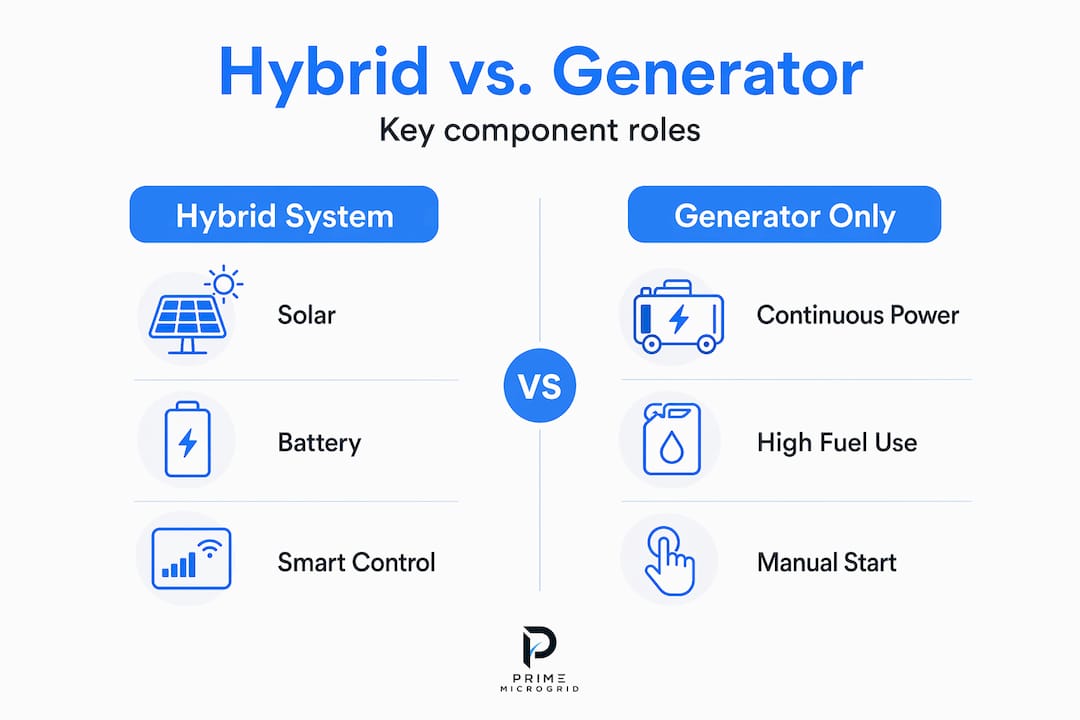
The generator's role in backup modes is to cover sustained demand when renewables and batteries cannot, while batteries provide fast response to smooth transients and reduce the generator's required ramping. This division of labor is what makes hybrid systems dramatically more efficient than standalone generator setups.
Compare the two approaches directly:
| Feature | Generator-only backup | Hybrid (battery + generator) |
|---|---|---|
| Fuel consumption | High (runs constantly during outages) | Low (generator runs only when batteries are depleted) |
| Engine wear | Heavy, frequent cycling | Minimal, optimized runtime |
| Response time | 10 to 30 seconds to start | Instantaneous (battery handles the gap) |
| Power quality | Can fluctuate on startup | Smooth, inverter-stabilized output |
| Noise and emissions | Constant during any outage | Rare, short generator runs |
| Long-term cost | High fuel and maintenance | Lower combined operating cost |
For large home backup scenarios or properties with significant loads like HVAC, well pumps, and medical equipment, this difference is dramatic. A generator running 48 hours straight to cover a two-day storm outage burns through hundreds of dollars in fuel. A hybrid system might run the generator for six to ten hours during that same event, with batteries covering the rest.
Pro Tip: Schedule your generator's charging cycles to run at 70 to 80% of its rated load rather than at low partial loads. Generators running below 30% capacity build up carbon deposits in cylinders, reduce efficiency, and can cause wet stacking in diesel units. Your controller can be programmed to start the generator only when there's enough battery deficit to keep it running at an efficient output level.
The generator versus hybrid comparison isn't just about fuel costs. It's about runtime hours and longevity. A generator rated for 2,000 service hours before a major overhaul will last many more years in a hybrid setup than in a generator-only configuration, simply because it runs far fewer total hours.
With the different components and control strategies laid out, let's zoom in on the real strengths of the generator within this coordinated system.
Sizing and switching: Keys to safe and effective generator integration
Understanding the "when and why" behind generator operation leads naturally to focusing on the "how," specifically, how to size and integrate a generator so it truly delivers on backup needs.
Getting the size wrong is the most common and costly mistake in hybrid design. Many installers calculate generator size based on peak household load alone. That's not enough. In hybrid off-grid systems, the generator must cover peak load plus battery charging demand plus a startup margin. Omitting charging demand can lead to a generator that is undersized for the combined system.
Here's a straightforward sizing process for a home hybrid backup:
- Calculate peak AC load. Add up the running watts of every critical load you want backed up: refrigerators, HVAC, lighting, pumps, and electronics. Account for startup surges on motor-driven loads, which can be two to three times running wattage.
- Add battery charging demand. Determine your battery bank's maximum charge rate in kilowatts. A 20 kWh battery bank charging at 0.5C requires 10 kW of charging capacity. This must be added to your peak load figure.
- Apply a startup margin. Add 15 to 25% on top of the combined load and charging demand. This handles simultaneous motor startups and gives the generator headroom to regulate output without overloading.
- Check inverter and charger compatibility. The generator's output voltage and frequency must match the inverter-charger's input specifications. Mismatches cause charger faults and inverter shutdowns.
- Verify fuel supply capacity. Propane tanks and natural gas service lines have flow rate limits. A 22 kW generator pulling full load needs a gas supply that can sustain that demand without pressure drop.
Pro Tip: An undersized generator won't always fail immediately. It will struggle to start under full load, cause voltage sags that trip sensitive electronics, and run at overloaded conditions that reduce its lifespan by years. The failure mode is slow and hidden until the system stops working during a real emergency.
Beyond sizing, transfer switching is the other critical piece. The ATS and transfer logic must safely isolate sources and transition loads without hazardous backfeed. In a hybrid system, the transfer switch becomes a core part of power orchestration, not just a simple on/off switch between grid and generator.
An automatic transfer switch (ATS) in a hybrid system monitors all source conditions simultaneously: grid voltage, battery inverter output, and generator output. It transitions between them based on predefined logic without any manual intervention. This is what prevents dangerous backfeed onto utility lines during outages and ensures seamless power delivery to your critical loads. The hybrid system integration process must account for all these switching scenarios during design, not as an afterthought during installation.
Explore your hybrid system options to understand what sizing and switching configurations look like in real residential and commercial applications.
Design nuances: Power quality, inverter-compatibility, and advanced control
Even with proper sizing and switching, the reliability of a hybrid system depends on mastering a few advanced technical nuances, especially as grid integration and inverter technology become dominant at home.
Hybrid systems running solar inverters alongside generators create a power quality challenge that standard equipment isn't always built to handle. When generator power interfaces with inverter-based sources, transfer and switching technology must be compatible with the source type and power-quality behavior. Mismatches can cause unsafe operation or nuisance trips, so the ATS and power electronics interface is part of the reliability design.
Standard generator transfer switches detect grid voltage and frequency. But battery inverters produce a "stiff" AC signal that mimics grid power. A standard ATS may see the inverter output as "utility present" and fail to start the generator when needed, or it may conflict with the inverter during switching transitions. PV-ready and inverter-compatible transfer switches solve this by using communication protocols (like dry contacts or CAN bus signals) rather than relying purely on voltage detection.
Key risks and solutions for inverter-generator integration in hybrid systems:
- Nuisance tripping. Generators with small engines struggle to maintain frequency during large load steps. Solution: use soft-start devices on high-inrush loads and program load prioritization in the controller.
- Backfeed hazards. If the inverter continues operating during a grid outage without proper isolation, it can energize utility lines. Solution: use a properly rated ATS with anti-islanding detection built in.
- Incompatible charging protocols. Some inverter-chargers require a clean AC input to lock on for battery charging. A generator with poor voltage regulation will cause the charger to repeatedly fault. Solution: specify a generator with tight voltage and frequency regulation, typically inverter-generator types for smaller systems.
- Load mismatch during transitions. Switching from battery to generator output can cause a brief voltage dip. Solution: overlap switching or use an uninterruptible transfer scheme.
Storage can provide rapid-response contingency capacity while grid or other generation assets respond, improving reliability even during sudden renewable drops. This is why advanced control logic, not just hardware, is what separates a truly resilient system from one that fails the first time conditions get complex.
A well-designed hybrid system can eliminate more than 70% of generator runtime compared to a generator-only backup setup. That translates directly to fuel savings, lower maintenance frequency, and an engine that outlasts what you'd see in a generator-only installation. Proper off-grid hybrid design accounts for all these nuances from the start, and understanding residential microgrid basics helps you ask the right questions when evaluating installers.
Why treating the generator as your 'safety net' changes everything
Here's a perspective most energy contractors won't tell you directly: the generator model you choose matters far less than how well your system is designed to use it.
We've seen homeowners spend thousands extra on a premium generator, only to have it fail during an outage because the transfer switch couldn't handle the inverter transition. We've also seen modest, mid-range generators perform flawlessly for years because the control logic was dialed in perfectly. The equipment is rarely the weak link. The design is.
Treat the generator as the long-duration safety net that runs only when the battery's state of charge and load exceed what solar and batteries can cover. Battery and inverter systems handle fast changes so the generator avoids inefficient low-load or frequent cycling. This principle sounds simple. But applying it correctly requires precise programming of your controller's dispatch thresholds, battery charge setpoints, and generator load targets.
The homeowners who get the most value from their hybrid systems are those who understand that the intelligence layer, the ATS, the control logic, and the compatible power electronics, is where the real investment matters. A generator without orchestration is just a loud box that burns fuel. With proper orchestration, it becomes a reliable last-resort resource that you might go months without needing to start, while still having complete confidence it will work when called on.
Thinking about how to replace grid dependency with a system that's both resilient and efficient? The answer isn't a bigger generator. It's a smarter design.
Explore hybrid solutions for resilient, efficient home power
Understanding how generators, batteries, and solar interact is one thing. Seeing it designed and installed for your specific property is another.

At Prime Microgrid, we design hybrid systems that put every component to work intelligently, whether that's a residential setup on the mid-Atlantic coast or a larger property with complex load requirements. Our hybrid microgrid solutions are built around your specific loads, fuel options, and resilience goals, not off-the-shelf packages. If you're not sure whether a battery-only system is enough or you need a generator in the mix, our is battery backup enough resource walks you through the real decision factors. You can also compare microgrid, generator, and solar options side by side to see what fits your situation. Ready to move forward? Contact us for a consultation tailored to your property.
Frequently asked questions
When does a generator turn on in a hybrid energy system?
A generator starts when batteries are depleted or renewable output can't meet your property's power demand for a sustained period. The generator covers sustained demand when renewables and batteries cannot, rather than running as a first response.
Can a generator charge home batteries in a hybrid setup?
Yes, the control system can direct generator output to recharge batteries while simultaneously supplying your loads. The control system chooses when the engine recharges batteries while meeting load, making dual-purpose operation a standard feature in hybrid designs.
What happens if a generator is too small for a hybrid system?
An undersized generator may fail to meet simultaneous load and battery charging needs, causing outages or battery shutdowns during extended backup events. Proper sizing accounts for three demand terms: peak AC load, battery charging load, and a startup margin.
Why is the transfer switch critical in hybrid energy designs?
The transfer switch isolates sources and transitions between them safely, preventing dangerous backfeed onto utility lines and ensuring seamless power delivery. Transfer switch guidance emphasizes safe mode transitions, making it a core piece of reliable power orchestration in any hybrid setup.