
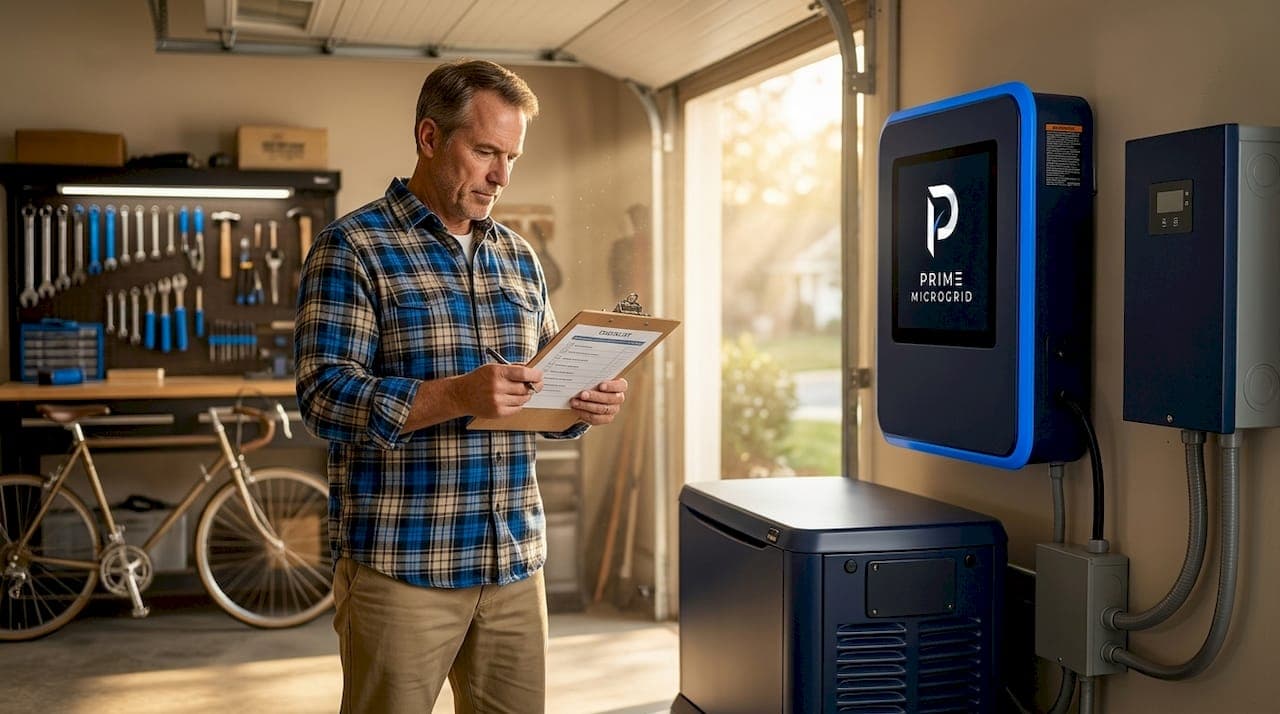
When the grid goes down, the question isn't whether you need backup power. It's which kind. The debate over large home generator vs battery storage has become one of the most consequential decisions homeowners face in 2026, and the wrong choice can mean thousands of dollars wasted on a system that doesn't fit your actual needs. Both options have real strengths and genuine limitations. This article walks you through the key criteria, honest trade-offs, and a clear framework to help you pick the backup solution your home actually needs.
Table of Contents
- Evaluating your home's backup power needs: key criteria
- Large home generators: features, pros, and cons
- Battery storage systems: features, pros, and cons
- Comparing large home generators and battery storage
- Choosing the right backup solution for your home
- Why combining battery storage with a smaller generator might be the smartest backup plan
- Explore tailored microgrid solutions for your home's backup power needs
- Frequently asked questions
Key Takeaways
| Point | Details |
|---|---|
| Understand your power needs | Translate your home's outage loads into energy terms (kWh) to estimate appropriate backup capacity. |
| Generator strengths | Generators offer continuous whole-home power during long outages but require fuel and produce noise and emissions. |
| Battery benefits | Battery storage runs quietly and cleanly for several hours to a day, especially suited for essential loads. |
| Safety first | Generator users must install carbon monoxide alarms due to infiltration risks; batteries pose no CO hazard. |
| Hybrid backup option | Combining batteries with a small generator maximizes reliability, safety, and cost-effectiveness for many homes. |
Evaluating your home's backup power needs: key criteria
Before you compare any hardware, you need to understand what you're actually asking a backup system to do. Most homeowners skip this step and end up oversizing, undersizing, or buying the wrong type of system entirely.
Start with two numbers: power (kilowatts, or kW) and energy (kilowatt-hours, or kWh). Power tells you how much load a system can handle at once. Energy tells you how long it can sustain that load. A battery rated at 5 kW but only 10 kWh will power a 5 kW load for just two hours. Experts recommend translating your household's expected outage loads into energy (kWh) to estimate realistic battery runtime. This single calculation changes most homeowners' assumptions about what they need.
Ask yourself these questions before comparing systems:
- How long do outages typically last in your area? A few hours, or multi-day events during hurricanes or ice storms?
- Which loads are truly critical? HVAC, refrigerator, medical devices, and sump pumps are common priorities.
- Do you have natural gas service at your home, or would you rely on propane?
- How much noise can you tolerate for hours or days at a stretch?
- Are you willing to perform regular maintenance, or do you want a system that largely runs itself?
Safety is not optional. Combustion generators produce carbon monoxide, a colorless, odorless gas that kills. Battery systems carry no combustion risk and are safe for indoor electrical rooms. This distinction matters more than most homeowners realize until it's too late.
Pro Tip: Before calling any installer, list every appliance you want to run during an outage and note its wattage. Add those up, then multiply by the number of hours you'd need to run them. That's your minimum kWh target. You can also use this guide on estimating battery backup needs to sharpen your numbers.
Large home generators: features, pros, and cons
Standby generators are the traditional answer to backup power, and for good reason. They've been protecting homes for decades, and modern units are more reliable than ever.
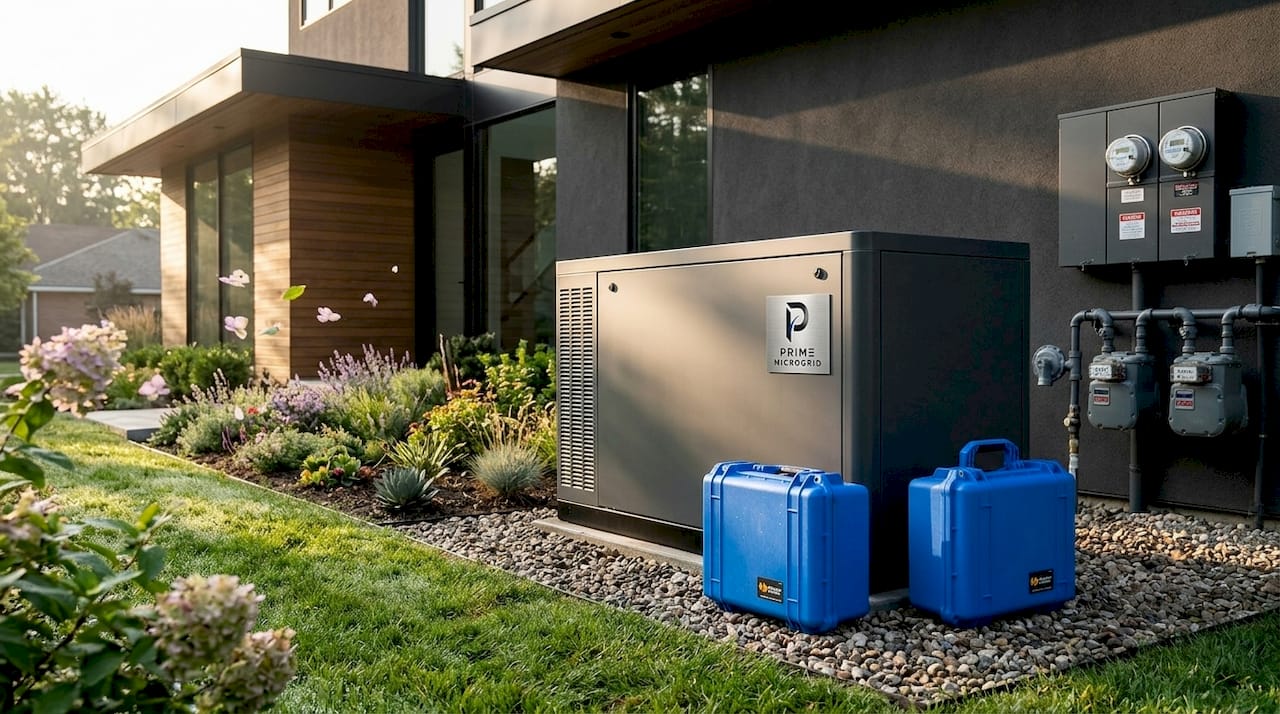
Standby home generators are sized from 8 to 26 kW, with natural gas units capable of running indefinitely as long as the utility gas line stays active. Propane units are limited by tank size, typically delivering 24 to 72+ hours of runtime. That's a meaningful advantage when you're looking at a five-day outage after a major storm.
Key advantages of large standby generators:
- Whole-home coverage, including heavy loads like central HVAC, well pumps, and electric ranges
- Automatic transfer switch activates within seconds of an outage
- Natural gas supply is essentially unlimited during most grid outages
- Lower upfront cost compared to full-home battery systems
Key drawbacks:
- Installation costs typically run $7,500 to $18,000 including the unit, transfer switch, and labor
- Noise output of 60 to 75 dB is roughly equivalent to a vacuum cleaner running continuously in your yard
- Annual maintenance: oil changes, spark plugs, coolant checks, and load testing
- Fuel costs add up during extended outages
The carbon monoxide issue deserves serious attention. Stationary generators produce CO that can infiltrate occupied spaces even when installed outdoors. CO alarms on every floor of your home are not optional. Placement, prevailing wind direction, and distance from windows all affect risk.
Pro Tip: If you're evaluating a generator for a larger property, read through the considerations specific to backup power for large homes before sizing your unit. Undersized generators short-cycle and fail early.
Battery storage systems: features, pros, and cons
Battery backup has changed dramatically in the past five years. What once covered only a few lights and a phone charger can now handle a meaningful portion of a home's daily load.
Typical residential battery capacity runs from 5 to 30+ kWh, with most homeowners installing 10 to 20 kWh for essential circuit coverage. That translates to 12 to 24+ hours of runtime for critical loads like the refrigerator, lighting, Wi-Fi, and a few outlets before the battery needs to recharge. Add solar panels to the equation and that runtime extends significantly, sometimes indefinitely during sunny weather.
Key advantages of battery storage:
- Silent operation, zero emissions, and minimal maintenance over a 10 to 15 year lifespan
- Seamless switchover during outages, often faster than you'd notice
- Safe for indoor installation in garages or utility rooms
- Pairs naturally with solar to reduce grid dependence year-round, not just during outages
- Software updates keep the system current without physical service calls
Key drawbacks:
- Installation costs range from $11,000 to $30,000 without solar, depending on capacity
- Runtime is finite without recharge, which creates real vulnerability during extended cloudy periods
- Heavy loads like central air conditioning or electric dryers drain batteries quickly
- Expanding capacity later requires additional units, adding cost
Pro Tip: If you're pairing battery storage with solar, size the battery to cover at least one full night of essential loads. That way, even a cloudy day doesn't leave you exposed. Explore your options with home battery backup systems designed specifically for residential use.
Comparing large home generators and battery storage
Here's how the two systems stack up across the factors that matter most to homeowners:
| Factor | Large standby generator | Battery storage system |
|---|---|---|
| Capacity | 8 to 26 kW, whole-home coverage | 5 to 30+ kWh, essential circuits typical |
| Runtime | Indefinite (natural gas) / 24 to 72+ hrs (propane) | 12 to 24+ hours before recharge needed |
| Upfront cost | $7,500 to $18,000 installed | $11,000 to $30,000 installed (no solar) |
| Ongoing costs | Fuel, oil, annual service | Minimal; software updates only |
| Noise | 60 to 75 dB (continuous) | Silent |
| Emissions | CO and exhaust, outdoor placement required | Zero emissions |
| Maintenance | Annual inspections, oil changes | Minimal; 10 to 15 year lifespan |
| Solar pairing | Not applicable | Extends runtime significantly |
| Best for | Long outages, heavy loads, rural areas | Short/frequent outages, solar homes |
Whole-home generators cost significantly less upfront than full-home battery systems, but the operating cost gap narrows over time when you factor in fuel, maintenance, and service contracts. Batteries cost more to install but cost almost nothing to run.
Where generators clearly win:
- Multi-day outages in areas prone to hurricanes, ice storms, or wildfires
- Homes with well pumps, large HVAC systems, or workshop equipment
- Rural properties without reliable solar recharge potential
- Homeowners prioritizing lower upfront cost
Where batteries clearly win:
- Frequent, shorter outages common in suburban and urban areas
- Homes already equipped with or planning solar panels
- Households with noise sensitivity or close neighbors
- Anyone prioritizing zero emissions and minimal maintenance
One factor that doesn't get enough attention: CO infiltration risk from standby generators is real even with proper outdoor installation. Wind patterns, HVAC intake placement, and home layout all affect exposure risk. Batteries eliminate this concern entirely.
For a deeper look at how these systems fit into a broader energy strategy, the generator vs battery comparison at Prime Microgrid covers integrated options worth reviewing.
Choosing the right backup solution for your home
The best system is the one that matches your outage reality, not the one with the best marketing. Here's a practical decision framework:
- Map your outage history. If your area loses power for a few hours a few times a year, a battery system handles that easily. If you regularly face multi-day outages, a generator or hybrid system is more appropriate.
- List your critical loads. HVAC and well pumps are high-draw appliances that batteries struggle with at scale. If these are non-negotiable, a generator earns its place.
- Check your fuel access. Natural gas at the meter is a major advantage for generator owners. Without it, you're managing propane tanks, which adds logistics and limits runtime.
- Evaluate your solar situation. If you have or plan to add solar panels, battery storage becomes dramatically more capable. Batteries win for short outages and for homes pairing storage with solar.
- Consider your lifestyle. Noise, emissions, and maintenance frequency are quality-of-life issues, not just technical specs. A generator running for three days straight affects your household differently than a silent battery system.
- Think hybrid. A battery system covering essential loads plus a smaller generator for extended events is often the most cost-effective and resilient combination. Generators win for multi-day outages and heavy loads, but that doesn't mean they have to do all the work.
- Get professional sizing. Both systems are undersold and oversold constantly. An independent assessment of your actual load profile prevents expensive mistakes.
Pro Tip: Ask any installer for a load analysis before they quote you a system size. If they skip this step and quote based on square footage alone, find someone else. Explore battery solutions for outages designed around actual load data, not guesswork.
Why combining battery storage with a smaller generator might be the smartest backup plan
Here's the perspective most articles won't give you: the "generator vs battery" framing is a false choice, and treating it as either/or is where most homeowners leave money and resilience on the table.
A properly sized battery system handles the vast majority of real-world outages without you noticing anything happened. Most grid interruptions last under four hours. Batteries cover that silently, automatically, and without burning a drop of fuel. That's not a compromise. That's the right tool for the most common problem.
But extended outages are different. Three days without sun after a major storm, a week-long grid failure after a natural disaster, these scenarios expose the limits of battery-only systems. Solar plus battery handles most outages, and a small generator can cover extended events and recharge batteries when solar can't keep up. A small, efficient generator running a few hours a day to top off your battery bank uses far less fuel, produces far less noise, and creates far less CO risk than a whole-home generator running continuously.
The hybrid approach also changes the financial math. You don't need a 22 kW whole-home generator if a 10 kWh battery covers your daily outage exposure. A smaller, less expensive generator paired with storage often costs less than either system alone at full scale. And critically, it reduces your dependence on any single technology or fuel source.
Forward-thinking homeowners are already moving this direction. The industry is following. Integrated systems that manage battery state, generator runtime, and solar input through a single controller are now available at the residential level, and they're getting more accessible every year. The hybrid microgrid solutions emerging today are designed around exactly this kind of layered resilience.
Don't let the framing of one versus the other push you into a system that only solves half your problem.
Explore tailored microgrid solutions for your home's backup power needs
You now have a clear picture of what separates a large home generator from battery storage, and where each one earns its place. The next step is translating that knowledge into a system designed around your home's actual energy profile.
Prime Microgrid designs residential microgrid solutions that combine generators, batteries, solar, and smart controls into systems built for your specific loads, outage patterns, and budget. We don't sell a product. We build a solution. Whether you need home battery backup options for frequent short outages or a full hybrid system for extended resilience, our team starts with a load analysis and works from there. See how the options compare with our back-up power comparisons and reach out to start the conversation.
Frequently asked questions
How long can a large home generator run during an outage?
A standby generator on natural gas can run indefinitely during an outage, while propane units typically deliver 24 to 72+ hours depending on tank size. Natural gas is the clear advantage for extended events.
What is the average runtime of a home battery storage system without solar recharge?
Typical home batteries provide 12 to 24+ hours of backup for essential loads before needing to recharge from solar or the grid. Runtime drops faster if you're running high-draw appliances like air conditioning.
Are standby generators safe to use because they are installed outdoors?
No. Even outdoor-installed standby generators can produce CO that infiltrates the home through windows, vents, and HVAC intakes. Every home using a generator must have carbon monoxide alarms on every occupied floor.
Which backup solution is quieter during power outages?
Battery storage systems operate silently, while generators produce 60 to 75 dB of continuous noise, roughly equivalent to a vacuum cleaner running in your yard around the clock.
Can I combine battery storage with a generator for backup power?
Yes, and for many homes it's the best approach. Batteries handle most outages automatically and silently, while a small generator covers extended events or recharges the battery during prolonged cloudy periods when solar can't keep up.