
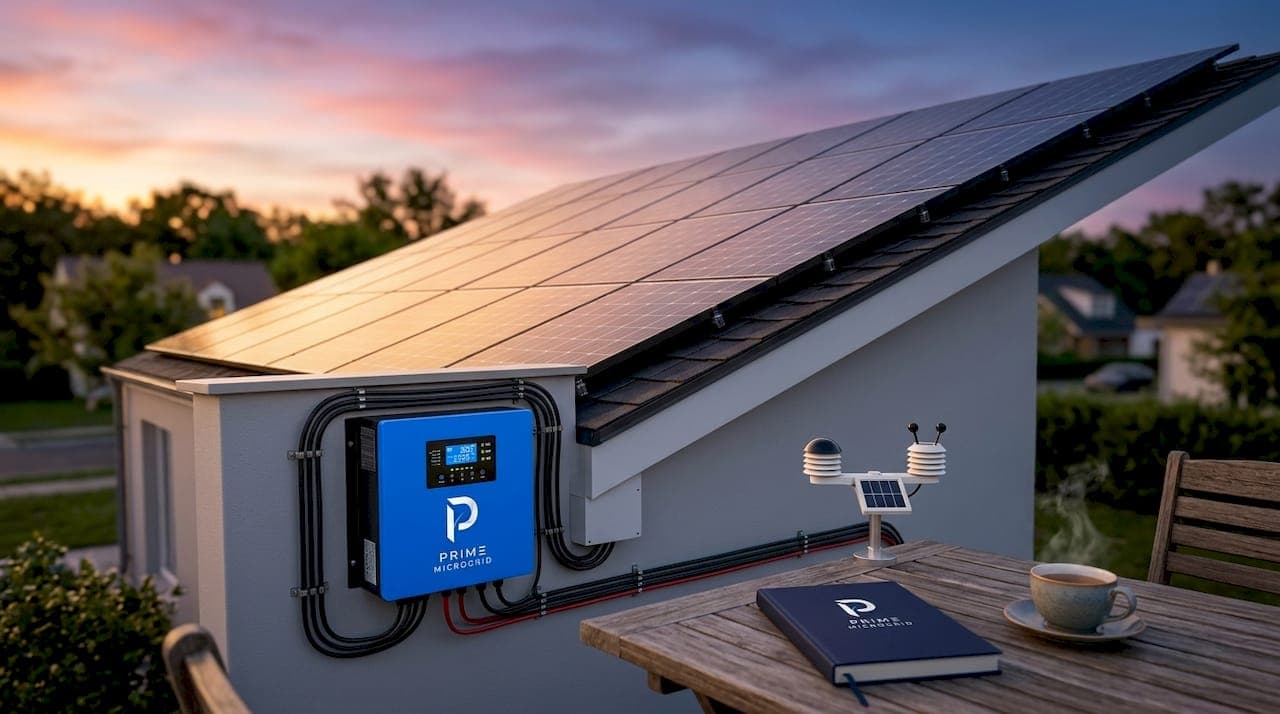
An off-grid power system is defined as a fully independent energy supply that requires solar arrays, battery banks, charge controllers, inverters, power conditioning equipment, and safety gear to deliver reliable electricity without any utility connection. The U.S. Department of Energy confirms that extending power lines costs $15,000 to $50,000 per mile, making self-sufficient generation the only practical option for many properties. Getting these critical home systems to power off-grid right means understanding how each component works together, how to size them correctly, and which safety codes govern their installation in 2026.
1. Essential energy generation: solar arrays and alternatives
The photovoltaic array is the primary generation source in any residential off-grid power system, and its size determines everything downstream. Sizing starts with your daily kilowatt-hour demand, divided by your location's peak sun hours, then adjusted for a derate factor that accounts for heat loss, wiring inefficiency, and soiling. A 200 W solar panel generates roughly 0.8 to 1.2 kWh per day depending on location. That means a typical U.S. home consuming 30 kWh daily would need 25 to 38 panels just for generation, before accounting for storage losses.
Most practical off-grid designs do not attempt to power every circuit. Instead, they target a reduced critical load of 8 to 15 kWh per day, which cuts the required array size dramatically and keeps costs manageable. Wind turbines, micro-hydro systems, and propane generators can supplement solar on cloudy days or during seasonal low-production periods. The DOE specifically highlights hybrid generation systems as the most reliable approach to off-grid performance, because no single renewable source is consistent enough on its own.
- Calculate your daily kWh load before selecting panel count
- Use peak sun hours for your specific ZIP code, not national averages
- Add a 1.25 derate factor to account for real-world efficiency losses
- Plan for a backup generation source to cover low-production periods
Pro Tip: Run your home on a single utility billing cycle and log every appliance's wattage and daily hours of use. That one exercise will cut your estimated array size by 20 to 40 percent compared to guessing.
2. Battery storage: sizing for autonomy and safety compliance

The battery bank stores energy generated during daylight and releases it at night or during cloudy periods, making it the backbone of any off-grid home energy solution. Sizing follows a straightforward formula: multiply your daily load in kWh by your desired days of autonomy, then divide by the battery's usable depth of discharge and round-trip efficiency. For a 10 kWh daily load with two days of autonomy, a 90% efficient LiFePO4 battery at 80% usable depth of discharge requires roughly 27.8 kWh of installed capacity.
Lithium iron phosphate (LiFePO4) chemistry now dominates residential off-grid installations because it offers 3,000 to 6,000 charge cycles, stable thermal behavior, and a flat discharge curve that maintains consistent voltage. For a detailed breakdown of how chemistry affects long-term performance, battery chemistry comparisons are worth reviewing before purchasing. Lead-acid batteries remain cheaper upfront but deliver roughly one-third the cycle life at comparable usable capacity.
| Sizing factor | What it means for your system |
|---|---|
| Daily load (kWh) | Total energy consumed by critical circuits per day |
| Days of autonomy | How many cloudy or low-production days the bank covers |
| Depth of discharge (DoD) | Usable percentage of total capacity (80% for LiFePO4) |
| Round-trip efficiency | Energy lost in charge/discharge cycle (typically 90 to 95%) |
| Code capacity limit | NFPA 855 caps indoor installations at 40 kWh per location |
The 2026 indoor installation codes are strict. NFPA 855 and IRC R328 cap residential indoor battery storage at 40 kWh per location, prohibit placement in sleeping rooms and living areas, and require UL 9540 listed systems with thermal runaway testing. Garages and basements are the most common compliant locations, and outdoor enclosures are required when indoor capacity limits are exceeded.
Pro Tip: Plan your battery placement and capacity limits before finalizing your system design. Practitioners consistently report that early compliance planning prevents costly redesigns when inspectors require outdoor enclosures or additional separation distances.
3. Charge controllers: regulating power and protecting batteries
A charge controller sits between the solar array and the battery bank, regulating the voltage and current flowing into storage to prevent overcharging and extend battery life. Maximum Power Point Tracking (MPPT) controllers are the standard for off-grid residential systems because they extract up to 30% more energy from the array compared to older PWM designs, particularly in cold weather and partial shading conditions.
Sizing a charge controller correctly requires applying the NEC 690.8 safety factor. SurgePV's 2026 guide uses the formula: (Array Watts divided by Battery Voltage) multiplied by 1.25. For a 3,000 W array on a 48V battery bank, that calculation yields a minimum controller rating of 78.1 amps, meaning a 80A controller is the smallest safe choice. Undersizing a controller does not just reduce energy capture. It creates a fire risk by forcing the device to operate beyond its rated current continuously.
Key sizing and selection considerations for charge controllers:
- Match the controller's maximum input voltage to your array's open-circuit voltage (Voc) at the coldest expected temperature
- Apply the NEC 690.8 ×1.25 safety factor to your calculated operating current
- Select MPPT over PWM for any array larger than 400 W
- Verify the controller supports your battery chemistry (LiFePO4 requires specific charge profiles)
- Choose a controller with data logging to monitor daily energy harvest and catch performance drops early
4. Inverters: converting DC power for your home's circuits
The inverter converts DC power stored in your battery bank into the 120V or 240V AC power that your home's circuits and appliances use. For off-grid living, a pure sine wave inverter is the only appropriate choice. Modified sine wave units damage variable-speed motors, medical equipment, and sensitive electronics, which are often the exact devices you most need to protect.
Inverter sizing covers two distinct values: continuous power rating and surge capacity. Continuous rating must exceed the total wattage of all loads running simultaneously on critical circuits. Surge capacity must handle the startup draw of motors, which can be two to six times their running wattage. A mid-size home with a well pump (1,200 W running, 3,600 W surge), refrigerator (150 W), and lighting (200 W) needs a minimum 1,550 W continuous inverter with at least 4,000 W surge capacity.
For homes with larger loads or multiple critical circuits, a 4,000 to 6,000 W pure sine wave inverter with a 12,000 W surge rating provides adequate headroom. Inverter-charger combinations that integrate battery charging, transfer switching, and AC output in a single unit simplify installation and reduce wiring complexity. Reviewing options for combining solar, generators, and batteries in a single system helps clarify which inverter-charger configuration fits your design.
5. Critical load prioritization: which circuits matter most
Powering an entire home off-grid requires a very large PV array and battery system that most budgets cannot support. The practical solution is load prioritization, which means identifying the circuits that matter most and sizing your system around them rather than your total household consumption. This single decision reduces system cost more than any other design choice.
The DOE confirms that load reduction and hybrid systems are the keys to reliable off-grid performance, not simply adding more panels. A dedicated critical loads panel separates high-priority circuits from non-essential ones, allowing your inverter and battery bank to serve only what you actually need during an outage or full off-grid operation.
Typical critical circuits to prioritize:
- Refrigeration and freezer (food safety and medication storage)
- Well pump or water pressure system (sanitation and drinking water)
- Lighting using LED fixtures (50 to 80% less draw than incandescent)
- Communication devices: routers, phones, and emergency radios
- Medical equipment: CPAP machines, oxygen concentrators, or dialysis units
- A single heating or cooling circuit for extreme weather safety
- Security systems and exterior lighting
Switching to LED lighting, Energy Star rated appliances, and propane for cooking and water heating can reduce a home's critical electrical load from 30 kWh per day to under 12 kWh per day. That reduction cuts required battery capacity and array size nearly in half, which translates directly to lower system cost.
Pro Tip: Install a dedicated critical loads subpanel before your off-grid system goes live. It costs $300 to $600 in materials and gives you precise control over exactly which circuits your batteries and inverter serve.
6. Balance-of-system and safety equipment
Beyond panels, batteries, and inverters, a code-compliant off-grid system requires a full set of balance-of-system (BOS) components that condition power, protect equipment, and satisfy inspection requirements. The DOE identifies BOS components including wiring, safety disconnects, meters, grounding systems, and monitoring instrumentation as integral to system resilience, not optional add-ons.
Required BOS and safety components for a residential off-grid installation include:
- DC and AC disconnect switches at the array, battery bank, and inverter output for safe maintenance and emergency shutoff
- Overcurrent protection (fuses or breakers) sized for each circuit segment
- System grounding per NEC Article 690 to prevent shock and equipment damage
- Revenue-grade or sub-meter monitoring to track daily generation, consumption, and battery state of charge
- Smoke detectors within 20 feet of battery installations per NFPA 855
- Signage and labeling on all disconnects and battery enclosures per local AHJ requirements
"Inverter systems that survive long outages include power conditioning and safety equipment as integral parts; code compliance ensures operational resilience and inspection readiness." — U.S. Department of Energy
Skipping any of these components does not save money. It creates inspection failures, insurance voids, and genuine safety hazards. A properly documented BOS package also makes future system expansions far simpler because every circuit is labeled, rated, and accessible.
Key takeaways
A reliable off-grid home power system requires correctly sized solar generation, lithium battery storage, MPPT charge controllers, pure sine wave inverters, and a prioritized critical loads panel, all installed to NFPA 855 and NEC 690 standards.
| Point | Details |
|---|---|
| Size generation to critical load | Target 8 to 15 kWh daily critical load, not your full household consumption. |
| Apply NEC 690.8 to controllers | Multiply calculated controller amps by 1.25 to meet code and prevent fire risk. |
| Respect NFPA 855 battery limits | Indoor installations cap at 40 kWh per location with UL 9540 listed equipment. |
| Prioritize pure sine wave inverters | Modified sine wave units damage motors and sensitive medical or electronic devices. |
| Plan BOS and compliance early | Safety disconnects, grounding, and labeling are required for inspection approval. |
What I've learned designing off-grid systems that actually hold up
After working through dozens of residential off-grid designs, the single most consistent mistake I see is homeowners sizing their system around their current utility bill rather than a reduced critical load. That approach produces a system that is two to three times larger and more expensive than necessary, and it still underperforms on cloudy winter days because the design never accounted for seasonal production variation.
My honest recommendation: start with your critical loads panel, not your solar array. Identify the eight to twelve circuits you genuinely cannot live without, calculate their actual wattage and daily hours, and build your battery and generation sizing around that number. You will end up with a more affordable system that performs more reliably than an oversized one designed around theoretical full-home coverage.
On battery storage, I have seen too many homeowners skip early compliance review and then face expensive redesigns when their inspector requires an outdoor enclosure or additional separation distances. NFPA 855 and UL 9540 requirements are not bureaucratic obstacles. They reflect real thermal runaway risks that have caused residential fires. Build compliance into your design from day one.
Hybrid systems that combine solar with a propane or natural gas generator are also consistently more reliable than pure solar setups, particularly in the Northeast and Pacific Northwest where winter sun hours drop sharply. The generator does not need to run often. It just needs to be there for the two or three week stretches when solar production cannot meet even a reduced load. Automation that starts the generator only when battery state of charge drops below 20% keeps fuel costs minimal while protecting your battery bank from deep discharge.
— David
Design your off-grid system with Primemicrogrid
Primemicrogrid designs residential microgrid systems that integrate solar generation, lithium battery storage, generators, smart controls, and load management into a single, code-compliant package built around your property's actual needs. Unlike standalone solar or a generator alone, a microgrid versus generator comparison shows why integrated systems deliver better reliability, lower long-term fuel costs, and automatic failover that a single-source setup cannot match. Whether you are in the Mid-Atlantic region or Texas, Primemicrogrid's residential microgrid solutions are designed for long-term performance, not just installation day. Contact Primemicrogrid to get a system design built around your critical circuits, your location, and your budget.
FAQ
What are the core components of an off-grid home power system?
An off-grid home power system requires a solar photovoltaic array, lithium battery bank, MPPT charge controller, pure sine wave inverter, and balance-of-system equipment including disconnects, grounding, and monitoring. Each component must be correctly sized and code-compliant to deliver reliable energy independence.
How many solar panels does an off-grid home need?
The number depends on your critical daily load and local peak sun hours. A 200 W panel produces 0.8 to 1.2 kWh per day, so a home targeting a 10 kWh daily critical load typically needs 10 to 15 panels, plus a derate factor for real-world losses.
What battery capacity do I need for off-grid living?
Multiply your daily critical load by your desired days of autonomy, then divide by your battery's usable depth of discharge and round-trip efficiency. NFPA 855 limits indoor residential battery installations to 40 kWh per location, so larger systems may require outdoor enclosures.
Can I power my whole house off-grid with solar?
Powering an entire typical U.S. home off-grid requires a very large array and battery system that most budgets cannot support. The practical approach is to identify and power only your critical circuits, which reduces system size and cost by 40 to 60 percent while maintaining genuine energy independence.
What safety codes govern off-grid battery installations?
NFPA 855 and IRC R328 govern residential battery storage, requiring UL 9540 listed systems, a 40 kWh indoor capacity limit per location, prohibition from sleeping and living rooms, and smoke detectors within 20 feet of battery enclosures. Planning for these requirements early prevents costly redesigns.