

A home battery storage system is a rechargeable energy device that stores electricity from solar panels or the utility grid for use during outages, peak pricing periods, or any time on-site generation falls short. The industry term for these installations is a Battery Energy Storage System, or BESS. For homeowners in 2026, the advantages of battery storage go well beyond simple backup power. Systems like the Tesla Powerwall and modular BESS units from multiple manufacturers now let you control when you buy electricity, how much you pay for it, and whether a grid outage affects your home at all. The home energy storage benefits covered below are grounded in real data from Lawrence Berkeley National Laboratory, EnergySage, and the Massachusetts Clean Energy Center.
1. Backup power during outages
Backup power is the most visible home battery storage system benefit, and the one that drives most purchase decisions. A battery system can keep your lights, refrigerator, and critical medical equipment running the moment the grid goes down, with no fuel run to the gas station and no extension cords across the driveway.
Capacity determines how long you stay powered. A 10 kWh battery paired with solar can carry essential loads through a three-day outage, while a 30 kWh system extends coverage to 96% of total home loads including heating and cooling. That gap between "essential circuits" and "whole-home backup" is the most important sizing decision you will make.
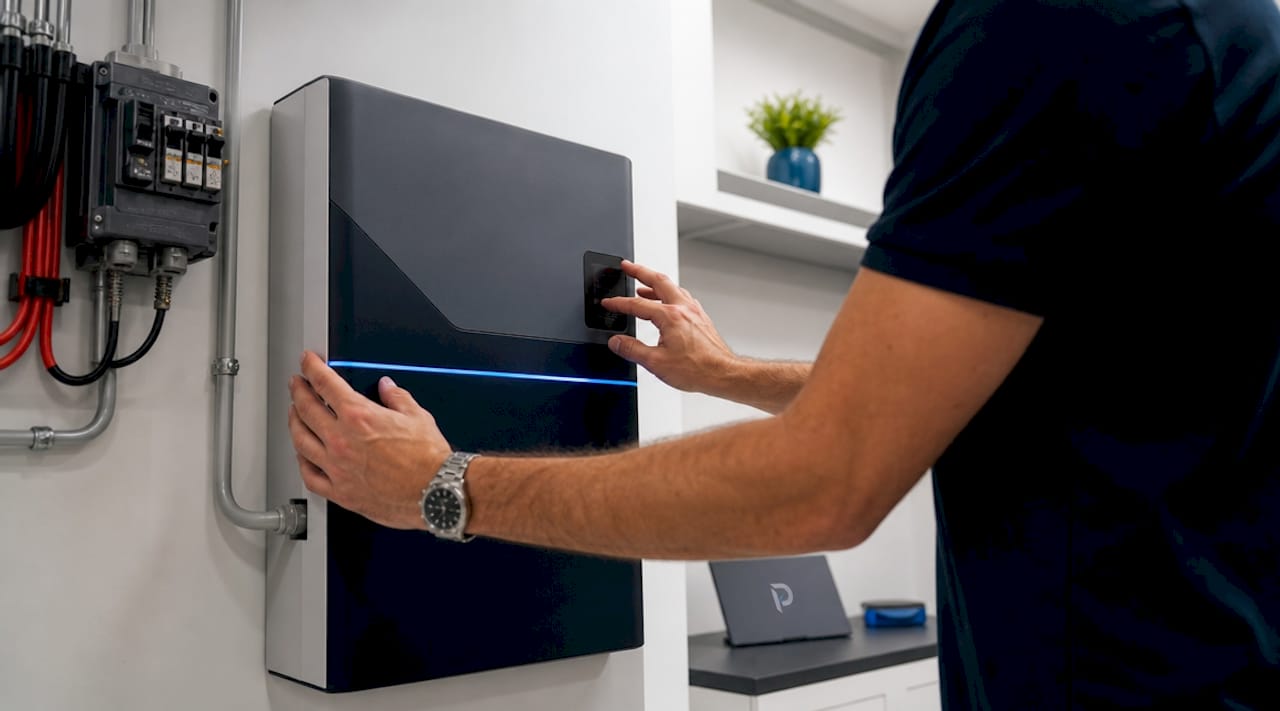
The ability to recharge during an outage is what separates a battery-plus-solar setup from a standalone battery. Without solar, a single charge lasts until the stored energy runs out. With solar recharging daily, the system can sustain backup indefinitely as long as the sun rises.
Compared to a gas generator, a battery system eliminates fuel logistics entirely. No stored gasoline, no carbon monoxide risk, no noise at 2 a.m. For most homeowners, that convenience alone justifies a significant portion of the cost. You can read a detailed side-by-side breakdown in the generator vs. battery comparison from Primemicrogrid.
Pro Tip: Identify your critical loads before sizing. A refrigerator, a few lights, and a Wi-Fi router typically draw 1.5 to 2 kW. Knowing that number lets you size for hours of coverage rather than guessing.
2. Cost savings through load shifting
Load shifting is the practice of charging your battery when electricity is cheap and discharging it when rates are high. Under time-of-use (TOU) billing, utilities in states like California, New York, and Massachusetts charge 2 to 3 times more during peak evening hours than during midday or overnight. That price spread is the financial engine behind battery storage.
Here is how the savings stack up in practice:
- Charge overnight or at solar peak when rates are at their lowest.
- Discharge during the 4 to 9 p.m. peak window to avoid buying expensive grid power.
- Reduce demand charges if your utility applies them to residential accounts.
- Avoid low-value solar exports by consuming your own generation rather than selling it back at a fraction of retail price.
Net metering policy is the variable that changes the math most dramatically. In states still offering full retail net metering, a battery's financial case rests mainly on TOU arbitrage. In states moving to net billing at avoided-cost rates, solar-plus-storage economics shift sharply in favor of batteries because self-consumption becomes far more valuable than exporting surplus power.
A 2026 analysis from Electrek confirms that bill control drives adoption more than backup power for many battery owners. That finding matters because it reframes the purchase: a battery is not just insurance against outages. It is an active tool for managing one of your largest monthly household expenses.
3. Increased solar self-consumption
A solar array without storage exports surplus power to the grid every sunny afternoon. A battery captures that surplus and holds it for evening use, which is exactly when your household demand peaks and grid rates are highest. Battery storage increases solar self-consumption by storing excess generation for use when solar production drops, at night or on cloudy days.
The practical result is that you buy less electricity from the utility at any price point. Instead of selling midday solar at a low export rate and buying back the same energy at a high peak rate, you use your own generation twice: once when it is produced and again when you need it most.
| Setup | Solar self-consumption | Grid dependence |
|---|---|---|
| Solar only | 30 to 50% | High during evenings |
| Solar plus battery | 70 to 90% | Low, mainly overnight |
| Solar plus battery plus EV charging | Near 100% on sunny days | Minimal |
Participation in Virtual Power Plant (VPP) programs adds another layer of value. Utilities like Pacific Gas and Electric and Green Mountain Power pay battery owners to discharge stored energy back to the grid during high-demand events. This turns your home battery into a small revenue source on top of its self-consumption savings.
Pairing batteries with solar maximizes both resilience and cost savings because the battery recharges each day, keeping your backup reserve full while simultaneously reducing your grid purchases.
4. Energy independence and grid resilience
Energy independence does not mean disconnecting from the utility. For most homeowners, it means reducing how much the grid controls your costs and your comfort. A battery system gives you a buffer between your home and whatever the utility does next, whether that is a rate increase, a rolling blackout, or a multi-day storm outage.
Backup duration and load coverage depend on battery capacity and whether the system can recharge during an outage via solar. A well-designed solar-plus-storage system running on a hybrid inverter can operate in island mode, disconnecting from the grid automatically and reconnecting when power is restored. That seamless transfer is something a portable generator cannot replicate.
Homeowners in outage-prone regions, particularly in the Mid-Atlantic, Southeast, and California, report that resilience and peace of mind are the primary reasons they installed a battery, even when the financial return on investment is modest. The value of keeping a medical device running or avoiding a $500 refrigerator loss during a summer storm is real, even if it does not appear on a spreadsheet.
Pro Tip: Ask your installer whether your battery system includes an automatic transfer switch or relies on manual switching. Automatic transfer is the standard for whole-home backup and makes a significant difference during a fast-moving outage.
5. Practical sizing and system selection
Battery sizing guidelines recommend matching capacity to your critical loads and desired outage duration, with 8 to 24 hours of coverage being the typical residential target. A 10 to 15 kWh system covers that range for most households running essential circuits.
The two sizing inputs that matter most are your daily solar surplus and your critical load draw. The larger of those two numbers governs your minimum battery size. If your solar array produces 8 kWh of surplus per day and your critical loads draw 1.5 kW, you need at least 12 kWh of usable capacity to cover an 8-hour overnight gap. You can work through the full calculation using Primemicrogrid's guide on sizing battery storage for your home.
Modular systems like the Tesla Powerwall 3 and Enphase IQ Battery allow you to start with one unit and add capacity later. That flexibility matters if your budget is limited today but your energy needs may grow when you add an electric vehicle or a heat pump. Most residential BESS units use 48V architecture with hybrid inverters that handle both grid-tied and backup operation without separate equipment.
Budget is the honest constraint most homeowners face. A single 10 kWh battery with installation typically runs between $10,000 and $15,000 before incentives. The federal Investment Tax Credit (ITC) covers 30% of the installed cost for battery systems paired with solar, which meaningfully changes the net cost calculation.
6. Long-term advantages and secondary benefits
The financial case for a battery grows stronger over time as electricity rates rise and the system continues to perform. Beyond monthly bill savings, there are several long-term advantages worth factoring into your decision.
- Home resale value. Adding batteries to solar systems can increase home resale value by 5 to 10%, a meaningful premium in competitive real estate markets. Buyers increasingly recognize energy-resilient homes as lower-risk purchases.
- Bill predictability. A battery lets you control when you draw from the grid, which smooths out the volatility in monthly electricity bills. That predictability has real value in states where utility rates have risen sharply year over year.
- Reduced carbon footprint. Using stored solar energy instead of grid power during peak hours reduces your reliance on fossil-fuel peaker plants, which are the dirtiest and most expensive generators on the grid.
- EV integration. Charging an electric vehicle from a home battery charged by solar is the most cost-effective EV fueling strategy available today. Systems designed around this use case, covered in detail in Primemicrogrid's guide on combining solar, generator, and battery, can eliminate most of your transportation energy costs.
"The homeowners who get the most from battery storage are the ones who treat it as an energy management tool, not just a backup device."
Emerging AI-managed home energy systems from companies like Span and Lumin take this further by automatically optimizing charge and discharge cycles based on weather forecasts, utility pricing signals, and your household usage patterns.
Key takeaways
Home battery storage system benefits are most valuable when backup power, cost savings, and solar self-consumption work together as a single coordinated system rather than isolated features.
| Point | Details |
|---|---|
| Backup power capacity | A 10 kWh battery with solar can cover essential loads for three days; 30 kWh covers 96% of total home loads. |
| Cost savings driver | TOU arbitrage in high-rate states like California and New York delivers the strongest financial return. |
| Solar self-consumption | Pairing storage with solar raises self-consumption from roughly 40% to 80% or more, cutting grid purchases significantly. |
| Sizing sweet spot | A 10 to 15 kWh system covers most residential critical-load backup needs for 8 to 24 hours. |
| Long-term value | Solar-plus-storage installations can increase home resale value by 5 to 10% while reducing monthly bill volatility. |
Why I think most homeowners underestimate what a battery actually does
Most people buy a battery because they are tired of losing power during storms. That is a completely valid reason. But after working through hundreds of residential energy projects, I have found that the homeowners who are most satisfied with their systems are the ones who sized for cost savings first and treated backup as the bonus, not the other way around.
The math is straightforward in high-TOU states. If you are paying $0.45 per kWh during peak hours and charging your battery at $0.12 per kWh overnight, every kilowatt-hour you shift saves you real money every single day. That daily return compounds in a way that a backup event, which might happen twice a year, simply cannot match.
Where I push back on conventional wisdom is the idea that batteries are only worth it if you have solar. In states with aggressive TOU rates, a grid-charged battery can pay for itself through arbitrage alone, especially if you add an EV to the equation. The home energy storage benefits are genuinely broader than the backup-power narrative suggests.
My honest caution: do not overbuy. A single 10 to 13 kWh unit covers the needs of most households. The homeowners who install 30 kWh systems expecting to run their whole home through a week-long outage often find the economics do not pencil out without a very specific rate structure or a large solar array. Size for your actual loads, not your worst-case fears.
— David
How Primemicrogrid can help you get this right
Choosing the right battery system involves more than picking a brand off a list. It requires matching capacity to your actual loads, understanding your utility's rate structure, and configuring the inverter and transfer equipment correctly for backup operation.
Primemicrogrid designs residential energy systems across the Mid-Atlantic region that integrate battery storage, solar, generators, and EV charging into a single coordinated setup. Whether you want essential-circuit backup or a full residential microgrid solution, the team sizes and installs systems built around your specific home and energy goals. If you are ready to move past the research phase, a consultation with Primemicrogrid will give you a clear picture of what a system sized for your home would actually cost and deliver. Explore the home battery backup options available for your property.
FAQ
What is the main benefit of a home battery storage system?
The primary benefit is reliable backup power during grid outages, but cost savings through TOU load shifting often deliver greater long-term financial value, particularly in states like California and New York where peak rates run 2 to 3 times higher than off-peak rates.
How long can a home battery power my house during an outage?
A 10 kWh battery covering essential loads can last through a three-day outage when paired with solar recharging. Without solar, the same battery covers roughly 8 to 16 hours depending on your load draw.
Do I need solar panels to use a home battery?
No. A battery can charge from the grid during off-peak hours and discharge during peak periods to reduce your electricity bill. Solar significantly increases the value of storage, but it is not a requirement.
How much does a home battery storage system cost?
A single residential battery system with installation typically costs between $10,000 and $15,000 before incentives. The federal 30% Investment Tax Credit applies to battery systems installed with solar, reducing the net cost substantially.
Does adding a battery increase my home's resale value?
Yes. Solar-plus-storage installations can increase home resale value by 5 to 10%, according to research cited by Electrek. Buyers in competitive markets increasingly treat energy resilience as a measurable home feature.