
Most homeowners think of distributed energy resources as solar panels on a roof. That framing misses the bigger picture. Distributed energy resources homes are evolving into complete energy systems: generation, storage, smart controls, and grid participation working together. Whether your goal is cutting your monthly utility bill, surviving the next multi-day outage, or simply owning your energy instead of renting it from a utility, the technology and policy support available today make a real system more achievable than most people realize.
Table of Contents
- Key takeaways
- Distributed energy resources at home: what's actually on the list
- Why the benefits go beyond the utility bill
- Managing home DERs: the challenges worth knowing upfront
- Comparing distributed energy resource combinations
- My honest take after years in this space
- How Primemicrogrid designs your home DER system
- FAQ
Key takeaways
| Point | Details |
|---|---|
| DERs go far beyond solar | A full distributed energy resource system includes generation, storage, EV charging, and smart load management working together. |
| Lifetime savings are significant | Coordinated DER adoption could save households $26,000 over a lifetime and create $1.5 trillion in national impact. |
| Grid connection beats full defection | Staying grid-connected while maximizing self-consumption delivers better cost control and resilience than going fully off-grid. |
| Interconnection is the biggest hurdle | Permitting and utility approval delays remain the top barrier, but states are actively working to automate the process. |
| System combinations drive the best results | Pairing solar with batteries, smart panels, and EV chargers creates layered backup and savings that no single device can match. |
Distributed energy resources at home: what's actually on the list
The term "distributed energy resources" sounds like utility jargon, but the concept is straightforward. These are energy assets located at or near your home that generate, store, or intelligently manage electricity. Here is the core distributed energy resources list for residential use:
- Rooftop solar: The most common starting point. A typical residential system runs between 5 and 15 kW of generation capacity, enough to cover most or all of a home's daily consumption during peak sun hours.
- Battery storage: Lithium-ion home batteries, like those in the 10 to 20 kWh range, store excess solar production for use at night or during outages. This is what transforms solar from a daytime convenience into a genuine backup resource.
- Bidirectional EV charging: Your electric vehicle is essentially a battery on wheels. Bidirectional EV chargers can add 40 to 100 kWh of usable storage per vehicle, which is two to five times more capacity than most standalone home batteries.
- Smart electrical panels: These replace or augment your standard breaker box with circuit-level controls, letting you prioritize loads, automate shutoffs, and optimize how energy flows through your home in real time.
- Small wind turbines: Less common in suburban settings, but viable for rural or coastal properties where consistent wind complements solar generation.
- Smart thermostats and appliances: Demand-side tools that shift when you use energy, not just how much you use. A smart water heater, for example, can pre-heat during peak solar hours and coast through the evening.
Pro Tip: Pairing rooftop solar with a home battery is where most homeowners see the biggest jump in self-consumption. Without storage, excess solar just flows back to the grid, often at low export rates. With storage, you capture that energy and use it when electricity costs most.
Why the benefits go beyond the utility bill
The financial case for distributed energy resources homes is stronger than most people expect. Research shows that coordinated DER adoption could be affordable for 96% of households, with each home seeing up to $26,000 in lifetime savings. The barrier has not been technology. It has been coordination and awareness.
Here is where the value actually comes from:
- Bill reduction through self-consumption: When your solar and battery system covers daytime and evening loads, you buy far less power from the grid, especially at peak rate periods when utilities charge the most.
- Backup power during outages: A properly sized solar-plus-battery system can keep critical loads running for hours or days. A New Orleans DER program investing $28 million in residential batteries demonstrates how seriously utilities now take home-based resilience.
- Virtual Power Plant participation: Utilities compensate homeowners who allow their batteries and smart appliances to respond to grid signals during high-demand periods. VPP programs deliver electricity at 40% to 60% of the cost of traditional infrastructure upgrades, which means utilities have real financial incentive to pay you for participation.
- Protection against rate increases: When you generate and store your own power, utility rate hikes hit you less hard. Your effective energy cost is partially locked in by what you produce.
Con Edison avoided $1 billion in substation costs by spending $200 million on customer-sited DERs. That math tells you exactly why utilities are now willing to pay homeowners to install these systems rather than build new infrastructure themselves.
Managing home DERs: the challenges worth knowing upfront
The technology works. The harder part is often getting it connected and coordinated properly. When you apply to connect a solar or battery system to the grid, you go through an interconnection process that requires utility review and approval. In many areas, this still takes weeks to months and involves paperwork that feels designed for utilities, not homeowners.
Automating residential permitting is now a priority in leading states, and that pressure is producing faster timelines. But until permitting reform reaches your area, working with an experienced installer who knows local utility requirements is the fastest path through the process.
Once your system is running, the next challenge is coordination. Managing distributed energy resources at home means deciding in real time: should the battery charge from solar or save capacity for tonight's outage risk? Should the EV charge now or wait until solar production peaks? DERMS software handles this at the utility scale by aggregating and coordinating thousands of customer assets simultaneously. At home, smart inverters and energy management systems do the equivalent job.
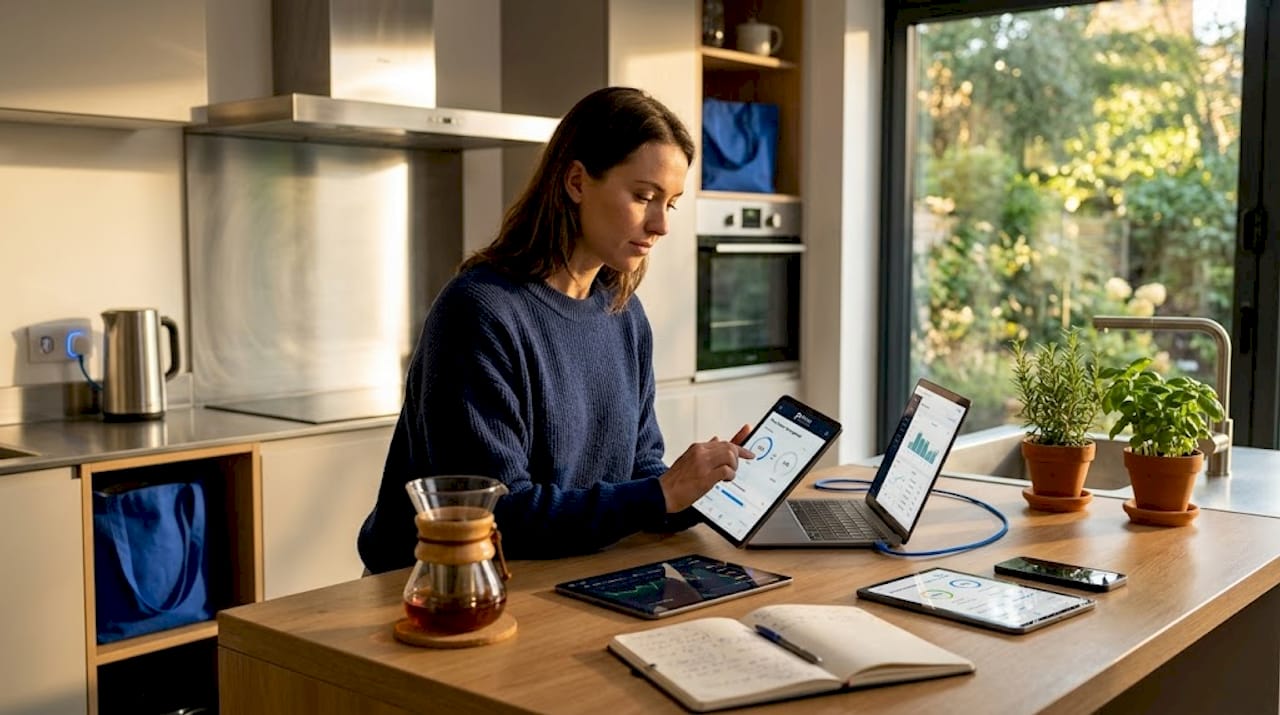
One often-overlooked risk is cloud dependency. Many home energy systems route control signals through a manufacturer's cloud server. If your internet goes down during an outage, so does automated control of your battery and loads. Local cloud-independent control using platforms like Home Assistant avoids this problem entirely by keeping coordination decisions on your local network regardless of internet status.
Pro Tip: When evaluating any home energy management system, ask specifically whether the system can operate and optimize locally without internet access. This single feature separates systems that fail during storms from ones that perform exactly when you need them most.
A hybrid strategy connects the grid as a flexible backup rather than replacing it entirely. Staying grid-connected while maximizing self-consumption gives you better economics and reliability than full grid defection, which requires massive overcapacity to handle cloudy stretches and seasonal shifts.
Comparing distributed energy resource combinations
Not every home needs every technology. The right configuration depends on your goals, budget, and local utility structure. Here is how common distributed energy resource combinations stack up:
| System combination | Primary benefit | Best for | Resilience level |
|---|---|---|---|
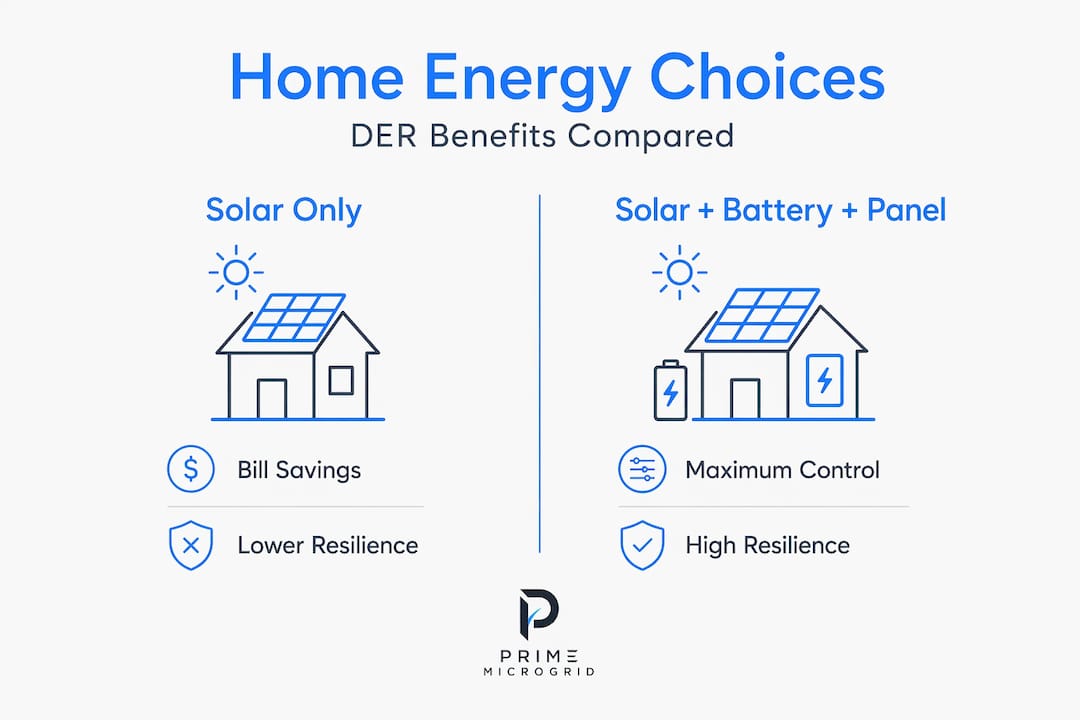
| Solar only | Bill reduction during daylight | Budget-conscious starters | Low (no backup) |
| Solar + battery | Self-consumption and backup | Most homeowners | High |
| Solar + battery + EV charger | Maximum storage and transportation savings | EV owners | Very high |
| Battery + generator | Backup with fuel flexibility | Areas with poor solar resources | High |
| Solar + smart panel + thermal storage | Load shifting without large battery cost | Efficiency-focused households | Moderate to high |
The solar plus battery plus smart panel combination is increasingly the baseline for serious home energy management. Smart panels enable thermal storage by directing excess solar into water heaters and HVAC systems as heat, which is stored for later use without needing more battery capacity. This approach improves the economics of the whole system because heat storage is far cheaper per kilowatt-hour than electrochemical battery storage.
If you own an EV, adding bidirectional charging capability to your configuration is one of the highest-leverage upgrades available. Your vehicle already carries more storage capacity than most standalone home battery systems. Using it for home backup power during outages or grid peak periods means your transportation investment pulls double duty as energy infrastructure.
The key to all of these combinations is that they compound. Each layer adds both cost savings and resilience. Solar alone is helpful. Solar with storage is a meaningful backup. Solar with storage, smart management, and a smart panel is a home energy system that can genuinely replace most of what you currently buy from the grid.
My honest take after years in this space
I've worked alongside enough homeowners to know where the real friction lives, and it is almost never the technology itself. The conversations that stick with me are the ones where someone spent two years planning an off-grid system, went through the expense and complexity of oversizing every component, and ended up with something fragile and expensive that would have been far more resilient if they had simply stayed grid-connected and optimized self-consumption.
Full energy independence sounds compelling. In practice, it usually means owning a much larger solar array and battery bank to cover you through a week of cloudy weather in December. The hybrid approach, treating the grid as a last-resort backup rather than your primary source, costs less, performs better, and keeps you connected to VPP programs that can actually pay you back.
What I've also learned is that the homeowners who get the most out of their systems are the ones who treat their residential microgrid as a system to be managed, not a product to be installed and forgotten. They track their self-consumption rate, they participate in utility programs, and they add components as their needs and budget evolve. That flexibility is exactly what good system design should allow.
The shift from passive energy consumer to active grid participant is real and accelerating. Utilities are paying homeowners to install batteries. States are reforming permitting. The economics keep improving. The homeowners who start building now, even with a modest solar-plus-battery configuration, will be positioned far better than those still waiting for the "perfect" moment.
— David
How Primemicrogrid designs your home DER system
Primemicrogrid builds residential energy systems around your actual goals, not a catalog of standard packages. Whether you need whole-home backup during grid outages, a system that cuts your monthly bill significantly, or a setup that can grow from solar-plus-battery today to full microgrid capability later, Primemicrogrid designs it around your property, your utility, and your priorities.
For homeowners in the mid-Atlantic region, Primemicrogrid offers residential microgrid solutions that integrate solar, battery storage, smart controls, and generator backup into a single coordinated system. If you are evaluating how a microgrid compares to a standalone solar or battery setup, the microgrid vs. generator vs. solar breakdown covers the tradeoffs in plain terms. For those interested in reducing or eliminating grid dependence entirely, off-grid home power options are also available for properties where that approach makes sense.
FAQ
What counts as a distributed energy resource for a home?
Any energy asset at or near your property qualifies: rooftop solar, home batteries, EV chargers, smart panels, and even controllable appliances. Together, these form a home-based distributed energy resource system.
How much can a home DER system actually save?
Research shows potential lifetime savings of $26,000 per household with coordinated DER adoption, though actual savings depend on system size, local utility rates, and participation in grid programs.
Do I need to go off-grid for DERs to be worth it?
No. A hybrid approach that keeps you grid-connected while maximizing self-consumption from solar and storage consistently outperforms full grid defection in both cost and reliability for most homeowners.
What is the biggest obstacle to installing home DERs?
The interconnection and permitting process with your local utility causes the most delays. Working with an experienced installer and choosing a state with automated permitting significantly reduces that friction.
Can my EV work as home battery backup?
Yes, if your vehicle and charger support bidirectional charging. An EV can provide 40 to 100 kWh of backup capacity, which is substantially more storage than most standalone home battery systems at a fraction of the added cost.