
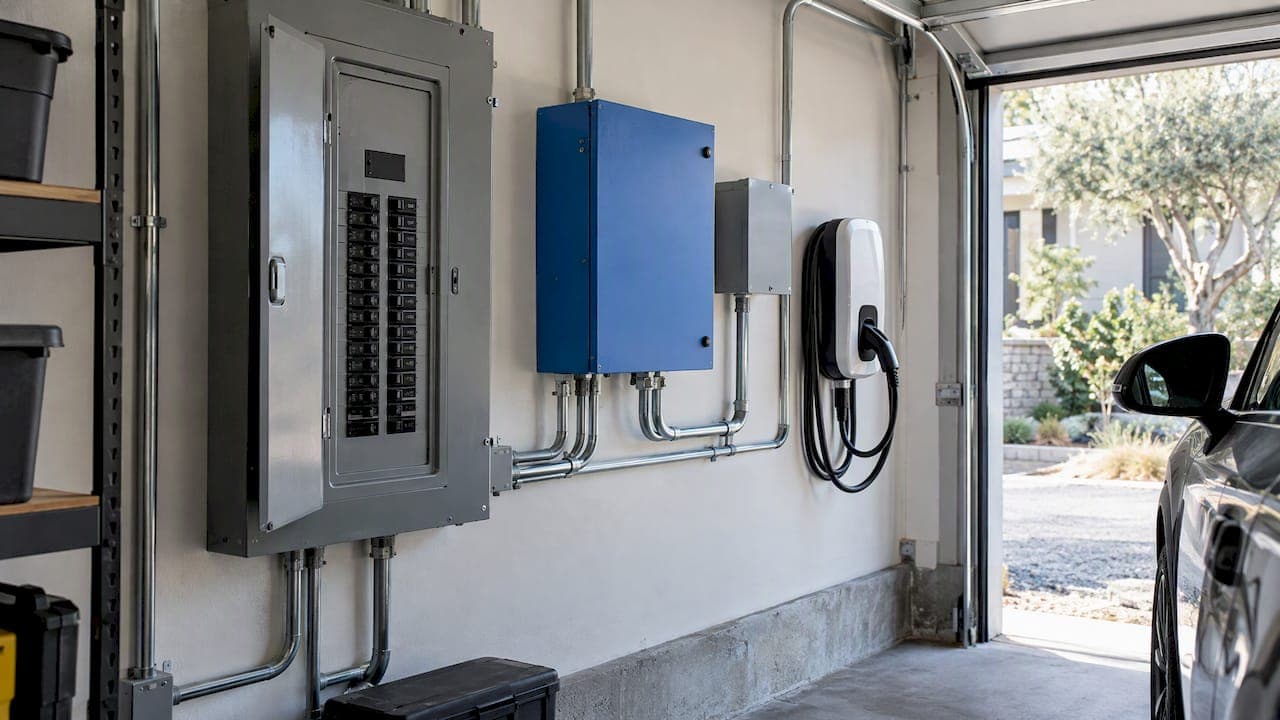
Home load management is the practice of controlling which large appliances run, and when, so your home never asks for more power than your electrical service, battery or generator can deliver. It can be as simple as a device that pauses an EV charger when the oven turns on. It can also be a full control system that sheds HVAC and water heating the moment you lose the grid. This guide covers the hardware options, rough costs, the code context, and how load management changes once you add batteries and generation.
TL;DR
- Load management keeps total demand under a limit: your panel rating, your inverter's output, or your battery's capacity.
- Hardware falls into three tiers: branch circuit switching, load pausing devices, and whole-home smart panels. The right tier depends on how many circuits you need to control.
- Done well, it can avoid a costly service upgrade when you add an EV charger, heat pump or other big load.
- With batteries and generators, it is what keeps a backup system from tripping during an outage.
- Map critical loads separately from deferrable loads at the design stage. It simplifies everything after.
Table of Contents
- What home load management actually does
- The three hardware tiers
- Load management and the code
- Costs: what to budget
- When load management is the whole point: batteries, solar and generators
- Load management for EV charging
- Load management and utility programs
- Our perspective
- Where Prime Microgrid fits
- How to start: a five-step checklist
- Key takeaways
- FAQ
- Sources
What home load management actually does
Your home has a fixed amount of power it can draw at once. A 200-amp service, for example, sets a ceiling for the whole house. Most of the time you sit far below it. The problem is the overlap: the dryer, the oven, the heat pump and the EV charger all running together.
Load management solves the overlap. A monitor reads total demand, and a controller turns down or pauses selected loads when demand nears a threshold. The loads it pauses are the ones that tolerate delay. A car does not care if it finishes charging at 5 a.m. instead of 1 a.m. A water heater holds heat for hours.

Researchers at Colorado State University and the Department of Energy's Building America program describe the idea as a balance between asset flexibility and grid constraints. The best candidates are HVAC, electric water heaters and EV chargers, because they can store energy as heat, cold or battery charge. Scheduling them well lets a household avoid time-of-use and critical peak rate penalties without changing its routine.
Smart load control vs. intelligent load management
The two phrases overlap, and vendors use them loosely. Here is how we separate them:
- Smart load control is rule-based. When demand exceeds a set point, pause load X. When a signal arrives, shift load Y.
- Intelligent load management adds forecasting and learning. The controller knows your HVAC run times, the weather forecast, your rate schedule and your battery's state of charge, then coordinates everything together.
A review of the field in the journal Energies traces this shift from manual, time-based switching to automated, real-time demand response. The goal is reducing demand without the household noticing any change in comfort.
The three hardware tiers
Most residential load management hardware sorts into three groups. A homeowner's guide from West Vancouver, Canada lays out the same tiers and gives base-level hardware prices. Those figures come from a Canadian municipality, so treat them as a rough scale, not a U.S. quote. They also exclude labor, permitting and site wiring.
| Tier | What it does | Typical starting hardware price (per the guide) | Best for |
|---|---|---|---|
| Branch circuit switching | Lets two loads share one circuit, so only one runs at a time | Around $700 | A single added load, such as an EV charger sharing with a dryer |
| Load pausing device (such as a DCC) | Watches total panel demand and disconnects a load when it climbs too high | Around $850 | Adding one large load to a panel with limited headroom |
| Whole-home smart panel | Monitors and controls many circuits, and can integrate with storage and renewables | Highest tier, no single figure | Homes with several large loads, batteries or generators |
How a load pausing device works
A DCC (demand control charger) type device watches the main panel. According to the same guide, if total load passes 80% of the panel's capacity, it disconnects the EV charger until demand falls back to a safe level. That behavior is why many electricians suggest trying load control before paying for a full service upgrade, which can run into the thousands and sometimes involves utility-side excavation.
What a smart panel adds
A smart panel replaces the breaker box with one that meters and switches every circuit. That gives you circuit-level data, remote control and the ability to rank loads by priority. A Department of Energy and NREL project on a smart panel-based home energy management system reported simulated daily savings of up to 10.4% in energy and 44.4% in energy cost on summer days. Those were performance targets analyzed in simulation, not guaranteed results for any particular house. The cost figure is high because the system shifts load away from expensive peak periods, not because it uses much less energy overall.
For a general contractor's view of what smart home upgrades involve on the construction side, this smart home installation overview is a useful read before you talk to an electrician.
Load management and the code
Homeowners often assume that adding an EV charger or heat pump automatically forces a bigger service. It does not always. Load calculations in the National Electrical Code decide what is required, and recent editions give engineers more room to use control systems.
The NFPA's summary of what changed in the 2026 NEC notes that Article 120 now covers load calculations, and that the general lighting and receptacle allowance for dwellings dropped from 3 VA to 2 VA per square foot. That does not remove the need to manage large added loads. It does mean calculations are done differently than they were a few years ago, so ask your electrician or engineer which code edition your jurisdiction has adopted. Local adoption varies, and the local authority having jurisdiction has the final say.
Power control systems (PCS) are the other piece. They let an interconnected system limit how much current flows through conductors, busbars or services. Engineers can use that limit when sizing service capacity, as long as the control system is listed and installed to code. This is why a documented, engineered controller is different from a plug-in gadget.
Costs: what to budget
The hardware prices above are only part of the picture. A realistic budget includes:
- The device or panel. Tier-dependent, as shown in the table.
- Electrician labor. Depends on panel location, wiring distance and condition of existing equipment.
- Permit and inspection. Varies by jurisdiction.
- Load calculation or engineering review. Often the step that prevents an undersized or oversized solution.
- Any integration work. Connecting to solar, batteries, a generator or an EV charger adds scope.
One installer-published guide puts a typical panel upgrade for an EV charger at $2,000 to $4,500, and says load management devices can sometimes avoid that cost. Treat it as a ballpark, since we cannot verify it against your service. Get a written load calculation before deciding which route is cheaper.
Pro Tip: Ask for the calculated load with and without management. The difference between those two numbers is the real value of the system. If the gap is small, you may not need active control at all.
When load management is the whole point: batteries, solar and generators
For a home with storage or backup generation, load management stops being a convenience and becomes a safety layer.
A battery and inverter have a maximum continuous output and a finite amount of stored energy. A whole house on the grid has effectively no such limit. When the grid drops and the home goes into island mode, the inverter suddenly carries everything that is still switched on. Starting an air conditioner compressor, a well pump and an electric water heater at once can trip the inverter or pull the battery down hard.

A Department of Energy briefing on microgrids and resilience hardware notes that specialized hardware can move from grid-tied to islanded operation in as little as 22 milliseconds. In that window, automatically shedding non-essential loads like HVAC or electric water heating protects the inverter and the battery from the full property load hitting at once.
Critical loads vs. deferrable loads
The simplest design habit is to sort every load into one of three groups before choosing any hardware:
- Critical: refrigeration, well pump, sump pump, medical equipment, lighting, communications, a furnace blower.
- Deferrable: water heater, EV charger, pool pump, dryer, dishwasher.
- Optional: a guest house, a second HVAC zone, workshop equipment.
Put critical circuits on a dedicated sub-panel and the control logic gets much simpler. Deferrable loads run when there is surplus. Optional loads only run when the system has plenty of margin. We cover which circuits matter most in our guide to critical home systems to power off-grid.
Making the most of onsite generation
Intelligent control also improves what you get from solar. A 2026 study of an intelligent load management framework found that combining forecasting with real-time control improved occupant comfort by 30% and raised renewable energy utilization by 18 percentage points. It is a modeling study, so results in your home will differ. The direction is still useful: controllers that know when the sun will shine can run the pool pump or pre-cool the house with energy that would otherwise be exported or wasted.
If you already own solar and want storage, our pages on residential battery storage and the guide to how solar integrates with storage explain where the controls fit.
Load management for EV charging
EV charging is the most common reason people search for this topic. A Level 2 charger can draw a large share of a panel's capacity for hours. Options, from least to most capable:
- A circuit-sharing switch so the charger and a dryer never run together.
- A load pausing device that watches the whole panel.
- A charger with built-in dynamic load balancing.
- A smart panel or site controller that prioritizes the charger against everything else.
For multi-vehicle properties and larger sites, see our post on EV charger load management.
Load management and utility programs
Controlled loads can also earn money or lower bills. Time-of-use rates reward shifting consumption, and some utilities pay for devices that reduce demand during grid peaks. Availability depends entirely on your utility and state. Our explainer on demand response programs covers how devices earn payments and what to check before enrolling.
Our perspective
We design microgrids for estates, rural properties and large homes, and load management is where most projects are won or lost. Here is our honest take.
First, a generic package rarely fits. A property with a well, a pool, a guest house and two HVAC systems has a very different demand profile from a standard suburban home. We size and program controls around the property's actual electrical demand and site conditions, and every design is reviewed by engineers.
Second, load management belongs inside the design, not bolted on afterward. When generation, battery, generator and controls are engineered as one system, you decide up front what stays on, what waits and what shuts off. That is far easier than retrofitting logic around hardware chosen separately.
Third, control should be automatic. During a storm you should not be walking to a panel to flip breakers. The system should shed and restore loads on its own, and tell you what it did.
Finally, we keep the process private. We do not use generic packages and we do not sell client information.
— Prime Microgrid
Where Prime Microgrid fits
If you are adding batteries, a generator or EV charging to a large or complex property, we can design the load management as part of the whole system, from engineering through installation and commissioning. Our Estate Microgrid, Battery Retrofit, Hybrid Generator and Off-Grid systems are each built around the property's real loads. If you already have solar and want smarter control, take a look at our AI-managed home energy approach, or read about backup power for large homes.
How to start: a five-step checklist
- List your large loads: HVAC, water heater, well pump, pool, EV charger, dryer, range, outbuildings.
- Get your service size and a load calculation from a licensed electrician or engineer.
- Sort loads into critical, deferrable and optional.
- Pick the lightest tier that solves the problem: circuit sharing, a load pausing device or a smart panel.
- Plan for what comes next. If batteries, solar or a generator are likely within a few years, choose controls that can integrate with them now.
Key takeaways
- Load management limits peak demand so you can add big loads without overloading your service.
- Hardware ranges from simple circuit sharing to whole-home smart panels. More circuits to control means a higher tier.
- Code context is shifting, but a calculated, documented approach still matters. Confirm the adopted code with your local inspector.
- With a battery or generator, load shedding protects the inverter and keeps critical circuits running.
FAQ
How much does a home load management device cost?
A West Vancouver homeowner's guide lists base hardware starting around $700 for branch circuit switching and $850 for a load pausing device, with smart panels at the top tier. Those are Canadian municipal figures and exclude labor and permits. Get a local electrician's quote for your actual cost.
How do I calculate the electrical load of my house?
An electrician or engineer follows the National Electrical Code's load calculation method, which adds up lighting, receptacles, fixed appliances and large loads by set rules. Code editions differ between jurisdictions, so the result should come from a licensed professional who knows your local rules.
Do I need load management on my EV charger?
Only if your panel lacks headroom. A load calculation shows whether it does. If the numbers are tight, a load pausing device or smart panel can be cheaper than a service upgrade.
Does load management matter if I have a battery or generator?
Yes. In an outage, the inverter or generator has to carry whatever is still switched on. Automatic shedding of non-essential loads like HVAC and water heating prevents trips and protects the battery from the initial surge.
Sources
- The Homeowner's Guide to Electrical Load Management, West Vancouver
- Smart Electrical Panel-Based Home Energy Management System, DOE/NREL 2023 peer review
- Microgrids, SmartGrids, and Resilience Hardware 101, U.S. Department of Energy
- What Changed in the 2026 NEC?, NFPA
- Electric Energy Management in the Smart Home, Building America
- Controllable Load Management Approaches in Smart Grids, Energies
- An Optimization Framework for Intelligent Load Management, MDPI