
Demand response programs let utilities and grid operators pay homes and businesses to reduce or shift electricity use during periods of high demand, in exchange for bill credits or direct payments. Enrollment is voluntary, and most programs build in opt-out options for events that come at a bad time. With distributed energy resources and new market rules opening up, the opportunities for participants are only expanding.
TL;DR:
- Most residential demand response programs are low-cost for consumers, with utility subsidies often covering device costs and limited comfort trade-offs.
- Devices like smart thermostats, heat pump water heaters, and smart EV chargers can respond automatically to grid signals, with opt-out options reducing participation barriers.
- Enrolled households typically experience very low opt-out rates, around 4%, indicating most participants barely notice when events occur.
- Commercial programs focus on capacity reductions and can involve automation systems that manage HVAC, lighting, or generators during high-demand periods.
- Site-scale systems with proper controls can participate in demand response and virtual power plant programs, unlocking additional revenue streams beyond backup power functions.
Table of Contents
- What demand response actually means
- How a demand response event actually unfolds
- Common residential demand response programs and devices
- Commercial and large-customer demand response programs
- Incentives, costs, and what to expect financially
- How to enroll and what to ask first
- Where policy is headed: Order No. 2222 and virtual power plants
- Where site-scale systems fit into demand response
- A turnkey path to resilience and demand response value
- Authoritative resources and primary sources
- Sources
- FAQ
What demand response actually means
Demand response is different from energy efficiency. Efficiency permanently lowers how much power a device or building needs. Demand response is a short-term, voluntary decrease in consumption triggered by grid conditions or price signals, according to the Department of Energy, and it happens on demand rather than around the clock.
A few terms come up in almost every program. A DR event is the specific window when a utility asks participants to cut back. Your baseline is the estimate of what you would have used without the event, used to calculate savings or payments. An aggregator bundles many small participants into one resource large enough to sell into wholesale or utility programs. Programs are either opt-in, where you choose to join and can typically decline individual events, or opt-out, where you're enrolled by default with a way to exit.
Utilities run these programs because avoiding a single hour of extreme peak demand is often cheaper than building a new power plant to cover it.

How a demand response event actually unfolds
Events are usually triggered by grid stress: extreme heat, a generation shortfall, or wholesale prices spiking. A utility or grid operator sends a signal, sometimes hours ahead, sometimes with almost no warning, and that signal reaches participants through one of two paths.
Direct load control lets the utility or aggregator briefly adjust a device itself, cycling an air conditioner's compressor or pausing a water heater's heating element for a set window. Price-based programs instead notify you of a temporary rate change and leave the response up to you or your automated devices. Many smart thermostats, water heaters, and EV chargers can respond to either signal without you touching a switch.

Utilities verify that reductions actually happened through measurement and verification, comparing real usage against your baseline to confirm and pay out savings. This is also where opt-out and override options matter: most residential programs let you back out of a specific event, often through an app, without losing your enrollment. A field validation study on heat pump water heaters found meaningful peak reduction with an opt-out rate around 4%, suggesting most participants barely notice when a program is well designed.
Common residential demand response programs and devices
Homeowners typically encounter a handful of program structures. Direct load control programs cycle air conditioners or water heaters during peak hours in exchange for a seasonal credit. Peak-time rebate programs pay you for usage below your baseline during an event, with no penalty if you don't respond. Critical peak pricing and time-of-use programs raise rates during set peak windows, rewarding anyone who shifts usage to cheaper hours. Smart thermostat programs are their own category, letting the utility make small temperature adjustments you can override.
The devices that make participation easy:
- Smart thermostats that accept temperature setbacks during events.
- Grid-enabled heat pump water heaters that pause or shift heating cycles.
- Smart EV chargers that delay charging until off-peak hours.
- Behind-the-meter batteries that discharge to cover load during an event instead of drawing from the grid.
Pro Tip: Check whether your utility's thermostat program is opt-in or opt-out before enrolling. Opt-out programs pay less per event but rarely require you to lift a finger.
Commercial and large-customer demand response programs
Business customers see a different set of structures, usually tied to how much load they can reliably shed. Capacity bidding programs commit a business to a guaranteed reduction during any called event, in exchange for a standing payment. Emergency load reduction programs activate only during genuine grid emergencies and pay per event. Peak day pricing raises rates on a limited number of high-cost days each year, and larger customers can also bid demand reductions directly into wholesale markets through a curtailment service provider.
Payment structures follow the program type: capacity payments for standing by, curtailment payments for actual reductions, and bill credits for shifting usage patterns. Coordination usually runs through building automation systems, onsite generation, or industrial process scheduling, since commercial curtailment often means adjusting HVAC setpoints, dimming non-critical lighting, or temporarily running a backup generator rather than one device flipping off.
Incentives, costs, and what to expect financially
Payments come in several forms: bill credits applied automatically, per-event payments for verified reductions, discounted time-of-use rates, or a flat annual payment just for enrolling. What you actually receive depends heavily on your utility, your region's market rules, and the specific program, so treat any number you see elsewhere as a starting point for research rather than a guarantee.
Costs on your side are usually modest. Expect a possible smart thermostat or controller purchase, occasional comfort adjustments during an event, and a data-sharing arrangement that lets your utility or aggregator see your usage patterns.
- Device costs are often subsidized or free through utility rebate programs.
- Comfort trade-offs are typically limited to a few degrees of thermostat setback or a delayed appliance cycle.
- Data sharing is usually limited to usage and event-response data, not personal information.
Field pilots have found opt-out rates near 4% for well-designed heat pump water heater programs, meaning most enrolled households simply let the program run. Beyond individual payments, demand response reduces the need for expensive peaking plants and new transmission infrastructure. This is a benefit the Department of Energy ties directly to lower system-wide costs.
How to enroll and what to ask first
Start with your utility's account portal, which typically lists every program you're eligible for. State energy offices and aggregator marketing offers are the other common entry points, especially for commercial capacity programs.
- Check eligibility, since some programs require specific equipment or a minimum load size.
- Confirm your devices are compatible, or ask whether the utility provides a qualifying thermostat or controller.
- Review and sign the program's consent terms, including data sharing.
- Complete installation or activation, if a new device is involved.
- Let the baseline period run so your usage pattern is established before events begin.
Before signing anything, ask when payments arrive, how many events to expect per season, exactly how to opt out of a single event, what data gets shared and with whom, and whether any installed equipment carries a warranty separate from the program itself.
Where policy is headed: Order No. 2222 and virtual power plants
FERC's Order No. 2222 opens wholesale electricity markets to aggregations of distributed energy resources, meaning batteries, smart water heaters, EV chargers, and other devices can be grouped together and sold as a single resource, according to FERC's own explainer. That is the technical foundation behind the growing interest in virtual power plants.
The order also includes rules against duplicate compensation, so a device already earning a retail utility payment generally can't collect a second, separate payment for the same reduction in a wholesale market. For homeowners and businesses with batteries or generation, the practical takeaway is that new revenue paths are opening, but they require real coordination between your utility and any aggregator, along with metering and communications that meet the market operator's requirements.
Where site-scale systems fit into demand response
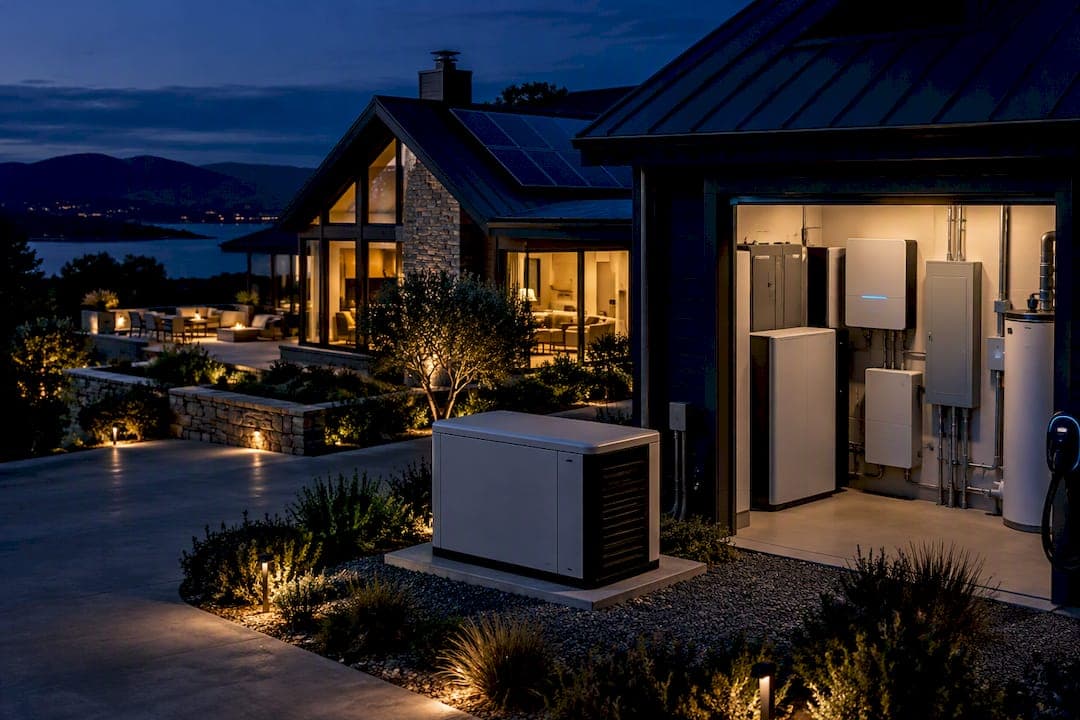
Battery storage, smart controls, and onsite generation don't just back up a property during an outage. When they're integrated with the right communications and metering, they can also respond to DR events and, increasingly, virtual power plant programs. A property with battery storage already sized for backup power has a head start, since the same hardware that rides out a grid outage can also discharge during a peak event instead of drawing from the grid. The prerequisite is controls that can actually receive and act on a dispatch signal, not just a battery sitting idle in a closet.
— Prime Microgrid
A turnkey path to resilience and demand response value
If you're weighing a smart thermostat against a full property-scale system, the difference is scope: a thermostat shifts one device, while a properly integrated microgrid can shift or shed load across your entire property and still keep the lights on during an outage. Systems can be designed around a property's actual electrical demand rather than a generic package, combining generation, storage, and controls into one coordinated setup.

- Estate Microgrid Systems and Battery Retrofit Systems built around a site's load profile.
- Controls and utility-grid integration designed with DR and VPP participation in mind.
- Engineering review at every stage, with no generic packages and no selling of customer data.
Explore Prime Microgrid's systems or start a conversation through Prime Microgrid to see what a custom-engineered system could look like on your property.
Authoritative resources and primary sources
- FERC Order No. 2222 explainer
- DOE: Demand response and time-variable pricing programs
- DOE: Heat pump water heaters and peak reduction
- DOE: Measured pathway homes program guidance
Sources
- FERC Order No. 2222 explainer: Facilitating participation in electricity markets by distributed energy
- Demand response and time-variable pricing programs | DOE
- Heat pump water heaters achieve significant peak reduction and energy savings | DOE
- Launching a measured pathway homes program (IRA Section 50121) | DOE
FAQ
Is demand response expensive to join?
Most residential programs cost little to nothing to join, since utilities often subsidize or provide the qualifying thermostat or controller. Any comfort trade-off is usually limited to a small, temporary temperature adjustment during an event.
What are examples of DERs?
Distributed energy resources include rooftop solar, battery storage, smart water heaters, EV chargers, and demand response itself, according to FERC's discussion of Order No. 2222. When grouped by an aggregator, these resources can provide grid services that a single utility-scale power plant would otherwise supply.
How do demand response programs work day to day?
A utility or grid operator sends a signal when the grid is stressed, either adjusting an enrolled device directly or raising prices temporarily to prompt a voluntary cutback. Usage is measured against your baseline afterward to confirm the reduction and calculate any payment.
What is a virtual power plant and how does it relate to demand response?
A virtual power plant aggregates many smaller resources like batteries, smart thermostats, and EV chargers so they act as one larger resource for the grid. FERC's Order No. 2222 is the rule that lets these aggregations participate directly in wholesale electricity markets, building on the same infrastructure used for traditional demand response.
Can batteries and site-scale systems participate in demand response?
Yes, when they include controls and communications capable of receiving a dispatch signal from a utility or aggregator. A system like those designed by Prime Microgrid can be engineered from the start with that participation in mind, alongside its role in backup power.