

Battery storage is defined as technology that captures electricity when prices are low and releases it when prices are high, directly reducing what homeowners pay on their utility bills. The role of battery storage in cost reduction works through three core mechanisms: price arbitrage using Time-of-Use (TOU) rates, demand charge management, and backup power that eliminates costly outage disruptions. Battery storage project costs have dropped 27% year-on-year globally, making residential systems more financially accessible than ever. For homeowners evaluating energy independence, this technology is no longer just a resilience tool. It is a financial asset.
How does battery storage reduce energy costs for homeowners?
Battery storage creates savings by shifting when you consume electricity, not necessarily how much you consume. The financial mechanics are straightforward once you understand how utilities price power.
Price arbitrage with TOU rates is the most direct savings mechanism. Under TOU pricing, utilities charge significantly more during peak hours, typically late afternoon through evening, and less during overnight or midday hours. A battery charges during the cheap window and discharges during the expensive one, so you draw from stored power instead of paying peak rates. Pairing batteries with solar panels amplifies this effect: your panels charge the battery for free during the day, and you discharge at peak evening rates, maximizing the spread between cost and value.

Demand charge reduction applies to homeowners whose utilities bill based on peak usage intervals, not just total consumption. A battery discharges specifically during your highest-draw moments, flattening that spike. Demand charge savings can reach hundreds of dollars annually without reducing total kilowatt-hour consumption at all. This is a counterintuitive but powerful benefit that most homeowners overlook entirely.
Price suppression is a system-level effect worth understanding. When large numbers of batteries discharge during peak demand, they reduce the need for expensive grid power, which lowers wholesale electricity prices for everyone. In Great Britain, batteries saved consumers £188 million between December 2024 and April 2026 through peak displacement and grid balancing. That figure equals the annual energy bills of 115,000 households, which shows how individual battery decisions aggregate into real system-wide savings.
Backup power carries financial value that rarely appears in ROI calculators. A single extended outage can cost a homeowner thousands of dollars in spoiled food, hotel stays, lost remote work hours, or sump pump failures. A battery that prevents even one serious outage per year can meaningfully shorten its effective payback period.
Pro Tip: Before buying a battery, pull your last 12 months of utility bills and identify your peak usage hours. If your utility offers TOU rates, calculate the price spread between peak and off-peak. A spread above $0.10 per kWh generally makes battery arbitrage financially worthwhile.
What do residential battery systems cost in 2026?
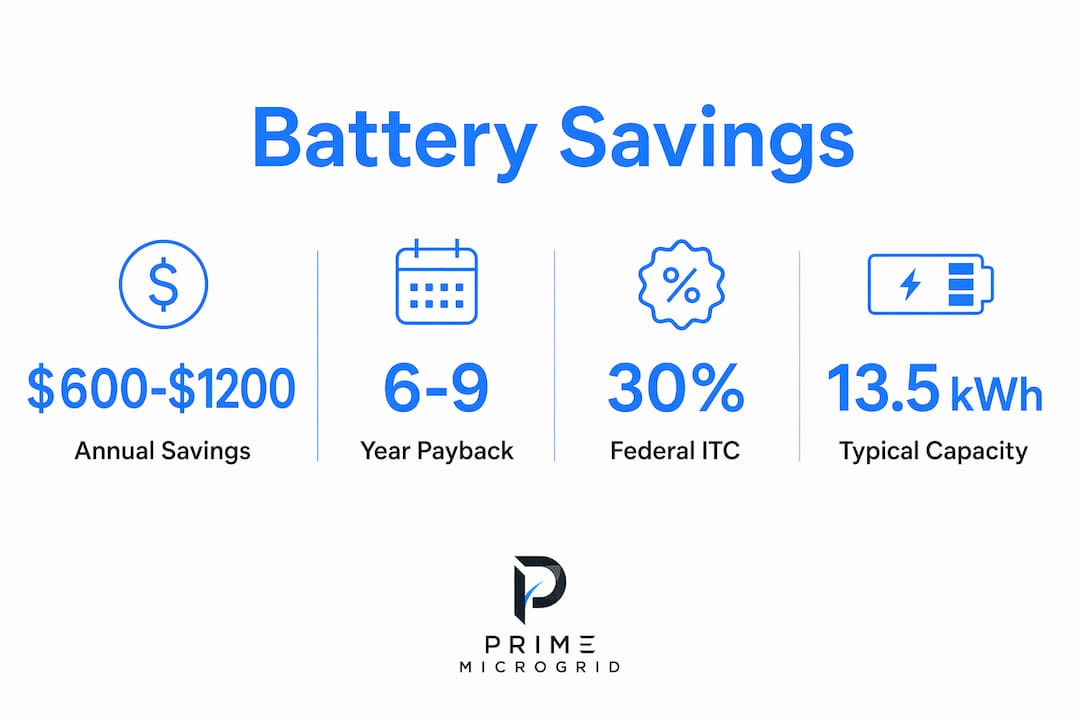
A typical 13.5 kWh home battery system, the size of a Tesla Powerwall or similar unit, costs $13,500 to $15,228 installed before incentives. That is the baseline number to work from.
The federal Investment Tax Credit (ITC) reduces that cost by 30% for systems paired with solar, bringing a $14,000 system down to roughly $9,800 out of pocket. Several states layer additional rebates on top. California's SGIP program, Massachusetts' ConnectedSolutions, and New York's Con Edison battery incentive program all provide cash rebates that can cut thousands more from the net cost. The actual price you pay depends heavily on where you live and which programs you qualify for.
| Rate structure | Typical payback period | Key driver |
|---|---|---|
| TOU with high peak rates | 6 to 9 years | Strong arbitrage spread |
| California NEM 3.0 | 7 to 9 years | Reduced solar export value |
| Flat rate with no demand charges | 12 to 18 years | Limited arbitrage opportunity |
| 1:1 net metering states | 14 to 18 years | Full retail credit reduces battery need |
Battery payback periods vary this dramatically because the savings depend entirely on local rate design. A homeowner in a flat-rate state with 1:1 net metering has little financial reason to arbitrage. A homeowner in California under NEM 3.0, where solar export rates dropped sharply, has a strong reason to store and self-consume.
Financing matters too. Paying cash produces the cleanest ROI calculation. A loan at 7% interest adds roughly $1,000 to $1,500 in annual carrying costs on a $14,000 system, which can push effective payback beyond 10 years even in favorable rate environments. Cash buyers in TOU markets consistently see the shortest payback timelines.
Pro Tip: Use EnergySage's battery calculator or your utility's own rate analysis tool to model your specific scenario. Input your actual peak usage hours and current rate schedule, not national averages. The difference between a 7-year and a 14-year payback often comes down to one or two rate design details.
How do utility rate structures affect your battery savings?
Rate design is the single biggest variable in battery economics, and most homeowners do not know which structure their utility uses until they look it up.
Flat rates charge the same price per kilowatt-hour regardless of when you use power. Batteries provide minimal arbitrage value here because there is no price spread to exploit. The only financial benefit comes from backup power and any demand charges that apply.
Traditional 1:1 net metering credits solar exports at the full retail rate, which means your solar panels already handle peak cost management effectively. Adding a battery on top provides resilience but limited additional savings. States like New Jersey and Massachusetts still offer generous net metering, which is good for solar economics but reduces the incremental value of storage.
TOU rates create the conditions where batteries perform best. Pacific Gas and Electric (PG&E) in California charges peak rates that can run two to three times higher than off-peak rates. Arizona Public Service (APS) and Salt River Project (SRP) in Arizona both offer TOU structures with meaningful spreads. In these markets, a battery that charges overnight and discharges during the 4 to 9 PM peak window can save $600 to $1,200 annually on a typical home.
Demand charges are most common in commercial billing but appear in some residential rate structures in states like Arizona, Hawaii, and parts of the Southeast. These charges bill based on your highest 15-minute or 30-minute usage interval during the month. A battery that targets those specific intervals, running the dishwasher and EV charger at different times while the battery covers the gap, can eliminate demand charges almost entirely.
The practical takeaway: check your utility's rate options before purchasing a battery. Many utilities offer TOU rates as an opt-in program, and switching to TOU before installing a battery can dramatically improve your financial return. You can explore how solar integrates with storage to understand how rate structure and system design interact.
What benefits does battery storage provide beyond direct savings?
The financial case for batteries extends well past monthly bill reductions. Several additional value streams deserve a place in your cost-benefit analysis.
- Grid resilience and outage protection. A battery keeps your critical loads running during outages. For homeowners with medical equipment, home offices, or properties in storm-prone regions, this is not a luxury. It is a practical necessity. Backup power for larger homes requires careful system sizing, but even a single battery can protect refrigerators, lighting, and communication devices for 12 to 24 hours.
- Virtual power plant (VPP) participation. Utilities and grid operators increasingly pay homeowners to make their batteries available for grid support. Programs like Sunrun's VPP in California, Green Mountain Power's program in Vermont, and various demand response programs pay cash or bill credits for grid services. Consumers joining utility programs can earn meaningful payments that further shorten payback periods.
- Renewable energy integration. Batteries allow you to capture and use more of your own solar generation instead of exporting it at low rates. This increases your self-consumption ratio, which is the percentage of solar power you use directly, and reduces grid dependence. In markets where export rates have dropped, this self-consumption value is now the primary financial driver for adding storage to an existing solar system.
- Long-term grid cost reduction. Long-duration battery storage replacing gas-fired peaking plants can save utilities the equivalent of €166 million annually in system operating costs. Those savings flow downstream to ratepayers over time, meaning widespread battery adoption benefits even homeowners who do not own a battery.
- Environmental value. Batteries reduce reliance on fossil-fuel peaking plants, which are the dirtiest and most expensive generators on the grid. Every kilowatt-hour discharged from a home battery during peak demand displaces power that would otherwise come from a gas turbine running at maximum cost.
Key takeaways
Battery storage reduces energy costs most effectively when paired with solar and TOU utility rates, making local rate structure the first thing every homeowner should evaluate before investing.
| Point | Details |
|---|---|
| Price arbitrage drives savings | Charging off-peak and discharging at peak rates saves $600 to $1,200 annually in TOU markets. |
| Installed cost before incentives | A 13.5 kWh system runs $13,500 to $15,228; the 30% federal ITC cuts that significantly. |
| Rate structure determines payback | TOU markets yield 6 to 9 year paybacks; flat-rate or 1:1 net metering markets can reach 14 to 18 years. |
| Demand charges are an overlooked win | Batteries flatten peak usage spikes, saving hundreds annually without reducing total consumption. |
| VPP programs add income | Utility demand response and virtual power plant programs pay homeowners for grid support services. |
What I've learned about making batteries actually pay off
I have worked with enough homeowners to know that the biggest mistake people make is buying a battery for the wrong reason. They buy it for backup power, which is a legitimate goal, but they do not run the financial numbers first. Then they are surprised when the payback period stretches past a decade.
The homeowners who get the best returns treat their battery as a financial instrument first and a resilience tool second. They switch to TOU rates before installation. They pair storage with solar so the battery charges for free during the day. They enroll in every available demand response or VPP program their utility offers. These are not complicated steps, but they require doing the homework upfront.
The one thing I consistently tell people: do not assume your current rate structure is the best one available. Many utilities offer TOU as an opt-in option that most customers never select. Switching to TOU, then installing a battery sized to your actual peak usage, is the sequence that produces the shortest payback. Buying a battery first and hoping the economics work out is the sequence that produces disappointment.
I also think the backup power value is genuinely underweighted in most ROI analyses. If you live in a region with frequent outages, or if you work from home, or if you have medical equipment that cannot lose power, the financial value of avoiding even two or three outages per year is real money. Build that into your calculation honestly. You can review whether battery backup alone is enough for your home's needs before committing to a system size.
The market fundamentals are moving in the right direction. Battery costs have dropped 27% year-on-year, incentives remain strong through at least 2032 under current federal policy, and utilities are actively creating new programs that pay battery owners for grid services. The financial case for residential storage has never been stronger for homeowners in the right markets.
— David
See how Primemicrogrid designs battery systems for your home

Primemicrogrid builds residential battery storage and microgrid systems designed around your specific utility rates, usage patterns, and resilience goals. Every system is sized and configured for your property, not pulled from a catalog. Whether you want to cut peak demand charges, maximize solar self-consumption, or build whole-home backup power, Primemicrogrid engineers the right combination of storage, controls, and grid integration to deliver real financial returns. Explore residential microgrid options for Mid-Atlantic homeowners, or compare microgrid versus generator solutions to understand which approach fits your budget and backup requirements. Contact Primemicrogrid for a customized assessment and incentive analysis.
FAQ
How much can a home battery system save per year?
In TOU rate markets, a properly sized home battery saves $600 to $1,200 annually through peak arbitrage alone. Demand charge reduction and VPP program payments can add several hundred dollars more depending on your utility and location.
What is the payback period for a residential battery in 2026?
Payback periods range from 6 to 9 years in TOU markets like California under NEM 3.0, and can extend to 14 to 18 years in states with flat rates or 1:1 net metering. The federal 30% tax credit applies to systems paired with solar and significantly shortens the timeline.
Does a battery storage system work without solar panels?
Yes, a battery can charge from the grid during off-peak hours and discharge during peak hours to reduce costs. However, pairing with solar produces the best financial returns because the battery charges for free during the day and discharges at peak rates in the evening.
Which utility rate structure benefits most from battery storage?
TOU rates with a large spread between peak and off-peak pricing produce the strongest battery savings. Demand charge structures, common in Arizona and Hawaii, also deliver strong returns. Flat-rate and 1:1 net metering structures offer the least financial benefit from battery arbitrage.
Can homeowners earn money from their battery by selling power back to the grid?
Yes, through virtual power plant programs and utility demand response enrollment, homeowners receive bill credits or direct payments for making battery capacity available during grid stress events. Programs like those offered by Green Mountain Power in Vermont and various California utilities pay meaningful amounts annually for this grid support service.