

Most homeowners shopping for a home energy storage system get lost comparing kilowatt-hours, brand names, and price tags. But there is one factor that determines how safe, how long-lasting, and how cost-effective your battery will actually be: the chemistry inside it. Understanding why battery chemistry matters for home storage is not a technical exercise. It shapes whether your system survives a decade of daily use or needs replacing in five years, whether your insurer raises your rates, and whether your local building inspector signs off without a fight.
Table of Contents
- Key takeaways
- Why battery chemistry matters in home storage
- How chemistry shapes performance and safety
- The real cost of your chemistry choice
- Regulations and safety standards you need to know
- Choosing the right chemistry for your home
- My honest take on chemistry in home storage
- How Primemicrogrid approaches battery chemistry
- FAQ
Key takeaways
| Point | Details |
|---|---|
| Chemistry drives safety | LFP batteries have a thermal runaway threshold nearly twice that of NMC, reducing fire risk in residential settings. |
| Cycle life varies dramatically | LFP delivers 6,000–10,000 cycles versus 1,000–3,000 for NMC, directly affecting how long your system lasts. |
| Lifecycle costs favor LFP | LFP systems can save 30–50% over 15 years compared to NMC by avoiding mid-life replacements. |
| Regulations now require more scrutiny | NFPA 855 mandates hazard mitigation analysis for nearly all residential batteries over 1 kWh as of 2026. |
| Match chemistry to your use case | Daily cycling, backup use, space constraints, and budget all point to different chemistry priorities. |
Why battery chemistry matters in home storage
When you hear "lithium battery," that phrase covers several entirely different chemistries with very different behaviors. Lithium Iron Phosphate, known as LFP, uses an olivine crystal structure for its cathode. That structure is chemically stable under heat and stress, which is why LFP has become the dominant choice for stationary storage. Nickel Manganese Cobalt, or NMC, uses a layered oxide cathode that packs more energy into a smaller space but behaves very differently when things go wrong.
Lead-acid batteries deserve a brief mention. They have been around for over a century, cost less upfront, and still show up in older backup systems and off-grid setups. Their cycle life tops out at around 300 to 600 cycles, which makes them a poor fit for daily cycling in a modern home storage application. If you are comparing home energy storage solutions today, lead-acid is mostly a legacy option.
Sodium-ion chemistry is emerging as a future contender, with lower material costs and good safety characteristics. It is not yet widely available at the residential scale, but watch for it over the next few years.
Here is a quick comparison of the main battery types for home storage:
| Chemistry | Cycle life | Safety profile | Relative cost (pack) | Best use case |
|---|---|---|---|---|
| LFP | 6,000–10,000 | Excellent | ~$81/kWh | Daily cycling, whole-home backup |
| NMC | 1,000–3,000 | Moderate | ~$128/kWh | Space-constrained installs |
| Lead-acid | 300–600 | Good (no thermal runaway) | Low upfront | Occasional backup only |
| Sodium-ion | TBD residential | Very good | Emerging | Future-proofing |
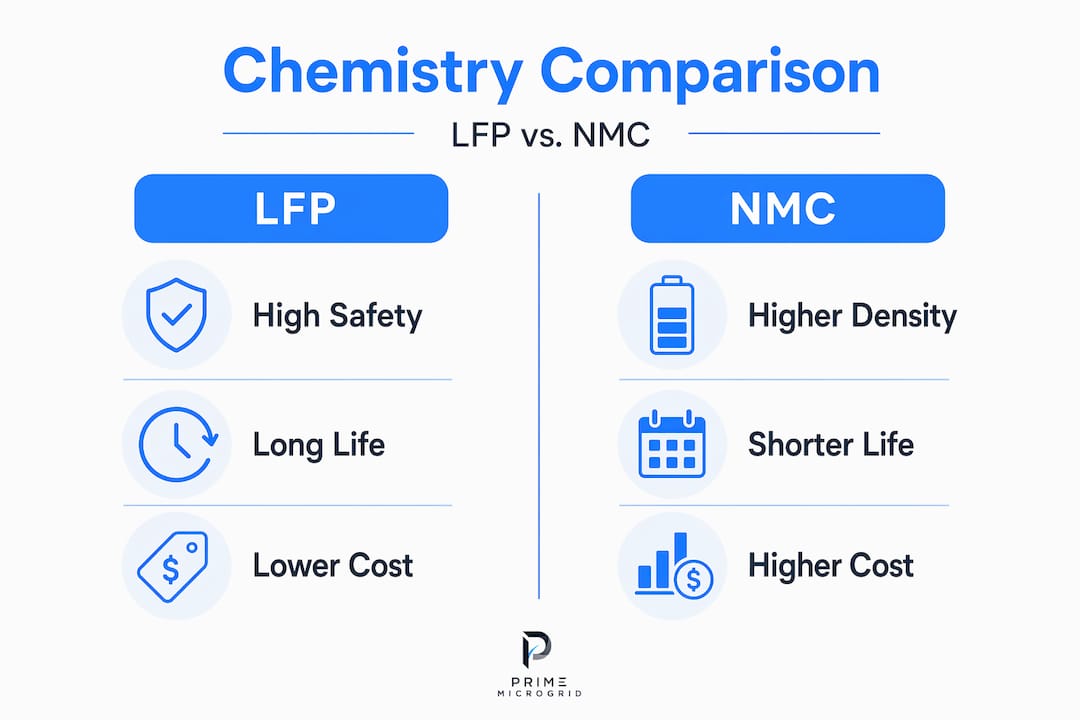
The key trade-offs are energy density, safety, and cost. NMC stores more energy per kilogram, which matters for electric vehicles where weight is critical. For a garage or utility room installation, that weight advantage is mostly irrelevant. Energy density advantages of NMC matter mainly for EVs, not home storage where space and weight constraints are modest.
How chemistry shapes performance and safety
Cycle life is the single most important performance number for a home battery. It tells you how many full charge-discharge cycles the battery can complete before it drops below usable capacity. LFP delivers 6,000–10,000 cycles at 80% depth of discharge, with a lifespan of 10 to 15 years. NMC manages 1,000 to 3,000 cycles. Lead-acid falls further behind at 300 to 600 cycles. If you cycle your battery once a day, an NMC system could be exhausted in under a decade. An LFP system keeps going.
Safety is where chemistry really separates itself. The thermal runaway threshold for LFP sits at 270 to 310 degrees Celsius, compared to 150 to 250 degrees Celsius for NMC. In plain terms, LFP needs to get much hotter before it enters a runaway reaction. That margin matters enormously when a battery is installed in a living space, attached garage, or utility room.

The structural reason behind this gap is worth knowing. NMC's layered oxide cathode releases oxygen during thermal runaway, which feeds the fire and makes it self-sustaining. LFP's olivine cathode does not release oxygen, which is why LFP fires are far less likely to propagate. This chemistry-level difference has real consequences for your home and your family.
Here is what the performance comparison looks like in practical terms:
- Capacity fade: LFP loses capacity more slowly over time, meaning you retain more usable storage after five or ten years of use.
- Temperature tolerance: LFP performs more reliably across a wider operating temperature range, which matters if your battery is in an unconditioned space.
- Depth of discharge: LFP handles deeper discharges without accelerating degradation, so you can actually use more of the rated capacity.
- Insurance implications: Some insurers now distinguish between battery chemistries when pricing residential policies, with LFP's safer fire profile often leading to lower premiums.
Pro Tip: Ask your battery installer to confirm the thermal runaway temperature of the chemistry they are proposing. Any reputable installer will know this number and be able to show you the relevant safety certifications.
The real cost of your chemistry choice
Upfront price is not the whole story. LFP pack prices averaged $81 per kWh in 2025 versus $128 per kWh for NMC, a difference of roughly 37 percent. When you multiply that across a 10 kWh or 20 kWh system, the savings add up fast before you even factor in lifespan.
The lifecycle cost picture is even more compelling. Consider how the numbers stack up over a 15-year horizon:
- Replacement intervals. An NMC system cycling daily may need replacement after 8 to 10 years. An LFP system in the same role often completes the full 15-year period without replacement, meaning you avoid the cost and hassle of a mid-life swap.
- Thermal management hardware. LFP requires simpler cooling and BMS hardware, reducing the overall system cost by 10 to 15 percent compared to NMC installations.
- Total lifecycle savings. LFP systems deliver 30 to 50 percent lower lifecycle costs than NMC over 15 years when you account for fewer replacements and simpler maintenance.
- Insurance. As noted above, LFP chemistry can reduce the risk profile of your system, which some insurers reward with lower premiums.
The wide adoption of LFP has also driven stationary storage pack prices down to $70 per kWh in 2025, a 45 percent drop from 2024. That price trend directly benefits homeowners who choose LFP today.
For property investors, the calculus is similar. A battery system that outlasts two NMC replacement cycles without additional capital outlay is a measurably better asset. It also reduces the carrying cost of maintaining backup power across multiple properties.
Regulations and safety standards you need to know
Chemistry affects more than your battery's performance. It affects whether you can get a permit and what your installation will look like. NFPA 855 now requires a hazard mitigation analysis for virtually all residential battery systems over 1 kWh, removing earlier energy exemptions that had simplified the process. That means more documentation, more engineering review, and in some cases, more spacing requirements.
LFP's superior safety profile does more than protect your home. It simplifies this process. Installers and inspectors familiar with LFP chemistry generally move through permitting more smoothly because the chemistry's known stability addresses many of the concerns the code is designed to manage.
Regardless of chemistry, a certified Battery Management System is non-negotiable. The BMS monitors cell temperature, voltage, and state of charge, cutting off charging or discharging when parameters go out of range. Proper BMS certification and installation standards are as important as the chemistry itself. Chemistry sets the ceiling for safety. The BMS and installation quality determine whether you actually reach it.
Pro Tip: Before signing any contract, ask your installer for documentation showing the battery system is listed to UL 9540 or an equivalent standard, and confirm the BMS is certified for the specific chemistry being installed. This documentation matters for permits, inspections, and insurance claims.
Choosing the right chemistry for your home
Now that you understand how battery chemistry affects performance, safety, and cost, here is how to translate that into a decision:
- If you cycle daily for solar self-consumption or time-of-use arbitrage, LFP is the clear choice. Its cycle life makes it purpose-built for this pattern, and the cost per cycle over a 15-year period is significantly lower than NMC.
- If you need a backup-only system that sits idle most of the time and activates during outages, LFP still wins for most homeowners because of safety and longer calendar life. A system that sits in a garage for years still needs to be safe.
- If space is genuinely tight, NMC's higher energy density may be worth considering. This is rare for home installations but can matter in certain retrofit scenarios. Explore solar battery vs. microgrid options if you are trying to fit storage into a constrained space.
- If you are a property investor managing multiple sites, standardize on LFP. Consistent chemistry simplifies maintenance contracts, reduces insurance complexity, and gives you predictable replacement schedules.
- If you are thinking about future-proofing, ask your installer about sodium-ion availability in your area. It is not yet mainstream, but it is coming.
For remote properties where outages are more frequent and grid reconnection is slow, the longevity and reliability of chemistry matters even more. The importance of battery chemistry for remote property energy storage becomes especially clear when a replacement battery is weeks away from delivery.
My honest take on chemistry in home storage
I have had hundreds of conversations with homeowners who came in focused entirely on brand names or kilowatt-hour capacity. Almost none of them asked about chemistry first. That is a problem, because the chemistry is the foundation everything else is built on.
Here is what I have learned from working through real installations: the homeowners who regret their battery decisions almost always bought on price alone, without accounting for cycle life or safety ratings. They end up with a system that fades faster than expected or creates headaches with their insurer. The chemistry conversation could have changed that outcome.
I will also push back on the idea that NMC is always the wrong call. In some space-constrained situations, it is a legitimate option. But for the vast majority of residential installations cycling daily with solar, LFP is not just a safe choice. It is the obvious one. The price gap, the safety margin, and the lifespan all point in the same direction.
What I tell every homeowner is this: do not let the upfront price number be the only number you see. Run the math over 15 years, factor in one potential replacement, and add in what you would pay for a system that makes permitting and insurance straightforward. The best battery chemistry for homes almost always comes out to LFP when you do that exercise honestly.
— David
How Primemicrogrid approaches battery chemistry
At Primemicrogrid, we design every home energy storage system around the chemistry that actually fits your situation, not the one that is cheapest to source or easiest to spec. That means we lead with LFP for the overwhelming majority of residential projects, because its safety record, cycle life, and total cost of ownership make it the right foundation for a system built to last. Whether you are a homeowner looking to cut utility costs, protect against outages, or build a whole-home backup solution, or a property investor managing multiple sites, the chemistry decision is one we take seriously on your behalf.
If you are in the Mid-Atlantic region, our residential microgrid solutions are designed with chemistry-first thinking, integrating battery storage, smart controls, and grid management into a system built around your real usage patterns and local regulatory requirements. Reach out to Primemicrogrid for a consultation and see what the right chemistry choice can do for your property.
FAQ
What is the best battery chemistry for home storage?
LFP (Lithium Iron Phosphate) is the best chemistry for most home storage applications due to its long cycle life, superior safety, and lower lifecycle cost compared to NMC or lead-acid options.
How does battery chemistry affect safety in a home installation?
Chemistry determines the thermal runaway threshold and whether a battery fire can self-sustain. LFP's olivine cathode does not release oxygen during thermal runaway, making it significantly safer than NMC in residential settings.
Why does cycle life matter when choosing a home battery?
Cycle life tells you how many charge-discharge cycles your battery can complete before losing significant capacity. LFP batteries last 6,000 to 10,000 cycles, meaning a daily-use system can serve you for 15 years without replacement.
Do battery chemistry choices affect permits and insurance?
Yes. NFPA 855 now requires hazard mitigation analysis for most residential batteries over 1 kWh, and some insurers price policies based on chemistry. LFP's safety profile generally simplifies both permitting and insurance conversations.
Is NMC ever the right choice for home energy storage?
NMC can make sense in space-constrained installations where energy density is a genuine constraint. For most homeowners cycling batteries daily, LFP delivers better value and safety over the life of the system.