
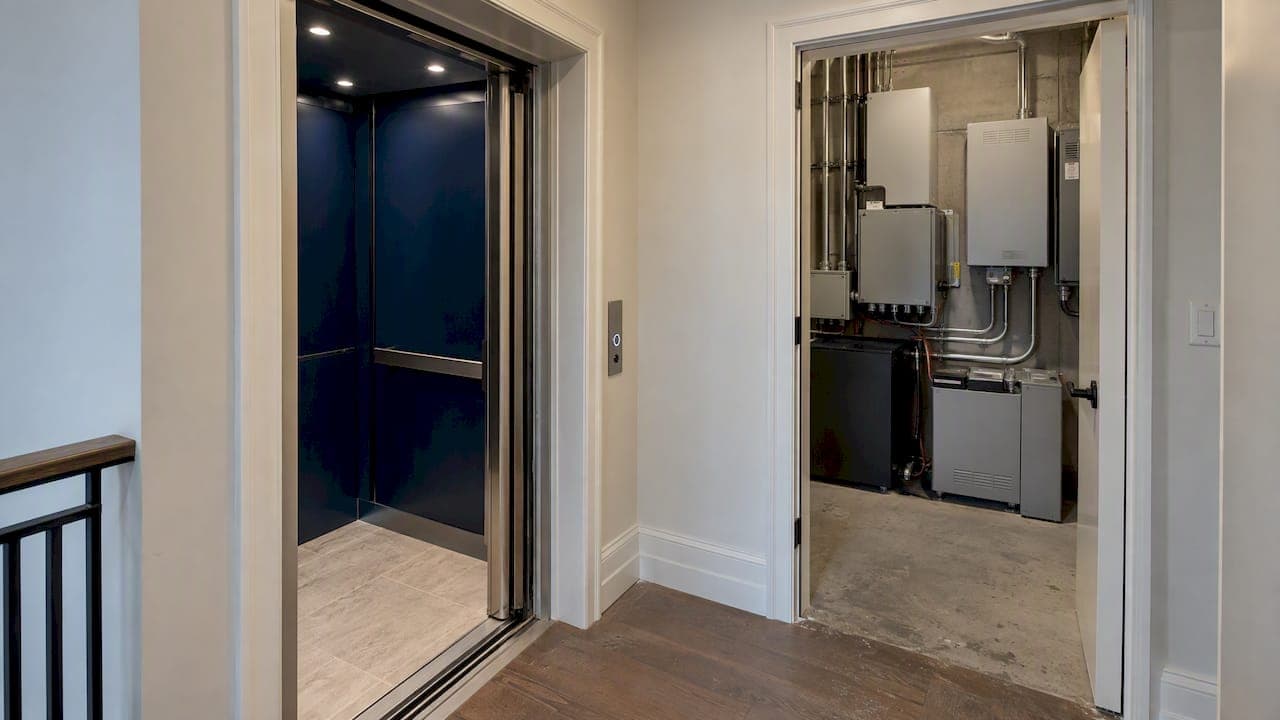
A home elevator can be made to work through an outage, but not with a generic battery or an undersized generator. Most residential elevators include a battery lowering device that brings the car to a landing so you can get out. Running the elevator for normal trips means a backup system engineered for the elevator's motor, controller and starting current. That system also has to carry the rest of your house at the same time.
This guide covers the three levels of elevator backup, what each one does, what goes wrong, and how to decide which level your home needs.
TL;DR
- Built-in battery lowering is for evacuation only. It gets passengers to a landing and opens the door. It is not meant for continued travel.
- A UPS built for the elevator's controller can add minutes of operation. One manufacturer's auxiliary supply is designed to bring the car to a landing and keep door power on.
- For ongoing use during long outages, the elevator needs a generator, battery or microgrid sized for starting current and clean power, with an automatic transfer switch.
- Plug-and-play backup for elevators effectively does not exist. Plan the elevator into the home's power design, ideally before it is installed.
Table of Contents
- What a home elevator does when the power goes out
- Three levels of elevator backup
- Why a generator alone is not enough
- What the codes say, and what they don't
- How to size backup power for a home elevator
- Generator, battery or hybrid: which fits an elevator
- Common mistakes
- Our perspective: treat the elevator as a critical load
- Plan the elevator into your home's power system
- Key takeaways
- FAQ
- Sources
What a home elevator does when the power goes out
The exact sequence depends on the drive type, the controller, the battery system and local code. Pollock Elevators explains that in many systems the brake engages when operating power is lost. A separate backup source may then power emergency lighting, communication equipment, controls and a controlled movement to a landing.
That distinction matters. Backup power for evacuation is a different job from backup power for use. Harmar notes that most home elevators rely on household electricity and will not keep operating normally in an outage, though many include a battery or emergency lowering system that moves the car to a safe landing.

If you or a family member depends on the elevator for mobility, "it will lower me to the first floor" is not the same as "I can use it for three days." Decide which one you need before you buy anything.
Three levels of elevator backup
| Level | What it does | Typical runtime | Best for |
|---|---|---|---|
| Battery lowering device | Moves the car to a landing, opens the door, powers emergency light and alarm | One trip | Safe exit when someone is inside |
| Elevator-specific UPS | Powers the controller and drive for a limited number of trips | 8 to 90 minutes depending on load, controller and battery | Short outages, bridging until a generator starts |
| Generator, battery or microgrid integration | Runs the elevator as one load on the home's backup system | Hours to days, depending on design | Mobility-dependent households, multi-story estates, long outages |
Level 1: Battery lowering
This is the baseline. Standard battery lowering devices are meant strictly for safety, getting passengers to the next floor and opening the doors, not for continued travel. Treat it as a safety feature, not as backup power.
Pro Tip: Ask the elevator manufacturer or installer for the specific emergency operation rating of your unit. A generic UPS spec sheet does not tell you whether the elevator's controller will accept that source.
Level 2: An elevator-specific UPS
A UPS configured for the elevator's motor and controller can extend operation. Nidec's runtime range of 8 to 90 minutes shows how wide the spread is. The same unit gives very different results with a heavy load, a different controller type or a smaller battery.
This level suits homes where outages are short and an elevator is a convenience. It is also a reasonable bridge: it holds the elevator up for the seconds or minutes a generator needs to start and transfer.
Level 3: Whole-property backup that includes the elevator
Where extended operation is required, systems must be custom-engineered. This is where a generator, battery bank or hybrid system takes over. The elevator becomes a designed load, with its own circuit, transfer logic and surge protection. The sections below explain what that design has to get right.
Why a generator alone is not enough
Building owners often assume a standby generator solves the problem. Elevator design guidance says otherwise: successful integration needs electrical coordination, including matching motor voltage, horsepower and fault current ratings. Four problems come up repeatedly.
1. Starting current
An elevator motor draws far more current when it starts than when it runs. If your backup system's surge capacity is not engineered for that, the elevator can trip the home's whole standby system, dropping other critical loads such as security, lighting or medical equipment.
The pattern is familiar if you have read about pumps. We covered the same math for sump pump backup power sized for startup surge and for well pump backup systems. An elevator is a larger motor with the same issue. Electricians sizing generators for elevators commonly work from NEC locked-rotor figures, as seen in this working discussion among electricians. In a home, the elevator's drive type changes the answer, so the manufacturer's data matters more than a rule of thumb.
2. Power quality
Many modern controllers are sensitive to waveform quality. A low-cost inverter or generator with poor output can cause controller errors. For a resilient residential system we specify clean, pure sine wave output and surge suppression at the elevator controller.
3. Controller lockout
The worst outcome is not simply losing power. Elevator specialists describe controller lockout: improper transfer or poor power quality trips the safety sensors and leaves the elevator in a dead state that a certified technician has to reset. Power is available, but the car will not move.
4. Transfer timing
When backup power is required for elevators in code-regulated buildings, power must transfer automatically to the backup source for each elevator and its associated systems, including lighting and ventilation for shafts and machine rooms. A single-family home usually isn't regulated that way, but the same logic is good practice. An automatic transfer switch, or a battery-based system that switches in milliseconds, avoids a manual step while someone may be inside the car.
What the codes say, and what they don't
Codes are written mainly for commercial and high-rise buildings. Standards Michigan summarizes that U.S. backup power rules for elevators and escalators are governed mainly by ASME, NFPA and the International Code Council. The 2018 International Building Code, Section 2702 covers emergency and standby power systems. UpCodes lists the requirement that each elevator required to have emergency power must be transferable to that supply. California adds its own layer: its Fire Code section 604.3 requires standby power, where required or furnished for an elevator, to follow Section 1203 and the California Building Code.
The practical point for homeowners is this. The rules that mandate standby power focus on high-rises and specific building types. Your private residence may have no mandate at all, and your local building department and elevator installer decide what applies. That puts the decision on you, which is why a clear plan matters.
How to size backup power for a home elevator
Here is the process we follow on a property with an elevator.
- Define the goal. Evacuation only, a few trips per outage, or full daily use for days.
- Collect the nameplate data. Motor horsepower, voltage, phase, drive type (hydraulic, traction, pneumatic, winding drum), controller model and whether it has a variable-frequency drive.
- Get the manufacturer's guidance. Ask for the emergency power requirements and the accepted backup sources in writing.
- Calculate starting and running load. Starting current sets the surge capacity you need. Running load plus trips per day sets the energy.
- Add the rest of the house. The elevator competes with HVAC, well pump, refrigeration, medical devices and communications. Look at the whole panel, not one load.
- Choose the architecture. Generator, battery, or a hybrid that uses the battery for instant transfer and surge and the generator for duration.
- Engineer the integration. Dedicated circuit, transfer logic, surge suppression, pure sine output, and a commissioning test with the elevator under load.
Pro Tip: Test the elevator on backup with the same loads running that you would have in a real outage. An elevator that starts fine on an idle backup system can trip it when the HVAC compressor and well pump are running.
Generator, battery or hybrid: which fits an elevator
- Generator only. Handles long outages if sized for the surge. Has a start-up gap, so the elevator sees an interruption unless a UPS bridges it. See our explanation of how whole-home generators work.
- Battery only. Instant transfer and strong surge capability when the inverter is sized for it. Duration is limited by stored energy, so a long outage with HVAC running can drain it. Our page on home battery backup covers the trade-offs, and whether battery backup is enough is worth reading if you have large loads.
- Hybrid. The battery takes the elevator's starting surge and holds the house during generator start. The generator recharges and carries long outages. For most estates with an elevator, this is the design we lean toward. Read what a hybrid backup power system is for the basics.
If you are weighing these types in general, the microgrid versus generator comparison lays out the differences, and our guide to evaluating home backup power options gives a decision framework.
Common mistakes
- Assuming the lowering battery is backup power. It evacuates; it does not provide service.
- Buying a generator by whole-house kW alone. The elevator's surge, not its running load, may set the size.
- Ignoring waveform. A cheap inverter source can lock out the controller.
- Putting the elevator on the main backup panel without load management. One start can drop critical loads. Load control and staged starting prevent that.
- Adding an elevator later without updating the backup design. If you are building or remodeling, include the elevator in the load study from the start.
- Skipping a loaded commissioning test.
Our perspective: treat the elevator as a critical load
We design backup power for large homes, estates and rural properties, and the elevator shows up on the same list as the well pump, medical equipment and HVAC: a load that decides whether the home is livable when the grid is down. My honest take is that elevators are the most overlooked large load in residential backup planning. People spend weeks on battery brands and then discover the elevator manufacturer will not support their chosen source.

Our approach is to start from the property's actual electrical demand and site conditions, not from a package. We integrate generation, battery, generator and controls into one system, and our engineers review every design. For an elevator, that means we ask for the controller data early, size the surge capacity for the starting current, specify clean output and surge suppression, and test under real load at commissioning. We do not use generic packages, and we do not sell client information.
One limit we state plainly: we are not the elevator manufacturer or the certified elevator technician. Your elevator company stays responsible for the elevator and for any controller reset. We make sure the power it receives is the kind it was built for.
— Prime Microgrid
Plan the elevator into your home's power system
If your home has an elevator, or you are adding one, our System Design and Installation & Commissioning services cover the engineering from load study to loaded testing. Depending on your property, that could be an estate microgrid, a battery retrofit or a hybrid generator system, all described on our systems page. Large properties with several heavy loads can start with our overview of backup power for a large home.
Key takeaways
- Decide whether you need evacuation, short-term operation or full use during long outages.
- Get the elevator manufacturer's emergency power requirements before choosing equipment.
- Size for starting current, require clean sine wave output, and add surge suppression at the controller.
- A hybrid battery and generator design is often the best fit for long outages.
- Test under real loads, with the elevator and a qualified technician present.
FAQ
Will my home elevator work during a power outage?
Usually not for normal use. Most home elevators depend on household power, though many include a battery or emergency lowering system that brings the car to a landing so passengers can exit. Continued operation needs a backup system designed for it.
Can I run a home elevator on a battery?
Yes, if the battery system and inverter are engineered for the motor's starting current and the controller's power quality needs. An elevator-specific UPS may provide roughly 8 to 90 minutes depending on the load and equipment. Longer runtime requires a larger battery or a generator in a hybrid design.
Is a standby generator enough for an elevator?
Not by itself. A generator must be sized for starting current, produce clean power, and transfer in a way the controller accepts. Design guidance warns that generic plug-and-play solutions are effectively non-existent for elevators.
Does the code require backup power for a residential elevator?
The standby power rules summarized by Standards Michigan come from ASME, NFPA and ICC standards and focus on commercial and high-rise buildings. Your state, local building department and elevator installer determine what applies to a single-family home.
What happens if the controller locks out?
The elevator stays stopped even though power is present, and a certified technician has to reset it. Poor power quality or improper transfer can cause this, which is why integration design matters.
Sources
- Nidec: Auxiliary Power Supplies (TAPS)
- Nidec Elevator
- DBR: Elevator Design Coordination and Best Practices
- SOLKER Elevator
- Pollock Elevators: Do Home Elevators Work During a Power Outage?
- Harmar: Can Home Elevators Run During a Power Outage?
- Standards Michigan: Elevator Backup Power
- 2018 IBC Section 2702
- UpCodes: Elevator Operation on Emergency Power
- California Fire Code Section 604
- Mike Holt forum: Generator sizing for elevator inrush current