
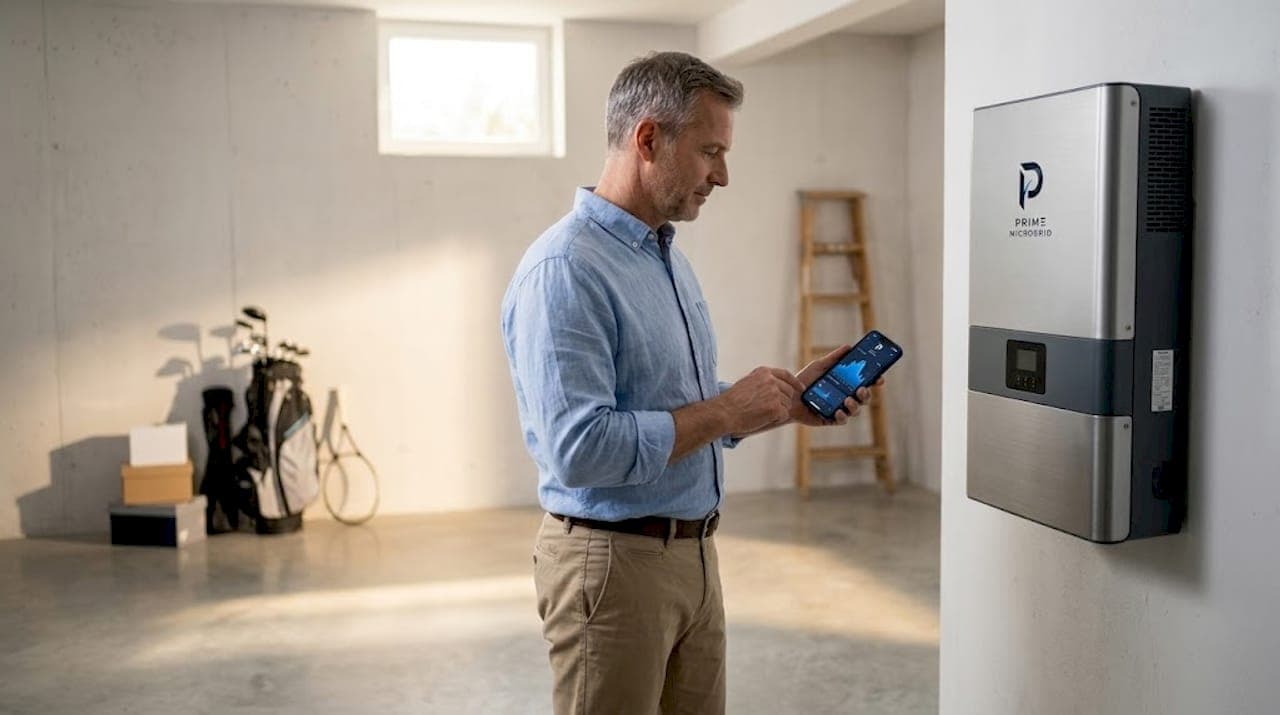
Most homeowners assume a generator is enough. Then the power goes out for three days in January, the generator runs out of fuel on night two, and suddenly the question changes. What is a hybrid backup power system, and why didn't anyone tell me about it sooner? These systems combine solar panels, battery storage, and a backup generator into one coordinated setup that covers outages intelligently, cuts energy costs between emergencies, and gives you real control over your home's power supply.
Table of Contents
- Key takeaways
- What is a hybrid backup power system
- Benefits of hybrid backup systems vs. traditional options
- Types of hybrid backup systems and design options
- Common challenges and limitations
- How to evaluate and get started
- My take on hybrid backup systems
- Build your hybrid backup system with Primemicrogrid
- FAQ
Key takeaways
| Point | Details |
|---|---|
| More than one power source | Hybrid systems combine solar, batteries, and a generator so no single failure leaves you without power. |
| Batteries act as the first line of defense | During most outages, batteries respond instantly and the generator only starts when reserves run low. |
| Smart controls make it work | Energy management logic determines when to draw from each source, protecting appliances and maximizing savings. |
| Sizing determines real independence | A system that's too small limits how long you can operate off-grid, making upfront planning critical. |
| Higher upfront cost, lower long-term cost | The initial investment is larger than a generator alone, but fuel and utility savings offset costs over time. |
What is a hybrid backup power system
A hybrid backup power system is a home energy setup that pulls from at least two power sources and manages them automatically. The most common configuration pairs solar panels and a battery bank with a backup generator and connects everything through a hybrid inverter. Hybrid systems balance solar, batteries, and generators with smart controls to improve power security and lower costs at the same time.
What makes it "hybrid" is not just having multiple sources. It's the fact that an energy management system (EMS) decides in real time which source to use, in what order, and at what threshold. You don't flip switches or monitor gauges. The system handles that automatically, whether you're home or not.
This is fundamentally different from a basic backup power system, which typically means a single standby generator or a battery with no solar input. Those options work for short outages, but they don't generate their own power or adapt to how your household actually uses energy throughout the day.
The core components and how they interact
Understanding how hybrid power works starts with knowing what each component does:
- Solar panels (PV array): Generate DC electricity from sunlight during daylight hours. They're the primary energy production source and reduce how much power you draw from the grid during normal operation.
- Battery storage: Stores excess solar energy and grid power during off-peak rate periods. Batteries cover short outages with a fast response, often within milliseconds.
- Hybrid inverter: Converts DC power from solar and batteries to AC power your home appliances use. It also manages the switching between grid, battery, and generator sources. A hybrid inverter typically lasts 10 to 15 years depending on installation quality and site conditions.
- Backup generator: Runs on propane, natural gas, or diesel. In a well-designed hybrid system, the generator acts as backup only for critical situations when batteries are depleted and solar can't recharge them fast enough.
- Energy management system: The software brain. It sets priorities, monitors state of charge, and executes transfer switching between sources.
Pro Tip: Ask any installer what the transfer switching speed is for their system. The best hybrid inverters switch in approximately 10 milliseconds, which is fast enough to protect sensitive electronics like computers, medical devices, and smart home hubs from power interruption.
The sequence during a grid outage usually works like this. Solar continues generating if the sun is out. The battery discharges to meet loads. If the battery drops to a preset threshold and solar isn't replenishing it fast enough, the generator starts automatically. Advanced EMS controls and rapid transfer switching are what separate reliable hybrid systems from ones that let sensitive appliances see a blip.

Benefits of hybrid backup systems vs. traditional options
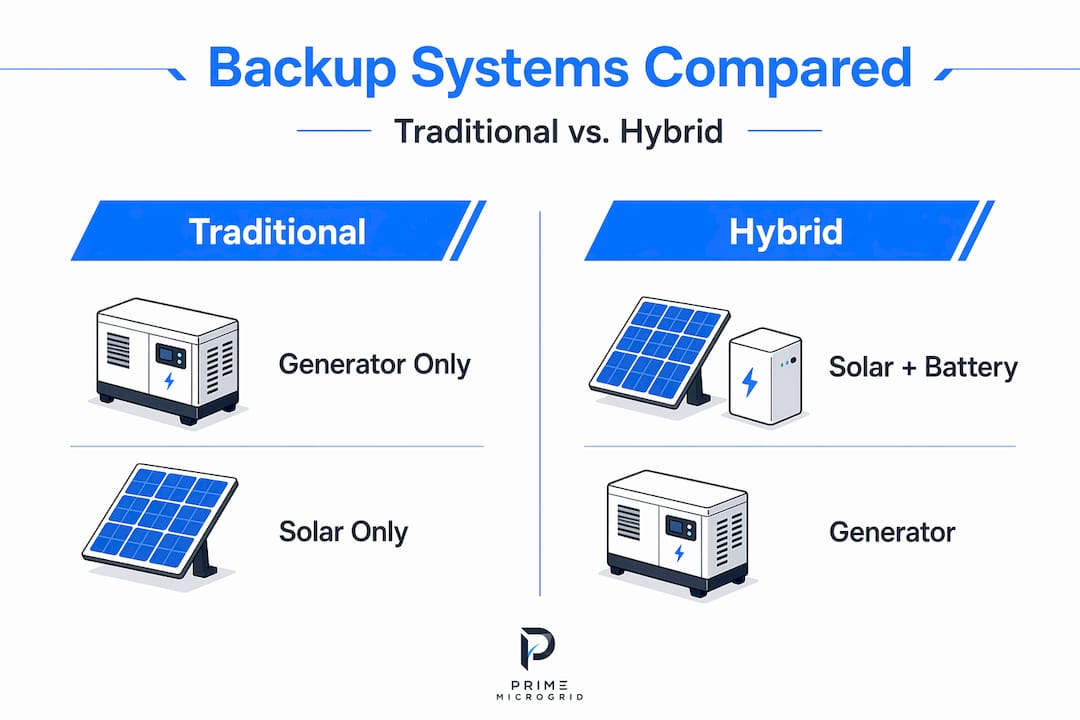
The simplest way to understand the benefits of hybrid backup systems is to compare them against what most homeowners already know.
| Feature | Generator only | Solar only (grid-tied) | Hybrid backup system |
|---|---|---|---|
| Works during grid outage | Yes | No | Yes |
| Generates its own power | No | Yes | Yes |
| Quiet operation | No | Yes | Mostly yes |
| Fuel dependency | High | None | Low |
| Reduces utility bills | No | Yes | Yes |
| Seamless outage transfer | Sometimes | No | Yes |
| Scales for future needs | Limited | Moderate | High |
A generator-only setup requires fuel, produces noise and exhaust, and does nothing for your electricity bill when the grid is running fine. A grid-tied solar system without storage goes dark the moment the grid goes down, because it's required to shut off for utility worker safety. Neither option gives you the full picture.
Hybrid systems automatically switch to battery during outages without fuel noise or manual intervention. Between outages, intelligent energy management maximizes local solar use before sending anything to the grid, which lowers your monthly bill and keeps your battery ready.
The environmental angle is real too. Hybrid systems defer generator operation until batteries are depleted, which means significantly less fuel burned per outage event. Over a year, that adds up to fewer emissions and lower fuel costs.
Pro Tip: If your utility offers time-of-use rates, a hybrid system with smart controls can charge your battery during cheap overnight hours and discharge during expensive peak periods. That's energy cost savings that have nothing to do with outages.
Types of hybrid backup systems and design options
Not every hybrid system is built the same way, and understanding the main types helps you make a better decision for your property.
Grid-tied hybrid systems stay connected to the utility grid and use net metering where available. They export surplus solar energy and draw from the grid when needed. The battery handles short outages and peak-shaving. This is the most common residential configuration.
Off-grid and islanding-capable systems can disconnect from the grid entirely and operate independently for extended periods. They require larger battery banks and generator capacity. They're well-suited for rural properties or areas with frequent, prolonged outages.
Here's what shapes the design of any hybrid system:
- Critical load identification: Do you need to power the whole house or just the refrigerator, HVAC, medical equipment, and a few lights? Sizing batteries and generator capacity to meet actual runtime needs is what determines real energy independence.
- Battery chemistry and capacity: Lithium iron phosphate (LFP) batteries are the current standard for residential use. They offer longer cycle life and safer chemistry than older lead-acid options.
- Generator sizing: Oversized generators run inefficiently at low loads. The generator should be sized to cover your critical loads and recharge the battery, not run the entire house indefinitely.
- Transfer switching: Whole-home transfer vs. critical-loads-only panel determines which circuits stay powered during an outage and at what cost.
| System type | Best for | Typical battery size | Generator needed? |
|---|---|---|---|
| Grid-tied hybrid | Most suburban homeowners | 10–20 kWh | Optional |
| Islanding-capable hybrid | Rural or high-outage areas | 20–40+ kWh | Strongly recommended |
| Off-grid hybrid | Remote properties, full independence | 30–60+ kWh | Yes |
If you're weighing generators vs. battery storage in your design, the answer for most homeowners is usually both, working together rather than competing.
Common challenges and limitations
A balanced view matters here. Hybrid backup systems are not without real tradeoffs.
- Higher upfront cost: A complete hybrid system with solar, battery, and generator integration costs significantly more than a standby generator alone. Incentives like the federal Investment Tax Credit can offset a portion of the solar and battery components, but the installation complexity adds labor costs too.
- Maintenance across multiple components: Maintaining all components including battery health, generator upkeep, and inverter performance increases what you need to manage. Generators still need annual service, oil changes, and load testing regardless of how rarely they run.
- Battery replacement cycles: Residential batteries typically last 10 to 15 years depending on depth of discharge and temperature management. Budget for eventual replacement.
- Off-grid runtime limits: Even the best-sized battery will run down after several cloudy days with no grid and high loads. The generator exists precisely for those worst-case stretches, but you still need fuel available.
- Integration complexity with existing wiring: Older homes may need electrical panel upgrades, transfer switch installation, or load center modifications before a hybrid system can be installed properly.
Pro Tip: Before getting quotes, pull your last 12 months of utility bills and note your highest-usage months. That data tells an installer exactly what your peak demand is and prevents undersizing the system.
How to evaluate and get started
If you're seriously considering a hybrid system, work through these steps before calling anyone for a quote.
- Audit your energy use. Pull 12 months of utility bills and identify your average daily kWh usage, your peak demand months, and which appliances or systems you consider critical during an outage.
- Check your outage history. If your area loses power for a few hours twice a year, a modest battery with grid-tied solar may be enough. If outages run multiple days, you need islanding capability and a generator in the mix.
- Identify critical loads. Decide whether you need whole-home coverage or a protected critical-loads circuit. This decision drives battery size, transfer switch type, and overall system cost more than almost anything else.
- Evaluate your roof and solar potential. A hybrid system without solar is really just a battery plus generator. Maximizing solar generation is what gives the system its long-term economic advantage.
- Request proposals from qualified installers. Look for contractors with specific experience in solar battery integration and hybrid inverter systems, not just standard solar installers or electricians.
- Plan for monitoring and future upgrades. Most modern hybrid inverters offer app-based monitoring. Ask about EV charging integration, expandable battery capacity, and smart load management as future additions.
Energy independence varies widely by system size, which is why the planning stage matters more than most homeowners expect.
My take on hybrid backup systems
I've worked with homeowners who spent $8,000 on a standby generator and still felt anxious every time a storm rolled through. The generator would start up fine, but they knew it depended on a propane delivery that might not come for a week. That anxiety doesn't go away with a single-source backup solution.
What I've found is that most people underestimate how much their peace of mind is worth in energy system design. A hybrid system isn't just a technical upgrade. It changes your relationship with power outages entirely. You go from reactive to prepared.
The mistake I see most often is treating this as a DIY research project where you size everything on a spreadsheet and hand it to the lowest bidder. Hybrid systems live and die by their control logic and installation quality. A poorly configured energy management system will run your generator unnecessarily, drain your battery at the wrong times, and leave you worse off than a simple standby setup.
My honest advice: find someone who designs these systems daily and can show you actual monitoring data from similar installations. The hardware is commoditizing fast. The expertise is still the differentiator. And if you're on the fence about whether battery backup alone is enough, the answer almost always depends on your specific load profile and outage risk. There is no universal answer, only a well-designed one.
— David
Build your hybrid backup system with Primemicrogrid
Primemicrogrid designs residential hybrid systems built around your actual energy needs, not a catalog package. Whether you need whole-home backup power that covers every circuit or a targeted critical-loads system with solar, battery, and generator working together, the design starts with your usage data and outage history.
Primemicrogrid serves homeowners across the Mid-Atlantic region and Texas with residential microgrid solutions that are engineered for long-term reliability. Every system includes smart controls, monitoring, and a design that scales with your future needs. If you want to stop guessing and start planning, talk to a Primemicrogrid energy advisor about what a hybrid system designed for your property actually looks like.
FAQ
What is a hybrid backup power system in simple terms?
A hybrid backup power system combines solar panels, battery storage, and a backup generator into one coordinated setup managed by smart controls. It keeps your home powered during outages and reduces electricity costs during normal operation.
How does a hybrid power system work during an outage?
When grid power fails, the hybrid inverter switches automatically to battery power within milliseconds. If the battery depletes and solar isn't recharging it fast enough, the backup generator starts automatically to cover critical loads.
What are the main benefits of hybrid backup systems over generators?
Hybrid systems generate their own solar power, operate quietly, reduce fuel dependence, and switch seamlessly during outages without manual intervention. They also lower utility bills between outages, which a generator alone cannot do.
How long can a hybrid backup system run without grid power?
Runtime depends on battery size, solar generation, and your home's energy load. A properly sized system can run critical loads for 24 to 72 hours on battery alone, with the generator extending that indefinitely as long as fuel is available.
Are hybrid backup systems worth the cost for homeowners?
For homeowners in areas with frequent or prolonged outages, the combination of energy cost savings, fuel reduction, and outage resilience typically justifies the higher upfront investment compared to a generator-only solution.