
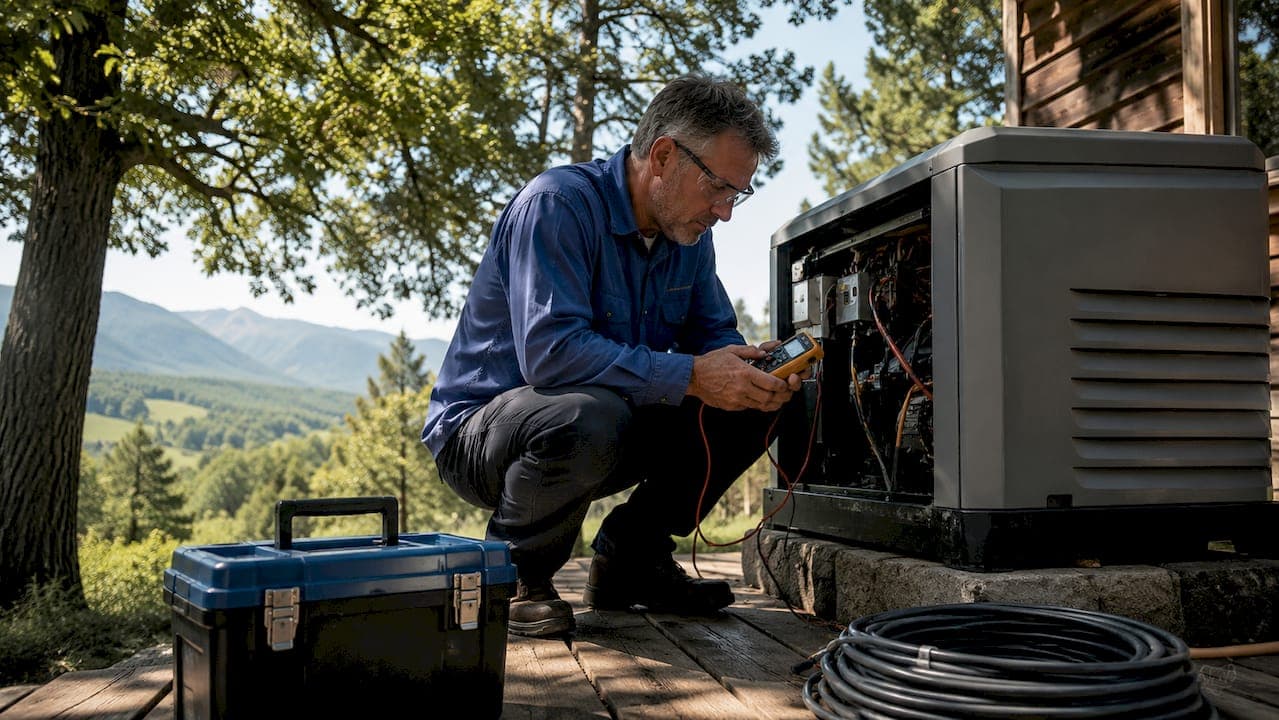
Well pump backup power system types fall into two primary categories: generator-based systems and battery-based systems, each designed to keep water flowing when the utility grid goes down. Choosing the wrong type means running dry during a storm or wasting money on capacity you never need. The right choice depends on three factors: your pump's surge wattage, how long outages typically last in your area, and where the backup equipment will be installed. This guide breaks down every major option so you can match the system to your actual situation.
1. Generator-based backup power system types for well pumps
Generator-based and battery-based systems are the two recognized backup categories in residential well pump design, and generators dominate when outages run longer than a few hours. They run on combustion fuels including gasoline, propane, and diesel, and they connect to your well pump circuit through a transfer switch. Three distinct generator types exist within this category, and each fits a different budget and use case.
Portable generators are the most common entry point. They cost less upfront, run on gasoline, and require manual setup during an outage. The downside is that someone must be present to start them, and they cannot be installed indoors due to carbon monoxide risk.
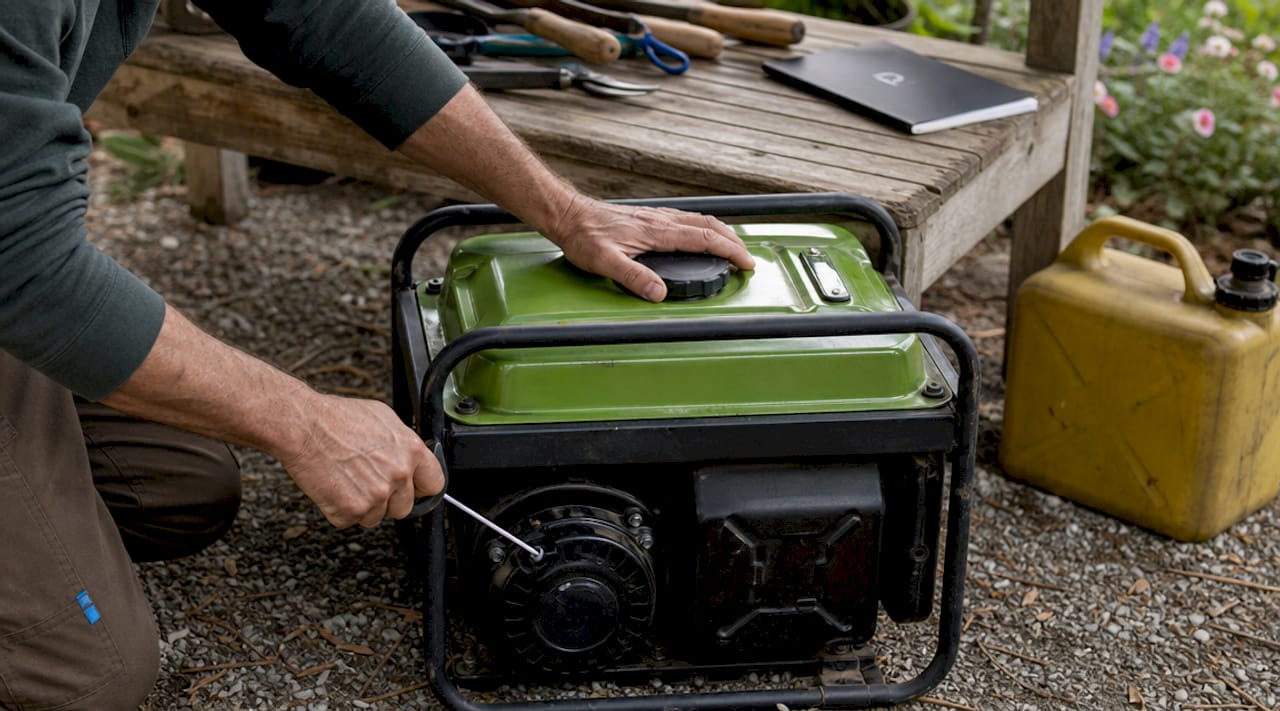
Inverter generators produce cleaner power with lower total harmonic distortion, which matters for variable-speed well pump motors that are sensitive to power quality. Brands like Honda EU7000iS and Yamaha EF6300iSDE are purpose-built for sensitive loads. They are quieter and more fuel-efficient than conventional portable units, though they cost more per watt of output.
Standby generators are permanently installed, connect to a natural gas or propane line, and start automatically within seconds of a power failure. Generac, Kohler, and Briggs and Stratton all manufacture residential standby units sized from 7,500 to 20,000 watts, which covers whole-house loads including well pumps. They are the gold standard for extended outages lasting 4 to 72 hours or more.
Sizing is where most homeowners make mistakes. A 1 HP well pump draws roughly 2,000 watts while running, but startup surge power can reach 6,000 to 10,000 watts for one to two seconds. A generator that handles running watts but collapses under surge will fail to start the pump every time.
Pro Tip: Always size your generator to the pump's locked-rotor amperage rating on the motor nameplate, not just the running wattage. That number tells you the true worst-case surge draw.
Transfer switches are non-negotiable. Manual transfer switches require you to physically flip a breaker before connecting the generator. Automatic transfer switches (ATS) detect the outage and switch the circuit within seconds without human intervention. Interlock kits are a lower-cost alternative that mechanically prevents the main breaker and generator breaker from being on simultaneously, satisfying anti-backfeed requirements at a fraction of the cost of a full ATS panel.
2. Battery-based backup power systems and their real limitations
Battery backup systems use DC battery storage paired with an inverter to deliver AC power to your well pump. They are silent, require no fuel, and can be installed indoors in a garage or utility room. Those advantages make them attractive, but they carry hard limits that generators do not.
Battery backups support short outages under approximately four hours for standard residential well pumps. A half-horsepower pump needs roughly 100 amp-hours of battery capacity at 24V to run for that window. A 1 HP pump needs closer to 200 amp-hours. That is a significant battery bank, and it still runs out well before a multi-day storm passes.
The surge problem is equally important. A Tesla Powerwall 3 offers 13.5 kWh of usable storage and 11.5 kW of peak output, which is sufficient for a 220V well pump drawing 4.4 kW continuously with an 8.8 kW surge. Most older or smaller battery inverters cannot sustain that surge long enough to spin the pump motor up to speed. The result is a tripped inverter even when the battery shows plenty of charge.
Pro Tip: When evaluating any battery backup for a well pump, ask for the inverter's surge duration spec, not just its peak surge wattage. You need at least 10 seconds of sustained surge capability to reliably start a submersible pump motor.
Here is what battery backup does well for well pumps:
- Handles outages under four hours without any fuel management
- Operates silently, which matters in suburban neighborhoods with noise ordinances
- Pairs with solar panels for daytime recharging during extended grid failures
- Qualifies for the federal Investment Tax Credit when paired with solar, reducing net cost
- Requires minimal maintenance compared to combustion generators
The battery sizing and surge capability must be confirmed together. Capacity alone does not guarantee the system will start your pump. Checking both numbers before purchase prevents the most common and expensive battery backup failure mode.
You can explore battery runtime limitations in more depth to understand whether a battery-only approach fits your outage profile.
3. How to choose based on outage duration and pump size
Matching backup type to outage duration is more critical than simply having backup power at all. The decision framework is straightforward once you know your pump size and your area's typical outage pattern.
| Outage Duration | Pump Size | Recommended System | Key Consideration |
|---|---|---|---|
| Under 4 hours | 1/2 to 3/4 HP | Battery backup with inverter | Confirm surge duration spec |
| Under 4 hours | 1 HP or larger | Battery backup, oversized inverter | 200+ Ah battery bank required |
| 4 to 72+ hours | Any size | Standby or portable generator | Size to locked-rotor amperage |
| Extended or off-grid | Any size | Generator plus battery hybrid | Solar recharge adds resilience |
Standby generators sized 7,500 to 20,000 watts cover whole-house loads including well pumps during severe weather events lasting days. Battery systems are the better fit for the frequent short outages common in areas with aging grid infrastructure.
Installation environment also drives the decision. Generators require outdoor placement with adequate ventilation and a concrete pad. Battery systems fit inside a conditioned or semi-conditioned space, which extends battery life and eliminates weather exposure. If your property has no outdoor space for a generator or sits in a community with strict noise rules, battery backup is the practical path regardless of outage length.
Fuel availability is the final variable. Gasoline generators require stored fuel that degrades within months without stabilizer. Propane stores indefinitely and works well for rural properties. Natural gas standby generators eliminate fuel management entirely but depend on the gas utility staying operational, which is not guaranteed in all disaster scenarios.
4. Electrical code and safety requirements for well pump backup
Every well pump backup power system, regardless of type, must comply with NEC Article 702, which governs optional standby systems in residential and commercial settings. These are not suggestions. They are the legal minimum for a safe and insurable installation.
-
Anti-backfeed protection. Transfer equipment must physically prevent the backup source and the utility from being connected simultaneously. Backfeed onto utility lines creates lethal hazards for line workers. This requirement applies to every system type, including portable generators connected through interlock kits.
-
Transfer switch identification. NEC Article 702 requires signage at the transfer switch and at the main service panel identifying the presence of a backup power source. This alerts emergency responders and utility workers to the system.
-
Manual versus automatic transfer switches. Manual transfer switches are permitted under Article 702 for optional standby systems. Automatic transfer switches are required only for emergency and legally required standby systems. However, an ATS is strongly recommended for any homeowner who cannot guarantee they will be present during an outage.
-
Transfer equipment ratings. The transfer switch must be rated for the full load it controls, including the pump's surge current. Undersized transfer equipment fails under startup loads and can cause arc faults or fires.
-
Professional installation. Optional standby systems must be installed by a licensed electrician in most jurisdictions. Permits are required in nearly all states. An unpermitted installation voids homeowner's insurance coverage for any damage the system causes.
The anti-backfeed and signage requirements under NEC Article 702 apply even to systems the homeowner considers temporary or low-risk. Code compliance is not optional when the system connects to a circuit that feeds a submersible pump drawing 20 or more amps.
Key takeaways
The most reliable well pump backup power system matches surge capacity to the pump's locked-rotor amperage, outage duration to system type, and installation environment to fuel and ventilation constraints.
| Point | Details |
|---|---|
| Surge capacity is the primary constraint | Size generators and inverters to startup surge, not running watts, to prevent startup failures. |
| Battery backup fits short outages only | Battery systems support roughly four hours of runtime for 1/2 to 1 HP pumps before fuel-free advantage ends. |
| Standby generators cover extended outages | Units sized 7,500 to 20,000 watts handle whole-home loads including well pumps for multi-day events. |
| NEC Article 702 governs all installations | Anti-backfeed transfer equipment and proper signage are legally required for every backup system type. |
| Hybrid systems maximize resilience | Combining battery backup with a generator covers both short outages and extended grid failures. |
Why surge capacity is the detail most homeowners miss
I have reviewed dozens of backup power installations where the homeowner bought what looked like a correctly sized system and still could not get water during an outage. In nearly every case, the failure point was the same: the inverter or generator could not sustain the surge long enough to spin the pump motor up to operating speed.
Running wattage is the number that gets advertised. Surge wattage is the number that determines whether your pump actually starts. A 1 HP submersible pump pulling 2,000 watts at steady state can demand 8,000 watts or more for the first two seconds of startup. A generator or inverter that clips that surge causes the motor to stall, which draws even more current, which trips the breaker or shuts down the inverter. You end up with a backup system that technically works but cannot do the one job you bought it for.
The fix is not complicated. Get the motor nameplate data before you buy anything. Look for the locked-rotor amperage (LRA) rating. Multiply by your supply voltage to get the true surge watt demand. Then size your backup source to that number, not the running watts listed in the product description.
I also recommend testing your backup system under full load at least twice a year, not just confirming it powers on. Start the pump while running on backup power. Watch for voltage sag, inverter trips, or generator governor hunting. Those symptoms tell you the system is marginal before an actual outage reveals it. For off-grid or farm properties where water supply is mission-critical, a hybrid generator and battery approach provides the redundancy that single-source systems cannot.
— David
How Primemicrogrid designs backup power for well pumps
Primemicrogrid builds residential microgrid systems that integrate battery storage, generators, and smart load management into a single coordinated solution for homes and farms that cannot afford to lose water supply.

Whether your property needs a battery system sized for short outages, a standby generator for multi-day events, or a hybrid microgrid system that handles both, Primemicrogrid designs around your pump's actual surge requirements and your local outage patterns. Every system is sized to code, permitted, and built for long-term reliability. Contact Primemicrogrid to get a custom backup power assessment for your well pump and property.
FAQ
What are the main well pump backup power system types?
The two main types are generator-based systems (portable, inverter, and standby generators) and battery-based systems (inverter-coupled battery banks). Each type suits different outage durations and pump sizes.
How do I size a generator for my well pump?
Size the generator to the pump's locked-rotor amperage, not its running wattage. A 1 HP pump running at 2,000 watts can demand 6,000 to 10,000 watts at startup, requiring a generator rated well above the running load.
Can a battery backup run a well pump during a long outage?
Battery backups support roughly four hours of runtime for standard residential well pumps. For outages beyond four hours, a standby generator or a generator-battery hybrid system is the more practical choice.
Do I need a transfer switch for a well pump backup system?
Yes. NEC Article 702 requires transfer equipment that prevents the backup source and utility from connecting simultaneously. This applies to every system type, including portable generators connected through interlock kits.
What is the best backup system for a well pump on a rural property?
A propane or natural gas standby generator paired with a battery backup provides the strongest combination for rural properties. The battery handles short outages instantly, while the generator covers extended events without fuel degradation concerns.