
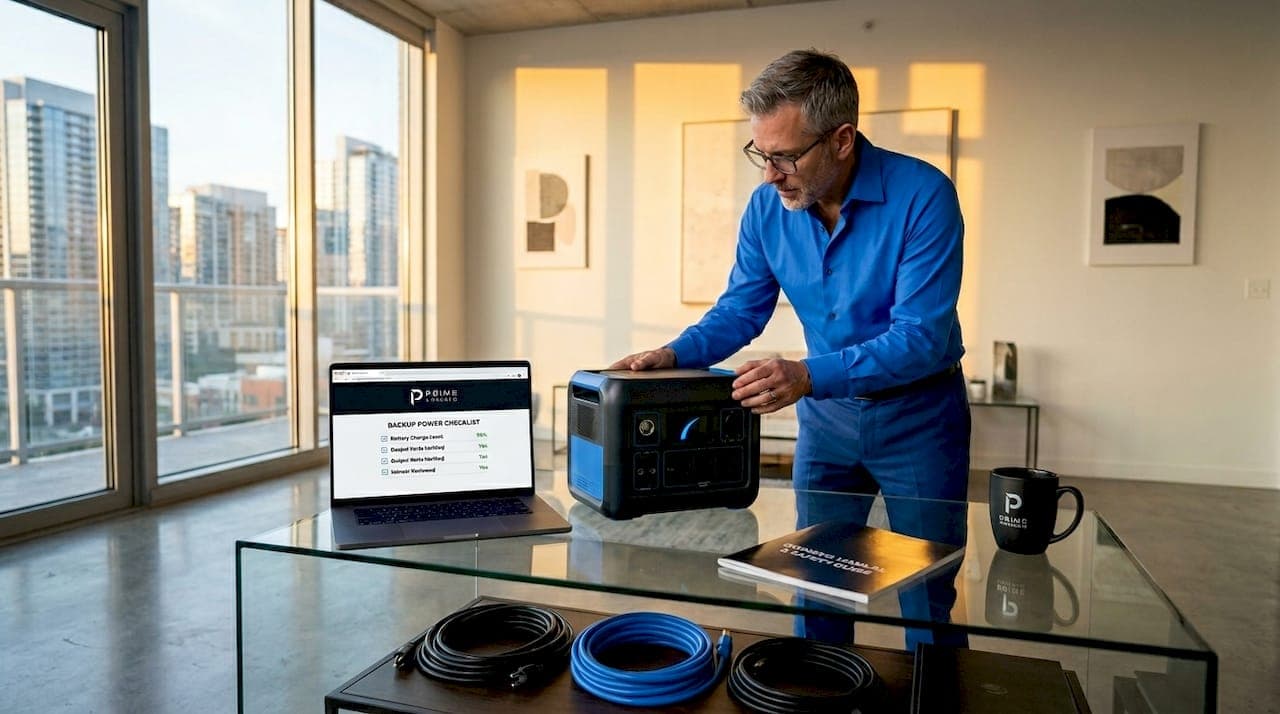
When grid power fails, your home's shelter function depends entirely on what you've planned in advance. Choosing the right backup power options for residential shelters isn't just about comfort. It's about keeping medical equipment running, food cold, heat or cooling functional, and communications open. The challenge is that no single solution fits every home or budget, and the wrong choice can create serious safety risks. This guide breaks down every major option in a tiered framework so you can match the right system to your actual needs.
Table of Contents
- Key Takeaways
- Backup power options for residential shelters: how to choose the right tier
- 1. Portable power banks
- 2. Small portable solar panels
- 3. Small portable power stations
- 4. Inverter-based portable gas generators
- 5. Vehicle power inverters
- 6. Large portable generators with transfer switches
- 7. Large indoor-safe power stations
- 8. Standby generators with automatic transfer switches
- 9. Whole-home battery backup systems
- 10. Comparing all tiers: a side-by-side look
- My honest take on residential shelter backup power
- How Primemicrogrid can help you design the right system
- FAQ
Key Takeaways
| Point | Details |
|---|---|
| Use a tiered approach | Match your backup power solution to your budget, outage duration, and which loads actually matter most. |
| Safety is non-negotiable | Transfer switches and CO precautions aren't optional extras. They're code requirements that protect lives. |
| Load triage extends runtime | Prioritizing refrigeration, lighting, and medical devices over HVAC can double how long any backup system lasts. |
| Battery systems are going mainstream | Residential battery backup grew 64% in 2024, making it a practical choice for most homeowners, not just early adopters. |
| Hybrid systems offer the best coverage | Combining a generator with battery storage covers both short outages and multi-day grid failures with fewer compromises. |
Backup power options for residential shelters: how to choose the right tier
Before you spend money on any system, you need a clear framework. The tiered approach to backup power organizes solutions from small portable devices up to whole-home automatic systems, and each tier has a different cost, capability, and complexity profile.
Start by identifying your critical loads. Refrigeration, lighting, communications, medical devices, and HVAC are the five categories that determine shelter survivability during extended outages. You don't need to power everything. You need to power the right things.
Key evaluation criteria for any option you consider:
- Safety: Carbon monoxide risk for fuel-burning equipment, and NEC Article 702 compliance for transfer equipment
- Runtime: How long can the system operate on a full charge or tank, and can you refuel or recharge it during the outage?
- Scalability: Can it grow with your needs, or is it a fixed capacity solution?
- Cost: Include installation, fuel or battery replacement, and annual maintenance, not just purchase price
- Integration: Does it connect to your existing wiring, and does it require a licensed electrician to install?
- Noise and placement: Generators require outdoor placement and significant clearance; battery systems work silently indoors
Pro Tip: Before buying anything, write down your five most critical electrical loads and their wattage. That single exercise will eliminate half the products on the market immediately.
1. Portable power banks
A portable power bank is the entry point for any backup power plan. These lithium battery devices range from 10,000mAh phone-sized units up to large packs capable of keeping a tablet, medical monitor, or CPAP machine running for several hours.
They charge from wall outlets, car adapters, or small solar panels, and they require zero installation. Their limitation is capacity. A standard power bank won't run a refrigerator or a window AC unit. What it will do is keep your phone charged for emergency communications, which matters more than most people realize in a genuine outage.
2. Small portable solar panels
A 100-watt foldable solar panel paired with a power bank or small battery station gives you a recharging source that doesn't depend on fuel availability. In a multi-day outage after a storm, this combination can keep communication devices running indefinitely as long as you have sunlight.
Solar panels in this size range won't power heavy appliances, but they extend the practical runtime of smaller battery systems significantly. They're also useful as part of a larger off-grid power system when paired with bigger storage.
3. Small portable power stations
Portable power stations in the 500 to 1,500 watt-hour range are the most flexible entry-level option for residential shelter use. They can run a refrigerator for several hours, charge laptops and phones, power a CPAP machine through the night, and even run a small medical device.
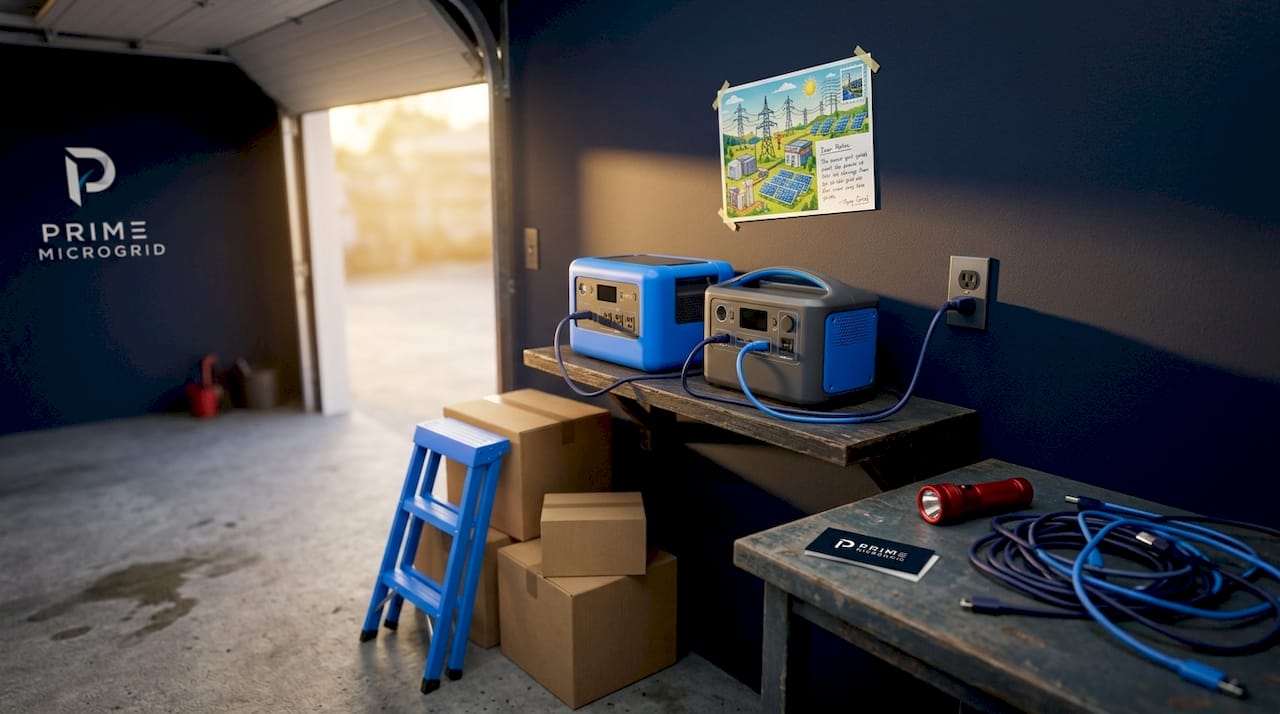
These units combine a large lithium battery with multiple AC outlets, USB ports, and DC outputs in a single box. No installation required, no fumes, and most can be recharged from solar panels. The tradeoff is that they don't last long if you try to run high-draw appliances continuously.
4. Inverter-based portable gas generators
Inverter generators produce cleaner electricity than conventional generators, making them safe for sensitive electronics. Models in the 2,000 to 3,500 watt range can run a refrigerator, several lights, a phone charging station, and a window AC unit simultaneously.
They're quieter than conventional generators and more fuel-efficient. The absolute requirement is outdoor placement. CO poisoning from generators can incapacitate a person within minutes indoors, and opening windows does not provide adequate protection. Operate any gas generator at least 20 feet from your home with the exhaust directed away from all openings, and install CO alarms inside.
5. Vehicle power inverters
A DC-to-AC inverter plugged into your car's 12V outlet or connected directly to the battery can deliver 300 to 1,500 watts of power. It's not a primary strategy, but it's a legitimate emergency backup for charging devices and running small appliances when nothing else is available.
More significantly, EVs with Vehicle-to-Load (V2L) capability carry batteries 20 to 40 times larger than typical portable power stations, and some models can power an entire home for days. This is an emerging option that will become more relevant as more V2L-capable vehicles enter the market.
6. Large portable generators with transfer switches
A 5,000 to 10,000 watt portable generator can power multiple essential circuits in your home when connected through a proper transfer switch or interlock kit. This is where you move from "device charging" to "keeping the house functional."
NEC Article 702 requires transfer equipment to prevent simultaneous energization of utility and generator circuits. That's not bureaucratic red tape. It prevents backfeed that could electrocute utility workers and destroy your equipment. A manual transfer switch or interlock kit is the minimum. An automatic transfer switch (ATS) is the better choice if budget allows.
Pro Tip: Transfer switches must be correctly sized and grounded by a licensed electrician. An improperly sized switch creates shock hazards and can void your homeowner's insurance.
Typical loads a 7,500-watt generator can handle:
- Refrigerator and freezer
- Well pump or sump pump
- Several lighting circuits
- Furnace blower motor
- One window AC unit
7. Large indoor-safe power stations
Battery-based power stations in the 3,000 to 10,000 watt-hour range, such as units from EcoFlow or Bluetti, can run essential home loads silently and indoors without any fuel. Some models support whole-home integration through a dedicated transfer switch panel.
These systems are particularly effective for short-term outages and for homeowners who need to power medical equipment around the clock. No fuel storage, no CO risk, no noise. The limitation is cost and the fact that capacity is fixed unless you add additional battery modules.
8. Standby generators with automatic transfer switches
A permanently installed standby generator running on natural gas or propane is the traditional whole-home emergency power solution. These units detect an outage and start automatically within seconds, switching your home to generator power without any action on your part.
Standby generators sized for whole-home use typically range from 11 kW to 24 kW for most residential applications. Natural gas models eliminate fuel storage concerns. Propane models require a tank but work where natural gas isn't available. Both require annual maintenance, including oil changes, filter replacements, and load testing, to remain reliable when you actually need them.
You can learn more about how standby generators work and what installation involves before committing to this path.
9. Whole-home battery backup systems
Residential battery backup systems grew 64% in 2024, with around half a million U.S. households now installed. This is no longer niche technology. Systems like the Tesla Powerwall, Enphase IQ Battery, and Franklin Electric APsystems provide instant switchover, silent operation, and solar integration.
A single 10 to 13.5 kWh battery can power essential home loads for 8 to 12 hours. Stacking multiple units extends that runtime significantly. When paired with rooftop solar, the system can recharge during the day and continue operating through multi-day outages.
The main advantages over standby generators:
- Zero emissions and no fuel logistics
- Instantaneous switchover vs. seconds for generators
- Silent operation
- Eligible for the federal residential clean energy tax credit (currently 30%)
- Works with solar for indefinite runtime during daylight
The main limitations are upfront cost and fixed capacity. A battery system alone may not cover extended outages without solar, which is where hybrid backup power systems combining generators and batteries provide the strongest coverage.
10. Comparing all tiers: a side-by-side look
| System Type | Typical Cost | Runtime | Noise | Maintenance | Best For |
|---|---|---|---|---|---|
| Portable power bank | $50–$300 | Hours (devices only) | Silent | None | Phone charging, basic devices |
| Small power station | $300–$1,500 | 4–12 hours | Silent | Minimal | Fridge, CPAP, devices |
| Portable generator | $800–$2,500 | Days (with fuel) | Loud | Moderate | Essential circuits |
| Standby generator | $5,000–$15,000 | Indefinite (with fuel) | Moderate | Annual | Whole home, automatic |
| Home battery system | $8,000–$20,000+ | 8–24+ hours | Silent | Minimal | Clean, automatic backup |
| Hybrid (battery + gen) | $12,000–$30,000+ | Indefinite | Low/Silent | Moderate | Full coverage, multi-day |
Budget often limits homeowners to backing up only selected circuits, which makes load triage the most important planning step regardless of which tier you choose.
My honest take on residential shelter backup power
I've worked with enough homeowners to know the most common mistake: buying the cheapest generator at the hardware store, running an extension cord through a cracked window, and calling it a backup plan. That approach is dangerous on multiple levels, and it doesn't actually solve the problem when you need it most.
Safety has to come first. CO poisoning from improperly placed generators kills people every winter. Backfeeding a utility line without a proper transfer switch puts lineworkers at risk and can destroy your home's wiring. These aren't theoretical risks. They're documented, recurring incidents.
My recommendation for most homeowners is to start with a solid mid-range power station for immediate needs, get a proper transfer switch installed if you own a generator, and then plan a longer-term upgrade to either a standby generator or a battery system depending on your fuel access and solar potential.
The trend toward whole-home battery systems is real, and the economics keep improving. But generators still make sense for multi-day outages in regions where solar recharging is unreliable. The hybrid approach combining both is often the most resilient design, not because it's the most expensive, but because it gives you redundancy. And redundancy is exactly what "shelter" means.
— David
How Primemicrogrid can help you design the right system
At Primemicrogrid, we don't sell off-the-shelf backup kits. We design systems around your home's actual load profile, your grid reliability, your solar potential, and your budget. Whether you need a straightforward battery backup or a full residential microgrid with generator integration and smart load management, every system we build is sized and configured specifically for you.
If you're in the Mid-Atlantic region, explore our residential microgrid solutions designed for homeowners who want reliable, long-term energy security. Want to see how a microgrid compares to a Powerwall or a Generac? Our detailed comparison page breaks down the real differences in cost, performance, and coverage. For homeowners in Texas, see our Texas microgrid options tailored to the state's unique grid challenges.
FAQ
What is the safest backup power option for a residential shelter?
Battery-based systems are the safest because they produce no carbon monoxide, operate silently indoors, and switch over instantly. If you use a gas generator, keep it at least 20 feet from your home and always run it outdoors.
Do I need a transfer switch for a portable generator?
Yes. NEC Article 702 requires transfer equipment to prevent backfeed into utility lines, which can injure utility workers and damage your home's wiring. An interlock kit is the minimum; an automatic transfer switch is the better choice.
How long can a home battery system run essential loads?
A single 10 to 13.5 kWh battery system can power essential circuits for 8 to 12 hours. Pairing it with rooftop solar allows the battery to recharge during daylight, extending runtime through multi-day outages.
What loads should I prioritize during an outage?
Refrigeration, lighting, communications, medical devices, and the furnace blower are the highest-priority loads for shelter function. Prioritizing these over HVAC and large appliances significantly extends how long any backup system can sustain your home.
Are whole-home battery systems worth the cost?
For many homeowners, yes. Residential battery backup installations grew 64% in 2024 as costs dropped and the federal 30% clean energy tax credit made systems more accessible. They're especially worth it when paired with solar or when reliable automatic switchover is a priority.