
Most homeowners picture a whole-home generator as a magic switch that keeps everything running the moment the grid goes down. The reality is more nuanced, more interesting, and honestly more empowering to understand. A properly designed backup power system does far more than just "kick on" when the lights go out. It monitors your utility connection around the clock, manages multiple layers of safety logic, and balances real electrical loads that most people never think about until a major storm is already bearing down. This article walks you through exactly how these systems operate, what they can and can't do, and what you should know before buying or upgrading one.
Table of Contents
- What is a whole-home generator system?
- How does automatic transfer switching work?
- Safety essentials: Preventing backfeed and protecting your home
- Sizing, coverage, and real-world limits: What most homeowners miss
- What most whole-home generator buyers overlook
- Discover resilient backup power options for your home
- Frequently asked questions
Key Takeaways
| Point | Details |
|---|---|
| Seamless auto-transfer | Whole-home generators use an automatic transfer switch to quickly and safely restore power during outages. |
| Safety first | Modern systems are designed to prevent dangerous backfeed and protect both your home and utility crews. |
| Sizing matters | Accurate load calculation and prioritizing critical appliances are essential for reliable operation. |
| Smart delays | Built-in timing logic prevents nuisance switchover and maximizes equipment longevity. |
| Whole-home ≠ every circuit | ‘Whole-home’ often means strategic coverage, not powering every device at once. |
What is a whole-home generator system?
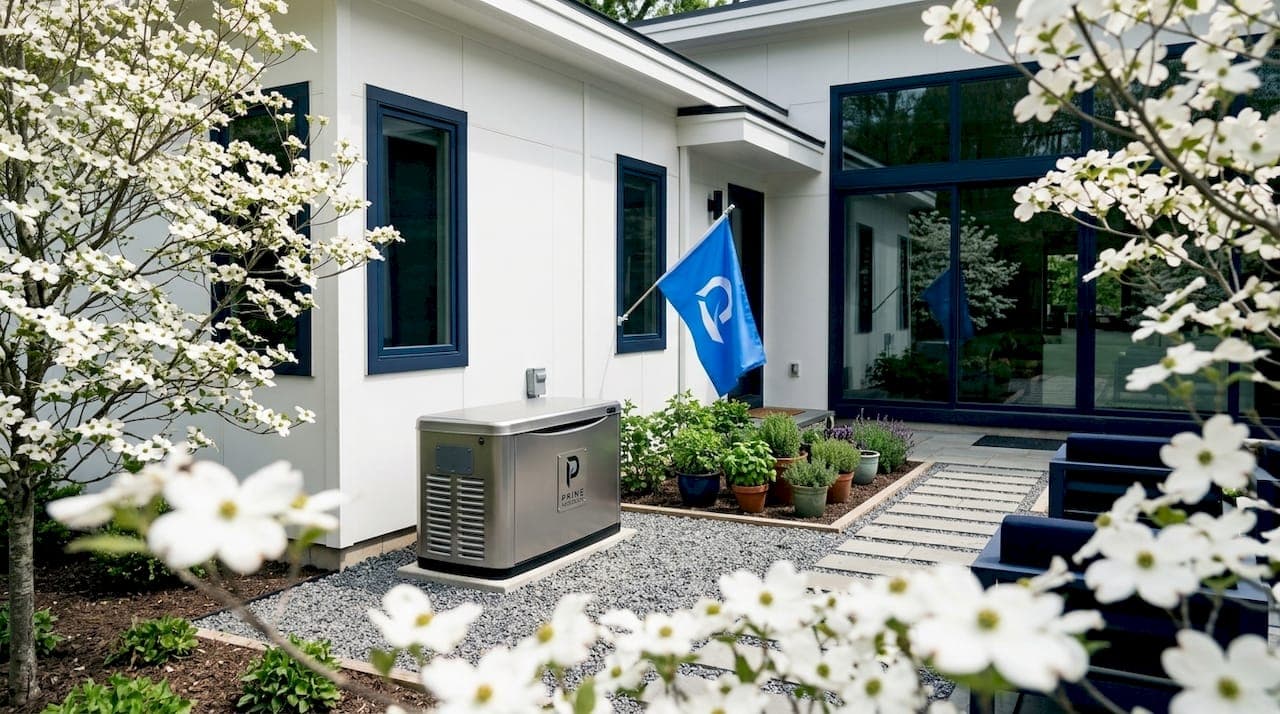
The term "whole-home generator" gets used loosely in advertising, but it refers to something specific in the electrical world. These are permanently installed standby generators, typically mounted outside the home on a concrete pad, connected directly to the home's electrical panel, and fueled by natural gas or propane through a permanent line.
Unlike a portable generator you roll out of the garage and plug extension cords into, a standby system is fully integrated into your home's electrical infrastructure. It works automatically without you lifting a finger, which is exactly what you want at 2 a.m. during a winter storm.
The core components of any whole-home backup system include:
- The generator itself. The engine and alternator unit that produces electricity, usually sized between 11 kW and 24 kW for residential use, though larger homes and farms often require much more.
- The automatic transfer switch (ATS). The brain of the operation. This device monitors your utility feed, commands the generator to start, and switches your home's load between utility and generator power.
- The control panel. Modern units include a digital control panel that logs performance, tracks exercise cycles, and alerts you to maintenance needs.
- Fuel supply. A natural gas line or propane tank sized for your expected runtime needs.
A whole-home backup guide can help you understand how all these pieces interact for your specific home layout and energy demands.
The ATS is what separates a true standby system from a makeshift setup. A permanently installed standby generator powers the home by automatically transferring electrical load between the utility grid and the generator using a transfer switch. That automation is the whole point. You don't need to be home. You don't need to throw any switches.
Pro Tip: Just because a generator is marketed as "whole-house" doesn't mean it's sized to run every circuit simultaneously. Always request a load calculation before purchasing, not after.
How does automatic transfer switching work?
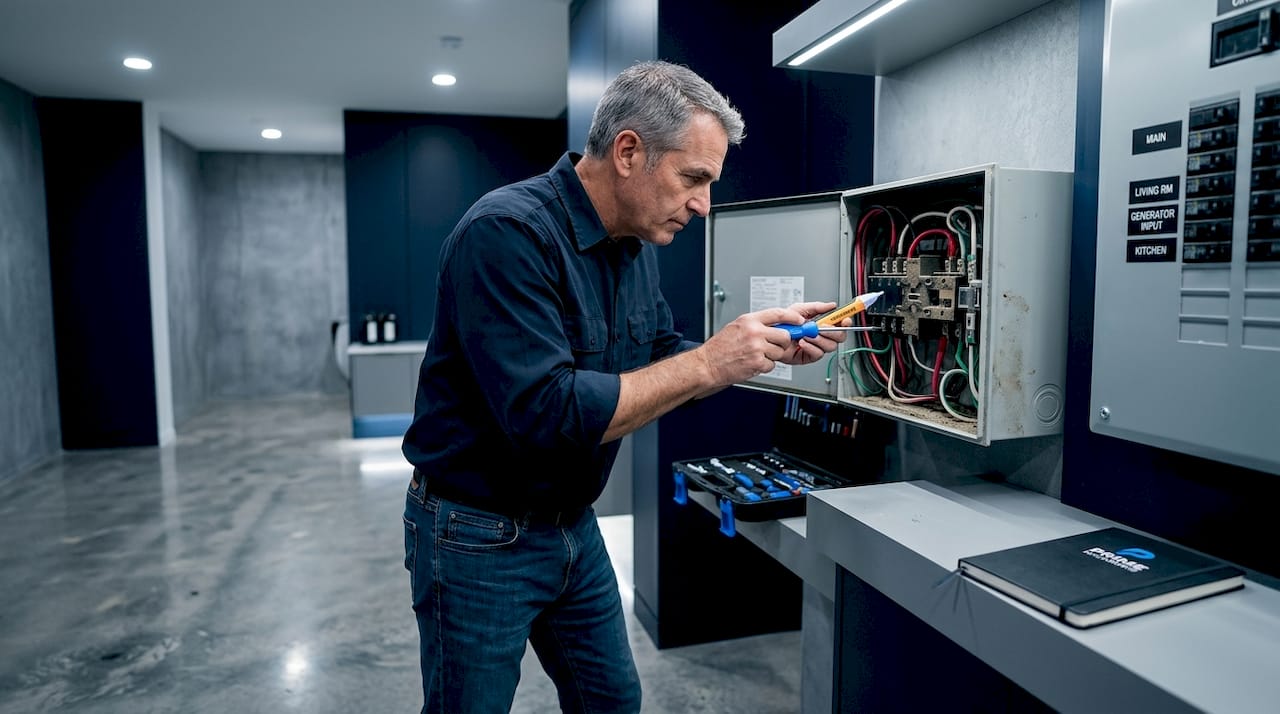
Understanding the ATS process removes a lot of anxiety about what actually happens during an outage. It's not a single dramatic moment. It's a carefully sequenced series of steps designed to protect both your equipment and the utility grid.
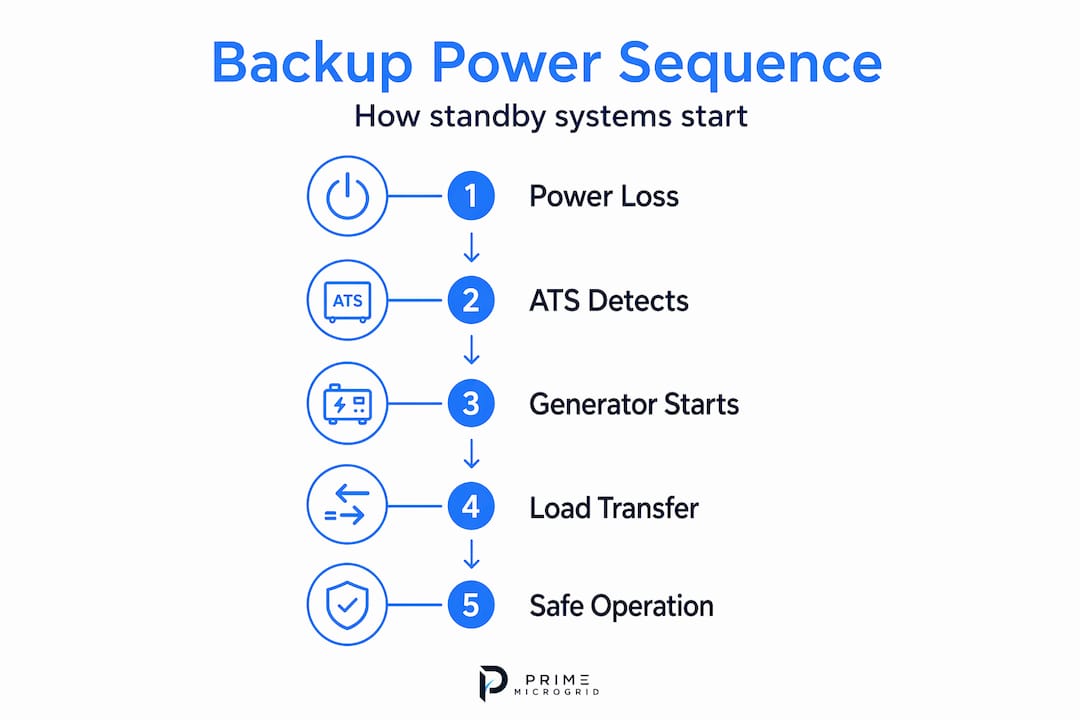
Here is the actual sequence your system follows every time the grid fails:
- Utility monitoring. The ATS continuously monitors the incoming utility voltage and frequency. It's watching for conditions that fall outside acceptable parameters, like voltage that drops too low or frequency that drifts.
- Sensing and delay. When the ATS detects a problem, it doesn't immediately act. It waits through a programmed delay, typically around 5 to 10 seconds. This avoids a full startup cycle for a brief flicker or momentary voltage sag.
- Start signal. After confirming the outage is real and sustained, the ATS sends a start signal to the generator. The engine cranks, warms up, and begins producing voltage.
- Voltage stabilization. The generator needs a few seconds to reach stable voltage and frequency output. The ATS monitors this and waits until the power quality meets the threshold before proceeding.
- Load transfer. Once the generator is stable, the ATS disconnects the home from the utility grid and connects it to the generator. This transition typically takes a fraction of a second.
- Normal power restored. When utility power returns and remains stable for a set period, the ATS transfers the load back to the grid, then allows the generator to run unloaded for a cooldown period before shutting down.
The role of ATS in this sequence is not passive. It's actively managing every transition.
The time delays built into this process are not bugs. They are intentional safety and reliability features. Transfer switchover behavior is controlled by time delays so that the generator starts, stabilizes, and only then assumes load.
| Transition | Typical delay |
|---|---|
| Normal to emergency sensing | 3 to 5 seconds |
| Engine start and warmup | 10 to 15 seconds |
| Emergency to normal re-transfer | 30 seconds |
| Generator cooldown before shutdown | 60 to 120 seconds |
"During normal operation, the transfer switch remains in standby/utility mode; when utility returns and remains within acceptable limits for a set period, the ATS transfers back to utility and returns the generator to standby, often after a cooldown." — Generac ATS User Guide
The ATS detects loss of utility conditions, signals the generator to start, then transfers the home's electrical load from the grid to the generator once the generator is producing stable power. This means total time from outage to restored power is usually under 60 seconds for most residential systems. For most outages, that's fast enough that you barely notice, except for a brief moment when lights may dim or reset.
Safety essentials: Preventing backfeed and protecting your home
Automatic transfer switching is not just about convenience. It is also the primary safety mechanism in your entire backup power setup.
The most critical safety function involves preventing backfeed. Backfeed happens when electricity generated inside your home travels backward out through the utility meter and onto the neighborhood distribution lines. This is genuinely dangerous. Utility workers responding to restore power in your area assume those lines are dead. Backfeed can electrocute them. It can also damage transformer equipment and cause fires.
A key safety function of the ATS is to prevent backfeeding by ensuring the utility and generator cannot be connected to the home's load simultaneously. This is achieved through a mechanical interlock, a physical design that makes it impossible to connect both sources at the same time. It is not just a software rule. It is a hard mechanical constraint built into the switch hardware.
Explore more on backfeed prevention to understand how modern transfer switch designs address this risk across different system configurations.
Beyond the mechanical protections, here are the safety habits every homeowner with a standby generator should maintain:
- Schedule annual professional inspections. Generator fuel lines, control boards, and transfer switches need routine checks just like your HVAC system.
- Run monthly exercise cycles. Most modern generators do this automatically, running for 15 to 20 minutes weekly or monthly to keep the engine lubricated and the battery charged.
- Check coolant and oil levels. These degrade over time regardless of usage. Catching low levels before a multi-day outage is critical.
- Never attempt DIY modifications to the ATS. This is where well-meaning homeowners can accidentally create a backfeed risk or void important safety certifications.
- Keep the generator area clear. Maintain at least three feet of clearance around the unit and never block ventilation pathways.
Pro Tip: Always use a licensed electrician for any installation, upgrade, or repair involving your generator or ATS. Many states legally require it, and skipping this step can void your homeowner's insurance coverage.
Sizing, coverage, and real-world limits: What most homeowners miss
Here is where a lot of disappointment happens. A homeowner buys a 20 kW generator believing it will run their entire home during a hurricane. Then the first serious storm hits and the air conditioning short-cycles, the generator bogs down, or key appliances don't behave the way expected. The generator wasn't undersized on paper. The problem was that nobody did a real load analysis first.
Standby generators must handle motor and pump starting surges, and fuel type can also reduce available wattage. This is why oversizing and proper load calculation are important, especially with HVAC compressors, well pumps, dryers, and other inductive loads.
Inductive loads like motors require a surge of current to start that can be two to three times higher than their running draw. A 5-ton central air conditioner might draw 5,000 watts at steady state but demand 15,000 or more watts for the split second it starts up. Your generator has to handle that surge cleanly, not just the average draw.
Here is a practical comparison of generator sizes and what each tier realistically supports:
| Generator size | Realistic coverage | Typical home profile |
|---|---|---|
| 11 to 13 kW | Critical circuits only | Smaller homes under 2,000 sq ft, gas appliances |
| 16 to 18 kW | Most circuits, one HVAC zone | Medium homes with one AC system |
| 20 to 22 kW | Full home with managed loads | Larger homes, multiple HVAC zones with load shedding |
| 24 kW and above | True whole-home comfort | Large homes, electric water heaters, EV charging |
Loads that deserve special attention during sizing include:
- Central air conditioning and heat pumps, which have high startup surges
- Well pumps, which are inductive motors that can trip smaller generators
- Electric dryers and ranges, which draw high wattage continuously
- Medical devices like home oxygen concentrators or dialysis equipment that require stable, uninterrupted power
- Sump pumps, critical during storms but easily overlooked in generator planning
Smart systems address this through load shedding, meaning the control system automatically disconnects lower-priority circuits when total demand approaches the generator's limit. Many systems use the ATS and load-shedding to prioritize critical circuits when generator output is constrained. This keeps the refrigerator, medical devices, and essential lighting on even if the generator can't handle the whole-home load at once.
Visit our resource on generator sizing for large homes and explore tools for critical circuit priorities to start building a realistic picture of what your home actually needs. For hurricane-prone regions, storm resilience strategies add another important layer to this planning. Some integrators also pair generators with generator-ready emergency batteries to buffer surge loads and extend runtime flexibility.
What most whole-home generator buyers overlook
We have designed and reviewed enough backup power systems to say this plainly: the technical specs on a generator's data sheet tell you almost nothing about whether it will meet your expectations during a real emergency.
Most buyers focus entirely on the kilowatt number and the brand name. They sign off on the installation without ever asking for a load analysis, and they never test the system under actual full-load conditions before they need it for real. Then a Category 2 storm knocks out power for five days and they discover that their "whole-home" system drops the upstairs AC every time the well pump kicks on.
We once spoke with a homeowner who had a 22 kW standby unit installed in a 3,400 square foot home in the Mid-Atlantic region. She was confident it would handle everything. First real outage, she ran her central AC, the electric clothes dryer, the range hood, and tried to charge an electric vehicle at the same time. The system hit its limit in under an hour. She was frustrated, but the system was actually working exactly as designed. The problem was that nobody explained load prioritization to her beforehand.
That kind of gap between expectation and reality is almost entirely preventable with an upfront audit. Knowing your peak load demand, your startup surge requirements, and your true priority circuits changes the entire buying conversation. It also opens the door to smarter hybrid solutions.
Generator plus battery storage combinations are growing fast precisely because they handle this problem elegantly. A battery can absorb startup surges, shave peak demand, and allow a smaller generator to serve a larger home more efficiently. Explore the common generator misconceptions we hear most often, because the best backup power investment starts with accurate information, not marketing promises. True energy resilience is a designed outcome, not something that comes standard out of the box.
Discover resilient backup power options for your home
Understanding how whole-home generators work is a great foundation, but applying that knowledge to your specific home, climate, and energy goals is where the real value comes from.

At Prime Microgrid, we design systems around your actual needs rather than pushing a one-size-fits-all product. Whether you need a generator-only solution, a battery-integrated system, or a fully customized residential microgrid, the right answer depends on your load profile, your utility situation, and how much resilience you want. If you are in the Mid-Atlantic or a region with serious storm exposure, explore residential microgrid options built for your environment. You can also start with a side-by-side look at generator, solar, and microgrid solutions to see where each technology fits best for long-term backup readiness.
Frequently asked questions
Can a whole-home generator really power everything in my house?
Not always. Actual coverage depends on correct sizing and load prioritization, and many systems use load-shedding to manage generator limits by keeping critical circuits running while temporarily shedding lower-priority ones.
How long does it take for a whole-home generator to automatically restore power after an outage?
Typically the entire process takes under 60 seconds, but the exact timing depends on programmed delays in the ATS. Transfer switchover time delays ensure the generator reaches stable output before your home's circuits are connected.
Why is it important to prevent backfeed in generator systems?
Backfeed can electrocute utility workers and damage grid equipment. The ATS prevents backfeeding by using a mechanical interlock that physically prevents utility and generator power from being connected to your home at the same time.
Will my generator run during a very brief power flicker?
Most systems won't activate for a brief flicker. ATS controls use sensing thresholds plus time-delay logic so they don't start the generator or transfer loads for short, non-sustained events like momentary voltage dips.
What fuels are most common for whole-home standby generators?
Natural gas and propane are the dominant choices for residential standby generators, offering long runtimes and, in the case of natural gas, automatic delivery through the utility line without any tank to monitor.