
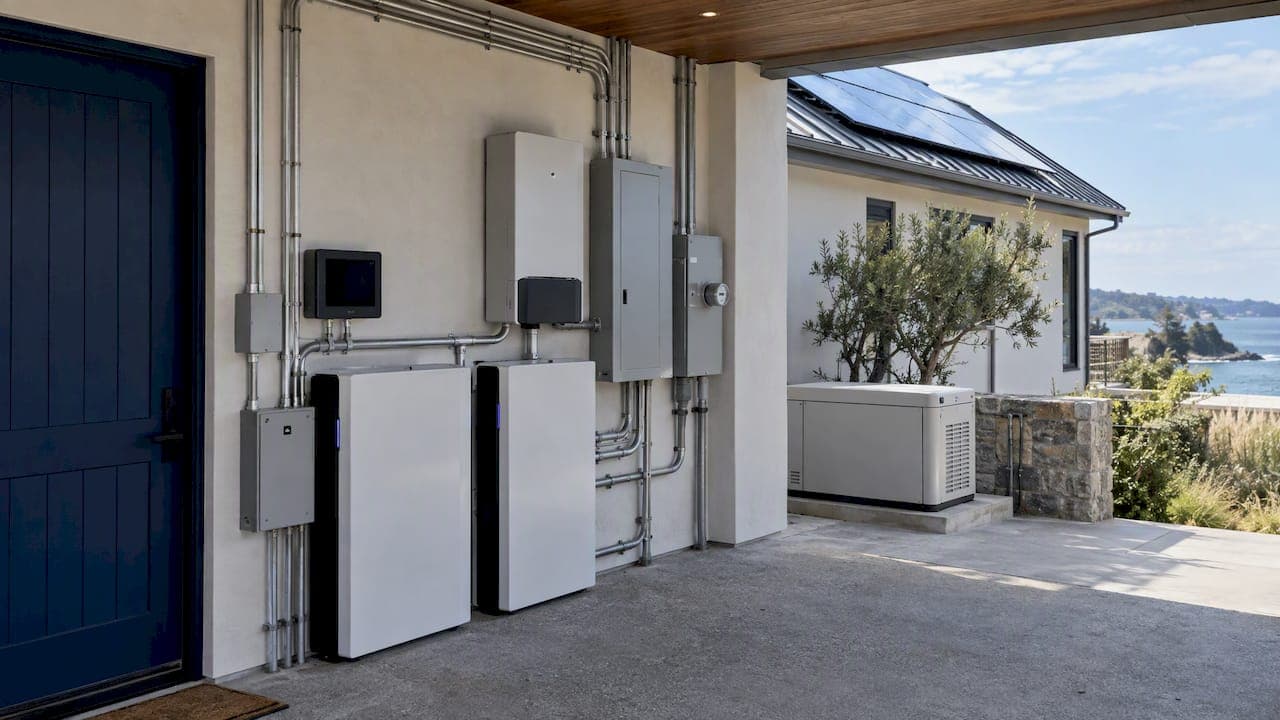
A time-of-use battery is a home battery that charges when electricity is cheap, from your solar panels or the grid, and discharges when your utility charges the most. Whether that pays off depends on your tariff, your loads and how you set the battery's priorities. On a flat rate it saves very little. On a rate with a wide peak spread or a demand charge, it can be the most useful part of your system.
This guide explains how the mechanism works, what decides the savings, how to size the battery, and the tradeoff most product pages skip: every kilowatt-hour you spend on bill savings is a kilowatt-hour you won't have in an outage.
TL;DR
- A time-of-use (TOU) battery shifts energy from low-price hours to high-price hours. Savings come from the price spread, the energy shifted and the battery's losses, so they are not guaranteed.
- Peak shaving is a different goal from TOU shifting. It targets demand charges (kW), and a battery that charges at the wrong moment can create a new peak.
- Bill-savings mode and backup mode compete for the same stored energy. Decide which one wins before you pick a battery size.
- Size from your actual loads (HVAC, pool, well, EV, guest house), using usable capacity, not the label on the battery.
- For large or complex properties, the battery works best as one part of an engineered system with controls, not a stand-alone appliance.
Table of Contents
- How a time-of-use battery works
- What decides whether it saves money
- TOU shifting versus peak shaving
- The tradeoff: bill savings versus outage backup
- How to size a time-of-use battery
- Where TOU batteries fit best, and where they don't
- Installation matters as much as the tariff
- Our perspective: treat the battery as one part of the system
- What a Prime Microgrid design includes
- Questions to ask before you commit
- FAQ
- Sources
How a time-of-use battery works
Under a TOU tariff, your utility charges different prices per kilowatt-hour at different times of day and sometimes by season. A battery exploits that in three steps:
- Charge during the cheapest period, usually overnight or midday when solar production is high.
- Hold the energy until the price climbs.
- Discharge to run your home during the peak window, so you buy little or nothing from the grid when it costs the most.
Utilities describe this directly. PG&E calls it a bill savings (time-based) mode, and it is separate from backup mode, which holds energy back for outages. Berkeley Lab describes the same mechanism as arbitrage of energy charges: buying at low-priced hours and using it in high-priced ones.
Two things sit behind the simple picture. First, no battery returns every kilowatt-hour you put in, so the price spread has to be big enough to cover those round-trip losses. Second, the battery needs an inverter and controls that follow a schedule, and those settings matter as much as the cells.
What decides whether it saves money
The same hardware can perform well on one tariff and poorly on another. Berkeley Lab's rate-design research makes this the central point: the financial value of behind-the-meter storage is highly dependent on rate design. In practice, four things decide the outcome.
The peak and off-peak spread
A wide gap between off-peak and peak prices gives the battery room to earn. An OSTI study of TOU and net-metering customers notes that residential savings can be limited when the price difference is small and there is no demand charge. If your utility offers a TOU plan with only a few cents of difference, a battery alone will rarely justify itself on bill savings.
Export compensation
If you have solar and your utility pays you well for exports, there is less reason to store midday energy. If export credit is low, storing it for the evening peak is worth more. This differs by utility and state, so check your current net metering or net billing terms before assuming anything.
Demand charges
Many commercial tariffs, and some residential ones, bill you for your highest power draw in a period, measured in kW, on top of energy in kWh. NYSERDA's guide to customer electric rates for storage explains how time-of-day delivery charges, standby charges and demand charges can all appear in the same rate structure. Large homes, estates and farms with big motors sometimes land on these tariffs.
Whether grid charging is allowed
Some utilities, incentive programs and interconnection agreements limit charging a battery from the grid. Others require solar-only charging for certain incentives. Verify your tariff, seasonal schedule, export rules and interconnection terms with your utility before you design around a charging strategy.
TOU shifting versus peak shaving
People searching for a TOU battery often also ask about peak shaving for a home. They are related but not the same.
| TOU shifting | Peak shaving | |
|---|---|---|
| What it reduces | Energy bought at high-price hours (kWh) | Highest power draw in a billing period (kW) |
| Billing line it hits | Energy charge | Demand charge |
| Control logic | Schedule based on clock and season | Real-time response to load spikes |
| Typical fit | Homes on TOU residential rates | Estates, farms, large homes and light commercial on demand tariffs |
| Risk if mis-set | Battery empty when the peak starts | Cheap-hour charging creates a new demand spike |
That last row is easy to miss. A system that simply charges at the cheapest hour can pull a large block of power at once and set a new demand peak, unless the controls optimize energy and demand together. This is why we treat controls and load management as part of the design, not an add-on. A large HVAC start, a pool pump, a well pump and an EV charger can stack up in the same few minutes.
The tradeoff: bill savings versus outage backup
A battery programmed to cut your bill is not the same as one programmed to protect you in an outage. A 2024 field study of 75 homes with 5 kW solar arrays and 13.5 kWh batteries compared the two. Homes on time-based control charged overnight and discharged during peak periods. Homes on backup-reserve control kept the battery full and held energy back for outages. The systems used a 20% minimum backup reserve, which left 80% available for normal use.

The lesson is plain. If you run the battery down every evening to avoid peak prices and the grid fails at 7 p.m., you may have little left. If you hold a high reserve, you give up some daily savings.
Pro tip: Set the reserve by season and by risk. A coastal home in hurricane season or a rural property with frequent winter outages should hold a higher reserve. In a calm month with a wide peak spread, a lower reserve can make sense. Good systems let you change this, and a well-designed one can do it automatically from a weather or outage signal.
My honest take: for homeowners who bought a battery because outages worry them, backup should come first and TOU savings second. The savings are a bonus on top of the protection, not a reason to leave your home exposed. If your outages are long, a battery alone has limits, which we cover in why battery-only backup has limitations for homes.
How to size a time-of-use battery
Sizing starts with what you want the battery to carry during the peak window, not with the biggest unit available.
- List the loads you want to run during the peak window. Include the large ones individually: HVAC, electric water heating, pool equipment, EV charging, well pumps and any guest house or detached building. DOE guidance gives the basic method: wattage multiplied by hours of use.
- Convert to kWh. Multiply each load's watts by its hours of operation, add them up and divide by 1,000.
- Use usable capacity. A battery's nameplate figure is not what you can draw. In the field study above, a 13.5 kWh battery with a 20% reserve gave about 10.8 kWh for everyday use. Inverter losses reduce it further.
- Check power as well as energy. A battery rated in kWh must also deliver enough kW to start your air conditioner and well pump at the same time. Large homes often run out of power rating before they run out of energy.
- Reduce first. DOE notes that efficiency measures are generally cheaper than buying more generation or storage. Shifting the pool pump schedule or pre-cooling the house before the peak can shrink the battery you need.
A worked example
Say a four-hour peak window and the following loads, using round illustrative numbers:
| Load | Power | Hours in peak | Energy |
|---|---|---|---|
| Central air conditioner | 3,500 W | 3 | 10.5 kWh |
| Refrigerators and lighting | 600 W | 4 | 2.4 kWh |
| Well pump | 1,000 W | 0.5 | 0.5 kWh |
| Electronics and cooking | 800 W | 4 | 3.2 kWh |
| Total | 16.6 kWh |
Covering all of that from a battery with a 20% reserve takes about 20.8 kWh of nameplate capacity (16.6 divided by 0.8), before inverter losses. If you only want to cover the air conditioner and essentials, the number drops sharply. This example is for illustration only: your loads, tariff and equipment will differ, and an engineer should confirm the figures against your actual usage data.
Where TOU batteries fit best, and where they don't
Good fit
- Homes on a TOU rate with a wide peak spread.
- Solar owners with low export compensation who want to use their own midday production in the evening.
- Properties with demand charges, such as estates, farms and homes with large auxiliary buildings.
- Owners who also want automatic outage protection and would buy a battery for that reason anyway.
Weaker fit
- Flat-rate customers, or those with a small peak spread and no demand charge.
- Homes with small loads where the battery would rarely cycle.
- Properties where the real problem is long outages, not price. A battery then needs a generator or other generation behind it.
Installation matters as much as the tariff
A home battery is electrical infrastructure, not a plug-in appliance. DOE guidance calls for protection from temperature extremes and safe access, and a 2025 DOE project description shows residential battery installations in garages, carports, utility closets or unfinished utility spaces, installed by certified personnel following health and safety procedures.
On remote or coastal properties, heat, humidity, salt air and flooding raise the stakes. Before sizing, check where the unit will live, how it is ventilated and how an inspector or firefighter would reach it. Our guides on battery enclosure ventilation and home battery safety, including UL 9540, 9540A and NFPA 855 cover what to ask your installer.
If you are pairing the battery with new rooftop solar, look at the roof first. A roof near the end of its life is expensive to reopen once panels are on it. This roof energy efficiency guide for Louisiana homes shows what a roofing contractor checks in storm-prone climates, and the same thinking applies on any hurricane coast.
Our perspective: treat the battery as one part of the system
We design residential microgrids, and we see the same pattern with TOU batteries. Owners start with a tariff question and discover a property question. A battery that shaves the evening peak is useful, but on an estate with a pool, a well, an EV charger and a guest house, the bigger gains come from how the whole system is controlled.

That is why we do not use generic packages. We size from the property's actual electrical demand and site conditions, then integrate generation, battery, generator and controls into one system. Load management decides which loads wait for off-peak hours. The battery handles the peak window. A generator, where the property needs one, covers outages that outlast the stored energy. The utility connection stays in the picture, so the system can import, export or island as the situation requires.
We also think owners should hear the limits plainly. A TOU battery will not pay for itself on every tariff, the savings depend on your utility's rules, and a battery programmed for maximum savings is a weaker outage defense. We would rather model both modes with your data and let you choose than promise a payback figure. If you want to compare approaches, our page on microgrids versus generators lays out where each one fits.
— Prime Microgrid
What a Prime Microgrid design includes
If you already own solar, a battery retrofit adds storage and controls to what you have. If you are planning new solar, we can design for future battery and generator integration from the start. For larger properties, our estate microgrid systems combine generation, storage, load control and utility integration under one engineered design, with installation and commissioning handled by us. Start with our residential battery storage page, or contact us through the main site to have an engineer review your property. For background on costs, see our article on the role of battery storage in cost reduction.
Questions to ask before you commit
- Which tariff will I be on, and how long is that rate guaranteed to stay in place?
- Does my utility allow grid charging, and does any incentive limit how I operate the battery?
- What is the usable capacity and continuous power output, not just the nameplate figure?
- Can I set a different reserve level for storm season?
- Will the controls manage demand as well as energy, if my tariff has a demand charge?
- Who is the certified installer, and who services the system afterward?
FAQ
Does a time-of-use battery work without solar?
Yes, if your utility allows charging from the grid. The battery charges at off-peak prices and discharges at peak prices. The savings come only from the price spread minus losses, so confirm both the spread and your utility's grid-charging rules first.
How much can a TOU battery save?
There is no honest single figure. Savings depend on your peak and off-peak prices, how much energy you shift and the battery's losses, and research notes they can be limited when the spread is small. A model built from your bills and tariff is the only reliable estimate.
Can I use the same battery for backup and for saving on peak rates?
Yes, but both draw on the same stored energy. Most systems keep a minimum reserve for outages, 20% in the 75-home field study, and use the rest for daily savings. A higher reserve gives more protection and less daily saving.
How do I calculate how long a battery will run my home?
Add the wattage of the loads you want to run, multiply by their hours to get watt-hours, and divide by 1,000 for kWh. Then compare that with the battery's usable capacity after the reserve and inverter losses, not the label figure.
Sources
- Residential Battery Storage, PG&E
- Implications of Rate Design for the Customer-Economics of Behind-the-Meter Storage, Berkeley Lab
- Maximizing the Cost-savings for Time-of-use and Net-metering Customers Using Behind-the-meter Energy Storage Systems, OSTI
- Energy Storage Customer Electric Rates Reference Guide, NYSERDA
- Performance Evaluation of 75 Residential Rooftop Solar PV and Battery Systems (2024)
- Battery Power for Your Residential Solar Electric System, U.S. Department of Energy
- Analysis and Field Validation of Home Battery Energy Storage Systems for Affordable Housing, U.S. Department of Energy