
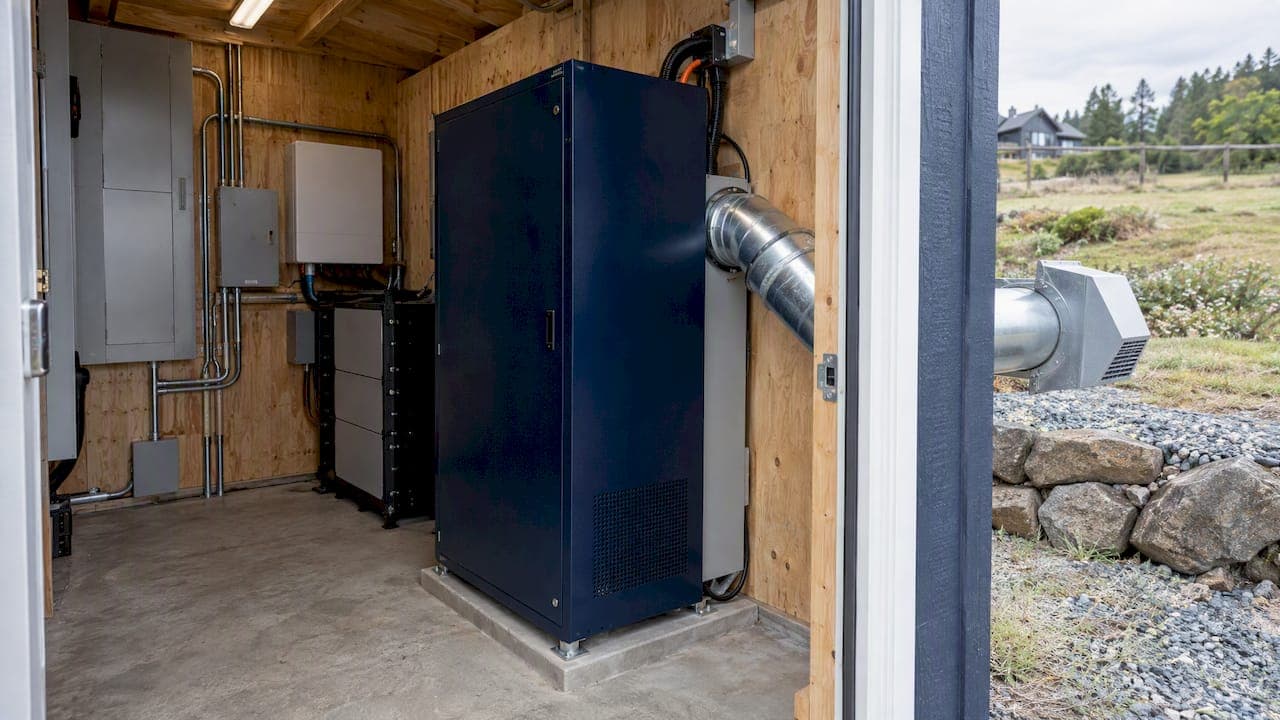
Vented lead-acid and Ni-Cd batteries typically need hydrogen dilution during charging, while VRLA depends on charge behavior and lithium-ion normally skips hydrogen ventilation in favor of engineered thermal-runaway controls under NFPA 855. Battery-room ventilation designs may use continuous ventilation or monitored ventilation with gas detection and interlocks. Either way, exhaust must terminate outdoors or into an engineered exhaust system.
TL;DR:
- Flooded lead acid and nickel cadmium batteries need hydrogen dilution; valve regulated lead acid needs site specific review, while lithium ion requires thermal runaway controls.
- Use continuous ventilation at 1 cfm per square foot, or monitored detection that keeps hydrogen below 1% of room volume, one quarter of the lower flammable limit.
- Hydrogen dilution does not guarantee safe battery temperatures; many manufacturers cite roughly 77°F as optimal, so size cooling for heat output, not gas production.
- Route exhaust outdoors or to an engineered exhaust system; use high level outlets and low level makeup air to move rising hydrogen out.
- Lithium ion storage needs a listed ESS enclosure and coordinated fire detection, suppression, gas detection, explosion control, and thermal runaway measures under NFPA 855.
Table of Contents
- When does a battery enclosure actually need ventilation?
- What the codes and standards require
- Continuous dilution vs. monitored ventilation: choosing a design approach
- Thermal management is a separate problem from gas dilution
- Cabinet vents, intake placement, and exhaust routing that actually works
- Installation, interlocks, and a maintenance checklist that holds up to inspection
- Lithium-ion and ESS-specific safety beyond ventilation
- How we think about ventilation when we design a system
- Get an engineered ventilation plan built into your system
- FAQ
- Sources
When does a battery enclosure actually need ventilation?
The answer depends on chemistry, how the battery is charged, and what the manufacturer's documentation says, not on a blanket rule you can apply to every cabinet.
Vented (flooded) lead-acid batteries and many Ni-Cd cells produce hydrogen gas as a normal part of charging, particularly during equalization or overcharge conditions. That gas needs somewhere to go, which is why OSHA's battery-charging rule requires unsealed batteries to sit in enclosures with outside vents or in well-ventilated rooms, with ventilation adequate to diffuse gases and prevent an explosive mixture from forming.
VRLA (valve-regulated lead-acid) batteries sit in a gray zone. Under normal float charging they recombine most of the gas internally, but a fault, overcharge, or thermal event can push them into gassing behavior similar to flooded cells. That is why IEEE 1635 / ASHRAE Guideline 21 treats VRLA as needing a site-specific ventilation review rather than a default exemption, with gassing rates confirmed against the manufacturer's data sheet.
Lithium-ion is different again. Under normal operation it does not generate hydrogen at levels that require dilution ventilation, but it introduces a separate hazard profile entirely: thermal runaway, off-gassing during failure, and the need for listed, engineered enclosures rather than a simple vented box.
Before sizing any ventilation system, check these three things:
- Chemistry and charge mode: flooded, VRLA, Ni-Cd, or lithium-ion, and whether charging is float, cyclic, or equalizing.
- Manufacturer gassing or thermal data: most battery manufacturers publish hydrogen evolution rates or reference IEEE/ASHRAE formulas.
- Listing and code status: whether the enclosure or battery system carries a listing that already specifies ventilation requirements.
What the codes and standards require
Several overlapping references set the numeric targets installers design to, and bringing these directly to your AHJ saves time during plan review. OSHA's rule for battery charging areas requires that unsealed batteries be housed where ventilation can diffuse gases, and it requires vent caps to stay installed and functional, since a blocked or corroded vent defeats an otherwise adequate design.
Mechanical-code guidance referenced through fire-extinguishing and detection system provisions describes continuous ventilation and monitored ventilation as design approaches. The applicable approach and ventilation requirements depend on the adopted code and the specific installation.
The 1 cfm/ft² continuous ventilation rate is one of two code-accepted design paths for diluting hydrogen in battery rooms, the other being monitored ventilation tied to gas detection, according to mechanical code guidance compiled by UpCodes. Mechanical ventilation systems used to meet either path must be supervised, and many jurisdictions require standby power so fans and detectors keep operating through a utility outage, a point echoed in code sections covering electrochemical ESS technology-specific protection.
Cabinets installed in occupied spaces carry their own clauses beyond the room-level requirements, often specifying supervision, alarm annunciation, and minimum opening sizes rather than leaving ventilation to judgment. Exhaust air, regardless of which path you choose, must discharge outdoors or into an engineered exhaust system. It cannot dump into a return air plenum, a crawlspace, or another occupied room.

Continuous dilution vs. monitored ventilation: choosing a design approach
Both code-accepted paths work, but they fit different projects.
Continuous ventilation may be a simpler option for some unconditioned enclosures, such as a detached battery shed or an outdoor cabinet where maintaining a temperature setpoint is not a concern. There is no detection hardware to maintain, and the fan simply runs whenever the batteries are charging or, in many designs, continuously. The tradeoff is that you are constantly exhausting air, which becomes expensive and impractical in a conditioned mechanical room where you also need to control temperature.
Monitored ventilation solves that problem by using hydrogen sensors interlocked with exhaust fans and alarms, so the system only exhausts at volume when gas concentration actually rises. Design guidance from ACHR News notes that for air-conditioned or larger spaces, monitoring and limiting hydrogen concentration is often preferred over continuous exhaust precisely because it avoids wasting conditioned air.
Setting up a monitored system involves a few sequential steps:
- Calculate worst-case hydrogen evolution using manufacturer data or the formulas in IEEE 1635, rather than assuming a generic rate applies to your chemistry.
- Set detector alarm tiers according to the applicable code, system design, and manufacturer instructions.
- Interlock the exhaust fan and alarm to the detector output, with a flow switch confirming the fan is actually moving air, not just powered on.
- Provide standby power for the fan and detector so the system functions during a grid outage, when battery activity often increases.
- Route the exhaust outdoors or to an engineered exhaust system, never into occupied space.
Pro Tip: Size the detector and alarm setpoints to the worst-case charging scenario (equalization or boost charging), not the average daily charge cycle, since that is when gassing rates peak.
Thermal management is a separate problem from gas dilution
Ventilation sized to dilute hydrogen will not necessarily keep your batteries at a healthy temperature, and conflating the two is one of the more common design mistakes we see. IEEE and ASHRAE guidance frames ventilation as serving two distinct functions: explosion control and thermal management, and a cabinet can pass one test while failing the other.
Battery life is sensitive to temperature. Many manufacturers reference roughly 77°F as an optimal operating point for maximizing service life and honoring warranty terms, with capacity and lifespan both declining as ambient temperature climbs above that range. A vent fan sized purely for hydrogen dilution may move far less air than what is needed to remove the heat generated during a heavy charge or discharge cycle, especially in a dense battery bank.
Practical options for closing that gap include:
- Dedicated cooling sized to the battery bank's heat output rather than its gassing rate.
- Packaged cooling hoods or mini-split systems built into larger battery rooms.
- HVAC integration coordinated between the electrical and mechanical designer, as IEEE 1635 recommends, so neither discipline assumes the other has covered thermal load.
When air conditioning is part of the design, monitored ventilation with gas detection is usually the better fit, since it avoids continuously exhausting conditioned air just to satisfy a dilution rate the room does not actually need at that moment.
Cabinet vents, intake placement, and exhaust routing that actually works
Hydrogen is lighter than air and rises, which should drive where you put your openings. In a room, that means high-level exhaust paired with low-level makeup air, so gas is pulled up and out rather than allowed to pool near the ceiling. In a cabinet, the same logic applies at a smaller scale: top exhaust ducting and bottom intake openings, a layout reflected in construction clauses like §111.15-10 governing storage battery ventilation, which specifies exhaust ducting that extends above the enclosure and intake openings near the floor.
A few field details matter more than they might seem to on paper:
- Exhaust must terminate outdoors or into an engineered exhaust system, never into a ceiling plenum, crawlspace, or occupied room, a point OSHA's charging-area guidance makes explicit.
- Deck boxes and outdoor cabinets typically need goosenecks or mushroom heads on exhaust openings to keep rain out while still allowing gas to escape.
- Louvers on at least two parallel sides improve cross-ventilation in cabinet designs where a single opening would create dead air pockets.
- Intake filters protect against dust and insects, but every filter adds pressure drop, so fan sizing has to account for a dirty-filter condition, not just a clean one.
Natural ventilation, relying on passive openings without a fan, is tempting for small installations, but it is sensitive to enclosure geometry, wind conditions, and temperature differentials. Mechanical ventilation, continuous or detection-controlled, gives you a verifiable airflow rate instead of a hopeful one.
Installation, interlocks, and a maintenance checklist that holds up to inspection
Getting the ventilation system installed correctly is only half the job. Codes expect it to keep working, which means supervision, standby power, and a documented maintenance routine.
- Interlock ventilation with the battery charger where the adopted code requires it, so charging cannot proceed if the exhaust fan has failed.
- Use non-sparking fans and flow switches rated for the hydrogen-bearing environment, confirming the fan is actually moving air rather than just drawing power.
- Provide supervised alarms that annunciate at an attended location or a monitored central station, consistent with mechanical code and NFPA/NEC cross-references covering fire-extinguishing and detection systems and ESS technology-specific protection.
- Size standby power to cover the fan and detector for whatever duration your jurisdiction requires, since outages often coincide with heavier battery use.
- Inspect vent caps regularly for corrosion, blockage, or missing hardware, a maintenance item OSHA calls out specifically because a battery enclosure with a well-designed vent path still fails if the vent cap itself is clogged.
- Test gas detectors and interlocks on a documented schedule and replace intake filters before pressure drop undermines your design airflow.
Pro Tip: Keep a simple log of vent cap inspections, detector calibration dates, and filter changes. It is the first thing an AHJ asks for during a commissioning walkthrough, and it is far easier to produce than to reconstruct after the fact.
Lithium-ion and ESS-specific safety beyond ventilation
A lithium-ion battery enclosure is not a lead-acid cabinet with a different label on it, and treating it that way misses the actual hazard. NFPA 855 requires ESS installations to address fire detection and suppression, explosion control, exhaust ventilation, gas detection, and thermal-runaway mitigation together, as a system, rather than relying on ventilation alone to carry the safety case.
NFPA's ESS framework treats exhaust ventilation as one of several interacting safety functions, alongside gas detection, fire detection, suppression, and explosion control, that a hazard mitigation analysis must evaluate for reliability, per NFPA's own standard development summary. That analysis, often called a hazard mitigation analysis or HMA, looks at how the enclosure, detection systems, and suppression measures behave together during an off-gassing or thermal-runaway event, not just whether a fan is big enough.
Practical implications for installers:
- Use enclosures that carry an actual listing for ESS applications rather than adapting a general-purpose cabinet.
- Follow manufacturer instructions over generic lead-acid vent layouts, since lithium failure modes do not behave like hydrogen accumulation.
- Plan for detection and response, including containment and safe evacuation paths, as part of the same design package as ventilation.
If you want more detail on how chemistry drives these differences, our breakdown of why battery chemistry matters for home storage walks through the practical distinctions between lead-acid and lithium hazard profiles.
How we think about ventilation when we design a system
We treat ventilation and thermal management as important considerations in system design. Every system we design is customized to the property's actual electrical demand and site conditions.
That means coordinating the design with the installation's requirements and incorporating relevant considerations into the system design.
— Prime Microgrid
Get an engineered ventilation plan built into your system
Figuring out whether your enclosure needs continuous dilution, monitored detection, or a full ESS safety package depends on specifics most generic guides cannot cover, which is exactly where our engineering process steps in. Our system design, installation, and commissioning process is part of developing a custom power system for your property.

For homeowners and property owners planning a battery addition, our estate microgrid and battery retrofit systems are engineered around your site's actual electrical demand. If you are weighing options for your property, request a site evaluation and we will discuss your needs as part of the design.
FAQ
What happens if you don't vent a battery enclosure?
Without adequate ventilation, hydrogen gas from charging can accumulate and reach concentrations capable of igniting, which is why OSHA requires unsealed battery enclosures to have outside vents or sit in well-ventilated rooms. Poor ventilation also traps heat, shortening battery life even when gas levels stay within a safe range.
What are the ventilation requirements for a battery charging room?
Battery charging rooms generally follow one of two code-accepted paths: continuous ventilation at 1 cfm per square foot of floor area, or monitored ventilation that limits hydrogen to 1% of room volume, equal to 25% of the lower flammable limit, as described in mechanical code guidance. Mechanical systems used for either path typically need supervision and standby power.
Why do we charge batteries in a well ventilated area?
Charging batteries, particularly vented lead-acid and Ni-Cd types, releases hydrogen gas that needs to disperse before it reaches an explosive concentration. OSHA's charging-area guidance identifies adequate ventilation as a critical safety measure specifically because charging increases gas generation beyond normal standby levels.
Where does the battery vent hose go?
A battery vent hose or exhaust path must terminate outdoors or into an engineered exhaust system, never into an occupied room, ceiling plenum, or crawlspace. This routing requirement comes directly from OSHA guidance on battery charging areas, which treats improper termination as a basic safety failure regardless of how well the rest of the system is designed.
Sources
- 1926.441 - Batteries and battery charging. | Occupational Safety and Health Administration
- IEEE SA - IEEE 1635-2012
- Fire-Extinguishing and Detection Systems | UpCodes