

Battery-only backup systems are finite energy reservoirs, not unlimited power sources, and that distinction defines every decision a homeowner should make about outage preparedness. A system like the Tesla Powerwall 3, rated at 13.5 kWh, sounds substantial until you run a central air conditioner for a few hours and discover the tank is empty. The drawbacks of battery backup go well beyond simple capacity numbers. Inverter ceilings, surge loads, temperature losses, and human behavior during outages all chip away at real-world runtime. This article explains why battery-only backup has limitations that no amount of marketing language resolves, and what smarter backup planning actually looks like.
Why battery-only backup has limitations in real outage conditions
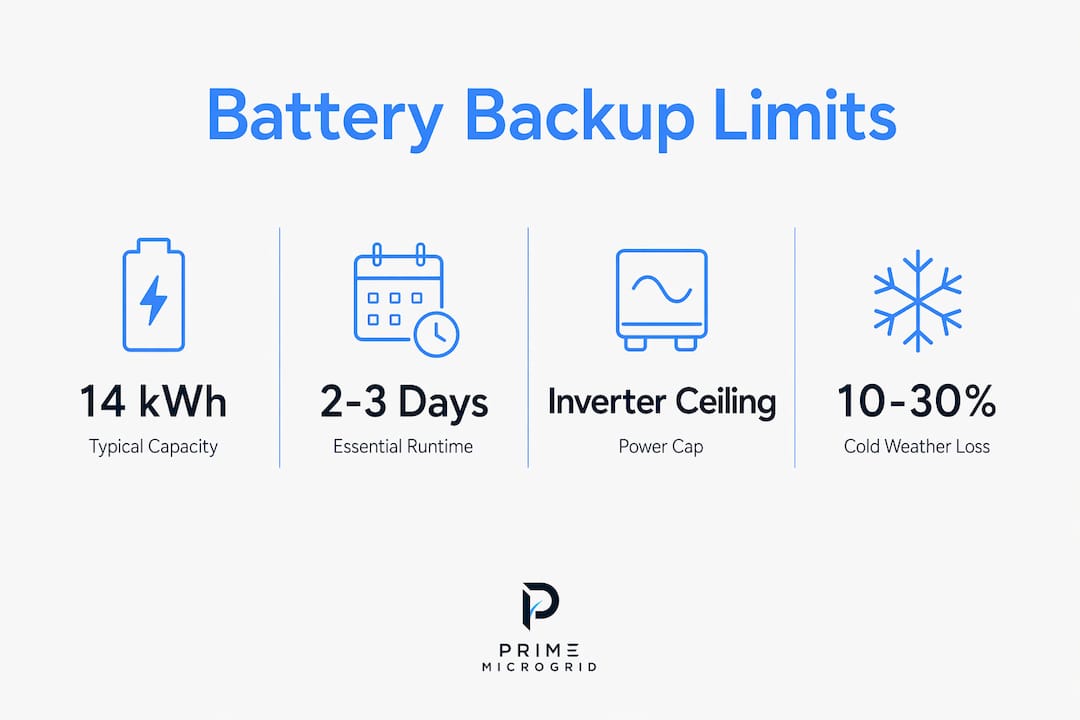
The most direct way to understand battery backup limitations is through runtime math under realistic load conditions. A standalone 14 kWh battery without solar can support essential loads like a refrigerator, lights, and phone charging for two to three days. Add a central air conditioner and that same battery drains in less than 24 hours. That gap between "essentials only" and "normal household use" is where most homeowners get surprised.
The industry term for what most people call a "battery backup" is a battery energy storage system, or BESS. These systems store DC electricity and release it through an inverter as AC power for your home. The storage capacity, measured in kilowatt-hours, tells you how much total energy is available. What it does not tell you is how fast you will use it, or whether the inverter can keep up with your appliances.
Pro Tip: Before buying any battery system, list every appliance you plan to run during an outage and add up their wattage. Compare that total to the inverter's continuous output rating, not just the battery's kWh capacity.
Consider a typical American home running a refrigerator (150W), LED lighting (200W), a few device chargers (100W), and a window AC unit (1,200W). That adds up to roughly 1,650 watts of continuous draw. A 14 kWh battery at that load lasts about 8.5 hours. Remove the AC and the same battery lasts nearly four days. The choice of what to power is not a preference. It is the core engineering decision of the entire system.

| Load scenario | Estimated runtime (14 kWh battery) |
|---|---|
| Essentials only (fridge, lights, chargers) | 2 to 3 days |
| Essentials plus window AC unit | 8 to 10 hours |
| Essentials plus central AC (5-ton) | Under 4 hours |
| Whole-home average draw | 12 to 18 hours |
How inverter limits and surge power cause unexpected shutdowns
Capacity is only one bottleneck. The inverter's output ceiling is the other, and it catches homeowners completely off guard. Surge loads can exceed inverter peak power even when the battery's state of charge is high, causing an immediate system trip. Motors and compressors, including those in refrigerators, well pumps, and HVAC systems, can require two to six times their running wattage at startup. A well pump rated at 1,000 watts running may demand 4,000 to 6,000 watts for the half-second it takes to start.
A battery at 100% charge can instantly shut down if inverter power limits are exceeded. This is one of the most misunderstood failure modes in residential backup. The system appears to be working fine, the battery shows full charge, and then a single appliance startup trips the whole thing offline. This is what the industry calls a depletion failure at the inverter level, not the storage level.
Here is where the disadvantages of battery-only systems compound:
- Startup surge mismatch: A 7.6 kW inverter like the one in the Powerwall 3 handles most household loads, but a 5-ton central AC unit alone can demand 10 to 15 kW at startup.
- Inverter idle draw: Every inverter consumes power just to stay on, typically 15 to 30 watts continuously, which adds up over multi-day outages.
- DC-to-AC conversion losses: Converting stored DC power to AC and then back to DC inside devices (laptops, phone chargers, LED drivers) wastes roughly 10 to 20% of every watt-hour you stored.
- Reconversion savings: Using DC or USB outputs directly from a battery bypasses the inverter entirely and reduces energy conversion loss significantly, extending total runtime for small devices.
Pro Tip: If your backup system includes a well pump or sump pump, check the startup surge rating on the motor nameplate, not just the running watts. Size your inverter to handle that surge, or plan to run those loads on a separate generator circuit.
Battery failures during outages often occur as depletion failures when inverter capacity becomes insufficient to handle peak or surge loads, leading to sudden shutdown. The system seems to work until load surpasses inverter capability, then cuts out abruptly. That is not a malfunction. It is the system doing exactly what it was designed to do. The problem is that most homeowners never knew the ceiling existed.
Why weather and human behavior reduce battery backup effectiveness
Environmental conditions and how people actually behave during outages both cut into battery backup effectiveness in ways that lab specifications never capture. Cold temperatures reduce battery usable capacity by 10 to 30%, and most residential batteries are installed in garages or basements that regularly fall below the ideal operating range of 60 to 80 degrees Fahrenheit. A Tesla Powerwall or LG Chem RESU installed in an unheated garage in January in Pennsylvania is not delivering its rated 13.5 kWh. It may deliver 10 kWh or less.
Storms that cause outages also tend to bring cloud cover, which eliminates solar recharge for any system paired with panels. That means the battery you were counting on to recharge daily from your solar array is now a one-time reserve until the grid comes back. Battery-only systems relying solely on grid charging are one-time reserves by definition. Once depleted, they require grid power to recharge, which limits outage autonomy to a single discharge cycle.
Human behavior during outages makes the math worse in predictable ways:
- People gather in fewer rooms, concentrating lighting and device charging loads into one or two spaces instead of spreading them across the house.
- Refrigerator and freezer doors get opened more frequently as family members check on food, increasing compressor cycling.
- Anxiety and boredom drive higher screen time, meaning televisions, tablets, and laptops run longer than on a normal day.
- Heating or cooling needs often spike because the outage coincides with extreme weather, which is frequently what caused it in the first place.
None of these behaviors are irrational. They are normal. But they mean that your real-world battery runtime will almost always be shorter than any estimate based on average daily consumption.
What are the practical strategies for managing battery backup limitations?
The most effective response to battery backup limitations is not buying a bigger battery. It is designing around consequences rather than convenience. Backup failures result more often from lack of load prioritization than from insufficient battery size. Treating all loads equally causes premature depletion and system collapse.
The first decision is whether you need whole-home backup or a critical load panel. Whole-home backup is expensive because load size climbs rapidly when you include high-draw circuits like central AC, electric ranges, and electric water heaters. A critical load panel isolates only the circuits that matter most, such as the refrigerator, a few lights, medical equipment, and internet. This approach costs less and delivers more reliable runtime from the same battery capacity. You can read more about prioritizing essential circuits to build a practical load list before sizing any system.
Smart load management can extend battery runtime by 40%, but it adds complexity and significant upfront cost, often $2,500 or more for a smart panel alone. These systems use software to shed non-critical loads automatically when battery reserves drop below a threshold. The tradeoff is real: the software can fail, require manual override during an emergency, or behave unexpectedly when multiple high-draw appliances cycle simultaneously.
Here is a practical sequence for building a more reliable backup plan:
- Audit your critical loads. List every circuit you genuinely need during a 72-hour outage and calculate total wattage including startup surge.
- Install a critical load panel. Isolate those circuits so your battery serves only what matters.
- Size the battery to the critical load panel, not the whole house. This reduces cost and extends runtime.
- Add solar if multi-day outages are a realistic risk. Solar pairing converts a one-time reserve into a daily rechargeable system.
- Consider a generator or microgrid for extended outages. A battery versus generator comparison shows that hybrid systems cover scenarios that neither technology handles well alone.
Experts note that "whole-home backup" is often an aspirational marketing term. Real designs that deliver cost-effective reliability start with critical loads. That is not a compromise. It is the correct engineering approach. Batteries also have finite lifespans measured in cycles, with degradation accelerated by deep cycling and poor control systems, which means oversizing a battery and cycling it deeply every outage shortens its useful life faster than a right-sized system used conservatively.
Key takeaways
Battery-only backup systems fail most homeowners not because the technology is bad, but because the systems are sized and used without accounting for inverter limits, surge loads, temperature losses, and realistic human behavior during outages.
| Point | Details |
|---|---|
| Capacity is not the only limit | Inverter output ceilings cause shutdowns even when the battery is fully charged. |
| Cold weather cuts real capacity | Temperatures below 60°F reduce usable battery output by 10 to 30% in garages and basements. |
| Prioritize loads, not battery size | Backup failures happen more often from poor load management than from undersized batteries. |
| Solar pairing changes the equation | Without solar, a battery is a one-time reserve that cannot recharge until the grid returns. |
| Smart panels add runtime but add cost | Load management technology can extend runtime by 40% but costs $2,500 or more upfront. |
The honest case against treating batteries as a complete solution
I have worked with enough homeowners after bad outages to know that the disappointment is almost never about the battery itself. It is about the gap between what they expected and what the system was actually designed to do. A Tesla Powerwall is a well-engineered product. So is an Enphase IQ Battery or a Franklin Electric aGate. None of them are whole-home replacements for grid power. They are finite reservoirs with hard ceilings, and the marketing around them rarely makes that clear.
What I find most telling is that the failures I hear about most often are not dramatic. The battery does not explode or malfunction. It just quietly runs out at 2 a.m. on the second night of an outage, and the homeowner wakes up to a warm refrigerator and a dead sump pump. That is a depletion failure, and it was entirely predictable from the load math done before installation.
The smarter framing is to treat a battery system the way you treat a spare tire. It gets you somewhere safe. It does not replace your regular tires. If you need to drive 300 miles on a spare, you need a different plan. For outages longer than 24 to 48 hours with real loads, that different plan is a hybrid microgrid: solar, battery, and a generator or grid connection working together under smart controls. That combination eliminates the single-point failure that every battery-only system carries by design. The whole-home versus partial backup distinction is not a technicality. It is the difference between a system that works when you need it and one that runs out before the outage ends.
— David
Build backup power that does not run out

The limitations covered in this article are real, but they are also solvable. Primemicrogrid designs residential energy systems that combine battery storage, solar, generators, and smart load controls into a single managed solution. Instead of a battery that depletes and waits for the grid, you get a system that recharges, adapts, and keeps your critical loads running through extended outages. If you are in the Mid-Atlantic region, explore residential microgrid options built specifically for whole-home reliability. For homeowners weighing all their options, a microgrid versus generator comparison shows exactly where each technology fits and where it falls short.
FAQ
How long does a 14 kWh battery last during a power outage?
A 14 kWh battery supports essential loads like a refrigerator, lights, and device chargers for two to three days. Running a central air conditioner reduces that runtime to less than 24 hours.
Why does my battery backup shut down even when it shows a full charge?
A full battery can still trip offline if the inverter's output limit is exceeded by a surge load. Motors and compressors can demand two to six times their running wattage at startup, which exceeds the inverter's peak capacity.
Does cold weather affect battery backup performance?
Cold temperatures reduce usable battery capacity by 10 to 30%. Batteries installed in unheated garages or basements regularly operate below their rated output during winter outages.
What is a critical load panel and why does it matter?
A critical load panel isolates only the circuits you need most during an outage, such as the refrigerator, lights, and medical equipment. This approach extends battery runtime and reduces system cost compared to whole-home backup.
Is a battery backup system enough for a multi-day outage?
A battery-only system without solar is a one-time reserve. Once depleted, it requires grid power to recharge. For outages lasting more than 48 hours, a hybrid system combining solar, battery, and a generator provides far more reliable coverage.