
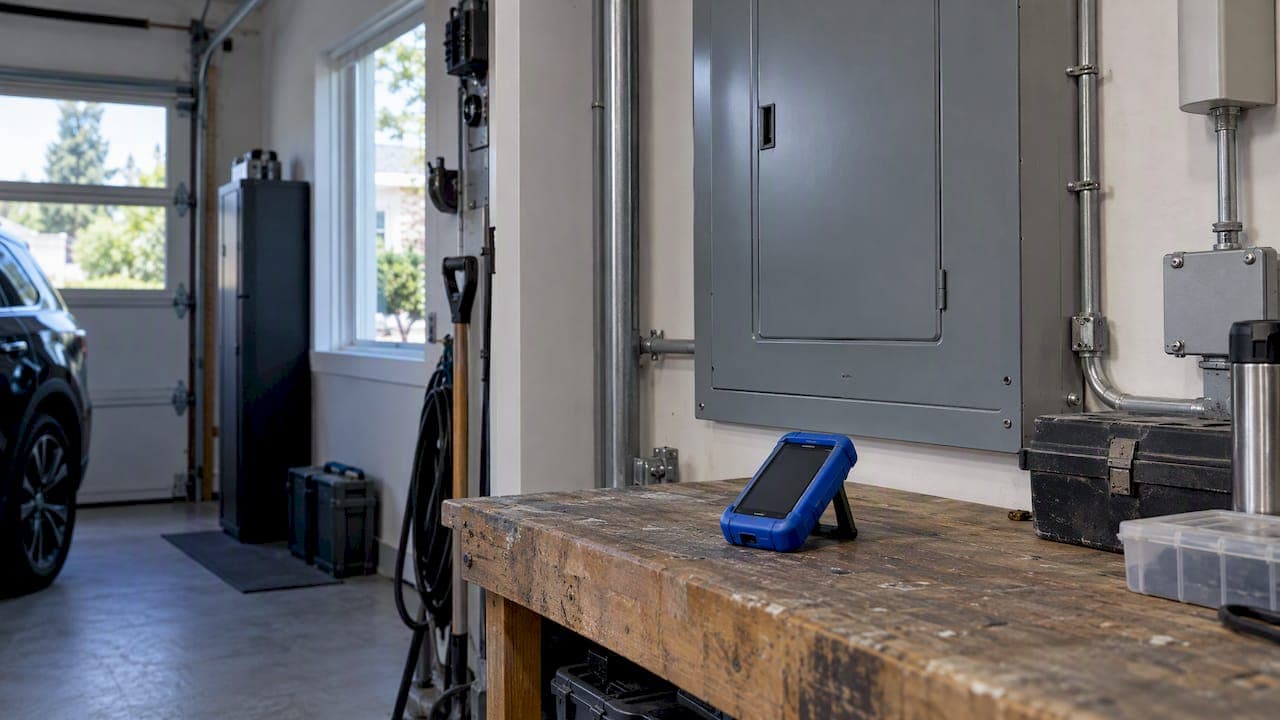
Power quality at home means your voltage, frequency, and waveform stay within the ranges your appliances and electronics expect, instead of drifting into sags, spikes, or distortion that cause flicker, resets, or early failures. If you're seeing those symptoms, start with two moves: install a surge protective device at your service panel, which NEC 2020 now requires for new or replaced dwelling panels, and begin logging when problems happen. Many issues trace back to wiring behind your own meter, not the utility.
TL;DR:
- Plug in voltage loggers can catch obvious sags and swells at one outlet, but they cannot detect waveform distortion or fast transients.
- For intermittent problems, monitor for one to two weeks; seasonal heating or cooling issues may require a longer period across different weather conditions.
- Line interactive UPS units handle moderate sags and brief outages for networking gear; online double conversion models provide cleaner power for sensitive equipment.
- A panel surge device or a few outlet protectors can take hours to a day and cost in the low to mid hundreds of dollars.
- Sparks, a burning smell, or any shock sensation require you to stop troubleshooting, switch off the affected circuit, and call a licensed electrician immediately.
Table of Contents
- Common power quality problems homeowners face
- Signs and quick checks: how to spot power-quality symptoms at home
- How homeowners monitor power quality: tools and practical options
- Practical mitigation: layered protections and where to invest first
- When monitoring and mitigation become a project: expected scope, timeline, and rough costs
- Applied options and installer checklist from an engineering integrator's perspective
- Self-help troubleshooting checklist before you call a pro
- How power quality affects specific home appliances and electronics
- Benefits of integrating power quality solutions with residential microgrid systems
- Backup power options related to power quality improvement
- Role of smart controls and load management in home power quality
- Why power quality belongs in home reliability planning
- FAQ
- Sources
Common power quality problems homeowners face
Most residential complaints fall into a handful of recognized categories, and knowing which one you're dealing with makes conversations with an electrician much faster.
- Sags and dips: brief voltage drops, often from a large appliance or air conditioner compressor starting up, that dim lights for a second.
- Swells and spikes: short voltage increases, sometimes from utility switching or a large load turning off nearby, that can stress sensitive electronics.
- Transients: fast, high-energy spikes, typically from lightning or grid switching, that are the main target of surge protection.
- Harmonics: waveform distortion from nonlinear loads like LED drivers, variable-frequency drives, and electronics with switching power supplies.
- Voltage unbalance: uneven voltage across phases, more common in homes with larger three-phase equipment or agricultural service.
- Interruptions: full loss of power, from momentary blinks to extended outages.
According to the definition used in power engineering, power quality describes how closely voltage, frequency, and waveform match the specifications equipment is designed around, and roughly 80% of these problems originate on the customer's side of the meter rather than on the utility's equipment. That statistic matters because it means the fix is often in your panel, wiring, or devices, not something the utility needs to repair.
Signs and quick checks: how to spot power-quality symptoms at home
Before you call anyone, a short period of careful observation tells you more than guessing ever will. The HTA Certified guide lists flickering lights, premature appliance failure, buzzing equipment, and electronic resets as the most common signs homeowners report.
- Watch for flicker, resets, or buzzing in lights, electronics, or transformers, especially if they repeat.
- Note nuisance breaker trips that happen without an obvious overload.
- Check for correlation with time of day, specific appliances cycling, or weather events like storms.
- Compare whole-house versus single-outlet symptoms to narrow down whether the issue is at the panel or a local circuit.
- Keep a trouble log with timestamps, duration, the circuit or room affected, and what was running at the time.
A utility resource from PG&E's power quality guidance recommends this same kind of trouble log as the starting point for any formal complaint or diagnostic visit, since it gives a technician a pattern to work from instead of a one-time anecdote.
How homeowners monitor power quality: tools and practical options
Monitoring options span a wide budget range, and the right choice depends on how often your symptoms occur and how precise you need the data to be.
- Plug-in voltage loggers and smart outlets record voltage over time at a single outlet, useful for catching obvious sags or swells but blind to waveform distortion.
- Clamp meters and portable power-quality loggers add measurement of total harmonic distortion (THD), sag and swell events, and some transient capture.
- Professional PQ analyzers, the kind an electrician or engineer brings on site, meet IEC 61000-4-30 measurement standards and catch the fast transients and harmonics that consumer tools miss.
- Smart panels and home energy management systems offer continuous monitoring with event logs, which is convenient if you already have one installed for other reasons.
For intermittent problems, plan on monitoring for one to two weeks; seasonal issues tied to heating or air conditioning loads may need a longer window spanning different weather conditions. Whatever tool you use, electricians want the same core data: timestamps, magnitude, duration, and which circuit was affected.
Pro Tip: Label your monitoring data by circuit and time of day as you collect it. A disorganized log of numbers is far less useful to an electrician than ten clearly annotated events.
Practical mitigation: layered protections and where to invest first
Mitigation works best as a sequence, starting with the code-required baseline and adding layers only where your trouble log justifies them.
-
Whole-home surge protective device at the service panel: the baseline step, now a code requirement under NEC 2020 for new or replaced residential panels.
-
Point-of-use SPDs: additional protection for high-value electronics like home theater systems or office equipment, layered on top of the panel device.
-
Uninterruptible power supplies (UPS): line-interactive units handle moderate sags and brief outages for things like networking gear, while online double-conversion units give cleaner, continuous power for more sensitive equipment.
-
Voltage regulation or power conditioning: addresses persistent high or low voltage rather than momentary events.
-
Wiring, grounding, and panel upgrades: often the actual root cause behind flicker or nuisance trips that surge protection alone won't fix.
**Utilities manage voltage at the grid level and maintain it within regulated ranges, but LADWP's power quality page makes clear that protecting equipment sensitive to normal variation within those limits is the homeowner's responsibility. This is the practical argument for layered protection rather than relying on the utility to solve a problem that sits on your side of the meter.
Batteries and integrated backup systems become relevant once you're dealing with extended outages or want resilience beyond momentary events, but they sit at the higher-cost end of this sequence and are worth considering only after the basics are in place.
When monitoring and mitigation become a project: expected scope, timeline, and rough costs
Project scope ranges widely depending on what your monitoring data actually shows.
- Small installs like a panel SPD or a handful of point-of-use devices typically take a few hours to a day and run low to mid hundreds of dollars.
- Panel upgrades or wiring fixes, when loose connections or undersized conductors are the real culprit, usually take one to three days and run from mid hundreds to a few thousand dollars.
- Whole-house conditioning, UPS systems, battery storage, or microgrid integration involve multi-week design and installation work, with costs ranging from thousands to tens of thousands of dollars depending on scope.
The trouble log and monitoring data you collect earlier directly narrow this scope. A contractor bidding on a documented, specific problem gives a tighter, more accurate quote than one working from a vague description of "flickering lights sometimes."
Applied options and installer checklist from an engineering integrator's perspective
A sound diagnostic workflow starts with a site survey, moves into a monitoring period, and only then produces a prioritized recommendation tied to what the data actually shows rather than a generic package. We design every system around a property's actual electrical demand and site conditions, which means monitoring results drive the intervention plan instead of guesswork.
When you work with a qualified integrator, expect a site survey, a defined monitoring period, written recommendations ranked by priority, and commissioning with a warranty on the completed work. For homeowners who find that power quality issues point toward a larger resilience need, whether that's frequent outages, aging infrastructure, or interest in combining generation and storage, our systems integrate generation, battery, generator, and controls into a single unified setup rather than a stack of disconnected fixes. Readers interested in how on-site generation ties into the broader grid can also look at grid interconnection considerations before committing to a design.
Self-help troubleshooting checklist before you call a pro
A short DIY process before any service call saves time and gives a technician better information to work with.
- Start a trouble log with date, time, duration, and the circuit involved.
- Isolate suspect circuits by noting which breaker feeds the affected area.
- Try a plug-in voltage logger at the outlet showing symptoms.
- Photograph your panel and breaker labels so you have a record before any work begins.
- Watch for repeating patterns, such as symptoms that always appear when a specific appliance cycles on.
Pro Tip: Share your log, photos, and exact symptom timing with the electrician before the visit. It lets them bring the right test equipment the first time instead of guessing on site.
Some signs mean stop troubleshooting immediately and shut off the circuit: sparks, a burning smell, or any shock sensation at a switch or fixture. Those are not monitoring situations, they're calls to a licensed electrician right away.
How power quality affects specific home appliances and electronics
Different devices tolerate power quality problems very differently. Motors in refrigerators, air conditioners, and washing machines are relatively forgiving of brief sags but can overheat or wear out faster under sustained voltage unbalance. Electronic devices with switching power supplies, including televisions, computers, and LED drivers, are more sensitive to harmonics and fast transients, since distorted waveforms can cause erratic behavior or accelerate component aging inside the supply itself.
Home electronics with microprocessors, like smart thermostats, routers, and security systems, are particularly prone to resets or lockups from momentary sags and swells that a motor-driven appliance wouldn't even register. Variable-frequency drives in modern HVAC systems and pumps are a double-edged case: they help manage motor loads efficiently, but they also generate harmonic distortion that can feed back into your home's wiring and affect other nearby electronics.
LED lighting deserves a specific mention, since LED drivers are nonlinear loads that both produce harmonics and are themselves sensitive to voltage swells, which is why flicker in LED fixtures is often one of the earliest visible symptoms of a power quality problem elsewhere in the home. Matching protection to device sensitivity, rather than assuming one surge strip covers everything, is the practical takeaway here.
Benefits of integrating power quality solutions with residential microgrid systems
Pairing power quality fixes with a broader microgrid or distributed energy setup addresses a problem that standalone surge protection can't: it gives you active control over the voltage and waveform your home actually sees, rather than just absorbing transients after they occur. A properly designed system can isolate your home's critical circuits from utility-side disturbances entirely during an event, which is a different level of protection than a panel SPD provides on its own.
Battery storage integrated into a microgrid can also smooth out the kind of momentary sags and swells that cause flicker and resets, since the system can respond to a voltage event faster than mechanical utility equipment typically does. This is part of why we design generation, storage, and controls as one unified system rather than as separate add-ons: a battery that isn't coordinated with your panel protection and load controls doesn't necessarily improve power quality on its own, and can even introduce its own voltage interactions if poorly configured, a point echoed in NIST's technical research on residential distributed energy resources. The practical benefit for homeowners is combining resilience against outages with a meaningful reduction in the day-to-day disturbances that damage sensitive electronics over time.
Backup power options related to power quality improvement
Battery storage and hybrid generator systems serve a different purpose than surge protection, but they're a natural next step once a home's trouble log points toward frequent or extended outages rather than momentary events. Battery systems respond quickly and silently, which makes them well suited to bridging short interruptions and maintaining clean power to sensitive loads during a transition. Hybrid generator systems, which combine a generator with battery buffering, extend that protection across longer outages while reducing how often the generator itself needs to run.
For homeowners who've already addressed the basics of panel protection and wiring, these systems represent the higher end of the mitigation sequence discussed earlier, where the investment is justified by the value of uninterrupted operation rather than just distortion reduction. Our hybrid generator systems and battery retrofit systems are both engineered around a property's specific demand profile rather than sold as fixed packages. If you're trying to decide whether a battery alone covers your needs or whether a more complete setup makes sense, this comparison of battery backup against a fuller system walks through that decision in more detail, and our guide to sizing a whole-home backup setup is a useful next read before you commit to a specific scope.

Role of smart controls and load management in home power quality
Smart controls and load management play a quieter but meaningful role in keeping power quality stable, mainly by reducing the chance that your own equipment causes the sags and transients you're trying to eliminate. Staggering the start-up of large loads like air conditioning compressors, water heaters, and EV chargers through a load management system prevents the kind of simultaneous demand spikes that cause voltage dips elsewhere in the house.
Home energy management systems that monitor in real time can also flag an emerging problem, such as a failing appliance drawing erratic current, before it causes a full outage or damages other equipment on the same circuit. Partner platforms focused on consumption tracking, like the data-driven monitoring approaches used in broader energy efficiency work, show how continuous data collection supports smarter decisions, a principle that applies just as well to a single home's load management as it does to a commercial energy strategy. For homeowners integrating battery storage or generation, smart controls become the coordination layer that decides which loads get priority access to backup power and which can shed during a voltage event, turning load management into an active part of your power quality defense rather than a passive convenience feature.
Why power quality belongs in home reliability planning
Clean power is equipment insurance you don't notice until it's missing. A refrigerator compressor, a smart thermostat, and a home theater receiver all age faster under repeated sags and transients, and a few years of unnecessary service calls can cost more than fixing the root cause ever would have. Monitoring before spending is the habit that separates a targeted fix from an expensive guess, and a panel-level surge device with solid grounding remains the foundation worth getting right before anything more elaborate.
— Prime Microgrid
FAQ
How much power does a 2,000 sq ft house need?
Household electricity use varies by climate, appliances, and habits rather than square footage alone, but the average U.S. residential customer purchased about 10,791 kWh annually, roughly 899 kWh per month, as of 2022. Homes with typical appliances and HVAC equipment would generally fall in that range, though homes with solar panels or batteries can show lower grid purchases.
What is a power quality system?
A power quality system is the combination of protective devices, monitoring equipment, and sometimes active conditioning that keeps a home's voltage, frequency, and waveform within the ranges your appliances and electronics expect. It typically starts with a surge protective device at the panel and can extend to point-of-use protection, voltage regulation, and monitoring equipment depending on the issues found.
What does a PQM do?
A power quality monitor (PQM) records voltage, current, and waveform data over time to capture events like sags, swells, transients, and harmonic distortion. Professional-grade PQMs follow measurement standards such as IEC 61000-4-30 and give electricians the specific event data needed to diagnose intermittent problems.
What are the signs that my home has high voltage?
Common signs include lights that are unusually bright or burn out quickly, electronics that run hot or fail prematurely, and occasional buzzing in transformers or dimmers. The HTA Certified guide lists flickering lights, buzzing equipment, and premature appliance failure among the most common symptoms worth logging before you call an electrician.
Sources
- Electric power quality — Wikipedia
- Home power quality protection guide — HTA Certified
- Power quality — LADWP
- How much electricity does an American home use? — EIA
- NIST SP 1900-601 — Residential devices and ancillary services