

Grid interconnection is the technical and regulatory process that allows home-generated electricity to flow safely between your property and the utility grid, enabling bidirectional energy exchange that forms the foundation of any effective home generation system. The industry term for this process is "distributed energy resource interconnection," and understanding it is the difference between a solar or battery system that works for you and one that sits underperforming behind a wall of compliance paperwork. Whether you are installing rooftop solar, a home battery, or a Vehicle-to-Home (V2H) system, the role of grid interconnection in home generation determines how much of your energy you actually control. Standards like IEEE 1547-2018, frameworks from the DOE, and policies tracked by the EPA all shape what your system can do once it is connected.
How do grid interconnection standards and policies shape home generation integration?
Interconnection policy is not background noise. The EPA confirms that inconsistent interconnection processes directly increase soft costs and cause schedule delays that can determine whether a home generation project moves forward at all. That means the regulatory framework you face is as important as the equipment you choose.
In the U.S., interconnection rules vary significantly by state and utility. The Federal Energy Regulatory Commission (FERC) sets baseline rules for wholesale markets, but retail interconnection for residential systems falls under state public utility commissions (PUCs). The result is a patchwork of requirements that can look very different depending on whether you are in California, Texas, or Virginia.
Here is what the typical interconnection process involves for homeowners and developers:
- Application submission: You file a formal interconnection request with your utility, including system specifications, equipment datasheets, and a single-line diagram.
- Technical review: The utility evaluates whether your system meets local grid requirements and whether upgrades are needed.
- Interconnection agreement: Once approved, you sign a legal agreement that defines operating conditions, export limits, and metering requirements.
- Inspection and permission to operate: A final inspection triggers the utility's permission to operate (PTO), the moment your system legally goes live.
The DSIRE database tracks state-level incentive and interconnection rules, and it shows just how much variation exists across jurisdictions. Policy clarity materially influences investor confidence, which matters if you are a developer financing multiple properties. Unclear or shifting rules add risk that shows up directly in project costs.
What technical standards govern safe home generation interconnection?
IEEE 1547-2018 is the national standard that defines how distributed generation systems, including solar inverters, home batteries, and V2H systems, must behave when connected to the grid. Compliance with IEEE 1547-2018 requirements is not optional. It is the baseline for interconnection eligibility across virtually every U.S. utility.
The standard requires inverters to perform several advanced functions that protect both your home and the broader grid:
- Voltage ride-through: The inverter must stay connected and operational during brief voltage fluctuations rather than shutting off and destabilizing local grid conditions.
- Frequency ride-through: Similar logic applies to frequency deviations. Inverters that trip offline during disturbances can worsen grid instability.
- Anti-islanding protection: If the grid goes down, your inverter must detect this and disconnect automatically to protect utility workers from unexpected energized lines.
Beyond IEEE 1547-2018, utilities often layer on their own technical requirements. Some require specific inverter brands or firmware versions. Others mandate communication protocols that allow the utility to remotely adjust your system's output. For battery storage and V2H systems, advanced inverter configuration for grid-support functions is not an optional upgrade. It is a prerequisite for approval.
Pro Tip: Before purchasing any inverter, confirm it carries UL 1741 SA certification. This certification verifies compliance with IEEE 1547-2018 advanced functions and is the fastest way to confirm your equipment will pass utility technical review.

The operating mode written into your interconnection agreement also determines your real-world resilience. A system approved only for backup-only mode cannot export power or provide grid support, which limits both your financial returns and your energy independence. Understanding this distinction before signing is critical.
What are the typical interconnection process timelines?
Approval timelines for home generation interconnection range from a few business days to several months, and the primary driver is not system size. It is application completeness and review depth. Simplified interconnection reviews can clear in approximately five business days, while supplemental reviews triggered by incomplete applications or complex systems can stretch beyond 90 days.
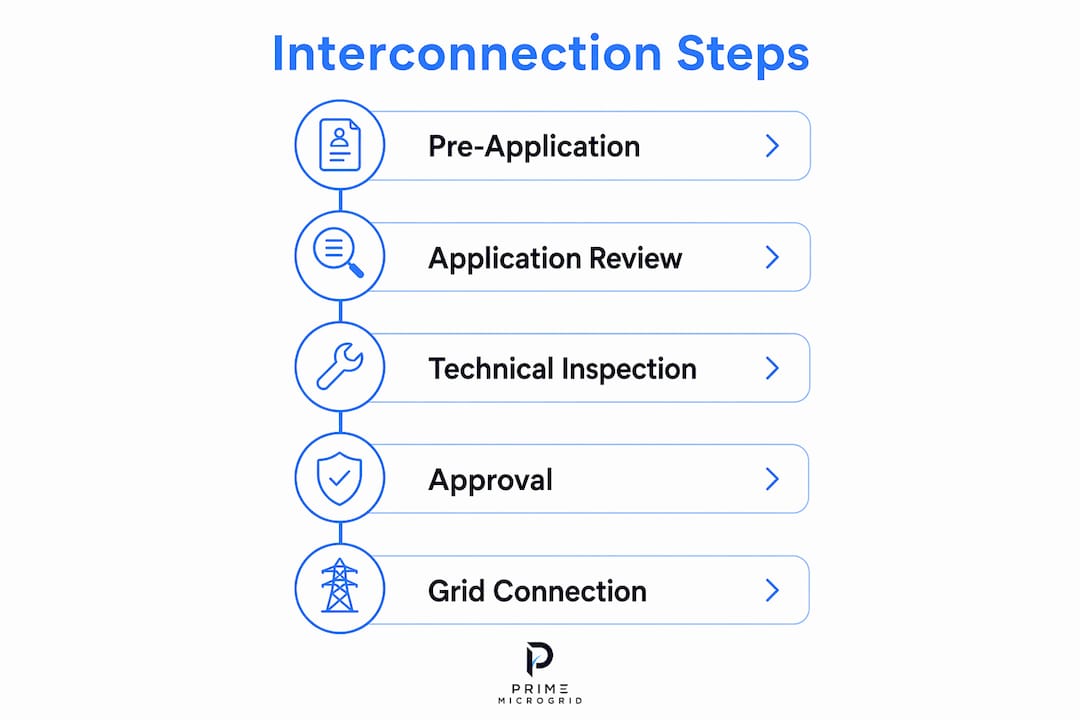
Most residential solar and battery systems qualify for a simplified or Level 1 review path, which applies when the system is small relative to the local circuit's capacity and the equipment is pre-certified. Here is how the process typically unfolds:
- Pre-application research: Confirm your utility's specific interconnection rules, export limits, and required forms before submitting anything.
- Complete application submission: Include all required documents in the first submission. Missing a single datasheet can trigger a supplemental review.
- Utility technical review: For Level 1 applications, this is often a desk review. For Level 2 or supplemental reviews, it may involve engineering analysis of the local distribution circuit.
- Interconnection agreement execution: Review the operating conditions carefully, particularly export limits and any utility curtailment rights.
- Final inspection and PTO: Schedule this promptly after installation to avoid delays in your permission to operate.
Pro Tip: Request a pre-application meeting with your utility's interconnection team before submitting. Many utilities offer this at no cost, and it can reveal local requirements that are not published in the standard application guide, saving weeks of back-and-forth.
The DOE's interconnection roadmap targets a reduction in median approval times while maintaining grid security. That goal reflects a real tension: faster approvals benefit homeowners and developers, but the grid reliability function of interconnection review cannot be bypassed without risk.
What are the practical benefits and challenges of grid interconnection?
Grid interconnection delivers concrete advantages for homeowners and developers that go well beyond simply "connecting to the grid." The home energy grid connection enables net metering, time-of-use optimization, and demand charge reduction, all of which affect your monthly utility bill. It also enables your system to draw from the grid when local generation falls short, which is the core of energy resilience rather than pure off-grid independence.
| Factor | Grid-tied system | Off-grid or standalone system |
|---|---|---|
| Energy resilience | High, with grid as backup | Depends entirely on storage capacity |
| Net metering / export revenue | Available where permitted | Not applicable |
| Upfront cost | Lower (no oversized battery required) | Higher (must cover all loads independently) |
| Regulatory complexity | Requires interconnection approval | Minimal utility involvement |
| Scalability | Easier to expand incrementally | Requires full system redesign |
The challenges are real too. Interconnection policy complexity increases investment uncertainty, particularly for developers managing multiple properties across different utility territories. Costs for utility-required upgrades, such as transformer replacements or protection equipment, can add thousands of dollars to a project budget with little advance warning.
The benefits of grid interconnection for most homeowners outweigh these friction points, particularly when you factor in incentives like the federal Investment Tax Credit (ITC) and state-level net metering programs. A well-designed solar and battery system that is properly interconnected can reduce grid dependence significantly while maintaining the reliability that a fully off-grid system cannot always guarantee.
How does interconnection complexity scale for larger or community projects?
For individual homeowners, interconnection is manageable with the right preparation. For property developers or community-scale projects, the process enters a different category entirely. The U.S. interconnection queue held approximately 10,300 active projects totaling around 2,300 GW at the end of 2024, with delays sometimes exceeding four years. That backlog does not affect a single-family solar installation, but it is a serious constraint for multi-home developments or community microgrids.
| Project scale | Typical review path | Median timeline | Key risk factor |
|---|---|---|---|
| Single-family solar (under 10 kW) | Level 1 simplified | 5 to 30 days | Incomplete application |
| Home battery or V2H addition | Level 1 or Level 2 | 15 to 60 days | Inverter compliance gaps |
| Multi-home or community project | Full interconnection study | 6 months to 4+ years | Queue position and grid upgrades |
For developers, the interconnection queue backlog directly affects financing strategies. Lenders want a clear timeline to operation before committing capital, and a project sitting in a multi-year queue creates real uncertainty. The DOE's distributed energy roadmap includes federal reforms targeting queue management and faster study processes, but these changes take time to reach the utility level where most residential and small commercial projects are processed.
The practical implication for developers is to treat interconnection as a project phase, not an afterthought. Engaging your utility early, understanding queue position, and building timeline buffers into financing models are standard practice for projects that actually get built. For distributed energy resources at the community scale, the interconnection process is often the longest single phase of development.
Key takeaways
Grid interconnection is the regulatory and technical gateway that determines whether a home generation system delivers real energy resilience or just sits on a roof.
| Point | Details |
|---|---|
| Standards drive eligibility | IEEE 1547-2018 compliance is required for inverter approval across virtually all U.S. utilities. |
| Application quality controls timelines | A complete first submission can reduce approval time from 90+ days to under 30 days. |
| Operating mode limits resilience | Your interconnection agreement's operating mode determines actual backup and export capabilities. |
| Scale changes the rules | Community and multi-home projects face queue delays measured in years, not weeks. |
| Policy clarity affects project economics | Inconsistent state rules increase soft costs and can make or break project viability. |
Why interconnection deserves more attention than most homeowners give it
Most homeowners focus on panels, batteries, and price quotes. The interconnection process gets treated as paperwork. That is a mistake I have seen cost projects months and thousands of dollars in avoidable delays.
The part that surprises people most is that your interconnection agreement defines what your system is actually allowed to do. A battery approved only for backup-only mode cannot export power during peak pricing windows. A V2H system without the right inverter settings cannot provide grid support, which some utilities now require as a condition of approval. You can have the best equipment on the market and still end up with a system that underperforms because the operating mode in the agreement was never questioned.
The other thing worth saying plainly: the interconnection process is not designed to be adversarial, but it rewards preparation. Utilities process hundreds of applications. A complete, well-documented submission moves through the queue faster than one that triggers back-and-forth requests for missing documents. Working with an installer or developer who understands your utility's specific requirements is not a luxury. It is the most reliable way to avoid supplemental reviews.
Federal reforms are moving in the right direction. The DOE's interconnection roadmap and FERC Order 2023 both push for faster, more standardized processes. But those changes filter down slowly. In 2026, the practical reality for most homeowners is still a state-by-state, utility-by-utility process that rewards those who engage early and come prepared.
— David
How Primemicrogrid helps you navigate grid interconnection
Primemicrogrid designs home generation systems with interconnection built into the process from day one, not added as a final step. Every system Primemicrogrid develops includes inverter selection and configuration aligned with IEEE 1547-2018 and your utility's specific technical requirements, reducing the risk of supplemental reviews and approval delays.
If you are a homeowner or developer in the Mid Atlantic region, Primemicrogrid's residential microgrid solutions are designed specifically for the interconnection requirements and grid conditions of that market. For homeowners weighing system options, the solar battery vs. microgrid comparison breaks down how each approach interacts with grid interconnection and what that means for your energy resilience. Primemicrogrid handles the technical and regulatory complexity so your system performs the way it was designed to.
FAQ
What is grid interconnection for home generation?
Grid interconnection is the process of connecting a home generation system, such as solar panels or a battery, to the utility grid so electricity can flow in both directions. It requires meeting technical standards like IEEE 1547-2018 and receiving utility approval before the system can operate.
How long does residential interconnection approval take?
Approval timelines range from approximately five business days for simplified reviews to 90 or more days for supplemental reviews triggered by complex systems or incomplete applications.
What is IEEE 1547-2018 and why does it matter?
IEEE 1547-2018 is the national standard governing how distributed generation systems must behave when connected to the grid, covering voltage ride-through, frequency ride-through, and anti-islanding functions. Inverter compliance with this standard is required for interconnection approval at virtually every U.S. utility.
Can a home battery system export power to the grid?
Only if the interconnection agreement permits it. Many battery systems are approved for backup-only mode, which prevents grid export. Homeowners who want net metering or time-of-use export revenue must confirm export permissions are included in their interconnection agreement before installation.
How does interconnection differ for community or multi-home projects?
Larger projects enter the formal interconnection queue, where backlogs of approximately 10,300 projects can cause delays exceeding four years. Individual residential installations typically follow a simplified review path that resolves in weeks rather than years.