
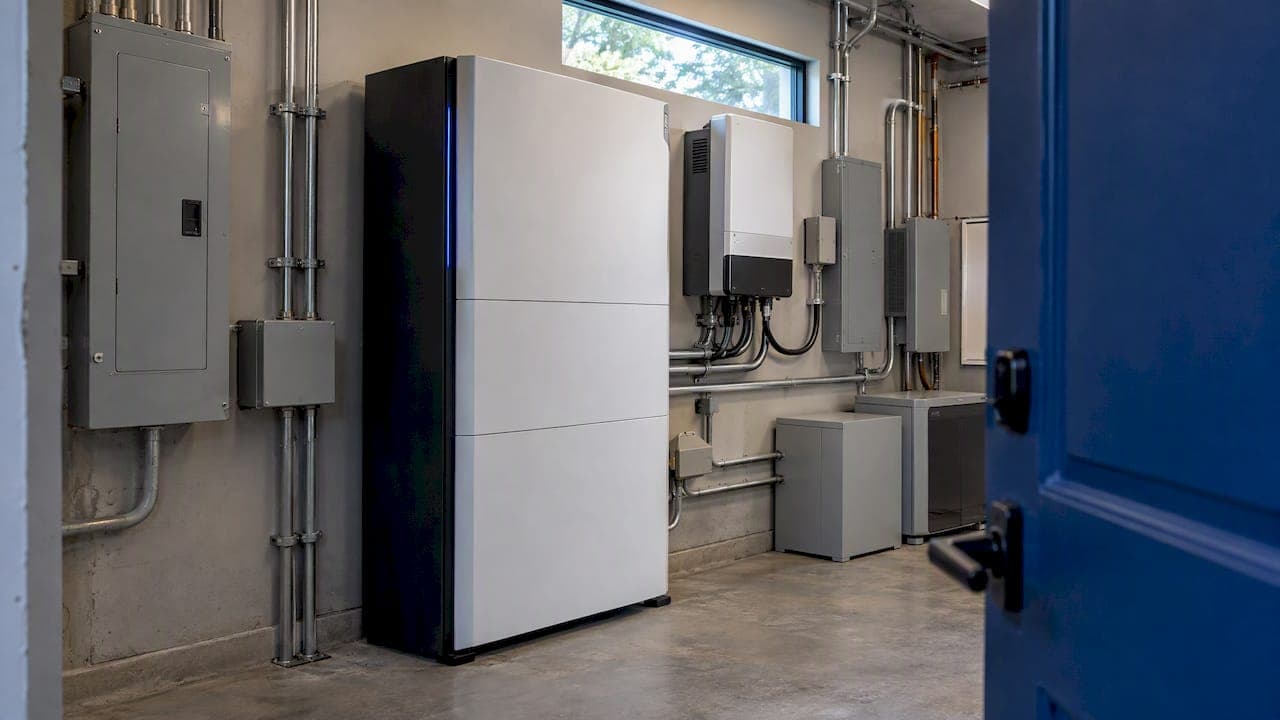
Most modern home batteries reliably serve for about 10 to 15 years before capacity drops below common replacement thresholds, and a typical 10 to 20 kWh unit can run essential loads for roughly a day on a single charge, though that number shifts with load and weather. Warranty terms, not age alone, usually set the real replacement timeline.
TL;DR:
- Check the warranty for its capacity floor and throughput cap; daily cycling for bill savings can exhaust the cycle limit before the stated term.
- LFP systems tend to offer longer cycle life and better thermal stability than NMC batteries, while sustained heat and frequent deep cycling speed capacity loss.
- Adding a second battery module roughly doubles usable runtime at the same load, but air conditioning or electric cooking can reduce a single charge to hours.
- Keep a reserve charge, avoid routine deep discharges, and review capacity health annually; contact your installer one or two years before the warranty threshold.
Table of Contents
- 1. Lifespan vs runtime: two different clocks
- 2. The technical metrics behind every lifespan claim
- 3. Why chemistry, climate, and daily habits change the math
- 4. Reading warranty terms and planning for replacement costs
- 5. Steps that actually extend battery life
- 6. How integrated system design changes lifecycle planning
- Plan a system built for long-term performance
- FAQ
- Sources
1. Lifespan vs runtime: two different clocks
Homeowners often blur two separate questions. "How long will my battery last" can mean the calendar life of the unit itself (the years before it needs replacing) or the runtime you get from one full charge during an outage. They're governed by different factors and answered differently.
Calendar life is about chemical aging and warranty thresholds: how many years before the battery drops below a minimum usable capacity. Runtime per charge is about math: your stored kWh divided by your hourly load.
A 13 kWh battery is a common mid-sized residential unit, and for a household running essential circuits only (refrigerator, some lighting, a well pump, internet) that charge can often stretch close to 24 hours. Push it to cover air conditioning or an electric range, and runtime drops sharply, sometimes to a few hours.
A few practical notes on runtime:
- Essential-only loads (fridge, lighting, routers, medical equipment) stretch a single charge the farthest.
- Heating, cooling, and cooking equipment drain capacity fastest and shrink runtime significantly.
- Stacking a second battery module roughly doubles usable runtime at the same load, which is why many installers size systems in pairs rather than single units.
If you're unsure how your own daily usage translates into backup hours, our guide on sizing battery storage for a whole house walks through the calculation in more detail.
2. The technical metrics behind every lifespan claim
Battery spec sheets and warranties lean on a handful of recurring metrics. Understanding them helps you read past marketing language into what a battery will actually do over time.
A battery cycled once a day for daily bill savings reaches its cycle limit years sooner than one reserved mostly for emergency backup.
Depth of discharge (DoD) measures how much of the battery's capacity gets used each cycle. Shallow, partial discharges generally stress the cells less than repeated deep discharges to near zero, which is one reason many systems default to a reserve floor rather than draining to empty.
Calendar aging happens regardless of use: the chemistry itself degrades over years, accelerated by high average state of charge and heat exposure during storage.
Round-trip efficiency and State of Health (SOH), sometimes reported as demonstrated capacity, are the numbers that matter for ongoing monitoring. The Department of Energy's battery evaluation guidance recommends analyzing at least a full year of metered charge and discharge data to estimate these figures accurately, since seasonal swings in temperature and usage affect short-term snapshots.
One sourced figure worth remembering: most home batteries maintain strong performance for 10 to 15 years, with manufacturers commonly guaranteeing 60% to 70% capacity retention by the end of the warranty period. That retention percentage, not a fixed age, is usually the real trigger for replacement.

3. Why chemistry, climate, and daily habits change the math
Not every battery ages the same way, and the biggest variables are ones homeowners can actually influence.
Chemistry matters more than most buyers realize. LFP (lithium iron phosphate) chemistries are commonly recommended for residential storage because they tend to offer higher cycle life and better thermal stability than older NMC lithium-ion chemistries, with well-managed LFP systems often expected to reach 15 or more years. NMC packs can offer slightly higher energy density in the same footprint but generally show faster capacity fade under heavy cycling.
Temperature is the other major lever. High sustained temperatures accelerate lithium-ion degradation, which is why installer guidance consistently favors cool, dry, ventilated, or conditioned mounting locations over a hot garage or an uninsulated exterior wall.
Use pattern creates a real trade-off:
- Daily cycling for time-of-use bill savings adds cycles faster and shortens the practical lifespan window.
- Reserving the battery mostly for outages means far fewer cycles and a longer service life, at the cost of giving up daily savings.
- A hybrid approach, cycling moderately while keeping a reserve buffer, splits the difference for many households.
The battery management system (BMS) ties all of this together, regulating charge rates, temperature, and cell balancing in the background. A well-configured BMS paired with correct installation settings often matters as much as chemistry choice.
Pro Tip: Ask your installer to show you the BMS dashboard settings during commissioning, not just the app. Reserve SOC and charge limits are usually adjustable, and getting them right from day one avoids avoidable wear.
4. Reading warranty terms and planning for replacement costs
Warranties are where theoretical lifespan becomes a contractual promise, and the fine print is worth reading closely.
Most residential battery warranties combine three elements:
- A stated number of years (commonly 10).
- A minimum capacity retention percentage (often 60% to 70%) that the battery must still deliver by the end of that term.
- A cycle or throughput limit (a maximum number of full-cycle equivalents or total kWh processed) that can trigger warranty expiration earlier than the year count if you cycle the battery heavily.
That third clause catches people off guard. A battery warrantied for 10 years but also capped at a certain cycle count can hit that cap well before the decade is up if it's cycled daily for bill arbitrage rather than reserved for backup.
Replacement isn't a failure of the system, it's a planned part of the timeline. Industry guidance frames at least one battery replacement as a normal expectation over a solar system's typical 25 to 30 year lifespan, and replacement costs are generally expected to decline as battery technology matures, so budgeting for it now doesn't mean paying today's prices later.
The practical move: set aside a rough replacement reserve when you install, and contact your installer a year or two before your warranty's capacity threshold is likely to hit for a current replacement estimate. For more on what a battery system can and can't cover on its own, our piece on why battery-only backup has limitations is a useful companion read.
5. Steps that actually extend battery life
A handful of habits make a measurable difference in how long your battery holds useful capacity.
- Set a sensible reserve state of charge instead of letting the battery run to empty on every outage cycle; shallow discharges reduce stress on the cells.
- Avoid unnecessary deep discharges by reserving full drawdowns for genuine emergencies rather than routine daily use.
- Choose a cool, ventilated, or conditioned location for the unit, away from direct sun and sustained heat, since temperature is one of the clearest drivers of capacity fade.
- Keep firmware updated through the manufacturer's app, since BMS updates often improve charge management and catch early warning signs.
- Check your monitoring app periodically for demonstrated capacity or SOH trends rather than waiting for a noticeable performance drop.
- Call a licensed installer if you notice faster-than-expected capacity loss, unusual heat, or inconsistent charging, since early diagnostics can sometimes correct a configuration issue before it becomes permanent degradation.
Pro Tip: Treat your first annual health check like an oil change: a quick look at SOH and cycle count each year catches problems while they're still cheap to fix.
6. How integrated system design changes lifecycle planning
In engineering work on microgrid systems, battery lifespan rarely depends on the battery alone. Sizing it correctly for the property's real daily load, pairing it with the right controls, and integrating a generator for extended outages all reduce how hard the battery has to work on any given day.
A battery that's undersized for its job cycles harder and deeper than one sized with margin, and a system without smart load management tends to pull on the battery for loads a generator or grid connection could handle more efficiently. Site-specific engineering, factoring in local climate, usage patterns, and backup priorities, lets us set reserve thresholds and charge behavior that match how a household actually lives, which in practice means less cycling stress and fewer surprise replacements.
— Prime Microgrid
Plan a system built for long-term performance
We design every system around your property's actual electrical demand rather than a generic package, which is the difference between a battery that cycles harder than it needs to and one sized to last. Our Estate Microgrid Systems, Battery Retrofit Systems, and Hybrid Generator Systems are engineered around site conditions, load patterns, and backup priorities specific to your home.

If you're ready to talk through options, request a system evaluation and bring your average daily kWh usage, how many backup hours you want to cover, and a few photos of your electrical panel and proposed equipment location. From there, our engineers can map out a design that balances battery life, generator integration, and cost. Start that conversation on our systems page.
FAQ
Are whole home batteries worth it?
For homeowners who want backup power and lower reliance on the grid, a well-sized battery paired with correct installation and settings can deliver 10 to 15 years of reliable service. Whether it's worth it depends on your backup priorities and budget, which is why a site-specific evaluation matters more than a generic answer.
How much does a whole home battery cost?
Pricing depends heavily on system size, chemistry, and installation complexity, and Prime Microgrid's product lines don't carry a published flat price. The most accurate way to get a figure for your property is a direct system evaluation through our systems page.
How long will a whole house battery backup last?
A typical 10 to 20 kWh battery can run essential loads like refrigeration, lighting, and internet for close to 24 hours on a single charge, though heavier loads like air conditioning shorten that window. Stacking additional battery modules extends runtime roughly in proportion to the added capacity.
Should I charge my home battery to 100%?
Charging to full occasionally is normal, but keeping a battery at a high state of charge for long stretches can accelerate calendar aging, especially in warm conditions.
Sources
- How Long Do Solar Batteries Last? | EnergySage
- Battery Energy Storage System (BESS) Evaluation Method — U.S. Department of Energy
- How long do solar batteries last? — Aurora Solar
- How long do residential solar batteries last? — pv magazine USA