
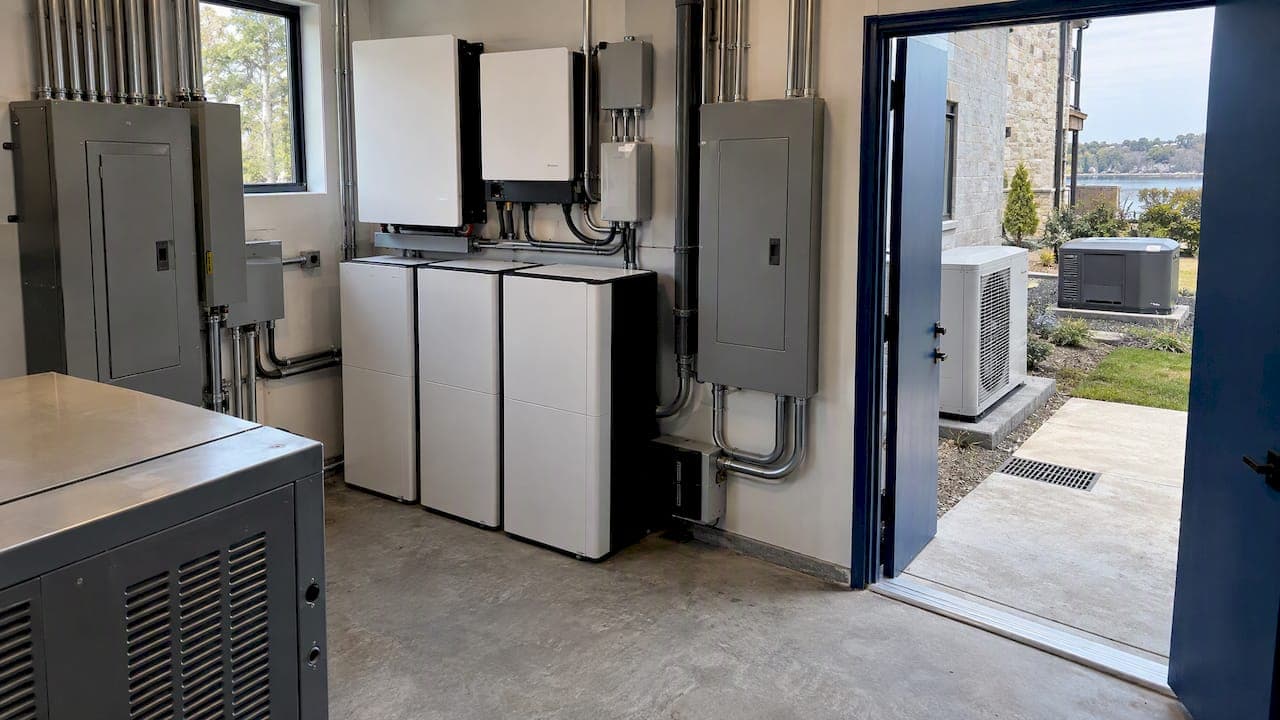
Keeping a heat pump running through an outage comes down to three workable approaches: battery-backed inverter systems, standby generators, and engineered hybrid microgrids that combine both. What separates a system that actually works from one that trips offline the moment the compressor kicks on is correct sizing, soft-start or load management, and a transfer switch matched to the equipment. Prime Microgrid designs these systems around each property's actual electrical demand rather than a generic package.
TL;DR:
- Size equipment for compressor startup, using full nameplate ratings or compressor rating plus 65% of supplemental heating for central systems; running watts alone are insufficient.
- Choose batteries for short outages, generators for longer outages with reliable fuel, and hybrids when you need instant battery response and extended generator runtime.
- Code frameworks typically require standby systems to restore within 60 seconds and sustain at least 2 hours; emergency classifications may require restoration in about 10 seconds.
- Require soft start or staged load sequencing for large compressors, and have the installer test automatic transfer with the heat pump running under real load.
Table of Contents
- How heat pumps draw power and why that changes backup planning
- Backup options compared at a glance
- What codes require for transfer time and runtime
- Hardware and controls that prevent nuisance trips
- Implementation checklist: from assessment to commissioning
- How heat pump backup systems can be approached
- Connecting backup power to your home energy management system
- Fuel types and availability for generator-based backup
- Maintenance that keeps backup power reliable
- Budgeting for a heat pump backup power system
- Examples of heat pump backup installations in practice
- When a full engineered hybrid actually pays off
- Get an engineered backup power plan for your property
- FAQ
- Sources
How heat pumps draw power and why that changes backup planning
A heat pump's compressor does not draw a flat, predictable load. Running wattage stays fairly steady once the unit is operating, but startup draws a brief surge, often several times the running current, as the compressor motor overcomes initial resistance. Backup equipment sized only for running watts will struggle the instant the compressor cycles on.
This is why load calculations for HVAC backup use rules built around that surge. UpCodes outlines criteria for selecting the kVA used to size heating and air-conditioning loads, including using full nameplate ratings or the compressor rating plus 65% of supplemental heating for central systems. Skipping this step and guessing at capacity tends to produce the same handful of problems:
- Nuisance tripping of the backup source the moment the compressor engages.
- Repeated start-stop cycling that stresses the compressor and shortens its service life.
- Voltage sag that affects other circuits sharing the same panel or generator output.
Getting the load calculation right before selecting hardware is the single most consequential decision in the whole project, more so than the brand of battery or generator chosen afterward.
Backup options compared at a glance
Each backup category fits a different outage profile, and matching the right one to your situation matters more than chasing the biggest or newest equipment on the market.
- Battery-backed inverter systems transfer power almost instantly and run quietly, which makes them well suited to short, frequent outages. Runtime is the tradeoff: without a sizable battery bank, extended multi-day outages will outlast the stored capacity.
- Standby generators deliver long runtime limited mainly by fuel supply, and they can be sized with enough startup capacity for larger heat pump compressors. The tradeoff is a slower transfer sequence and the ongoing logistics of keeping fuel on hand.
- Hybrid microgrids, pairing batteries with a generator under coordinated controls, deliver the instant response of a battery with the extended runtime of a generator, while sequencing logic keeps fuel use efficient and avoids unnecessary generator starts.
Not every load in the home needs the same treatment. Heat pump water heaters, for example, often have low power consumption in heat-pump-only mode according to ENERGY STAR and Efficiency Maine guidance, which means a modest battery system can often keep one running through an outage without needing generator support at all.
Pro Tip: Map your outage history before choosing architecture. A property with brief, occasional outages rarely needs the same backup investment as one with multi-day events every storm season.
What codes require for transfer time and runtime
Backup systems for critical loads do not operate on an arbitrary schedule. IBC Chapter 27 and related code frameworks require standby power to restore within 60 seconds of a utility outage, with emergency systems defined for faster restoration, around 10 seconds, in sections where that classification applies. Standby systems are also expected to sustain a minimum of 2 hours of runtime unless a longer duration is specified for the application.
Transfer-switch equipment is where that timing gets enforced. UpCodes guidance on transfer-switch equipment describes how switch selection and transition type govern how quickly and cleanly backup power reaches building loads, with references back to NFPA standards for standby and emergency power.
Before an engineer can size anything properly, gather this data:
- Nameplate ratings for the heat pump and any other major electrical loads.
- Compressor kVA, since this drives the startup surge calculation.
- Main panel rating and available capacity.
- A prioritized list of critical circuits, including the heat pump, controls, and any heat pump water heater.
Supplying accurate numbers here shortens the design process and avoids costly resizing later.
Hardware and controls that prevent nuisance trips
Correct sizing solves half the problem. The other half is hardware and sequencing that manage the startup surge and keep competing loads from overwhelming the backup source.
Soft-start devices reduce a compressor's inrush current by ramping the motor up gradually instead of slamming it to full draw instantly. They matter most on larger compressors, where the surge-to-running ratio is steepest and where an undersized generator or inverter would otherwise stall or shut down.
Transfer switch selection matters just as much. Open-transition switches briefly disconnect from both sources during the switch, which is fine for most residential equipment but can disrupt sensitive electronics. Closed-transition switches overlap the sources momentarily for a smoother handoff, generally at higher equipment cost.
- Load sequencing stages which circuits draw power first, so the heat pump compressor does not start at the same instant as a well pump or an electric range.
- Prioritized circuits keep essential loads (heat pump, refrigeration, medical equipment) online first if total capacity runs tight.
- Commissioning tests verify behavior under real load, not just on paper, which is the only reliable way to confirm the system performs as designed.
Pro Tip: Ask any installer to demonstrate an actual transfer test with the heat pump running, not just a paper spec sheet. Behavior under real load is the only proof that matters.
Implementation checklist: from assessment to commissioning
A heat pump backup project moves through a predictable sequence, whether it is a straightforward battery installation or a full hybrid microgrid.
- Collect data. Gather nameplate and panel information and identify critical circuits, including the compressor, controls, and any heat pump water heater.
- Set runtime goals. Decide how many hours or days of backup you need based on your outage history, then choose battery, generator, or hybrid architecture to match.
- Size the equipment. Apply the nameplate or compressor-plus-65%-supplemental baseline, and determine transfer switch type and soft-start requirements.
- Plan fuel or recharge strategy. Confirm fuel storage needs, delivery access, or solar recharge capacity, and secure any required permits.
- Install, commission, and document. Test automatic transfer and load sequencing under real conditions, then keep a written operations and maintenance record.
Reviewing evaluation criteria for home backup power options before signing a proposal helps you ask sharper questions at each step.
How heat pump backup systems can be approached
Such systems can be designed around the property's actual electrical demand rather than a standard package. They may integrate battery storage, generator capacity, load management, and controls into one coordinated system engineered for whole-property continuity, not just for the heat pump in isolation.
A typical engineering deliverable set can include a full load study, a documented control sequence for transfer and staging, a transfer-switch selection rationale tied to the site's equipment, a runtime and fuel plan matched to the owner's outage expectations, and a commissioning report confirming the system performs under real load before the project is considered complete.
Connecting backup power to your home energy management system
A heat pump backup system works best when it talks to the rest of your home's energy controls rather than operating as an isolated box in the garage. Smart thermostats, panel-level monitoring, and home energy management platforms can coordinate with battery and generator controls to avoid running the heat pump at full demand the instant backup power engages, which preserves runtime and reduces strain on the system.
Reviewing a thermostat checklist before you buy is worth doing before integration, since not every smart thermostat communicates cleanly with load management controls, and a mismatch here can undercut an otherwise well-designed backup system.
Integration also means setting priorities ahead of time. A home energy management system can be configured to shed non-critical loads, like a pool pump or an EV charger, the moment backup power kicks in, reserving capacity for the heat pump and other essential circuits. This kind of coordinated control is what separates a backup system that merely keeps the lights on from one that keeps the whole property functioning through an extended outage. For multi-load properties, this sequencing logic often matters as much as the generator or battery capacity itself.
Fuel types and availability for generator-based backup
Standby generators run on diesel, natural gas, propane, or gasoline, and the choice affects both reliability and how much planning the fuel supply requires. Natural gas offers continuous supply through a utility connection with no on-site storage to manage, which makes it a common choice where a gas line is already available. Propane and diesel require on-site storage tanks, giving you direct control over fuel reserves but adding a refill schedule to track, particularly during extended outages when delivery trucks may face the same regional disruptions as the power grid.

On-site standby generator standards such as NFPA 110 call for fuel supply planning that accounts for extended runtime at full load, often sized for multiple hours of continuous operation, along with regular testing regimes to confirm the system starts and performs as expected. Gasoline-fueled portable units are the least suited to heat pump backup specifically because of limited run tank capacity and the need for frequent manual refueling, which is impractical for a load that needs to run continuously through a multi-day outage.
An engineered hybrid approach sidesteps much of this fuel-logistics burden by using battery capacity to absorb the first hours of an outage, calling on the generator only once stored energy runs low. This reduces total fuel consumption and generator runtime hours, which in turn reduces maintenance frequency and wear.
Maintenance that keeps backup power reliable
Backup power equipment sits idle most of the time, which is exactly why it tends to fail when called upon unless it gets regular attention. Batteries need periodic checks of state of health and connections, since a battery bank that has quietly degraded will not reveal the problem until an outage exposes it. Generators need scheduled oil changes, filter replacement, and load-bank or exercise runs to prevent fuel system issues and confirm the unit still starts reliably under load.
Transfer switches and control systems also deserve a place on the maintenance schedule. A soft-start device or sequencing controller that has not been tested in a year is a liability, not a safeguard. Routine automatic-transfer testing, ideally run on a scheduled basis rather than only after something goes wrong, confirms the whole chain, from outage detection to compressor restart, still performs within the timing your system was designed around.
Documentation matters here too. A written operations and maintenance record, created at commissioning and updated after every service visit, gives you (or a future technician) a clear history of what has been tested, replaced, or adjusted, which shortens troubleshooting time considerably if something does go wrong during an actual outage.
Budgeting for a heat pump backup power system
Costs for heat pump backup power vary widely depending on architecture, property size, and how many circuits the system needs to support beyond the heat pump itself. A battery-only system sized for a single heat pump and a few critical circuits sits at the lower end of the spectrum, while a full hybrid microgrid covering an entire estate, with battery storage, a standby generator, and coordinated load management, represents a considerably larger investment.
Line items to budget for typically include the battery bank or generator unit itself, the transfer switch and any soft-start devices, electrical panel upgrades if the existing panel cannot support the new equipment, permitting fees, and the engineering and commissioning work that ties it all together. Ongoing costs include fuel for generator-based systems, periodic battery maintenance, and scheduled generator servicing.
Because Prime Microgrid designs each system around a property's specific load profile and goals, pricing for Estate Microgrid Systems, Battery Retrofit Systems, and Hybrid Generator Systems is available on request rather than published as a flat rate. Reviewing a comparison of large home generators versus battery storage ahead of time can help you frame realistic budget expectations before requesting a quote.
Examples of heat pump backup installations in practice
Properties that rely on a heat pump as the primary heating and cooling source tend to fall into a few recurring patterns when planning backup power. A rural property with a well pump, a heat pump, and a heat pump water heater typically needs load sequencing to prevent all three high-surge loads from starting simultaneously during the transfer to backup power, since staggering startup across a few seconds each can be the difference between a clean transfer and a tripped breaker.
An estate with a large heat pump system and frequent multi-day outages benefits most from a hybrid architecture, where the battery bank absorbs the first stretch of the outage silently and the generator only starts once stored capacity runs low, extending total runtime while minimizing fuel consumption and generator wear.
A property with brief, occasional outages and modest backup needs, such as a single heat pump water heater drawing under 500 watts, can often be served well by a smaller battery system alone, without the added cost and complexity of generator integration. The common challenge across all these scenarios is the same: undersized or unsequenced systems that trip the moment the compressor engages, which is precisely what a proper load calculation and staged design are meant to prevent.
When a full engineered hybrid actually pays off
A full hybrid system earns its cost on estates, properties with mission-critical continuity needs, or anywhere outages run long and frequent. For a weekend cabin with rare, short outages, a simpler battery or generator setup is often the more sensible choice. Before signing any proposal, ask for the load calculation method used, the transfer-switch rationale, and a commissioning report that proves the system works under real load, not just on paper.
— Prime Microgrid
Get an engineered backup power plan for your property
We design, install, and commission heat pump backup systems built around your property's actual electrical demand, not a generic package. Whether you need a battery-first setup or a full hybrid microgrid with generator integration, our engineering-led process covers load study through commissioning.

- Learn more about home battery backup if a battery-first approach fits your outage profile.
Reach out to request a site assessment and get a backup power plan matched to your property.
FAQ
What size backup power do I need for a heat pump?
Sizing depends on the compressor's startup surge, not just its running wattage. UpCodes load-calculation guidance recommends using the full nameplate rating or the compressor rating plus 65% of supplemental heating for central systems as a baseline.
Can a battery alone power a heat pump during an outage?
A battery alone can power a heat pump, especially for shorter outages, but runtime is limited by battery capacity. Heat pump water heaters specifically often have low power consumption in heat-pump-only mode, which a modest battery system can often support on its own.
How fast should backup power switch on after an outage?
Code frameworks such as IBC Chapter 27 call for standby systems to restore power within 60 seconds, with emergency systems defined for faster response, around 10 seconds, where that classification applies. Minimum runtime is typically set at 2 hours unless a longer duration is specified for the application.
Do I need a soft-start device for my heat pump's backup power?
Soft-start devices are especially useful for larger heat pump compressors, where the startup surge is several times the running current. They reduce that inrush, which helps prevent nuisance tripping on a battery inverter or generator that would otherwise need to be oversized to handle the surge alone.
How much does a heat pump backup power system cost?
Cost depends heavily on architecture, from a battery-only setup for a single heat pump to a full hybrid microgrid covering an entire property. Pricing for custom systems through Prime Microgrid is provided after a site assessment rather than as a published flat rate.
Sources
- IBC 2018 Chapter 27 — Electrical
- Heating and air-conditioning load (UpCodes)
- Heat Pump Water Heater Frequently Asked Questions (ENERGY STAR / Efficiency Maine excerpt)