
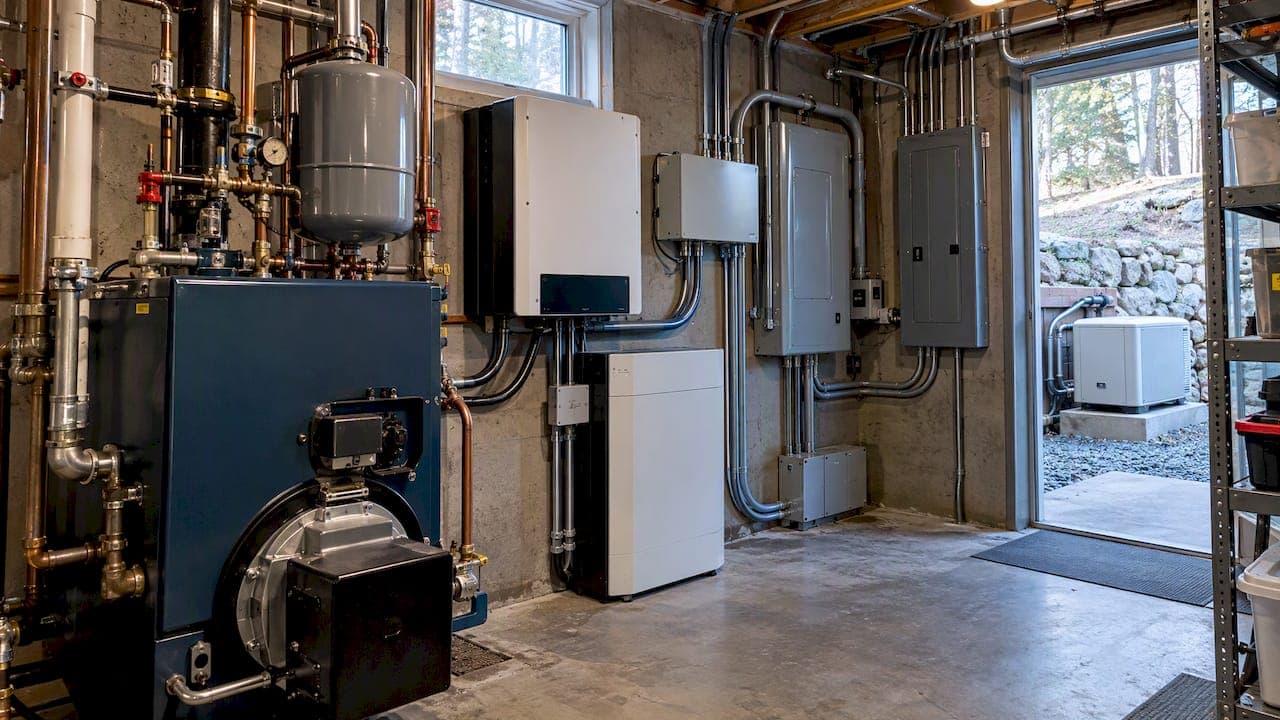
The most reliable ways to keep a boiler running during an outage are a standby generator paired with an automatic transfer switch, or an inverter and battery bank sized for startup surge. A portable generator can work too but only with a proper transfer switch or emergency power inlet and strict carbon monoxide precautions. Backfeeding a circuit by running an extension cord into an outlet is never an option, and for most households, the safest long-term answer is an engineered system that handles the sizing, wiring, and permitting for you.
TL;DR:
- A standby generator with an automatic transfer switch provides seamless backup but is more costly and requires a dedicated fuel source.
- Portable generators with manual switches are practical for occasional outages but need manual operation and proper placement for safety.
- Battery and inverter systems are quiet and low maintenance but are limited by capacity unless supplemented with solar or a generator for extended outages.
- Proper generator safety involves maintaining sufficient distance, pointing exhaust away from the house, using detectors, and never backfeeding circuits through outlets.
- Correctly sizing backup power requires calculating startup surge, adding 20% headroom, and documenting your home's load details before purchase.
Table of Contents
- Which Backup Methods Actually Work for a Boiler
- Carbon Monoxide and Generator Safety Rules You Cannot Skip
- Sizing Backup Power So the Boiler Actually Starts
- Wiring Rules: Transfer Switches, Inlets, and When to Call an Electrician
- Your Outage Checklist: Before, During, and After
- Keeping Backup Power Ready Between Outages
- Why an Engineered System Beats a Patchwork of Fixes
- When a DIY Fix Is Fine, and When It Is Not
- Get a Custom Boiler Backup Proposal From Prime Microgrid
- FAQ
- Sources
Which Backup Methods Actually Work for a Boiler
Before picking hardware, it helps to know what you are actually choosing between. Boilers draw relatively little continuous power, usually a few hundred watts for the control board and circulator pump, but the motors inside them pull a hard jolt of current for a second or two at startup. That startup surge is what trips up undersized backup plans, so each option below needs to be judged on surge handling as much as on run time.
Standby generator with automatic transfer switch. This is the closest thing to a seamless experience: the generator senses the outage, starts itself, and an automatic transfer switch (ATS) shifts your home circuits over within seconds. Boilers, well pumps, and refrigeration all stay online without you doing anything. It is also the most expensive option up front and requires a dedicated fuel supply, typically natural gas or propane.
Portable generator with a manual transfer switch or interlock kit. A gas-powered portable unit connected through a manual transfer switch or an interlock kit on your panel can power a boiler circuit safely, but you have to go outside, start it, and switch it over yourself. It is a practical stopgap for occasional outages and costs a fraction of a standby system, though you are limited by fuel storage and the noise of running it for days at a time.
Inverter and battery bank. A battery system sized for your boiler's startup surge and continuous draw runs quietly, requires no fuel, and switches over instantly if wired with an automatic transfer function. The tradeoff is capacity: without solar recharging or a generator to top it off, a battery bank eventually runs dry, so it suits shorter outages better than multi-day events unless it is part of a larger home battery backup system.
Electric backup heating elements. Some boilers, particularly electric or hybrid models, include a backup electric resistance element that can run on far less power than the primary burner, buying time without full output. This is boiler-specific and worth checking against your unit's manual rather than assuming it exists.
Manual workarounds. Battery-powered Wi-Fi thermostats, a battery pack for the circulator pump, or simply draining and isolating the system to prevent freeze damage are not real backup power, but they matter when nothing else is available. These buy hours, not days.
- Standby generator plus ATS: highest cost, automatic, best for frequent or extended outages.
- Portable generator plus manual transfer switch: moderate cost, requires manual action, good for occasional outages.
- Battery and inverter system: quiet and low maintenance, limited by stored capacity unless paired with solar or a generator.
- Electric backup element: boiler-dependent, short-term heat maintenance only.
- Manual workarounds: freeze prevention only, not a real power source.
A single afternoon outage calls for a very different answer than a week without grid power, and that distinction should drive your choice more than price alone.
Carbon Monoxide and Generator Safety Rules You Cannot Skip
Generator exhaust is the most dangerous part of any DIY boiler backup plan, and it deserves to be treated that way before anything else. The CDC reports that carbon monoxide causes more than 500 deaths in the United States every year, and many post-hurricane poisoning cases involved generators placed within just 7 feet of a home.
Distance and direction matter more than people assume. A joint NIST and CDC modeling study found that a generator sitting around 15 feet from a house is not always safe, and that moving it further away while pointing the exhaust away from the building substantially reduced the indoor carbon monoxide levels the model predicted. Wind direction and exhaust orientation change the risk as much as distance does, which is easy to overlook when you are just trying to get the heat back on.

Past disasters show the pattern clearly. A CDC investigation of hurricane-related carbon monoxide poisonings in Florida found that portable generators were implicated in nearly all of the nonfatal poisoning cases reviewed after the storm. Generator exhaust produces carbon monoxide comparable to several idling cars running at once, and running one indoor, in a garage, or too close to a window or air intake is the single most common way people get hurt.
Backfeeding is the other major hazard. Plugging a generator into a wall outlet to power circuits backward through your panel can energize the utility line outside your home, which risks electrocuting a lineworker and can destroy your generator and appliances when the power comes back on. A transfer switch physically isolates your home's wiring from the utility grid before the generator connects, which is the only way to run a generator into your house wiring safely and, in most jurisdictions, the only way to do it legally.
The best practices are straightforward:
- Run portable generators at least 20 feet from doors, windows, and vents, per CDC guidance.
- Point the exhaust away from the house and account for wind direction, not just distance.
- Install battery-backed carbon monoxide detectors on every level, including near the boiler.
- Use a transfer switch or emergency power inlet, never a cord run through a window into an outlet.
- Store fuel in approved containers away from the generator while it runs, and let the unit cool before refueling.
Small, quiet, well-sized emergency boiler power keeps a home warm without turning a storm into a second emergency.
Sizing Backup Power So the Boiler Actually Starts
Undersizing is the most common reason a backup system fails a boiler, and it almost always comes down to ignoring the startup surge. Here is how to get the numbers right before you buy anything.
- Find the nameplate on the boiler and the circulator pump. Look for voltage, amperage, and, on the circulator, horsepower or watts; the transformer that runs the control board is usually rated in volt-amps (VA) and listed separately.
- Calculate continuous load first. Multiply voltage by amperage for each component, or use the listed wattage directly, then add the control board and any zone valves running at the same time.
- Apply a surge multiplier. Motors like circulator pumps can draw three to five times their running current for a second or two at startup, so your generator or inverter needs to handle that spike, not just the steady draw.
- Add headroom. Manufacturer and safety guidance commonly recommends sizing backup power with roughly 20% of headroom above the boiler's maximum consumption, which absorbs voltage sag and accounts for other loads switching on at the same moment.
- Convert battery capacity into runtime. Divide the battery's usable kilowatt-hours by your boiler's continuous draw in kilowatts to estimate hours of runtime, then subtract a reserve margin since most batteries should not be run down to zero.
A typical gas boiler with a single circulator pump might draw around 300 to 600 continuous watts, with a startup surge that briefly climbs well above that before settling down. A 2 kilowatt-hour battery running a 400-watt continuous load, for example, could theoretically supply about five hours before depletion, though real-world performance depends on inverter efficiency and how many other loads share the circuit.
Boilers with multiple zones rarely surge all at once. Circulators and zone valves tend to start in sequence rather than together, which is worth knowing because it means your real surge requirement is often lower than adding up every component's worst case.
Pro Tip: Photograph every nameplate on your boiler and circulator before calling a generator dealer or system designer. It turns a guessing game into a five-minute sizing conversation.

Wiring Rules: Transfer Switches, Inlets, and When to Call an Electrician
The method you use to connect backup power to your boiler circuit matters as much as the generator or battery itself, and this is the part of the project that genuinely benefits from a licensed electrician.
Manual transfer switch. Installed next to your main panel, it lets you switch selected circuits, including the boiler, from utility power to generator power with a lever or set of switches. It requires you to be present to flip it, but it is reliable, inspectable, and relatively affordable to install.
Automatic transfer switch (ATS). Senses an outage and switches circuits automatically, which is the standard for standby generators and increasingly common in battery systems. It costs more but removes the need for anyone to act during the outage itself, which matters if no one is home or the outage happens overnight.
Interlock kit. A mechanical device added to your panel that prevents the main breaker and a generator breaker from being on at the same time, an affordable alternative to a full transfer switch for portable generators. It is code-compliant in many jurisdictions but still requires a qualified electrician to install correctly.
Emergency power inlet. A weatherproof outlet mounted on the outside of your home that lets you plug a portable generator in through a proper cord, feeding your transfer switch or interlocked panel instead of a random outlet. This is the legal, visible alternative to running a cord through a cracked window and backfeeding a wall socket.
- Manual transfer switch: lowest cost among code-compliant options, requires someone present during the outage.
- Automatic transfer switch: highest convenience, standard for standby systems, higher installed cost.
- Interlock kit: budget-friendly for portable generators, still needs a qualified installer.
- Emergency power inlet: the safe, legal entry point for a portable generator, paired with a switch or interlock.
Breaker sizing, grounding, and whether your boiler circuit needs its own dedicated subpanel are all decisions that depend on your home's existing wiring and local code, which is exactly the kind of judgment call that belongs to a licensed electrician rather than a weekend project. Most jurisdictions require a permit and inspection for any transfer switch or interlock installation, and skipping that step can void your homeowner's insurance in the event of a fire.
Pro Tip: If your utility or municipality requires a permit for generator interconnection, get that answer before you buy equipment. Rules vary enough that the wrong assumption can mean reinstalling your switch.
Your Outage Checklist: Before, During, and After
A good backup plan is only as strong as the habits around it. This checklist covers the three phases that matter: getting ready, acting safely in the moment, and closing the loop afterward.
- Document your boiler's specs now. Write down or photograph the nameplate data for the boiler and circulator pump, and store a copy with your generator or battery paperwork.
- Install carbon monoxide detectors on every level of the house, including one near the boiler and one near any planned generator location.
- Label your transfer switch or interlock circuits clearly so anyone in the household can operate them without guessing.
- Keep fuel stabilized and stored properly if you rely on a portable or standby generator, and check battery state of charge monthly if you use a battery system.
- When the power goes out, engage your approved backup path first. Flip the transfer switch, connect through the emergency inlet, or confirm the automatic system has started, rather than improvising a workaround.
- Monitor carbon monoxide detectors and fuel levels throughout the outage, and conserve battery capacity by limiting other loads sharing the circuit.
- Watch for boiler-specific failure signs, like a circulator that will not restart or an error code on the control board, and note them for later.
- Shut down safely once grid power returns. Let the transfer switch or interlock return to utility power in the proper sequence rather than disconnecting everything at once.
- Inspect the system after the outage for fuel levels, battery depletion, or any unusual boiler behavior.
- Log any problems you noticed, including odd noises, error codes, or a failure to restart, and bring that log to an electrician or technician if something seems off.
Keeping Backup Power Ready Between Outages
A backup system that only gets tested during an actual emergency is a system you cannot fully trust. Routine maintenance is what separates a generator or battery bank that works when you need it from one that fails at the worst possible moment.
Standby and portable generators need a regular exercise cycle, typically a short run every few weeks, to keep the engine, battery, and fuel system in working order. Stored gasoline degrades within months unless treated with a fuel stabilizer, and propane or natural gas units avoid that problem entirely but still need an annual service check. Winterizing matters too: battery health drops in cold weather, and a generator that has not been started in freezing temperatures can refuse to fire exactly when you need it most.
Battery systems should go through periodic capacity checks to confirm they still hold close to their rated kilowatt-hours, since lithium batteries lose some usable capacity over years of cycling. Most systems with smart monitoring will flag a falling state of health automatically, which is one advantage over a battery bank with no monitoring at all.
- Exercise standby or portable generators on a regular schedule, even without an outage.
- Stabilize stored gasoline or switch to propane and natural gas units to avoid fuel degradation.
- Check battery state of health periodically and replace cells that show significant capacity loss.
- Keep spare filters, belts, and a logbook of service dates on hand for quick reference.
- Review your whole setup once a season, since seasonal temperature swings affect both generators and batteries.
Pro Tip: Set a recurring calendar reminder for generator exercise cycles and battery health checks. The systems that fail during outages are almost always the ones nobody checked in the months before.
Why an Engineered System Beats a Patchwork of Fixes
A DIY generator or battery setup can absolutely keep a boiler running, but an engineered system closes the gaps that trip up most homeowner-assembled solutions: undersized surge capacity, missing permits, and no way to know a component has failed until the heat stops.
An engineered microgrid or hybrid generator-and-battery system typically starts with a load audit of your whole property, not just the boiler, which catches surge interactions between the boiler, well pump, and other large appliances before they become a problem. From there, the system pairs a properly sized battery bank with an automatic transfer switch and integrated controls, often backed by a generator for longer outages, so the switchover happens without anyone flipping a lever in the dark.
- Load audit: measures the real surge and continuous draw of every major circuit, not just estimated nameplate values.
- Battery bank sized for surge and duration: built to handle the boiler's startup spike alongside other loads running at once.
- Automatic transfer switch and integrated controls: switch sources instantly and coordinate the generator and battery together.
- Generator integration: extends runtime well past what a battery alone could provide during multi-day outages.
- Monitoring and commissioning: verifies the system actually performs as designed, with ongoing visibility rather than a one-time install and hope.
We design every system around the property's actual electrical demand and site conditions rather than a generic package, which is the difference between a backup plan that works on paper and one tested against actual load before an outage. Permitting and code compliance are handled as part of the project rather than left for the homeowner to sort out afterward, and the combination of generation, battery, and controls is commissioned as one coordinated system rather than several devices that happen to share a panel.
When a DIY Fix Is Fine, and When It Is Not
Here is an honest read on where the line sits. A single-circulator home with occasional, short outages can often get by with a well-sized inverter and battery setup, or a portable generator run through a proper interlock and emergency inlet. The risk is low, the load is simple, and a motivated homeowner can size it correctly with a few hours of research.
That calculus changes fast for multi-zone hydronic systems, larger homes, or anyone who sees repeated multi-day outages. The surge interactions between several circulators, zone valves, and a well pump get complicated quickly, and a system sized by guesswork is a system that fails at the worst possible moment. If that describes your situation, the smartest first step is not buying equipment, it is documenting what you have: nameplate photos, a rough list of every major circuit, and how often and how long your outages tend to run. That single page of notes is what turns a vague "we need backup power" conversation into a real engineering proposal.
Get a Custom Boiler Backup Proposal From Prime Microgrid
If you have read this far and realized your home needs more than a generator and an extension cord, that instinct is usually correct. We design custom residential and estate-scale systems that integrate generation, battery storage, and controls into one unit built around your property's actual electrical demand, not a generic package pulled off a shelf.

Depending on what your boiler and home need, that might mean:
- Systems for properties that need coordinated generation, storage, and controls across multiple buildings or large electrical loads.
- Systems that pair battery storage with a generator for both instant switchover and long-duration runtime.
- Battery retrofit services for homeowners who already have backup hardware but need it properly sized and integrated.
- Design, installation, and commissioning handled as one project, including permitting and inspection work.
A consultation starts with a site survey and a load list of your major circuits, including the boiler, and ends with a proposal sized to what your property actually draws, surge included. Explore our Estate Microgrid Systems and other system options or review how we approach backup power for larger homes to see what a properly engineered boiler backup plan looks like before the next outage hits.
This article is general information, not a substitute for advice from a qualified doctor. Consult a qualified healthcare professional about your own circumstances before acting on anything here.
FAQ
Can a boiler be powered by electricity?
Most boilers need electricity to run the control board, igniter, and circulator pump even when the primary heat source is gas or oil, so losing power stops the boiler even though the fuel supply is unaffected. A small number of boilers are fully electric, using electric resistance elements instead of gas or oil to generate heat, which changes how much backup power they need.
What is the best backup heat source for a power outage?
For most homes, a properly sized battery and inverter system or a standby generator with an automatic transfer switch keeps a gas or oil boiler running through an outage without any manual steps. For an electric boiler, which draws far more continuous power, a sized generator or an engineered battery system built for that higher load tends to work better than a battery bank alone.
What is the best backup power option for a gas furnace?
A gas furnace has similar electrical needs to a boiler: a blower motor and control board that need continuous power plus a short startup surge. A portable generator through a proper transfer switch or interlock, or a battery and inverter sized for that surge, both work, with the choice depending on outage frequency and duration.
Does a boiler need power to run?
Yes, nearly every residential boiler needs electricity for its control board, ignition system, and circulator pump, regardless of whether it burns gas, oil, or propane for heat. Without power, the boiler cannot ignite or circulate hot water even if the fuel tank is full, which is why backup power planning matters as much as fuel supply.