
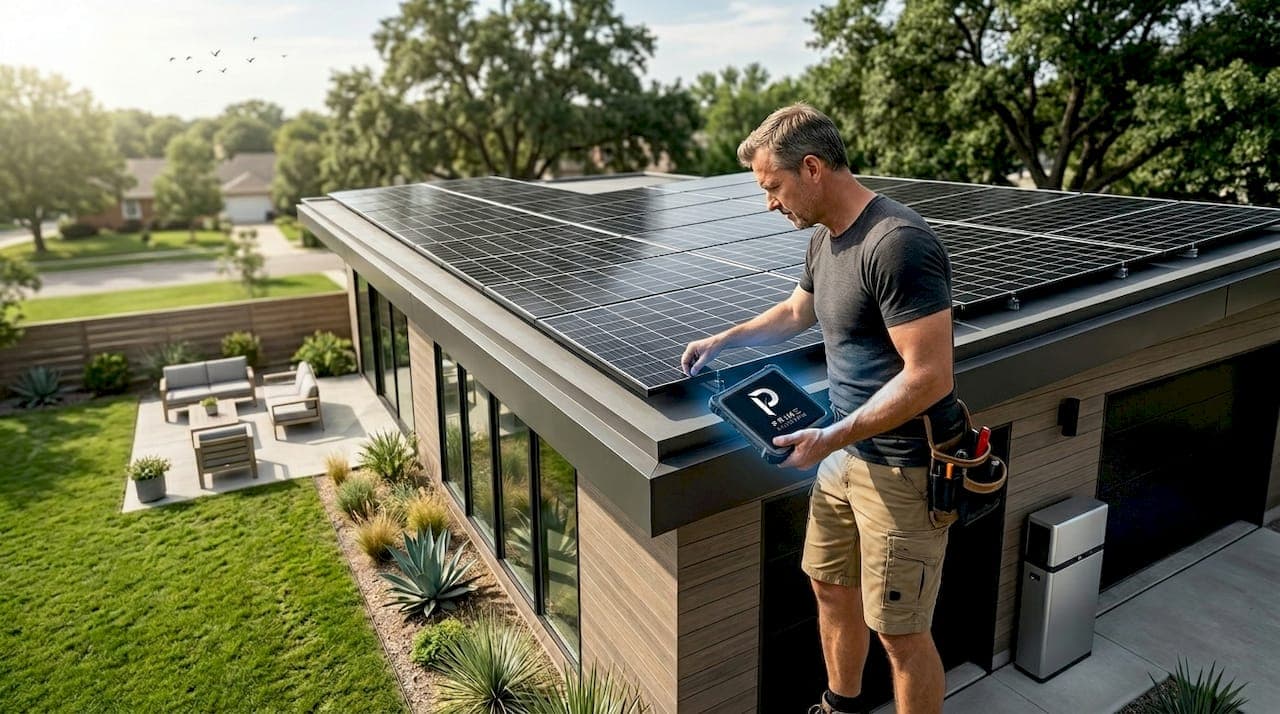
A hybrid energy system is defined as a coordinated combination of two or more generation and storage technologies working together to deliver reliable, efficient electricity from a single integrated setup. Unlike a standalone solar array or a generator running alone, a hybrid system uses sources like solar photovoltaics, wind turbines, battery storage, and backup generators in concert, managed by an energy management system (EMS) that decides in real time where power comes from and where it goes. Hybrid renewable energy systems operate with multiple generation types plus storage and grid subsystems to improve flexibility and resilience. For homeowners and property owners, this coordination is what makes the difference between a system that merely generates power and one that actually protects you from outages, high bills, and grid dependence.
What is a hybrid energy system and how does it work?
A hybrid energy system combines distinct generation sources with one or more storage technologies, all governed by an EMS that continuously optimizes energy flow. The most common residential configuration pairs solar panels with a battery bank and a backup generator, but the principle scales to include wind turbines, small hydro, fuel cells, and grid connections. Optimal component sizing and coordination minimize investment and operation costs while improving performance. The EMS is the brain of the operation. It monitors generation output, battery state of charge, load demand, and grid status simultaneously, then dispatches power according to preset or AI-driven rules.
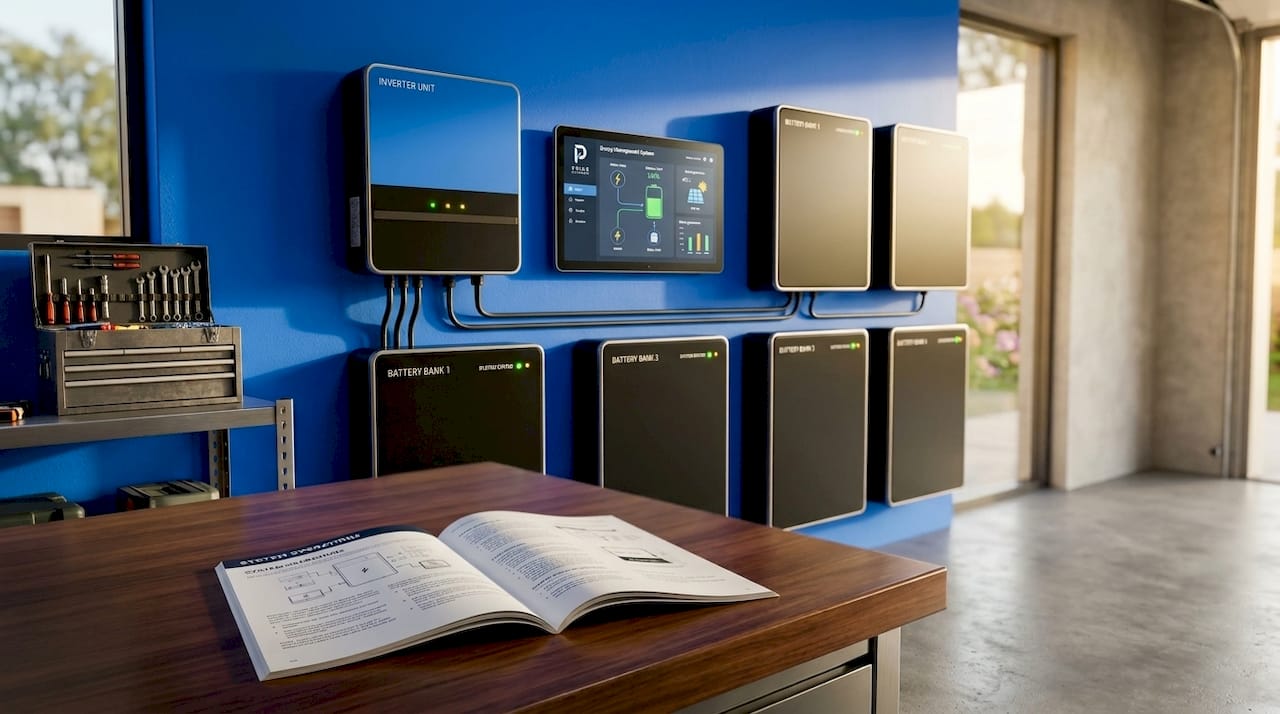
Storage within a hybrid setup often involves more than one technology. Hybrid energy storage systems combine supercapacitors for high-power, short-duration needs with lithium-ion or lead-acid batteries for high-energy, longer-duration storage. Supercapacitors handle sudden load spikes without stressing the battery, which extends battery lifespan and reduces replacement costs. This layered storage approach is one reason well-designed hybrid systems outperform single-battery setups over a ten-year horizon.
Pro Tip: A battery-only system is not a hybrid energy system. True hybrid systems include at least two distinct generation or storage technologies coordinated by an EMS. If a vendor calls a single solar-plus-battery package a "hybrid," ask specifically how the EMS manages multiple sources.
| Component | Role in the system |
|---|---|
| Solar photovoltaics | Primary renewable generation during daylight hours |
| Wind turbines | Supplemental generation, often strongest at night or in winter |
| Battery storage | Stores excess generation for use during low-production periods |
| Supercapacitors | Absorbs rapid load spikes to protect battery health |
| Backup generator | Dispatchable power when renewables and storage fall short |
| Energy Management System | Coordinates all components in real time |
What are the benefits of a hybrid energy system?
The core advantage of a hybrid setup is reliability through redundancy. Advanced controls manage energy flow to maximize renewable use and maintain reliability during fluctuations, so a cloudy week or a calm wind day does not leave you without power. For property owners in areas with unreliable grid service, this layered approach is the most practical path to genuine energy security.
The benefits extend well beyond backup power:
- Reduced energy costs. Renewables cover the bulk of your load, and the EMS shifts consumption away from peak-rate grid hours, cutting your monthly bill.
- Energy independence. Hybrid systems reduce reliance on external power and fossil fuels, supporting resilience in off-grid or weak-grid scenarios.
- Lower emissions. Wind-diesel and solar-diesel hybrid configurations balance cost and emissions for remote communities, and the same logic applies to residential properties.
- Grid revenue potential. Grid-tied hybrid owners can participate in ancillary services markets, earning revenue while battery assets provide regulation and reserve support.
- Scalability. A well-designed hybrid system can grow with your needs. Add an EV charger, a second battery bank, or a small wind turbine without rebuilding from scratch.
- Longer equipment life. Coordinated dispatch reduces cycling stress on individual components, particularly batteries, which extends the useful life of the entire system.
"Hybrid energy solutions embody the future of sustainable, decarbonized energy by integrating renewables with flexible backup and storage." — Diversegy
This is not aspirational language. For a homeowner who has lost power during a hurricane or paid peak-demand charges for three summers in a row, a properly designed hybrid system is a practical financial and safety decision.
How are hybrid systems designed and sized for homes?
System design is where most residential hybrid projects succeed or fail. The starting point is your load profile: how much electricity you use, when you use it, and which loads are critical during an outage. A home with a well pump, medical equipment, and a chest freezer has very different design requirements than a vacation property that only needs lighting and a few outlets.
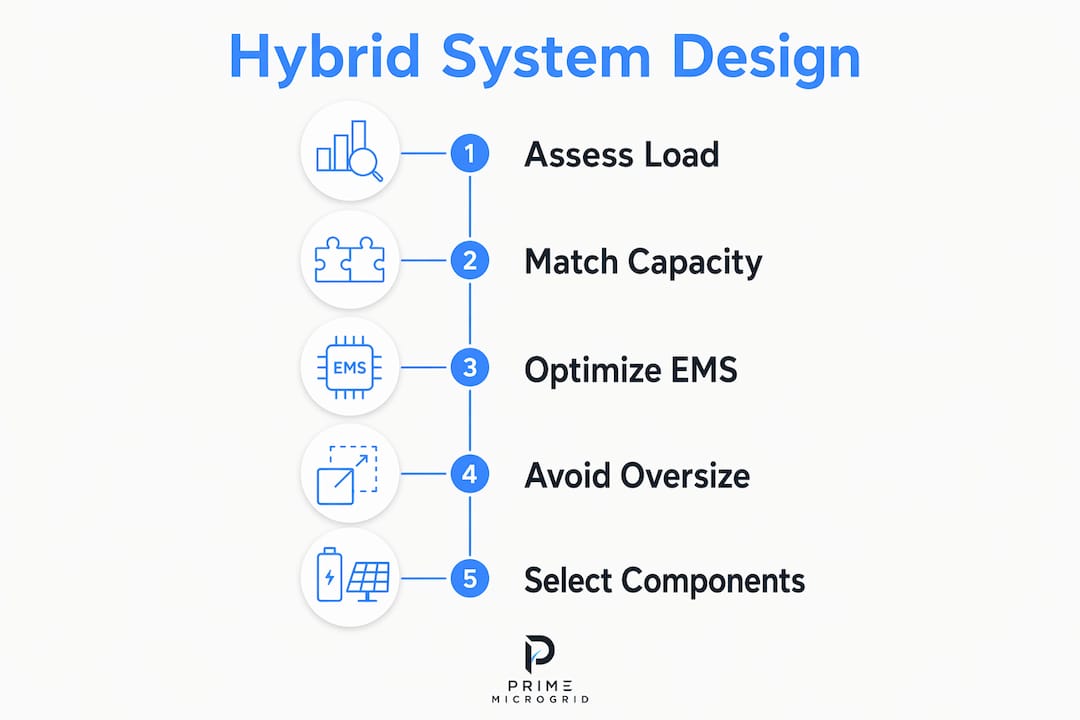
Matching generation capacity to your load and local renewable resource availability is the foundation of good design. A property in Arizona with 300 days of sun per year needs a different solar-to-battery ratio than a farm in Vermont. Techno-economic modeling and multi-objective optimization balance cost, reliability, and environmental impact across these variables, and professional design tools simulate performance under years of weather data before a single panel is installed.
The EMS strategy matters as much as the hardware. Control strategies use real-time data, forecasts, and demand estimates to minimize losses and improve component lifespan. A rule-based EMS might simply charge batteries from solar and discharge at night. A model-predictive EMS looks at tomorrow's weather forecast and tonight's time-of-use rates to decide whether to charge from the grid at 2 a.m. or save that capacity for solar. An AI-based EMS learns your household patterns over weeks and continuously refines its dispatch decisions.
The most common and costly design mistake is oversizing storage. Oversizing one component without coordination can degrade system cost-effectiveness and performance. A 40 kWh battery bank on a home that only needs 8 kWh of nightly backup is not twice as good. It is an expensive asset that cycles at a fraction of its capacity, wears unevenly, and never pays back its cost. Proper sizing requires honest load analysis, not worst-case assumptions.
Pro Tip: Before you talk to any installer, pull twelve months of utility bills and note your three highest-consumption months. That data tells a designer more about your real load profile than any online calculator.
For homeowners who want to understand how generators fit into this picture, the article on generators in hybrid design explains how dispatchable backup integrates with renewables and storage without creating redundancy or waste.
What types of hybrid energy systems exist?
Different hybrid configurations serve distinct operational goals, and understanding which type fits your property is the first step toward a useful conversation with a designer or installer.
| System type | Key features | Typical application |
|---|---|---|
| Solar + battery + generator | Solar primary, battery buffer, generator backup | Suburban homes, farms, small businesses |
| Wind + diesel hybrid | Wind reduces diesel consumption, generator fills gaps | Remote properties, rural farms |
| Solar + battery (grid-tied) | Exports excess to grid, draws from grid as backup | Urban and suburban homes with net metering |
| Off-grid microgrid | Fully islanded, no utility connection | Remote cabins, agricultural operations |
| Hybrid Energy Storage System (HESS) | Multiple storage types (battery + supercapacitor) | High-load properties, EV charging sites |
The distinction between a grid-tied hybrid and an off-grid microgrid matters enormously for design and cost. A grid-tied system uses the utility as a backstop, which reduces the battery capacity you need to buy. An off-grid system must be sized to cover your worst-case period of low renewable production entirely on its own, which typically means larger storage and a more capable backup generator.
Microgrids are a specific category of hybrid system where all components operate as a coordinated local grid, capable of islanding from the utility during outages and reconnecting when the grid recovers. Primemicrogrid specializes in exactly this configuration, designing systems that can operate independently or in parallel with the utility depending on conditions. For a deeper look at how battery storage supports remote properties, that resource covers the storage sizing and dispatch logic specific to off-grid and weak-grid scenarios.
How can property owners implement a hybrid energy system?
Moving from research to installation is a structured process, and skipping steps early creates expensive problems later. Here is a practical sequence for property owners:
- Audit your energy use. Gather twelve months of utility bills. Identify your peak demand, average daily consumption, and which loads are non-negotiable during an outage.
- Assess your renewable resources. Use tools like the National Renewable Energy Laboratory's PVWatts calculator for solar, or local wind resource maps for wind potential on your property.
- Define your resilience goals. Do you need 24-hour backup for critical loads, or full off-grid capability? Your answer determines system size and cost more than any other factor.
- Evaluate your existing infrastructure. Assess your electrical panel capacity, roof condition, available land, and any utility interconnection requirements before committing to a design.
- Work with a qualified designer. A professional will model your system against real weather data, size components correctly, and configure the EMS for your specific load profile.
- Understand available incentives. The federal Investment Tax Credit (ITC) applies to solar and battery storage. Many states offer additional rebates or property tax exemptions for renewable energy systems.
- Plan for monitoring and maintenance. A hybrid system with remote monitoring lets you track performance, catch degradation early, and verify that the EMS is operating as designed.
For homeowners considering a solar-plus-battery-plus-generator combination, the guide on combining solar, generator, and battery walks through the integration decisions in practical detail.
Key takeaways
A hybrid energy system delivers reliable, cost-effective power because coordinated EMS control, not hardware quantity, determines how well the system performs under real-world conditions.
| Point | Details |
|---|---|
| Definition is precise | A hybrid system requires two or more generation or storage technologies managed by a coordinating EMS. |
| EMS is the critical variable | Two identical hardware setups perform differently based on dispatch logic and EMS configuration. |
| Sizing drives economics | Oversizing storage without load analysis wastes capital and reduces long-term system performance. |
| Types vary by application | Grid-tied, off-grid, microgrid, and HESS configurations each serve different property needs and goals. |
| Benefits compound over time | Reduced bills, longer equipment life, and grid revenue potential make hybrid systems a long-term financial asset. |
Why the EMS is the part most homeowners underestimate
I have seen homeowners spend months comparing panel brands and battery chemistries, then accept whatever EMS settings the installer defaults to. That is the wrong priority order. The hardware matters, but dispatch logic and EMS setpoints determine resilience and cost-effectiveness more than hardware specs alone. Two properties with identical solar arrays and battery banks will perform completely differently if one has a well-tuned predictive EMS and the other is running basic rule-based controls.
The emerging shift toward AI-managed home energy is the most significant development in this space right now. Systems that learn your consumption patterns, anticipate weather changes, and optimize dispatch in real time are no longer experimental. They are available today, and the performance gap between AI-managed and rule-based systems is measurable in both kilowatt-hours and dollars over a five-year period.
My honest advice to any property owner starting this process: spend as much time evaluating the EMS and the installer's commissioning process as you spend evaluating the panels and batteries. Ask specifically how the system will be configured for your load profile, not a generic residential template. And insist on remote monitoring from day one. A hybrid system you cannot see is a system you cannot manage.
— David
See how Primemicrogrid designs hybrid systems for your property
Primemicrogrid designs residential microgrid systems that combine solar, battery storage, generators, smart controls, and EMS technology into a single coordinated setup built around your specific load profile and resilience goals. Every system is sized and configured for your property, not a generic template. Primemicrogrid's AI-managed home energy platform takes hybrid performance further by continuously optimizing dispatch based on real-time data and usage patterns. If you are ready to move from research to a real design, Primemicrogrid's team will assess your energy needs and build a system that delivers reliable, cost-effective power for the long term.
FAQ
What is a hybrid energy system in simple terms?
A hybrid energy system is a power setup that combines two or more energy sources, such as solar panels, a battery bank, and a backup generator, managed by a control system that decides in real time how to supply your home with electricity.
How does a hybrid energy system differ from solar plus battery?
A solar-plus-battery system is one component of a hybrid system, but a true hybrid includes at least one additional generation or storage technology and an EMS that coordinates all sources. The coordination layer is what defines the hybrid.
What are the main types of hybrid energy systems?
The main types include grid-tied solar-battery-generator systems, off-grid microgrids, wind-diesel hybrids, and hybrid energy storage systems (HESS) that combine batteries with supercapacitors. Each type serves different load profiles and resilience requirements.
How much does a hybrid energy system cost for a home?
Costs vary widely based on system size, component selection, and site conditions, but a residential hybrid system typically ranges from $20,000 to $80,000 before incentives. The federal Investment Tax Credit and state rebates can reduce that figure significantly.
Can a hybrid energy system work during a grid outage?
Yes. A properly designed hybrid system with battery storage and a backup generator can island from the grid and supply your critical loads indefinitely, provided generation and storage are sized to match your actual consumption during an outage.