
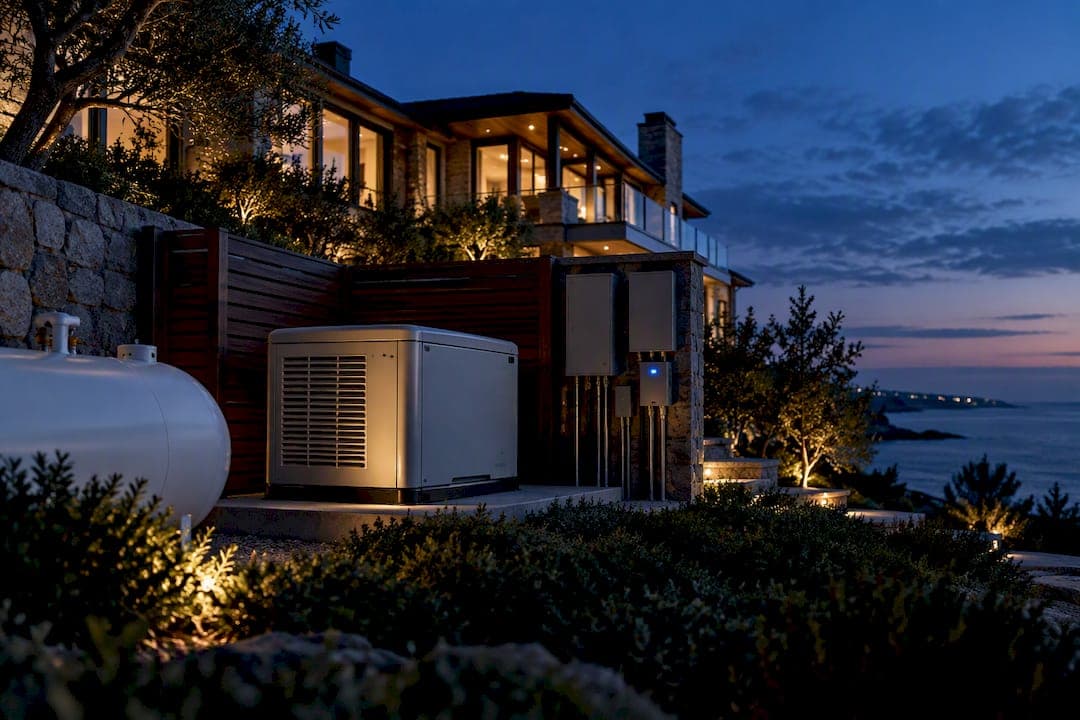
A small standby generator (5 to 30 kW) typically burns between 0.4 and 3.6 gallons of diesel per hour depending on load, a mid-size unit (30 to 500 kW) runs roughly 3 to 50-plus gallons per hour, and units above 500 kW can consume tens to hundreds of gallons per hour at full output. A quick rule of thumb: at moderate load, many diesel standby units burn approximately 0.08 to 0.12 gallons per hour for every kW of nameplate capacity, though this is a rough planning figure, not a substitute for a manufacturer curve.
TL;DR:
- Fuel consumption varies by generator size, load, and conditions, with smaller units burning less than 4 gallons per hour at moderate load, and larger units consuming significantly more.
- Fuel use increases non-linearly as load approaches full capacity, with efficiency dropping at very low or very high loads, making proper sizing crucial.
- Tank capacity should be planned based on usable gallons, accounting for vaporization limits and fuel reserves, especially for propane in cold weather.
- Using manufacturer-specific fuel consumption data and real-time monitoring improves accuracy and helps detect efficiency issues early.
- Pairing generators with battery storage reduces total fuel use and extends runtime, often providing a more cost-effective and efficient backup solution.
Table of Contents
- Consumption charts by generator size and load percentage
- How to calculate fuel use from kW, load, and BSFC
- Fuel tank sizing and runtime: usable gallons and vaporization limits
- Estimating operating cost per hour and per outage
- Why load factor changes how much fuel you burn per kWh
- Maintenance habits that keep fuel consumption in check
- Worked examples for common home and commercial sizes
- Fuel use isn't steady during startup and load swings
- Tools for tracking fuel use in real time
- Temperature and altitude change how much fuel a generator needs
- Why the smartest fix for fuel consumption is often less generator, not more fuel
- Let Prime Microgrid size your backup power around real fuel savings
- Where these figures come from
- Sources
- FAQ
Consumption charts by generator size and load percentage
Fuel use scales with both the generator's rated capacity and how hard you're running it. A 100 kW unit at 25% load burns far less than the same unit at 100% load, and the relationship isn't perfectly linear because engines lose efficiency at the extremes.
The table below reflects commonly cited approximate diesel consumption figures across standard load points, drawn from manufacturer specification sheets and industry reference charts. Actual figures vary by engine model, altitude, fuel quality, and ambient temperature, so treat these as planning numbers rather than guarantees.
| Generator size (kW) | 25% load (gal/hr) | 50% load (gal/hr) | 75% load (gal/hr) | 100% load (gal/hr) |
|---|---|---|---|---|
| 10 | 0.4 | 0.4 to 0.7 | 1.0 | 1.3 |
| 20 | 0.8 | 1.4 | 2.0 | 2.6 |
| 30 | 1.2 | 2.0 | 2.9 | 3.6 |
| 50 | 1.9 | 3.2 | 4.6 | 6.0 |
| 100 | 3.6 | 6.1 | 8.9 | 11.6 |
| 250 | 8.9 | 14.9 | 21.6 | 28.3 |
| 500 | 17.2 | 28.8 | 41.8 | 54.8 |
Consumption tables like this one draw on the type of rated-load data published in manufacturer specification sheets covering common standby model lines, and larger commercial units follow the same pattern shown in spec sheets from engine makers like MTU, which lists fuel flow in liters per hour and grams per kilowatt-hour at 100%, 75%, and 50% load under ISO reference conditions.
A few assumptions sit behind every chart like this one:
- Figures assume liquid-cooled diesel engines running at standard ISO test conditions, not the hotter or higher-altitude conditions many installations actually see.
- Fuel density is assumed near standard diesel weight, so real-world numbers shift slightly with fuel blend and temperature.
- Air-cooled residential standby units (the smaller end of the range) often show slightly higher gallons per kW than liquid-cooled prime-rated units because of lower thermal efficiency.
- One gallon per hour converts to about 3.785 liters per hour, useful if you're comparing a U.S. chart against a metric spec sheet.
When you know the exact model you're evaluating, pull the manufacturer's spec sheet instead of relying on a generic table.
How to calculate fuel use from kW, load, and BSFC
The table above gets you a fast estimate. For a precise number tied to your exact generator, walk through the calculation yourself using brake-specific fuel consumption, or BSFC, the metric engine manufacturers use to describe fuel burned per unit of electricity produced.
- Find your generator's nameplate kW and expected load percent. A 22 kW home standby unit running your well pump, refrigerator, and a few circuits during an outage might sit near 50% load.
- Calculate the kW actually being demanded. Multiply nameplate kW by load percent: 22 kW times 50% equals 11 kW of real demand.
- Apply a specific fuel consumption figure in gallons per kWh, or convert a manufacturer's BSFC (given in grams per kWh) to gallons per hour. Diesel weighs about 3,180 grams per gallon, so BSFC in g/kWh divided by 3,180 gives gallons per kWh, which you then multiply by the kW demanded to get gallons per hour.
- Cross-check against the manufacturer's published curve when one is available, since small standby engines and large industrial engines have different efficiency curves at partial load.
For quick shorthand, small standby diesel units commonly land between 0.35 and 0.5 gallons per kWh delivered at mid-range loads, a figure you can pull directly from a spec sheet's rated-load fuel consumption table when one is published for your model.
Using a typical specific consumption of roughly 0.55 gallons per kWh at that partial-load point (partial loads run less efficiently than full load), you get approximately 6 gallons per hour.
Statistic callout: The EPA's guidance on stationary internal combustion engines recommends using brake-specific fuel consumption tied to load factor for the most accurate fuel and emissions estimates, rather than a flat per-kW assumption. That's the method behind the worked example above, and it's why two generators of identical nameplate capacity can burn noticeably different amounts of fuel under the same load.

Fuel tank sizing and runtime: usable gallons and vaporization limits
Knowing gallons per hour only matters once you translate it into hours or days of runtime, and that math depends on how much fuel you can actually use, not just how much your tank holds.
The standard runtime formula is straightforward: usable gallons divided by gallons per hour equals hours of runtime. The catch is that "usable gallons" is smaller than tank capacity for both diesel and propane.
- Diesel tanks are typically sized with some reserve to avoid drawing sediment from the tank bottom, so treat 90 to 95% of rated capacity as usable for planning.
- Propane tanks are filled to roughly 80% of rated capacity by design, a safety standard that leaves room for vapor expansion, according to propane tank sizing guidance from Portlandia Electric Supply.
- A 120 gallon propane tank yields about 96 usable gallons, a 250 gallon tank yields about 200, and a 500 gallon tank yields usable capacity somewhat lower than nominal, per the same guidance.
- A 22 kW generator burning around 2 gallons per hour on propane at moderate load would run roughly 100 hours on a 250 gallon tank's usable volume.
Propane brings a second constraint that diesel doesn't: vaporization rate. A tank's usable capacity tells you how much liquid propane is available, but the tank can only convert liquid to vapor fast enough to feed the generator under certain conditions. Cold weather slows vaporization, which means a tank that looks adequately sized on paper can still struggle to keep up with generator demand during a winter outage, a point the Portlandia Electric Supply guide raises directly.
Pro Tip: Before winter storm season, confirm your propane tank's vaporization rate at your region's typical low temperature, not just its rated gallon capacity, since undersized vaporization can starve a generator even with fuel still in the tank.
Natural gas sidesteps tank sizing entirely since the generator draws from the utility line, but it introduces its own limit: pipe and meter capacity, measured in BTU per hour. Before installing a natural gas standby unit, confirm with your utility that your meter and service line can deliver the BTU load your generator demands at full output, since an undersized meter can throttle a generator exactly when you need full power.

Estimating operating cost per hour and per outage
Converting fuel burn into dollars is simple arithmetic once you have gallons per hour: multiply by your local price per gallon to get cost per hour, then multiply by expected outage duration for a total cost estimate.
- Formula: gallons per hour times price per gallon equals cost per hour, and cost per hour times hours of runtime equals total fuel cost for the outage.
- Residential example: a 22 kW generator at 50% load burning roughly 6 gallons per hour, with diesel priced at $4.00 per gallon, costs about $24.00 per hour, or roughly $576 for a 24 hour outage.
- Commercial example: a 200 kW generator at 50% load burning approximately 12 gallons per hour, with diesel priced at $3.50 per gallon, costs about $42.00 per hour, or roughly $1,008 for a 24 hour outage.
- Part-load operation increases the effective cost per kWh delivered, since the engine burns fuel less efficiently below its rated capacity.
Statistic callout: A permit technical support document for a 2,000 kW standby generator lists a maximum fuel flow of 139.5 gallons per hour at full load, illustrating how quickly fuel costs scale at commercial and industrial capacities. At $4.00 per gallon, that single unit running flat out would cost roughly $558 per hour, a figure worth knowing before assuming a backup generator is a cheap insurance policy.
For a precise dollar figure on your own equipment, pull the specific fuel consumption value from your generator's spec sheet rather than relying on the approximate gallons per hour from a general chart.
Why load factor changes how much fuel you burn per kWh
Load factor describes how much of a generator's rated capacity you're actually using, and it has an outsized effect on efficiency. Brake-specific fuel consumption, the gallons or grams of fuel burned per kWh produced, isn't constant across the load range: it's worst at low load and best somewhere in the mid-to-upper range.
The EPA's technical guidance on stationary engines ties fuel consumption directly to load factor and recommends BSFC-based calculations for accurate fuel and emissions estimates, precisely because a flat per-kW number misses this curve.
- Running a diesel generator below roughly 30 to 40% of rated load for extended periods is disproportionately inefficient, burning more fuel per kWh delivered than the same engine at 60 to 80% load.
- Sustained light-load operation also raises the risk of wet stacking, a condition where unburned fuel and carbon accumulate in the exhaust system and can damage the engine over time.
- Right-sizing a generator to your actual demand, or using load-bank testing to periodically exercise an oversized unit at higher load, helps avoid both the fuel penalty and the mechanical risk.
A generator sized for a 50 kW peak but typically running a 12 kW household load spends most of its runtime at a punishing 24% load factor, burning noticeably more fuel per kWh than a generator matched closer to the typical demand. That mismatch is one of the most common and most expensive sizing mistakes in backup power planning.
Maintenance habits that keep fuel consumption in check
A well-maintained generator burns less fuel per kWh than a neglected one, and the gap widens every year equipment goes without service.
- Replace fuel and air filters on schedule, since clogged filters force the engine to work harder and burn more fuel to produce the same output.
- Service injectors periodically, as worn injectors atomize fuel poorly and waste energy as unburned diesel.
- Keep oil and coolant at correct levels and specifications, since an overheating engine loses efficiency fast.
- Inspect the turbocharger on turbocharged units, since a failing turbo reduces combustion efficiency and increases fuel burn per kWh.
- Log runtime hours and fuel consumed after every use, ideally with an inline fuel meter, so you can spot a developing efficiency problem before it becomes a failure.
- Schedule load-bank testing and regular exercising cycles at meaningful load, not just a five-minute weekly test at no load, to prevent wet stacking and confirm real-world fuel burn matches your planning numbers.
Pro Tip: Track fuel consumed per runtime hour every time you use the generator. A gradual upward drift in gallons per hour at the same load is often the earliest sign of a maintenance issue, well before the engine shows other symptoms.
Pairing a generator with battery storage changes this equation further. Batteries absorb short, frequent loads and let the generator run fewer total hours, often at a better average load factor, which reduces both fuel consumed and the wear that drives up maintenance costs over the system's life.
Worked examples for common home and commercial sizes
Three scenarios cover most of what homeowners and property managers actually plan for.
- 22 kW home standby at 50% load: roughly 6 gallons per hour on diesel. A 250 gallon propane-equivalent or diesel tank filled to 90% usable capacity (225 gallons) supports about 37 hours of runtime; a 500 gallon tank at 90% usable (450 gallons) stretches that to roughly 75 hours. At $4.00 per gallon, a 48 hour outage costs approximately $1,152 in fuel.
- 10 kW backup on propane at light load (around 25%): roughly 0.6 to 0.8 gallons per hour. A 120 gallon tank's 96 usable gallons supports well over 100 hours on paper, but confirm the tank's vaporization rate can keep pace in cold weather before relying on that number for a winter outage.
- 200 kW commercial unit: using manufacturer-style spec data, a unit in this class burns about a dozen gallons per hour at 50% load and roughly one-and-a-half to two dozen gallons per hour at 100% load, figures consistent with the fuel flow and BSFC data published in large engine spec sheets like MTU's. At $3.50 per gallon, that's roughly $42 per hour at half load and $63 to $70 per hour at full load.
Fuel use isn't steady during startup and load swings
Fuel consumption rarely stays flat during an outage. Startup itself briefly demands more fuel than a generator's steady-state number suggests, since the engine has to overcome its own inertia and bring an alternator up to speed before settling into a normal combustion pattern.
Transient load changes cause similar spikes. When a large appliance like a well pump or air conditioner compressor kicks on, the generator's governor has to respond quickly to hold frequency and voltage steady, and that response typically involves a brief surge in fuel delivery before settling back to the load-appropriate rate. A generator sized with little margin above its expected peak load will show these transients more sharply, since it has less headroom to absorb the sudden demand smoothly.
This is one reason average gallons-per-hour figures from a chart or spec sheet describe steady-state operation rather than the messier reality of a household or facility cycling loads on and off throughout a multi-day outage. A generator running a refrigerator, well pump, and HVAC system on staggered cycles burns somewhat more fuel over 24 hours than a simple average-load calculation predicts, because every transient adds a small fuel penalty on top of the baseline curve.
Tools for tracking fuel use in real time
Most planning numbers, including every figure in this article, describe expected consumption rather than what a specific generator is actually burning at a given moment. Closing that gap requires monitoring.
Inline fuel flow meters, installed in the fuel supply line, give the most direct reading: gallons per hour in real time, which you can log against load to build your own consumption curve over repeated outages or test runs. Many standby generator controllers also track total runtime hours and, on more advanced units, estimated fuel consumed, though these estimates are only as accurate as the assumptions programmed into the controller.
Fuel level sensors in the tank, paired with a controller or a simple remote monitoring app, let you see remaining fuel without a physical inspection, which matters most during an extended outage when driving to check a tank isn't always practical. Larger commercial installations sometimes pair tank-level sensors with the generator's own data output to calculate real-time gallons per kWh, catching efficiency drift before it shows up as a shortened runtime.
For most homeowners, the practical version of this is simpler: log the fuel level before and after every generator run, note the hours logged, and calculate your own real-world gallons per hour. Compare that number against the manufacturer's chart periodically, since a widening gap is often the first sign of a maintenance issue worth addressing.
Temperature and altitude change how much fuel a generator needs
Manufacturer fuel consumption figures are typically rated under ISO reference conditions: a specific ambient temperature, altitude, and air density. Real installations rarely match those conditions exactly, and the deviation affects fuel burn.
Cold temperatures thicken diesel fuel slightly and can affect combustion efficiency, while extreme cold on propane systems slows vaporization, a limit covered in the tank sizing section above rather than a consumption change itself. Hot ambient temperatures reduce air density, which can reduce an engine's effective output and push it toward a higher load factor to deliver the same kW, indirectly increasing fuel burn per kWh.
Altitude has a similar effect: thinner air at elevation reduces the oxygen available for combustion, and naturally aspirated engines in particular may need to work harder, or may be de-rated by the manufacturer, to produce their nameplate output at higher elevations. Turbocharged engines compensate for this better than naturally aspirated ones, but even they show some efficiency change at extreme altitude.
None of this makes the consumption charts and calculations above wrong. It means a chart built on standard conditions is a starting point, and a generator running in high heat, deep cold, or at elevation should be expected to burn somewhat more fuel per kWh than the chart suggests. When precision matters, especially for a permanent installation, that's a conversation for whoever is sizing your fuel storage and generator capacity together, not just a lookup on a table.
Why the smartest fix for fuel consumption is often less generator, not more fuel
The instinct after running the numbers above is usually to size the tank bigger. In practice, we find the more effective fix is often reducing how much the generator has to run in the first place.
Pairing the generator with battery storage sized to handle routine loads, and reserving the generator for genuine peak demand or extended runtime, tends to produce a better lifecycle cost than simply oversizing the generator and the fuel delivery contract behind it. We design every system around the property's actual load profile first, because the fuel math only makes sense once the hardware sizing does.
— Prime Microgrid
Let Prime Microgrid size your backup power around real fuel savings
Every gallon-per-hour number in this article assumes a generator running alone. A hybrid system, one that pairs a right-sized generator with battery storage and load management, typically asks the generator to do less work overall, which is where the real fuel savings come from rather than a bigger tank.

Prime Microgrid designs Estate Microgrid Systems, Hybrid Generator Systems, and Battery Retrofit Systems around each property's actual electrical demand, not a generic package, so the generator you install (or already own) runs fewer hours at a better load factor. If you're planning fuel storage for a new standby generator or trying to figure out why an existing one burns more than the spec sheet suggests, explore Prime Microgrid's systems and request a design consultation built around your property's real numbers.
Where these figures come from
The consumption tables, tank sizing math, and calculation methods in this article draw on a handful of technical sources worth consulting directly if you're planning fuel storage for a specific generator model.
- The EPA's stationary internal combustion engine guidance explains load factor and BSFC calculations in technical detail.
- Manufacturer specification sheets, including examples from Cummins and MTU, list precise fuel flow by load point for specific engine models.
- The propane tank sizing guide from Portlandia Electric Supply covers usable-gallons math and vaporization limits in detail.
Your own generator's spec sheet, available from the manufacturer, remains the most accurate source for its specific BSFC curve, since even similar engines vary in real-world fuel efficiency.
Sources
- Stationary internal combustion sources — EPA (April 2025)
- Cummins specification sheet (CM20 series) — Cummins
- Propane tank sizing guide — Portlandia Electric Supply
FAQ
How much fuel does a generator use per hour?
It depends heavily on size and load: a small residential standby unit around 20 kW typically burns 0.8 to 2.6 gallons per hour on diesel depending on load percentage, while larger commercial units can burn well over 50 gallons per hour at full output. Check your generator's manufacturer spec sheet for a precise figure at your expected load.
What is the 20/20 rule for generators?
This isn't a standard engineering term defined by manufacturers or the EPA, and definitions circulating online vary. Rather than rely on an informal rule, size your generator and fuel storage using your actual load profile and your manufacturer's rated-load fuel consumption table.
How long will a 5,000 watt generator run on 5 gallons of gas?
Runtime depends on load, and fuel consumption varies by generator model and fuel type. Check your specific model's fuel consumption rating for an exact figure, since gasoline engines vary more by design than diesel units of similar size.
How long will a 20 lb tank of propane run a generator?
A 20 lb propane tank holds a limited volume of usable propane, and runtime depends on your generator's size and load, similar to the gallon-based calculations covered above for larger propane tanks. For anything beyond short, light-duty backup, a larger tank sized with the usable-gallons and vaporization guidance covered earlier is the more practical choice.
Does running a generator at partial load waste fuel?
Right-sizing the generator to your actual demand, or pairing it with battery storage to absorb routine loads, helps avoid both problems.