
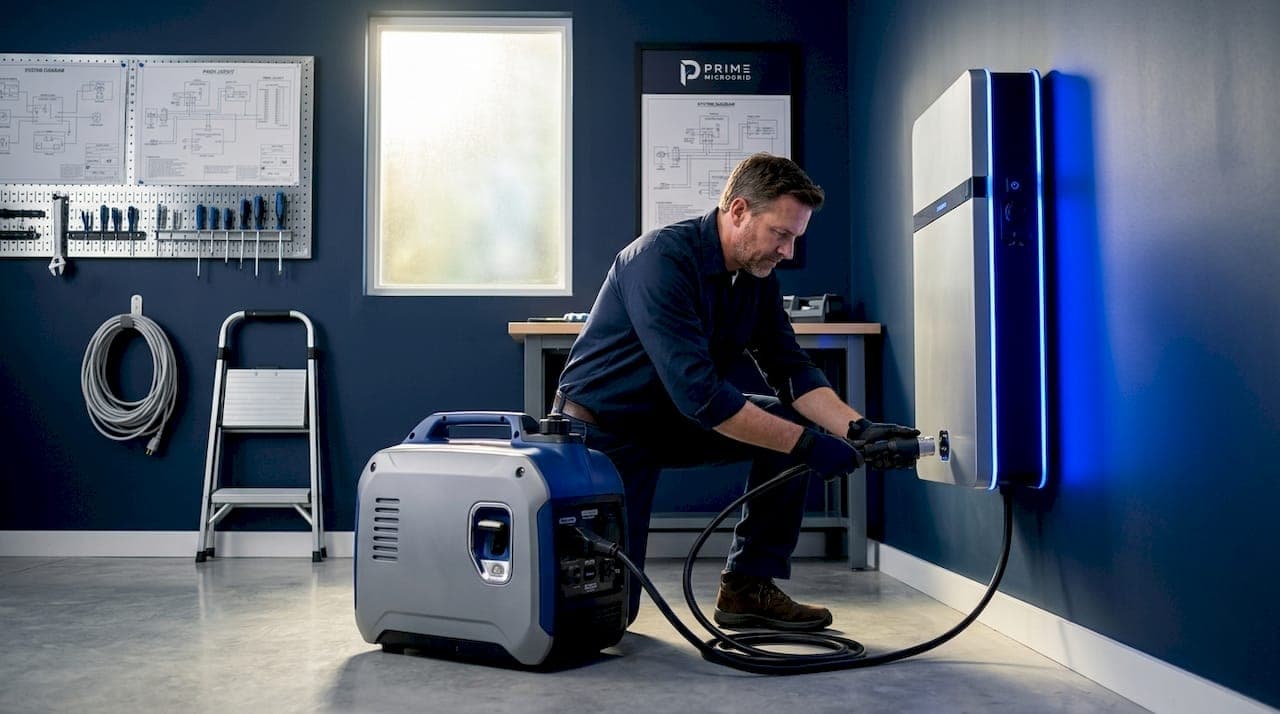
Linking battery storage to a backup generator means connecting your battery inverter system through dedicated transfer equipment so both power sources work together safely, without ever energizing each other simultaneously. This hybrid approach, known in the industry as a battery-generator integrated backup system, gives homeowners and property managers the best of both worlds: the instant response of battery storage and the extended runtime of a fuel-powered generator. The result is a backup power setup that handles short outages on battery alone and longer events by using the generator to recharge the battery bank. Getting this right requires the correct transfer switch, compatible equipment, and attention to power quality.
How to link battery storage to a backup generator safely
Before you wire anything, two compatibility factors determine whether your system will work or fail: transfer equipment and generator power quality.

Transfer equipment is the legal and technical backbone of any battery backup generator setup. NEC Article 702 requires transfer equipment to prevent the utility grid and your generator from being connected at the same time, protecting utility workers and your own equipment from backfeed. In practice, this means installing either an automatic transfer switch (ATS) or a manual transfer switch between your utility meter and your main panel. Some modern battery systems use a purpose-built power dock that combines the ATS, backup distribution panel, and generator input management into one unit. The Anker Solix E10, for example, uses a power dock managing ATS and backup circuits as a single integrated component.
Generator power quality is the factor most homeowners miss entirely. Your battery inverter requires clean AC input to charge safely. Generator output must stay below 10% total harmonic distortion (THD) for safe battery charging. Open-frame portable generators commonly produce 15 to 25% THD, which puts your battery system at risk of damage or unstable operation. Inverter generators from brands like Honda or Yamaha typically produce cleaner power, often below 3% THD, making them far better candidates for direct battery integration.
Here are the core prerequisites before starting any installation:
- ATS or manual transfer switch rated for your home's load, compliant with NEC 702.5 signage requirements
- Inverter generator or low-THD conventional generator producing less than 10% THD
- Battery inverter with AC input port or a dedicated generator charging circuit
- Licensed electrician for panel work and transfer switch installation
- Electrical permit from your local authority having jurisdiction (AHJ)
Pro Tip: Check your battery inverter's spec sheet for its "AC coupling" or "generator input" requirements before purchasing a generator. Some systems, like the Anker Solix E10, specify maximum generator wattage and THD limits that must be matched exactly.
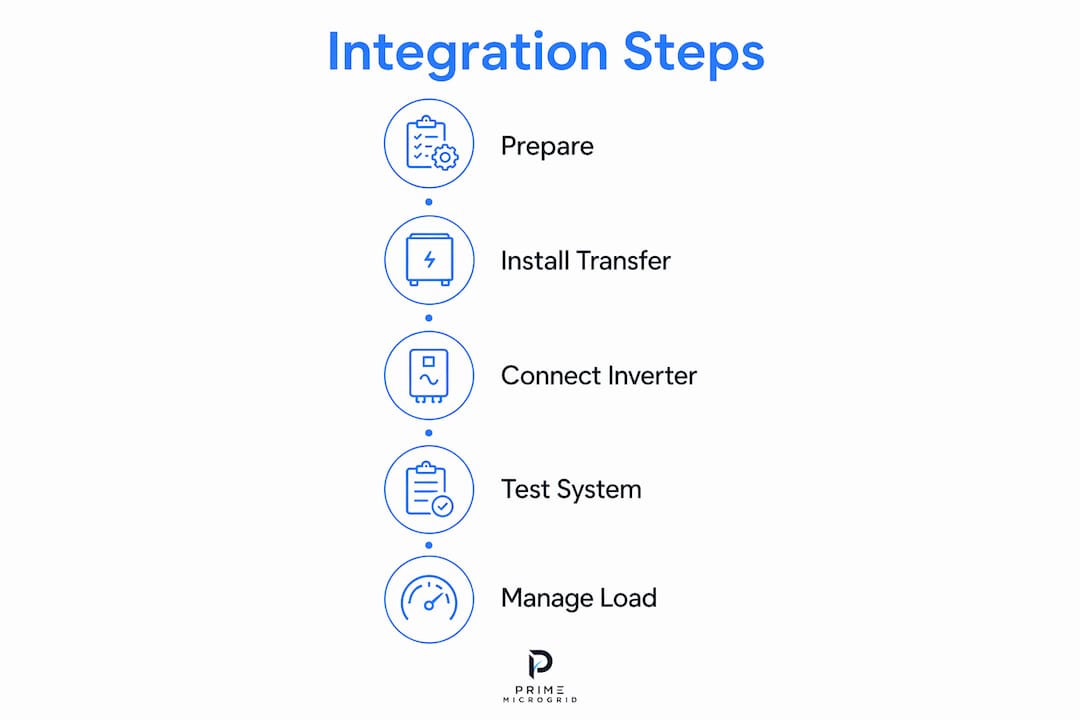
Step-by-step installation for a generator and battery integration
A functional generator and battery integration follows a specific physical and logical sequence. Skipping steps creates safety hazards and system conflicts.
- Install the transfer switch or power dock between your utility meter and main panel. This is the first physical component and must be completed by a licensed electrician. The transfer switch isolates your backup loads from the utility grid the moment an outage is detected.
- Connect your battery inverter to the backup distribution panel created by the transfer switch. The inverter becomes the primary power source for your critical circuits during an outage.
- Wire the generator input to the battery inverter's AC input port or to a dedicated generator circuit on the backup panel. Dedicated generator input circuits prevent overlapping energized sources and give the system controller clear authority over which source is active.
- Configure load management through your battery system's app or control panel. Assign circuits by priority so the most critical loads (refrigerator, medical equipment, lighting) receive power first.
- Commission and test the system with the utility connected, then simulate an outage by opening the main breaker. Verify the battery takes over within milliseconds and that the generator input is recognized by the inverter.
- Test the generator charging sequence by running the generator and confirming the battery system begins accepting charge through the designated input.
The table below summarizes the key components and their roles:
| Component | Role in the system |
|---|---|
| Transfer switch or power dock | Isolates utility from backup sources; prevents backfeed |
| Battery inverter | Supplies instant power to critical circuits during outage |
| Generator | Charges battery bank during extended outages |
| Load management controller | Prioritizes circuits to match available power capacity |
| System app or control panel | Monitors state of charge, generator status, and load data |
Pro Tip: When pairing a portable generator, always start the generator before enabling the AC input on your battery inverter. This gives the generator time to stabilize its output frequency and voltage before the inverter begins drawing load.
What common challenges arise when linking batteries with a generator
Even a correctly installed system can develop operational problems. Knowing the most common failure points saves hours of troubleshooting.
- Battery charging does not initiate. The most frequent cause is generator THD exceeding the inverter's tolerance. If your battery system refuses to charge from the generator, test the generator's THD with a power quality meter. Switching to an inverter generator almost always resolves this.
- Unstable voltage or flickering loads. High harmonic distortion from generators causes the battery inverter to reject the input or operate in bypass mode, passing dirty power directly to your appliances. This is particularly damaging to sensitive electronics.
- Generator overload during startup. Large motor loads like HVAC compressors draw three to five times their running wattage at startup. If your load management is not configured to shed non-critical circuits before the generator starts, the generator will trip its breaker.
- Manual transfer switch delays. Manual transfer switches are permitted under NEC Article 702 for optional standby systems, but they require you to physically switch the load. During a nighttime outage, this delay can mean minutes without power. An ATS eliminates this gap entirely.
- Slow battery recharge. Generator output wattage must exceed your home's active load to have surplus power available for battery charging. If your generator is undersized, it will power your loads but never charge the battery. Size your generator to at least 125% of your expected backup load.
For ongoing reliability, schedule a monthly generator test run of at least 30 minutes under load, inspect transfer switch contacts annually, and review your battery system's charge logs after every outage event. Monitoring through your system's app gives you real-time visibility into charging rates and load behavior that manual inspection cannot match.
How do integrated systems optimize fuel efficiency during extended outages
The most efficient hybrid backup systems treat the battery and generator as complementary tools rather than redundant ones. Integrated systems prioritize battery usage with millisecond switching, reserving the generator strictly for recharging the battery bank rather than running loads directly. This approach cuts generator runtime dramatically, which reduces fuel consumption and engine wear.
The logic works like this: your battery handles all active loads during an outage. When the battery state of charge drops to a preset threshold (typically 20 to 30%), the system automatically starts the generator. The generator then charges the battery at its maximum input rate while the battery continues supplying the home. Once the battery reaches a target charge level (typically 80 to 90%), the generator shuts off. This cycle repeats as needed, and the generator may only run two to four hours per day during a multi-day outage instead of continuously.
| Approach | Generator runtime | Fuel use | Battery wear |
|---|---|---|---|
| Generator only (no battery) | Continuous | High | N/A |
| Battery only (no generator) | None | None | High during deep cycles |
| Hybrid battery and generator | Intermittent (charge cycles) | Low to moderate | Moderate, managed |
Load management sequencing amplifies these gains further. Systems like the Anker Solix E10 use smart circuit management to allocate power across up to 12 prioritized circuits, automatically shedding lower-priority loads when available power is constrained. You can also explore combining solar with your generator and battery to reduce generator dependency even further during daylight hours.
Pro Tip: Set your generator auto-start threshold at 25% battery state of charge rather than 10%. Starting the generator earlier keeps the battery in a healthier charge range and prevents the deep discharge cycles that accelerate battery degradation.
Key takeaways
Linking battery storage to a backup generator requires proper transfer equipment, a low-THD generator, and load management configuration to create a safe, efficient hybrid backup system.
| Point | Details |
|---|---|
| Transfer equipment is non-negotiable | Install an ATS or power dock to prevent backfeed and meet NEC Article 702 requirements. |
| Generator THD must stay below 10% | Open-frame portable generators often exceed this limit; inverter generators are the safer choice. |
| Battery acts as buffer, generator as charger | Run the generator only during charge cycles to cut fuel use and extend engine life. |
| Load management prevents overload | Prioritize critical circuits so the system never draws more than the generator or battery can supply. |
| Professional installation is required | Transfer switch work requires a licensed electrician and a permit from your local AHJ. |
Why most homeowners underestimate this integration
I have reviewed dozens of battery-generator setups over the years, and the single most consistent mistake is treating the generator as a direct power source rather than a charging tool. Homeowners buy a capable battery system, add a generator, and then wire them together without accounting for power quality. The battery system rejects the generator input, nothing charges, and the homeowner concludes the equipment is defective. It is not defective. The generator is simply producing power that the battery inverter cannot accept.
The second pattern I see regularly is undersizing the transfer switch. Most homeowners underestimate the switching and load management complexity in these systems. A transfer switch rated for 60 amps on a home that pulls 100 amps during a storm is a fire risk, not a backup plan. Get a load calculation done before specifying any equipment.
The technology is genuinely moving in a better direction. DC-coupled generator options and purpose-built power docks are making integration cleaner and more reliable than the cobbled-together systems of five years ago. If you are comparing your options before committing, the generator vs. battery storage breakdown from Primemicrogrid is worth reading first. The hybrid path is almost always the right answer for homes that need more than a few hours of backup, but only when the system is designed correctly from the start.
— David
Build your hybrid backup system with Primemicrogrid
Primemicrogrid designs residential microgrid systems that integrate battery storage, backup generators, and smart load management into a single, code-compliant solution for homes and properties across the Mid-Atlantic region. Every system starts with a load analysis, generator compatibility review, and a transfer equipment plan built around your specific property.

If you are ready to move beyond a single-source backup plan, Primemicrogrid's team handles the design, permitting, and installation so you get a system that works the first time the grid goes down. Explore whole-home backup options or contact Primemicrogrid directly to schedule a site assessment and get a system designed around your home's actual needs.
FAQ
What equipment do I need to link battery storage to a generator?
You need a transfer switch or power dock, a battery inverter with an AC generator input, and a generator producing less than 10% THD. A licensed electrician must install the transfer switch to meet NEC Article 702 requirements.
Can any generator charge a home battery system?
No. Open-frame portable generators typically produce 15 to 25% THD, which exceeds the safe input limit for most battery inverters. Inverter generators from brands like Honda or Yamaha produce cleaner power and are the recommended choice for direct battery integration.
How long will a battery last before the generator needs to start?
Battery runtime depends on your system's total watt-hour capacity and your active load. A system with two 6,144 Wh battery modules running a 2,000-watt load will last roughly six hours before the generator needs to cycle on for recharging.
Is a manual transfer switch good enough for a battery-generator setup?
A manual transfer switch meets NEC Article 702 requirements for optional standby systems, but it requires you to physically switch the load during an outage. An automatic transfer switch provides faster load pickup and is strongly recommended for any system where the battery and generator need to coordinate automatically.
Do I need a permit to install a battery-generator backup system?
Yes. Transfer switch installation requires an electrical permit from your local authority having jurisdiction. Skipping the permit creates liability issues and may void your equipment warranties.