
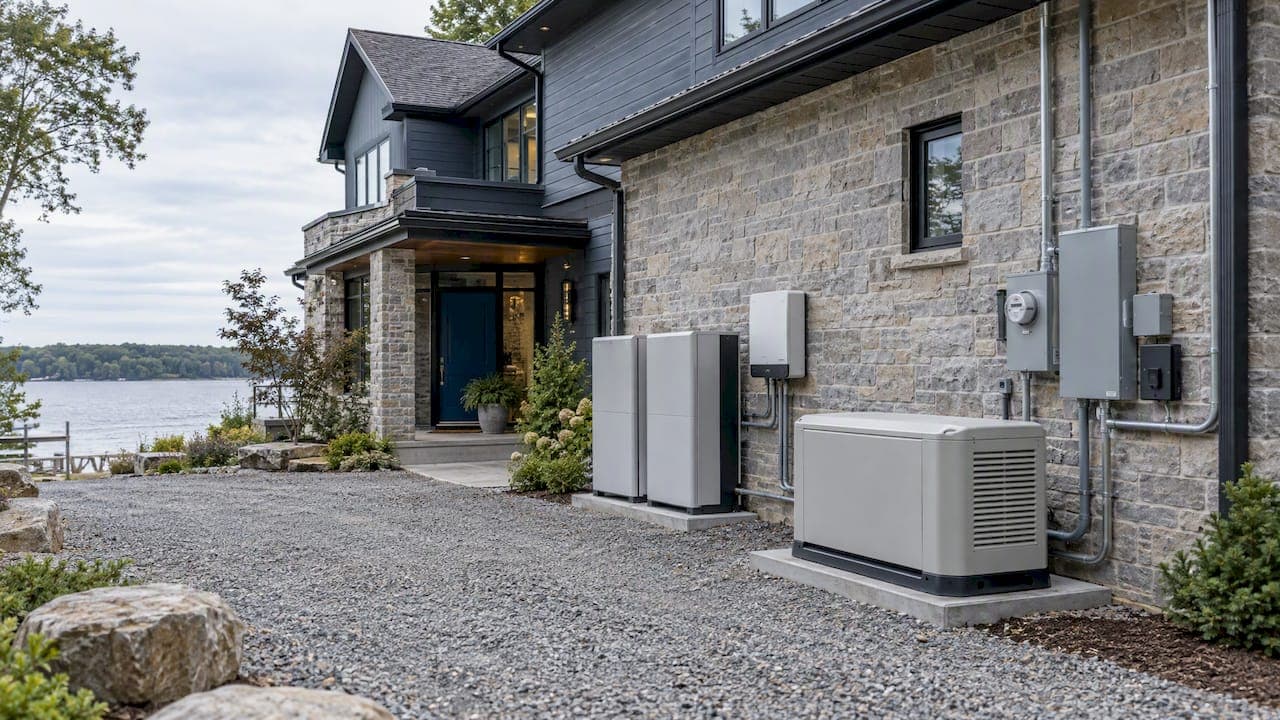
Yes, you can have reliable backup power at home without a single solar panel. A permanently installed battery can charge from the utility grid and carry your essential circuits through an outage, and a standby generator can do the same for as long as it has fuel. The better question is how long you need to stay powered, because that decides whether a battery alone is enough or whether you need a layered system.
This guide covers how solar-free backup works, what it costs, where the limits are, and how to size a system around your actual loads.
TL;DR
- A home battery does not need solar. It charges from the grid when power is on and switches to stored energy automatically when the grid fails.
- Without solar or a generator, a battery is a one-time reserve. Once it is drained during a long outage, it stays empty until the utility returns.
- For outages longer than a day or two, pairing a battery with an automatic standby generator is the practical approach. The generator handles heavy, sustained loads and recharges the battery.
- Load control matters as much as battery size. Prioritizing HVAC, refrigeration and well pumps stretches your reserve far more than a bigger bank usually does.
- The federal 30% residential battery credit no longer applies to systems placed in service after December 31, 2025, so budget without it.
Table of Contents
- How backup power works without solar
- The real limit: a battery only stores energy
- How long will a battery last without solar?
- What it costs
- Battery, generator or both?
- Who does fine with battery-only backup
- Who needs more than a battery
- Load control: the part most people skip
- Where the battery can go: safety and permitting
- A step-by-step way to plan
- Perspective: why we design around the property, not the product
- Solar later: designing so you can add it
- Work with us
- Key takeaways
- FAQ
- Sources
How backup power works without solar
A solar-free battery system has four core components:
- Battery bank. Usually lithium iron phosphate (LFP) chemistry, measured in kilowatt-hours (kWh) of stored energy.
- Inverter. Converts the battery's DC power to the AC your home uses, and sets how many kilowatts (kW) you can draw at once.
- Transfer switch or gateway. Disconnects your home from the grid during an outage so power does not flow back to utility lines, then reconnects when service returns.
- Controls. Decide which circuits are powered, how fast the battery charges, and how much charge is held in reserve.
When the grid is up, the battery charges from it. When the grid goes down, the system isolates your home and supplies stored energy. EnergySage describes this setup as keeping the lights on during outages even without panels on your roof, with the tradeoff that it will not cut your electric bill the way solar does.
The switchover is fast. Battery systems typically transfer in under a second, which is why computers and medical devices usually keep running, while a generator alone takes 10 to 30 seconds to start.
The real limit: a battery only stores energy
A battery does not make electricity. It holds what it was given. Home Power Helper explains that without solar or a generator as a second charging source, the battery cannot replenish while the grid is down, which makes battery-only systems less suited to prolonged regional disasters.
That is fine for the outages most homeowners actually see: a storm that takes lines down for six hours, a brownout, a substation fault. It is a problem for multi-day events after hurricanes, ice storms, wildfires or grid emergencies.
We cover this in more depth in why battery-only backup has limitations for homes. The short version: size the battery for the outage you expect most often, and add a second energy source for the outage you fear most.
How long will a battery last without solar?

Runtime is simple arithmetic: usable kWh divided by the average kW you draw. Standalone systems commonly store 10 to 20 kWh, which can cover essential appliances for one to three days only if the load is kept lean. Whole-home loads run it down much faster.
Here are illustrative figures. They are our own arithmetic on round numbers, not measurements from a specific home.
| Scenario | Average draw | Usable energy | Approximate runtime |
|---|---|---|---|
| Essentials only (fridge, lights, internet, well pump cycling) | 0.8 kW | 13 kWh | About 16 hours |
| Essentials plus one HVAC zone | 2.5 kW | 13 kWh | About 5 hours |
| Whole home, central AC running | 6 kW | 27 kWh (two units) | About 4.5 hours |
| Essentials only, with load control | 0.5 kW | 27 kWh (two units) | About 54 hours |
The pattern is clear. Doubling the battery doubles the runtime. Cutting the average load in half does the same, and costs far less. That is why we start every design with a load study, not a battery model.
Pro tip: separate peak power from energy
Two numbers matter and homeowners often confuse them. Energy (kWh) is how long you last. Power (kW) is what you can run at once. A well pump, a central AC compressor or a pool pump can need a large surge on startup. A battery with plenty of kWh but a small inverter will trip when the AC kicks on. Ask for both continuous and surge ratings in writing.
What it costs
Prices vary by region, equipment and site complexity. One 2026 consumer guide puts a typical installed home battery system at $10,000 to $25,000, and up to $50,000 for whole-home power. The same source lists standby generators at roughly $3,000 to $15,000 upfront, though large homes with high loads can land above that once transfer equipment, gas lines and permitting are included.

We do not publish prices, because a custom system for a 6,000 square foot estate with a well, a pool and a guest house is not comparable to a condo-sized package. Any honest number needs a load study and a site visit first.
The federal tax credit has ended
Many older articles, and some pages still online, say a 30% federal credit applies to batteries of 3 kWh or more. That was true through 2025. The Residential Clean Energy Credit was terminated by the One Big Beautiful Bill Act for expenditures after December 31, 2025, so a battery bought and placed in service this year does not qualify for it. If you installed one in 2025, you may still claim it on your 2025 return with IRS Form 5695; talk to a tax professional about your situation. We track what remains in our guide to the home battery tax credit and 2026 paths. Check state and utility programs too, since some pay for batteries that support the grid.
Battery, generator or both?
Both work without solar, and they fail in opposite ways.
| Battery only | Generator only | Battery plus generator | |
|---|---|---|---|
| Switchover | Under a second | Seconds to start | Seamless, battery carries the gap |
| Runtime | Limited by stored kWh | As long as fuel lasts | Long, generator recharges battery |
| Noise | Silent | Audible | Generator runs only when needed |
| Maintenance | Minimal | Regular service and exercise cycles | Both, but generator runs far less |
| Best for | Short outages, quiet, indoor-adjacent placement | Long outages, heavy loads | Estates, rural homes, storm-prone coasts |
| Weakness | One-time reserve | Gap during startup, fuel supply | Higher upfront cost, more engineering |
Industry guidance for homes facing long outages points toward a layered approach: a high-capacity battery with an automatic standby generator, as Wirecutter's backup power guidance outlines. The generator takes heavy, sustained loads and refills the battery. The battery covers instant switchover and quiet nights. Our page on microgrids versus generators walks through that comparison in more detail, and Is battery backup enough? helps you decide where your property falls.
Who does fine with battery-only backup
Battery-only backup is a sound choice when most of these are true:
- Your outages are usually under 12 hours.
- Your critical loads are modest: refrigeration, lights, internet, a sump pump, one HVAC zone.
- You live in a suburban area where crews restore power quickly.
- You want silent operation or have no safe outdoor place or fuel supply for a generator.
- You have time-of-use rates and want the battery to shift some usage off-peak. Savings here are modest and depend entirely on your utility's rate structure.
If that is you, a well-designed home battery backup system may be all you need. For the daily benefits beyond outages, see home battery storage benefits for homeowners.
Who needs more than a battery
Add a second energy source if any of these describe your property:
- Rural or remote service. Long feeders mean long restoration times.
- Coastal or storm exposure. Hurricanes and ice storms can mean days or weeks without grid power.
- Large electrical loads. Central HVAC across several zones, pools, wells, shops, barns, EV charging, or a detached guest house.
- Second homes. Nobody is there to react, and a failed freezer or a frozen pipe becomes a loss before you arrive.
- Medical or shelter needs. If someone depends on powered equipment, or the home is your emergency shelter, a finite reserve is a risk.
Our large-home guide, backup power for a large home, covers how those loads are split across circuits, and the residential shelter power guide covers the shelter case.
Load control: the part most people skip
Homeowners tend to expect a whole-home system to run the house exactly as the grid does. In a long outage it does not, and it should not. Success depends on intelligent load control: protecting essential circuits such as HVAC, refrigeration and well pumps, while shedding non-essential loads automatically to stretch the reserve. ENERGY STAR's work on electrification loads shows how much EV charging and large new appliances can add to a home's peak demand, which is exactly what controls are there to manage.
A practical priority list:
- Life-safety and health: medical devices, well pump, sump pump, heat in cold climates.
- Food and water: refrigerator, freezer, water heater on a schedule.
- Communications: router, modem, phone charging, lighting.
- Comfort: one HVAC zone, cycling instead of continuous.
- Deferrable: pool pump, EV charging, dryer, oven, hot tub. These shed first.
My honest take: a 27 kWh battery with smart load shedding will outlast a 40 kWh battery that runs everything. Controls are the cheapest capacity you can buy.
Where the battery can go: safety and permitting
Indoor lithium storage is regulated. NFPA 855 governs stationary energy storage installations, and residential units are limited to places such as attached or detached garages, utility closets and exterior walls, with at least 3 feet of clearance from doors and windows. Local adoption varies, and your fire marshal or building department has the final say.
If the battery sits in a garage or driveway area where vehicles move, the same guidance points to protective barriers such as bollards. Mounting the unit higher or choosing a non-vehicle location is usually cheaper than adding bollards later. Settle placement before you order equipment. Redesigning during permitting is the most common source of avoidable cost and delay.
A step-by-step way to plan
- Pull a year of utility bills and, if you have a smart meter, hourly data. This shows peak demand.
- List critical loads with their running and startup wattage. Check nameplates on the well pump, HVAC and freezer.
- Define your design outage. Pick a duration you want to ride through comfortably, such as 24 hours, 72 hours, or a week.
- Decide the second source. If the design outage exceeds what the battery can cover at essential load, add a generator or plan a future solar array.
- Choose the panel strategy. A critical-loads subpanel is cheaper. Whole-home backup needs larger inverters and careful controls.
- Pick the location under local code, then submit permits and utility interconnection paperwork.
- Commission and test. A system is not finished until you have simulated an outage and watched it transfer.
Perspective: why we design around the property, not the product
We build private power infrastructure for estates, farms, coastal homes and large residences, and we see the same pattern on a first call. The owner has priced a battery, been told it is enough, and has never been asked how long the outage might last or what the well pump draws on startup.
We think that is backwards. A battery is a component, not a plan. The plan starts with the property's real electrical demand and site conditions, then integrates generation, storage, a generator and controls into one system that keeps the whole property running. Every design is reviewed by our engineers, we do not use generic packages, and we do not sell client information.
For many homes without solar, that ends up being a battery for instant, quiet coverage plus a hybrid generator for endurance, with the option to add solar later without rebuilding anything. If your needs are modest, we will say so. A smaller system that fits is better than a large one that does not.
— Prime Microgrid
Solar later: designing so you can add it
Skipping solar today does not close the door. The cost of adding it later depends on decisions made now: inverter type, DC or AC coupling, panel capacity, conduit routes and where the controls live. A system designed with a future array in mind can accept panels without replacing the inverter. If you may add solar in two or three years, tell your designer at the start. Our off-grid home power and home power without grid pages show where a property can go if you want to depend less on the utility.
Work with us
We design, engineer, install and commission custom systems for homes, estates and farms, including battery retrofit systems, hybrid generator systems and estate microgrids. If you want backup power without solar, we start with your loads and your outage risk, then recommend the leanest system that meets them. See our residential battery storage page or start with a system design conversation.
Key takeaways
- Solar is optional for backup power. A grid-charged battery works on its own.
- A battery alone is a finite reserve. Plan a generator or future solar for long outages.
- Size by load and design outage, not by the biggest battery on the market.
- Load control extends runtime more cheaply than added capacity.
- Placement rules and permits shape the design, so settle them early.
- Do not count on the 30% federal battery credit for systems placed in service after 2025.
FAQ
Can you install a battery backup without solar?
Yes. A hardwired battery with an inverter and transfer switch charges from the grid and powers selected circuits when it fails. Home Power Helper covers the same arrangement. It needs a permit and usually a licensed installer.
Is a home battery worth it without solar?
It is worth it if outage protection is the goal: food, heat, sump or well pump, and medical devices. It is a weaker investment if you expect large bill savings, which come mostly from solar or from favorable time-of-use rates. Weigh the cost against what an outage would cost you.
What is the cheapest way to get home backup power?
The lowest-cost route is a small battery or generator feeding a critical-loads subpanel, not the whole house. One 2026 guide lists roughly $10,000 to $25,000 for an average battery system. Portable products are cheaper but are not a permanent whole-property solution, and we do not design those.
Can a battery run my whole house?
Sometimes, for a short time. With central AC, electric cooking, a pool and a well, the load can drain a single battery in hours. Whole-home backup works best with several batteries, a large inverter, load control, and often a generator.
Sources
- EnergySage: Home battery backup without solar
- EnergySage: energy storage overview
- Home Power Helper: Battery backup without solar
- PowerOutage.us: Home battery backup guide 2026
- Solar Permit Solutions: Solar battery tax credit 2026
- Wirecutter: Choosing backup home power options
- ENERGY STAR: Reducing the cost of electrification
- NFPA: Residential energy storage system regulations