
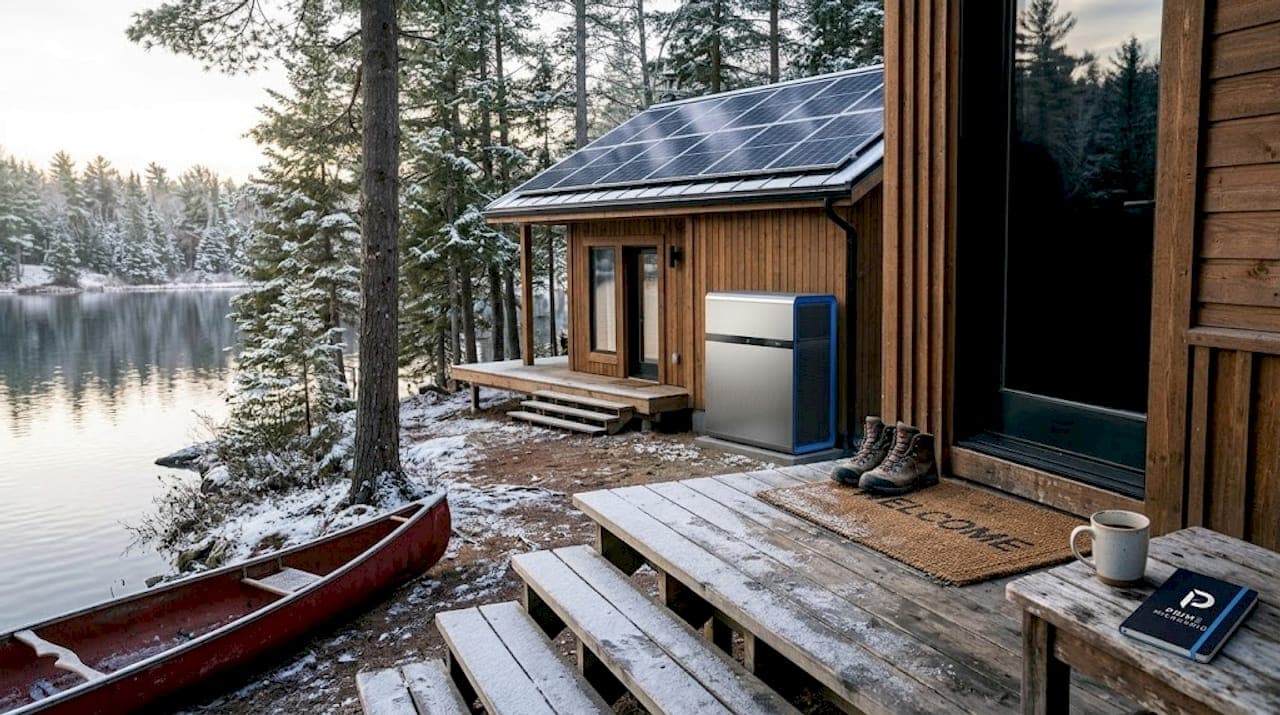
Most cabin owners assume a couple of solar panels and a battery bank will keep the lights on indefinitely. That assumption leads to undersized systems, frustrated guests, and dead batteries by Tuesday. The real role of battery storage vacation cabins depend on is more nuanced: batteries act as the energy buffer in a carefully designed system that includes generation, management, and backup. This article walks you through how to size storage correctly, which battery technology to choose, how to integrate everything into a reliable power setup, and what it actually costs you over time to get this right.
Table of Contents
- Key takeaways
- The role of battery storage vacation cabins need to get right
- Comparing battery technologies for cabins
- Designing a complete off-grid power system
- Best practices for managing your cabin battery system
- Environmental and economic impact of battery storage
- My take on what actually works off-grid
- Power your cabin the right way with Primemicrogrid
- FAQ
Key takeaways
| Point | Details |
|---|---|
| Batteries are part of a system | Battery storage works as an energy buffer, not a standalone power source, requiring solar, wind, or generator input. |
| Sizing depends on usage pattern | Weekend cabins need 5–10 kWh of usable capacity; full-time setups typically require 15–20 kWh with 2–5 days autonomy. |
| Lithium outperforms lead-acid | Lithium batteries offer up to 90% usable capacity versus 50% for lead-acid, making them the better long-term investment. |
| Buffer capacity extends lifespan | Adding a 20–30% buffer beyond calculated needs protects against deep discharge and dramatically extends battery life. |
| Off-grid beats grid extension financially | Running grid lines to a remote cabin can cost tens of thousands of dollars, making solar-plus-battery systems a smarter financial choice. |
The role of battery storage vacation cabins need to get right
Before selecting a battery, you need to know how much power your cabin actually uses. This is where most owners make their first mistake: they guess instead of calculate.
A cabin's daily energy demand depends on what appliances run, for how long, and how often the property is occupied. A simple weekend retreat with LED lighting, a small refrigerator, phone charging, and a water pump typically draws 2 to 4 kWh per day. Add a coffee maker, a television, a laptop, and a small air conditioning unit, and you are looking at 5 to 8 kWh daily. Full-time residences with electric water heaters and full kitchen appliances can push past 15 kWh per day with ease.
Small cabins with basic needs typically require 5–10 kWh of usable battery capacity, while full-time setups need 15–20 kWh with 2–5 days of autonomy built in for reliability. That metric of "days of autonomy" matters enormously. It tells you how long your cabin stays powered with no solar input at all, which is the reality during extended cloudy stretches or winter storms.
Here is a quick reference for typical scenarios:
| Cabin Type | Daily Usage | Usable Battery Capacity | Days of Autonomy |
|---|---|---|---|
| Basic weekend getaway | 2–4 kWh | 5–10 kWh | 2–3 days |
| Moderate comfort retreat | 5–8 kWh | 10–15 kWh | 2–3 days |
| Full-time off-grid residence | 12–18 kWh | 15–20 kWh | 3–5 days |
One detail that trips people up: battery capacity must be based on usable capacity, not nominal rating. A 10 kWh battery that only allows 50% discharge gives you 5 kWh of actual power. Sizing on nominal numbers rather than usable capacity is one of the most common and costly sizing errors cabin owners make.
Comparing battery technologies for cabins
Not all batteries behave the same way in off-grid cabin applications. The two main technologies you will encounter are lithium iron phosphate (LiFePO4) and lead-acid, and they are not interchangeable.
| Feature | Lithium (LiFePO4) | Lead-Acid |
|---|---|---|
| Usable capacity | ~90% depth of discharge | ~50% depth of discharge |
| Lifespan | 2,000–5,000+ cycles | 300–800 cycles |
| Charging speed | Fast, accepts higher charge rates | Slower, needs controlled stages |
| Maintenance | Minimal | Regular watering and equalization |
| Upfront cost | Higher | Lower |
| Weight | Lighter per kWh | Heavier per kWh |
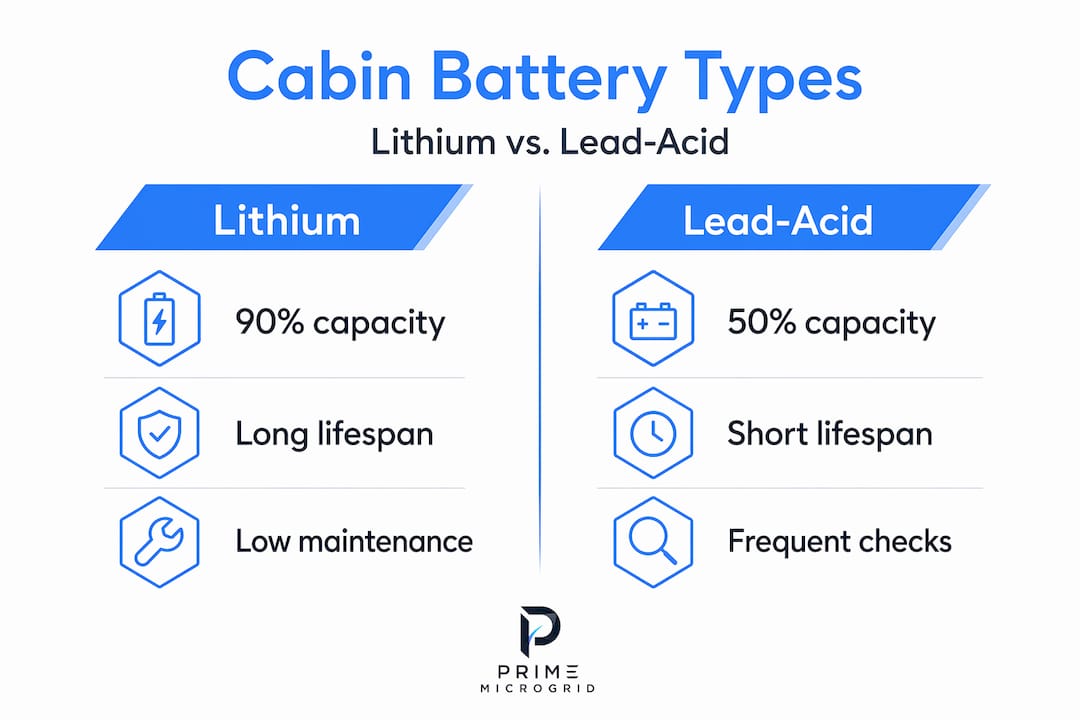
Lithium batteries allow around 90% usable capacity compared to lead-acid's 50%, which directly reduces the size of the battery bank you need. A lead-acid bank that delivers 10 kWh of usable power has to be rated at 20 kWh nominal. The lithium version handles the same job at 11 kWh nominal. That gap affects weight, space, wiring, and overall cost more than the sticker price alone suggests.
For most cabin owners today, lithium is the right call. The higher upfront cost is offset by the longer lifespan, lower maintenance burden, and the fact that you simply need fewer batteries to do the same job. Lead-acid still makes sense for a very tight budget on a rarely-used property where someone is willing to handle the maintenance.
Pro Tip: When comparing battery quotes, always ask for the price per usable kilowatt-hour, not per nominal kilowatt-hour. That single number cuts through the marketing and shows you the true cost of energy storage.
Designing a complete off-grid power system
Battery storage is the center of your cabin's off-grid system, but it cannot do anything useful without energy coming in and going out efficiently. Think of it like a water tank. The solar panels, wind turbine, or generator fill the tank. Your appliances draw from it. The charge controller manages how fast water flows in, and the inverter converts that stored DC power into the AC power your cabin uses.
A well-designed system for a vacation cabin typically includes these components working together:
- Solar panels or wind turbines as the primary charging source, sized to replenish the battery bank on an average sunny day plus enough to recharge after a cloudy stretch
- A charge controller (MPPT type for most cabin setups) that regulates current from your panels to protect the batteries
- A battery bank sized with appropriate usable capacity and days of autonomy for your usage pattern
- An inverter-charger that converts stored DC power to AC and can also charge the batteries from a generator
- A backup generator for extended low-sunlight periods, heavy loads, or emergency top-ups
Off-grid systems combining solar, wind, and batteries with backup can reliably power even large vacation properties without any grid connection. One documented example is a luxury lodge running entirely on solar, wind, and a 28 kWh battery bank. What made it work was not the size of the battery alone. It was the whole-system design thinking behind it.
Successful off-grid power depends on designing batteries, efficient appliances, good insulation, and backups as one coordinated system. A cabin with poor insulation and an old chest freezer will chew through battery capacity that a better-designed property never burns.

Pro Tip: If you add a generator, use it strategically to top off batteries during extended low-sun periods rather than running it continuously. Pairing it with an integrated solar-generator setup keeps fuel costs down and generator hours low, which means less maintenance.
Best practices for managing your cabin battery system
Getting the system installed is only half the work. How you manage your batteries over time determines whether they last 5 years or 15.
-
Never drain below your battery's minimum state of charge. For lithium, this is typically 10–20%. For lead-acid, stop at 50%. Going deeper even occasionally accelerates degradation faster than anything else.
-
Size in a 20–30% buffer from day one. Adding overhead capacity beyond your calculated needs prevents regular deep discharges and extends battery lifespan significantly. If you calculate 10 kWh of usable storage needed, buy 12–13 kWh of usable capacity.
-
Adjust reserve charge levels for winter. Battery systems require active management during winter by raising the reserve state of charge before severe weather arrives. Heading into a storm with 60% battery is very different from starting at 90%.
-
Use a hybrid energy approach for heating. Electric heating is inefficient on battery systems. Running propane or a wood stove for heat while solar handles lights, electronics, and smaller loads prevents battery exhaustion and keeps your system from ballooning in size just to cover one big load.
-
Monitor your system regularly. Modern battery management systems and inverters offer app-based monitoring. Check state of charge trends, daily generation versus consumption, and any fault alerts before they become problems. For a property you visit occasionally, remote monitoring is not optional, it is necessary.
Pro Tip: Before winter, manually raise your battery's minimum reserve charge threshold by 10–15% beyond normal. This gives you a larger cushion during short days when your panels produce a fraction of their summer output.
Environmental and economic impact of battery storage
The case for sustainable power storage cabins is not just philosophical. It is financial.
Extending traditional grid lines to remote cabins can cost tens of thousands of dollars, with some rural extensions running $50,000 or more depending on terrain and distance. A well-designed solar-plus-battery system with generator backup often lands in a similar price range but gives you full energy independence, no monthly utility bills, and a system you own outright.
Beyond the cost math, battery storage reduces dependence on fossil fuels and helps cabin owners minimize greenhouse gas emissions while offering guests reliable, clean energy. The impact of battery storage on cabins extends to property appeal too. Eco-conscious travelers actively seek out sustainable rental properties, and a solar-powered cabin with battery backup is a genuine differentiator in a crowded vacation rental market.
Here is a summary of the key environmental and economic benefits:
- No grid extension costs in remote locations
- Elimination or sharp reduction of generator fuel consumption
- Lower long-term operating costs compared to grid-tied utility rates
- Marketable sustainability credential for vacation rental listings
- Contribution to reduced carbon output over the system's lifetime
For how battery storage helps remote properties thrive economically, the math consistently favors investing in storage-based systems over grid extension once a property is more than half a mile from the nearest utility line.
My take on what actually works off-grid
I've reviewed and helped design enough off-grid cabin systems to spot the pattern that separates the ones that work from the ones that frustrate their owners after the first winter.
The issue is almost never the battery itself. It's the expectation that the battery does the heavy lifting alone. I've seen beautifully specified lithium battery banks fail to meet basic cabin needs because the solar array was undersized for winter angles, or because no one accounted for the chest freezer running 24 hours a day. Consumers often misunderstand battery storage as a standalone solution without thinking through integration and realistic usage patterns. That gap between expectation and reality is where most off-grid frustration lives.
What I've found actually works is thinking about your cabin's power system the way a good contractor thinks about a building envelope. Every piece interacts with every other piece. Upgrading to an efficient refrigerator might do more for your energy independence than doubling your battery capacity. Improving insulation might reduce your heating load enough to eliminate the need for a second battery bank.
The other thing I tell cabin owners: plan for your worst-case month, not your average month. Design around January, not July. If your system can carry you through five days of overcast skies in December, summer will take care of itself. For practical guidance on sizing your storage system correctly, start with real load calculations before you ever look at a product brochure.
— David
Power your cabin the right way with Primemicrogrid
If you've read this far, you already know that getting off-grid cabin power right requires more than picking a battery off a product page. It requires a system designed around your specific cabin, your usage patterns, your location, and your budget.
Primemicrogrid specializes in exactly this kind of customized design. From battery storage sizing and solar integration to generator coordination and smart monitoring, we build off-grid power systems that match how you actually use your cabin, not how a generic spec sheet assumes you do. Whether you are starting from scratch or improving an existing setup, Primemicrogrid's residential microgrid solutions give you a system built for reliability, affordability, and long-term performance. Reach out and tell us about your cabin. We will help you figure out exactly what you need.
FAQ
How much battery storage does a vacation cabin need?
Most weekend cabins need 5–10 kWh of usable battery capacity, while full-time off-grid cabins typically require 15–20 kWh with 2–5 days of autonomy to handle cloudy periods reliably.
What type of battery is best for an off-grid cabin?
Lithium iron phosphate (LiFePO4) batteries are the preferred choice for most cabin setups because they offer around 90% usable capacity, a longer lifespan, and minimal maintenance compared to lead-acid alternatives.
Can a battery system power a cabin without solar panels?
No. Batteries store energy but do not generate it. They require a charging source such as solar panels, a wind turbine, or a generator to replenish the energy your cabin uses each day.
Is solar-plus-battery cheaper than running a power line to a remote cabin?
In most cases, yes. Grid line extensions to remote cabins can cost tens of thousands of dollars, while a solar-plus-battery system with generator backup often delivers full energy independence at a comparable or lower total cost.
How do you manage cabin batteries during winter?
Raise the minimum reserve charge threshold before cold or cloudy weather arrives, use propane or wood stoves for heat rather than electric heating, and monitor your system remotely to catch issues before they cause problems.