
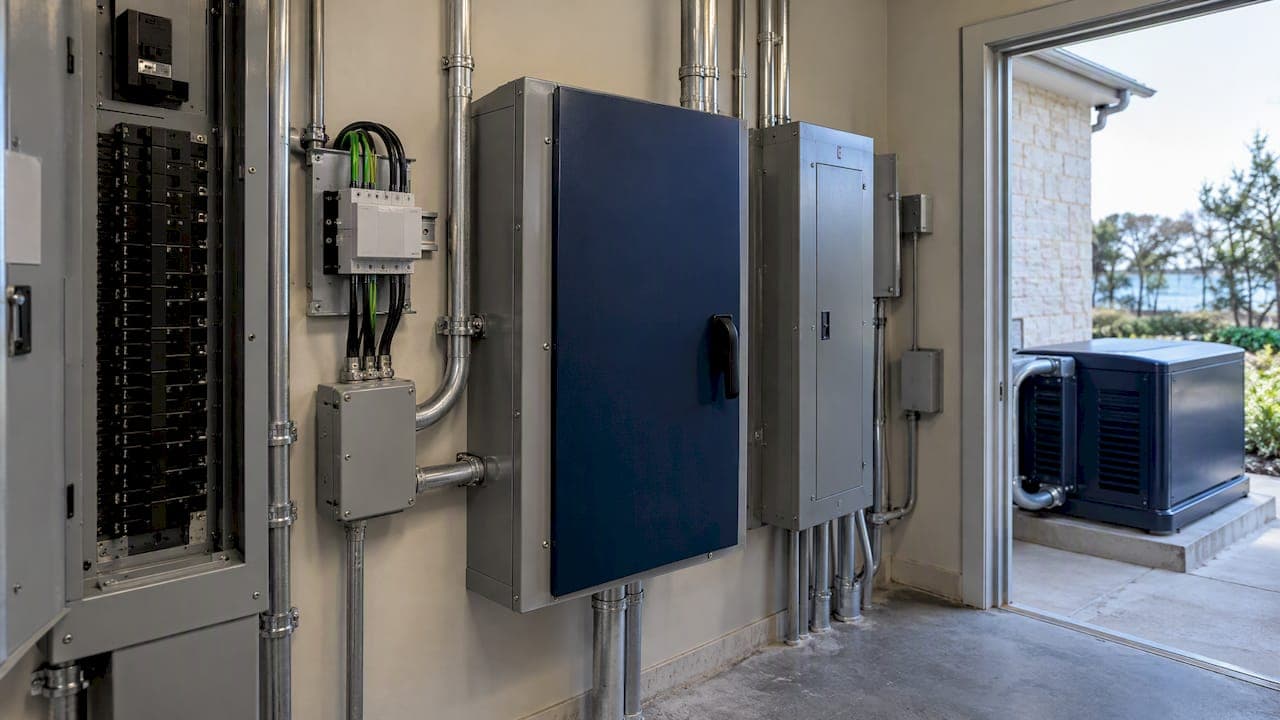
Yes, if you run a residential generator, you need listed surge protective devices (SPDs) at the automatic transfer switch (ATS) and generator input as part of a layered protection strategy, installed by a licensed electrician. Standards bodies point installers toward UL 1449-listed devices placed at the service entrance, the ATS, and the generator connection, not a single surge strip plugged in after the fact.
TL;DR:
- Surge protective devices rated UL 1449 must be installed at the service entrance, transfer switch, and generator connection, not just a single outlet strip.
- Protecting the generator input is critical, especially when wiring exceeds 30 feet from the transfer switch, because transients during start and transfer events can damage electronics.
- Installing Type 1 or Type 2 SPDs at multiple points, including the generator side, reduces surge energy load on downstream devices and extends system lifespan.
- Proper wiring practices, such as short leads and verified grounding, are essential for SPD effectiveness and compliance during installation.
- Regular inspection and proactive replacement of MOV-based SPDs prevent unnoticed capacity loss from multiple surge events.
Table of Contents
- Why generator-backed systems need surge protection
- How surge protective devices actually work
- Where to place protection in a generator and ATS system
- How to choose the right SPD for a generator setup
- Installation checklist and wiring best practices
- Maintenance, testing, and how long SPDs actually last
- Prime Microgrid perspective on layered surge protection
- What conventional surge protection advice gets wrong
- Code-compliant surge protection as part of a whole-home system
- FAQ
- Sources
Why generator-backed systems need surge protection
A generator doesn't just add backup power. It adds a second source of switching events, and switching events generate their own transients. NEC and NFPA guidance references UL 1449 for proper SPD application and includes requirements and recommendations for installing listed SPDs in dwelling and service equipment contexts, precisely because a generator-equipped home has more points where a surge can enter.
Three sources tend to account for most of the risk homeowners should plan around:
- Lightning strikes, direct or induced, that travel down utility or generator wiring into the home.
- Switching transients created when the ATS moves the house between utility and generator power.
- Start and stop events at the generator itself, which stress windings and control electronics.
Technical modeling of generator surge behavior shows that generator windings and control electronics are vulnerable to a range of overvoltage events, including lightning, switching, and breaker operations, not lightning alone, according to a technical report on generator surge protection. That's worth sitting with: a sunny day with a scheduled ATS transfer test can still produce the kind of transient that shortens the life of generator electronics. Our guide to how whole-home generators work walks through ATS mechanics in more depth if you want the fuller picture before you talk to an installer.
How surge protective devices actually work

Most residential SPDs are parallel, or diverting, devices. They sit alongside the circuit they protect and stay essentially invisible until a voltage spike arrives, at which point they divert the excess energy to ground and clamp the voltage before it reaches your equipment.
The core component inside most of these devices is a metal oxide varistor (MOV). An MOV conducts almost no current at normal voltage, then becomes highly conductive once voltage crosses a threshold. It's a consumable part: every surge event uses up some of its capacity, and enough small surges can degrade an MOV as thoroughly as one large one.
Code and industry guidance sort SPDs into three categories relevant to a generator installation:
- Type 1: installed ahead of the main overcurrent device, typically at the service entrance or utility connection, built to handle large lightning-related impulses.
- Type 2: installed at panels, subpanels, or the ATS, handling both residual lightning energy and switching surges.
- Type 3: point-of-use devices, like a surge strip or an appliance cord, offering the last layer of protection closest to sensitive electronics.
Devices installed near an ATS need to handle more than lightning. Industry guidance recommends protecting both the utility and generator inputs to an ATS with Type 1 or Type 2 SPDs, because ATS electronics and transfer events are vulnerable to switching surges as well as lightning. A device rated only for slow lightning impulses can miss the fast, repetitive ring-wave transients that transfer switches themselves generate.
Where to place protection in a generator and ATS system
Layered protection means distributing SPDs across the system rather than relying on one device to catch everything. Each location does a distinct job, and each one reduces the surge energy the next device downstream has to absorb.
- Service entrance or main panel. A Type 1 or Type 2 SPD here is your first line of defense against utility-side lightning and grid switching events.
- ATS utility input. Protecting this point shields the ATS's internal electronics from surges arriving through the utility feed before a transfer even happens.
- ATS generator input. This is the location homeowners most often skip, and it's the one industry application notes single out: generator-side transients during start, stop, and transfer events can damage ATS electronics just as readily as a lightning strike on the utility side.
- Generator AC output, especially on long runs. When generator wiring runs more than 30 feet from the ATS or is exposed outdoors, practical guidance recommends adding an SPD at the generator end to catch induced surges before they travel the full length of the conductor.
- Low-voltage control circuits. The 12 to 24-volt DC wiring that starts and stops the generator deserves its own protection, often a series-connected or data-line SPD, since standard panel-level devices won't cover it.
- Point-of-use devices. Type 3 protection at individual appliances or electronics handles whatever residual energy makes it past the upstream layers.
The benefit of this approach is cumulative. Each layer absorbs part of a surge, so the device closest to your sensitive electronics never has to handle the full event alone. Our piece on layered backup power design covers how this interacts with overall system sizing.
Pro Tip: If your generator sits more than 30 feet from the transfer switch, treat the generator-side SPD as mandatory, not optional, regardless of what the base ATS package includes.
How to choose the right SPD for a generator setup
Not every surge protector sold at a hardware store belongs anywhere near an ATS or generator circuit. A few specifications separate a device that will actually do its job from one that will fail quietly the first time it's tested.
- UL 1449 listing, confirmed for the specific device Type the location requires (Type 1 at service entrance, Type 2 at the ATS, Type 3 at point-of-use).
- MCOV (maximum continuous operating voltage) that matches your circuit voltage with margin, not a device rated for a different voltage class.
- Nominal discharge current (In) and voltage protection rating (VPR), which tell you how much surge current the device can handle repeatedly and how low it clamps the voltage.
- Short-circuit current rating (SCCR) appropriate to the panel, along with an enclosure rating suited to indoor or outdoor exposure for service-side units.
- Response to both impulse and ring-wave events, since ATS and generator locations see switching transients in addition to lightning-induced surges.
Before signing off on an installation, ask your electrician which Type is going where, what the MCOV and In ratings are for each device, and whether the generator-side SPD accounts for your specific wiring distance. A qualified installer should answer these without hesitation.
Installation checklist and wiring best practices
A compliant SPD installation is as much about wiring discipline as it is about the device itself. A correctly rated SPD installed with long, looping leads performs worse than a modest unit installed properly.
- Keep SPD leads short and straight. Excess lead length and sharp bends add inductance that undermines the device's clamping speed.
- Verify grounding and bonding at every connection point. An SPD is only as effective as the ground path it relies on, and our grounding requirements guide covers what a compliant setup looks like.
- Match conductor gauge and enclosure rating to the panel and environment, outdoor generator-side devices need weatherproof enclosures rated for the exposure.
- Apply distance-based rules. When the generator sits more than 30 feet from the ATS, add a generator-side SPD rather than relying solely on the ATS-mounted device.
- Coordinate with existing lightning protection and service disconnects so devices don't work against each other or leave gaps at the transition points.
Pro Tip: Ask your installer to document which SPD protects which location on an as-built drawing. It makes future testing and replacement far faster.
Maintenance, testing, and how long SPDs actually last
MOVs wear down with use, and that wear is invisible without testing. A device can look intact while its surge-handling capacity has already dropped well below its rated performance.
- Inspect annually, and after any known major surge event such as a nearby lightning strike or a utility outage with a hard restoration.
- Watch status indicators. Most SPDs include a visual or audible indicator that signals when the device has reached end of life; a dark or alarming indicator means immediate replacement, not a wait-and-see approach.
- Replace proactively rather than waiting for failure, particularly for ATS and generator-side units that see more switching activity than a typical household panel.
- Budget for periodic replacement as a normal line item in generator system upkeep, the same way you'd budget for generator oil changes or battery replacement.
Prime Microgrid perspective on layered surge protection
We evaluate SPD placement against actual site conditions such as wiring distance between generator and ATS, weather exposure, and integration with the backup system. That often means balancing a weatherproof enclosure against a location that's easy to inspect, or balancing added protection cost against the realistic surge exposure for a given property. Our hurricane power protection work reflects how often these trade-offs come down to the specific site rather than a generic checklist.
What conventional surge protection advice gets wrong

Most consumer advice on this topic still treats surge protection as a single purchase: buy a whole-house SPD, mount it at the panel, done. That misses the point that a generator changes the surge environment inside your own walls. The ATS itself becomes a transient source every time it transfers, and that risk sits entirely inside the property, no lightning required.
The bigger gap we see is homeowners protecting the service entrance thoroughly while leaving the ATS generator input bare, often because installers price the ATS and the generator as a package and treat surge protection as an optional add-on for the utility side only. If you prioritize one location beyond the basic panel SPD, make it the ATS generator input and the low-voltage control wiring. That's where switching transients concentrate, and it's the location most residential installations skip.
— Prime Microgrid
Code-compliant surge protection as part of a whole-home system
Surge protection is designed as part of the full backup power system rather than as an afterthought bolted onto an existing generator. A consultation covers ATS configuration, wiring distance, SPD types and ratings, and a maintenance plan for scheduled replacement.

Typical services include site surveys covering ATS placement, generator distance, grounding, and electrical infrastructure; system design specifying SPD type, rating, and location; and installation and commissioning carried out to code with documentation.
If you're planning a new generator installation or retrofitting surge protection onto an existing one, explore our Estate Microgrid Systems and Hybrid Generator Systems or request a consultation to talk through your property's specific setup.
FAQ
How do surge protection devices work?
Surge protective devices sit in parallel with the circuit they protect and stay inactive at normal voltage. When voltage spikes above a set threshold, the internal metal oxide varistor conducts the excess current to ground, which clamps the voltage before it reaches connected equipment.
How can I prevent a power surge from my generator?
Install listed SPDs at the ATS utility input, the ATS generator input, and the generator's AC output, with an additional device at the generator side if wiring runs more than 30 feet, as industry guidance recommends. Pairing this with verified grounding and a licensed electrician's installation addresses most of the switching and lightning-related risk specific to generator setups.
Which type of surge protector works best for a generator system?
There's no single best brand; what matters is matching the right Type to each location. A UL 1449-listed Type 1 or Type 2 device at the service entrance and ATS, paired with Type 3 point-of-use protection for sensitive electronics, covers the layered approach that generator systems need.
Do appliances connected to a generator need their own surge protection?
Yes, point-of-use Type 3 devices add a final layer of protection for sensitive appliances and electronics, catching any residual surge energy that passes through the upstream panel and ATS-level devices. This is especially relevant for electronics without their own internal surge tolerance.
Sources
- Protection of Automatic Transfer Switches Using Surge Protective Devices (SPDs) — NEMA surge group
- NEC/NFPA statements on surge protection and SPDs
- Surge protection of generators (technical report) — OSTI
- Protect automatic transfer switches with multi-point surge protection — Intermatic