
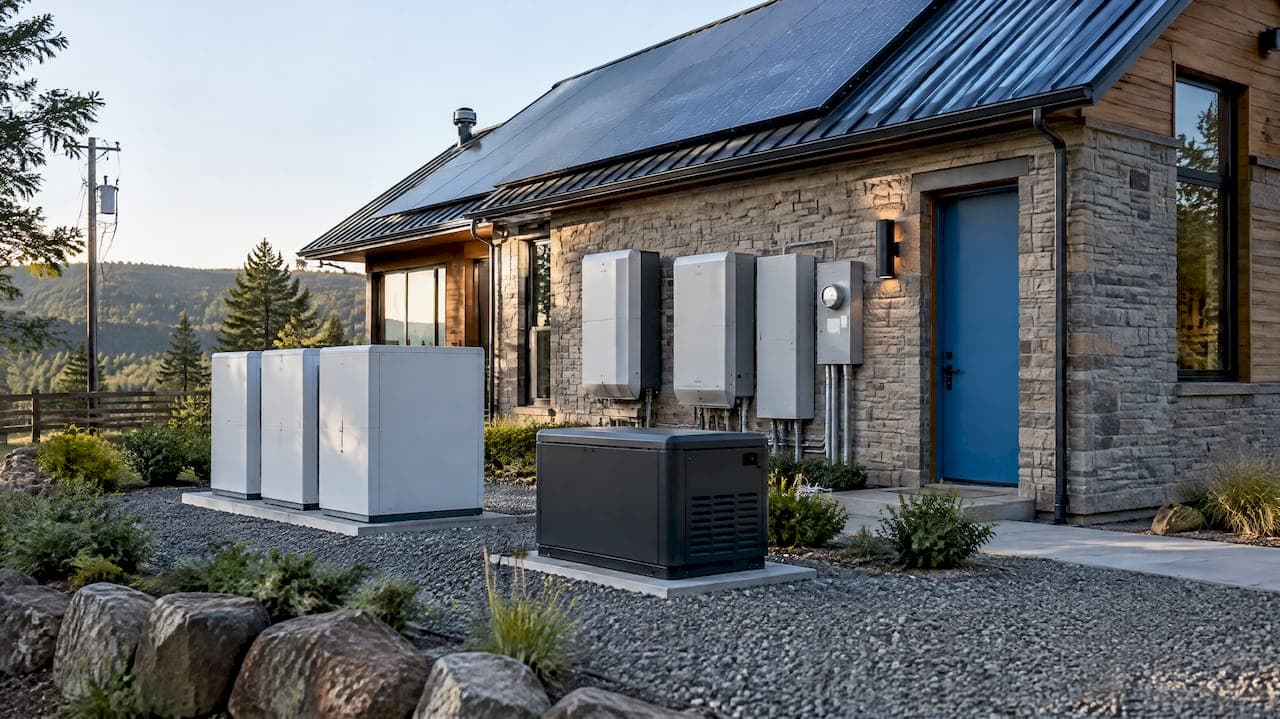
Yes, solar still makes financial and practical sense without net metering, but the lack of 1:1 export credit changes how we design the system. Without full export value, the winning strategies shift toward avoiding grid exports altogether, adding battery storage, directing surplus power into useful loads like water heaters, or building an off-grid or microgrid setup that sidesteps the utility's export rules entirely.
TL;DR:
- Without full export credits, sizing a system for on-site use rather than maximum production generally offers better financial returns.
- Battery storage becomes more cost-effective in regions with low export rates, frequent outages, or wide time-of-use rate spreads.
- Upgrading to microgrids or adding export controls can improve resilience and self-consumption, but require careful planning of inverters and system components.
- Utility policies on interconnection, metering, and export rules vary, making early utility consultation essential for optimized system design.
- Federal incentives like the Residential Clean Energy Credit apply regardless of export credits, which is crucial in markets with weak net metering.
Table of Contents
- How grid-tied solar behaves when net metering is limited or absent
- Economics: when solar-only pays and when storage or microgrids pay off
- Practical design options: zero-export controls, dump loads, ATS, and microgrids
- What to check with your utility and how incentives apply
- Prime Microgrid's practitioner view: when a custom system makes sense
- How federal and state incentives affect the calculus
- Realistic expectations for homeowners in 2026
- How we can help: site assessments and custom installations
- FAQ
- Sources
How grid-tied solar behaves when net metering is limited or absent
Grid-tied solar systems without strong export compensation still work, but they behave differently than the fully net-metered systems most homeowners picture when they think of rooftop solar. The first thing to understand is anti-islanding: standard grid-tied inverters are required to shut down automatically during a utility outage. This protects utility line workers from backfeeding, but it also means a typical rooftop system provides zero backup power unless it includes storage and approved transfer equipment, a point confirmed by solar industry technical explainers.
Export compensation also varies by utility and state. Some still offer 1:1 net energy metering, where every exported kilowatt-hour earns a retail credit. Others have moved to net billing, where exports are credited at a lower, often wholesale-linked rate. When the compensation for exported power drops, the value of oversizing a system for maximum production falls with it.
Several technical controls let us manage exports directly rather than relying on favorable utility rates:
- Zero-export inverters sense grid flow and throttle production to match on-site demand, preventing any export.
- Export limiters cap the amount of power sent to the grid at a programmed threshold rather than blocking it entirely.
- An automatic transfer switch (ATS) paired with a dedicated subpanel can isolate critical circuits, allowing safe operation during outages without backfeeding the grid.
When export credits are weak, sizing a system to match on-site load, rather than to maximize annual production, usually produces a better return. Oversizing without a plan for the surplus just means wasted generation or power sold back at a fraction of its retail value.
Economics: when solar-only pays and when storage or microgrids pay off
The math behind solar economics without net metering depends heavily on three variables: the export credit rate, the time-of-use rate spread, and how much you value outage protection. Solar-only systems tend to have shorter paybacks when export credits are close to retail rates, since every exported kilowatt-hour still earns close to full value. Once export credits drop, as they have under California's NEM 3.0 transition, adding storage to capture and use that surplus power on-site instead of exporting it often becomes the more financially attractive path.
A review of solar-centered multi-energy systems notes that pairing photovoltaic generation with storage and complementary loads improves on-site utilization and helps smooth out the mismatch between when solar is produced and when it's consumed, which is exactly the problem that weak export credits create, according to this ScienceDirect review.
A short decision checklist helps homeowners figure out which path fits their goals:
- Define your primary goal. Are you optimizing for bill reduction, backup resilience, or lowering your carbon footprint? Each goal points toward a different design.
- Check your utility's export credit rate. If it's close to your retail rate, a larger solar-only system can still pencil out well.
- Calculate your time-of-use spread. A large gap between peak and off-peak rates makes storing midday solar for evening use more valuable.
- Assess your outage frequency. Frequent blackouts tip the scale toward storage or a microgrid, regardless of export economics.
- Factor in available incentives. Federal and state credits can shrink the cost gap between a solar-only system and one with storage.
Storage usually becomes close to essential in a few recurring scenarios: utilities with low export credits similar to California's post-NEM-3.0 structure, regions with frequent grid outages, and rate structures with wide time-of-use spreads that reward shifting self-consumption into the evening. In those cases, a battery isn't just a resilience upgrade, it's often the more economical choice because it lets you use your own solar generation instead of selling it back cheaply and buying it again at a higher rate hours later.
Practical design options: zero-export controls, dump loads, ATS, and microgrids
Homeowners facing weak or no net metering have a range of design options, generally scaling from lowest cost to highest capability.
- Zero-export or export-limiting inverters are the simplest and cheapest adjustment, suited to homeowners who want to avoid exporting without major hardware changes.
- Dump loads, like resistive water heater elements, give surplus solar somewhere useful to go instead of being curtailed or exported at a poor rate. Forum discussions among solar practitioners frequently cite electric water heaters as a low-cost way to absorb midday production.
- Automatic transfer switches paired with prioritized subpanels let you island a defined set of critical circuits, such as refrigeration, well pumps, and a few outlets, during an outage without the complexity or cost of backing up the entire home.
- Off-grid and estate microgrid systems go further, combining generation, storage, and often a backup generator into a unified system that operates independently of the utility, or integrates with it only on favorable terms.
The jump from a battery retrofit to a full microgrid isn't just about more hardware, it reflects a different design philosophy. A battery added to an existing rooftop system is usually sized to shift some load and provide partial backup. A microgrid is engineered around the property's actual electrical demand from the start, coordinating generation, storage, and backup generation as one system rather than retrofitted parts. Our solar battery vs. microgrid comparison breaks down that distinction in more detail.
Pro Tip: Plan your inverter and control selection before installation, even if you're staging the project. Adding zero-export or ATS capability after the fact often means replacing equipment that could have been specified correctly from day one.

What to check with your utility and how incentives apply
Before finalizing any design, a few utility-side questions determine what's actually allowed and what it will cost.
- Ask about interconnection and export rules. Some utilities permit zero-export configurations with simplified interconnection agreements, which can speed up approval.
- Confirm metering requirements for paired storage. PG&E's paired storage billing FAQ explains that utilities may require a dedicated meter (often called an NGOM) or an estimation method to correctly allocate export credits once a battery is added, which can affect both cost and billing accuracy.
- Verify your current export compensation structure. Confirm whether you're on net metering, net billing, or another structure, and ask about any announced changes.
- Review permitting and inspection requirements early, since export-limiting equipment and transfer switches often need specific utility and building department sign-off.
On the incentive side, the IRS Residential Clean Energy Credit applies to qualifying solar panels and battery storage regardless of how your utility compensates exports, and utility payments for energy you sell back don't reduce your qualified expenses for the credit.
Prime Microgrid's practitioner view: when a custom system makes sense
When we evaluate a property for a storage or microgrid upgrade, we start with the load profile: which circuits matter most during an outage, how much the home or farm actually consumes hour by hour, and what site constraints, like panel space, generator placement, or EV charging, shape the design. Staged upgrades make sense for many homeowners: install solar sized to on-site load first, add export controls, then layer in storage once priorities and budget are clear. Combining thermal loads, like water heating, with battery storage often improves self-consumption further. For most properties, the real diagnostic question is whether the goal is resilience, bill reduction, or both, since that answer drives everything else about system size and configuration.

How federal and state incentives affect the calculus
The IRS Residential Clean Energy Credit covers qualifying solar electric panels and battery storage as eligible expenses, and that holds true whether your utility offers generous net metering or none at all. This federal credit is one of the most consistent incentives available, since it applies to the equipment itself rather than to how exported energy gets billed, according to IRS guidance on the credit. State and local programs vary widely and can shorten payback further, so it's worth checking what stacks with the federal credit in your area. In markets with weak export credits, these incentives often make the difference in whether adding storage or a microgrid pencils out sooner rather than later.
Realistic expectations for homeowners in 2026
Most homeowners across the U.S. can still benefit from rooftop solar, even where net metering has weakened or disappeared. Whether storage or a microgrid makes sense for your property comes down to your utility's export compensation and how much outage risk concerns you. The clearest next step is a site-specific energy assessment before committing to any particular design.
— Prime Microgrid
How we can help: site assessments and custom installations
When export credits are weak or your utility limits what you can send back to the grid, an off-the-shelf solar-plus-battery kit often doesn't match your actual electrical needs or site conditions. We design every system around your property's real demand, whether that means a battery retrofit for an existing rooftop system, a hybrid generator integration for added resilience, or a full estate microgrid built from the ground up.

We provide system design, engineering review, and installation and commissioning, avoiding generic packages or selling client information. If weak net metering or frequent outages have you reconsidering your options, request a site assessment and we'll help you figure out what actually fits your property.
FAQ
Can I install solar without net metering?
Yes, solar panels can be installed and operated without net metering, though the system typically needs to be designed to minimize or avoid grid exports. This usually means pairing solar with export-limiting inverters, battery storage, or useful on-site loads like water heating to capture surplus production instead of selling it back at a low rate.
Why are people getting rid of their solar panels?
Some homeowners remove or replace solar systems when the economics no longer work under new utility billing structures, particularly after a shift from favorable net metering to net billing with lower export credits. Others upgrade rather than remove panels entirely, adding storage or export controls to restore value lost from reduced export compensation.
What is the 33% rule in solar panels?
If you've encountered this term in a specific local program or utility tariff, check with that utility or jurisdiction directly, since definitions vary by region.
Why is plug-in solar illegal?
Plug-in or "balcony" solar devices that connect directly to a wall outlet face restrictions in much of the U.S. because standard electrical codes and utility interconnection rules are built around systems installed by licensed electricians with proper inverters and safety disconnects. Rules vary by state and locality, so the safest step is confirming your area's electrical code and utility interconnection requirements before considering any plug-in setup.
Does adding a battery affect my net metering credits?
Adding battery storage can change how your utility meters and credits your exports, since some utilities require special metering, like an NGOM, to correctly separate battery-discharged energy from direct solar export, as explained in PG&E's paired storage billing FAQ. It's worth confirming these requirements with your utility before finalizing a storage system design.
Sources
- Residential Clean Energy Credit | Internal Revenue Service
- Solar
- NEM Paired Storage Billing FAQ | PG&E
- Solar-centered integrated multi-energy systems: A review of technologies and applications - ScienceDirect