

Most homeowners assume that installing solar panels means they have backup power covered. They don't. The role of solar in microgrid vs battery systems is widely misunderstood, and that misunderstanding leads to expensive surprises during outages. Solar panels go dark the moment the sun sets or clouds roll in. Without batteries working alongside them, your microgrid goes silent too. Getting these two components right, and understanding what each one actually does, is the difference between a system that carries you through a three-day storm and one that leaves you scrambling for candles.
Table of Contents
- How solar power works within microgrids
- Why batteries are essential for microgrid reliability
- Grid-forming versus grid-following inverters: why it matters
- Economic and operational benefits of combining solar with batteries in microgrids
- Real-world microgrid examples showcasing the solar and battery synergy
- Our perspective: solar and batteries are not competing choices
- Build your solar and battery microgrid with Prime Microgrid
- Frequently asked questions
Key Takeaways
| Point | Details |
|---|---|
| Solar provides daytime power | Solar panels generate electricity only during daylight, requiring storage for other times. |
| Batteries ensure reliability | Batteries store excess solar energy to supply power at night and during outages for uninterrupted electricity. |
| Grid-forming inverters stabilize | Grid-forming inverters maintain voltage and frequency, enabling microgrid operation without the main grid. |
| Cost savings through storage | Batteries reduce peak energy costs by shifting solar energy use to high-demand periods. |
| Microgrids enhance resilience | Combining solar and batteries in microgrids supports extended backup power during disasters and outages. |
How solar power works within microgrids
Solar panels convert sunlight into direct current electricity, which an inverter then converts to usable AC power for your home. During peak daylight hours, a well-sized solar array can generate far more power than your home consumes. That sounds like a win. The problem is what happens the rest of the time.
Solar energy in microgrids operates on a simple but unforgiving schedule: the sun determines when you have power. A partly cloudy afternoon can cut output by 40 to 70 percent. At night, output drops to exactly zero. Solar PV in microgrids primarily generates power during daylight hours but requires batteries for nighttime and cloudy periods, meaning any microgrid designed around solar alone will have predictable, daily gaps in supply.
Here is how the generation cycle typically plays out in a residential microgrid:
- Early morning: Output ramps up slowly as the sun rises, often insufficient to cover full household loads
- Midday: Peak generation, frequently exceeding household demand and creating surplus power
- Afternoon: Output begins to taper, especially on partly cloudy days
- Evening: Generation stops entirely as daylight ends, just as household energy demand typically peaks
- Night: Zero solar generation, full reliance on other sources
The daytime surplus is the key opportunity. Without a place to send that excess energy, it either gets pushed back to the grid or wasted entirely. With the right battery storage, it becomes your evening and nighttime power supply.
Pro Tip: If your utility offers net metering, you can export surplus solar power during the day. But net metering credits do not power your home during a grid outage. Only a battery connected to your microgrid can do that.
With the basics of solar generation clear, let's see why batteries are indispensable for consistent power.
Why batteries are essential for microgrid reliability
A battery energy storage system, often called a BESS, is what transforms solar from a daytime convenience into a genuine backup power solution. Think of it this way: solar is the income, and the battery is the savings account. You need both to handle expenses that arrive at inconvenient times.
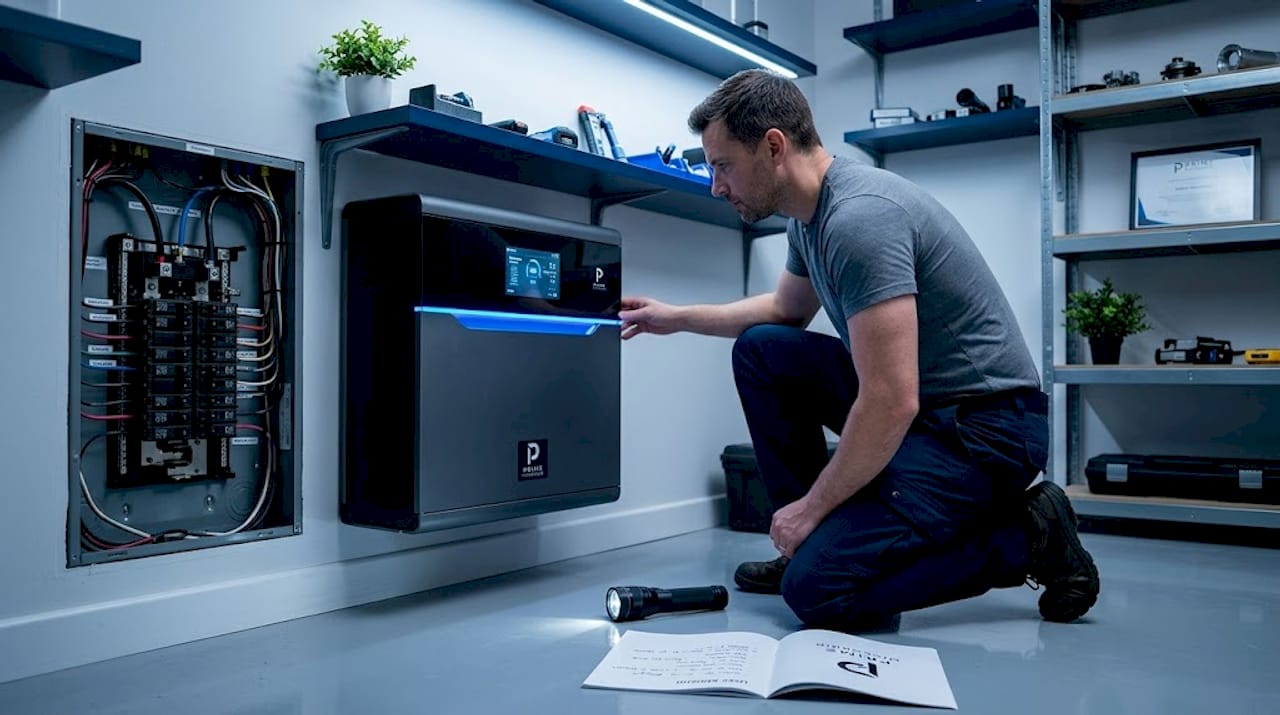
Batteries store excess solar energy and dispatch it during peak demand or when solar isn't generating, enhancing grid stability and preventing blackouts. That function covers more ground than most homeowners realize. It is not just about keeping lights on at night.
Here is what battery storage actually does in a well-designed microgrid:
- Nighttime supply: Powers your home after sunset using the solar energy captured during the day
- Cloudy day buffering: Smooths out dips in solar output so your appliances don't notice the difference
- Outage backup: Keeps critical loads running when the utility grid goes down, whether for hours or days
- Peak shaving: Discharges stored energy during high-rate utility periods to reduce your electricity bill
- Voltage and frequency stability: Maintains clean, stable power that protects sensitive electronics and appliances
Wondering if battery backup alone is enough without solar? The answer depends on how long the outage lasts and what loads you need to keep running. A battery without solar can only hold so much energy. Once it depletes, you're out of power until the grid restores or another source charges it back up. That is why pairing the two is not optional in a serious residential microgrid. It is the whole point.
For homeowners evaluating home battery backup options, sizing matters enormously. A single battery that covers your overnight essentials behaves very differently from a multi-battery system sized to power your whole home for several cloudy days.
Understanding battery functions sets the stage for appreciating their technical integration with solar in microgrids.
Grid-forming versus grid-following inverters: why it matters
Most homeowners never hear the terms "grid-forming" and "grid-following" until something goes wrong. Understanding the difference can save you from designing a microgrid that looks good on paper but fails during an actual outage.
Here is how they work:
-
Grid-following (GFL) inverters sync to the existing voltage and frequency of the utility grid. They require that reference signal to operate. If the grid goes down, a GFL inverter typically shuts off, which means solar panels wired to one will stop producing power exactly when you need it most.
-
Grid-forming (GFM) inverters create their own voltage and frequency reference. They can operate independently of the utility grid, which is what enables a true islanded microgrid to function during outages.
-
GFM inverters with battery backup provide what engineers call inertial support. When solar output drops suddenly, say during a passing cloud, the GFM inverter and battery respond within milliseconds to prevent voltage swings that could damage equipment or trip protective relays.
-
Hybrid configurations pair a GFM battery inverter with GFL solar inverters. The battery inverter sets the grid reference for the island, while solar inverters follow that reference and contribute generation. This arrangement combines cost efficiency with resilience.
Grid-forming battery inverters provide inertial support and stabilize microgrids during rapid solar irradiance drops, unlike grid-following inverters which struggle under weak grid conditions. For homeowners, this translates directly: if your backup system uses only grid-following inverters and the grid fails, your solar panels will not power your home. Your solar battery vs microgrid configuration needs to account for this from the design stage.
Pro Tip: When interviewing installers, ask specifically whether your battery inverter is grid-forming capable. If they can't answer that question clearly, that tells you something important about their expertise.
With inverter technology insights, next we compare how solar and batteries together improve economic and operational benefits.
Economic and operational benefits of combining solar with batteries in microgrids
The financial case for solar plus battery microgrids has improved dramatically over the past several years, and it is not just about energy independence. The numbers increasingly favor this combination on a pure cost basis.
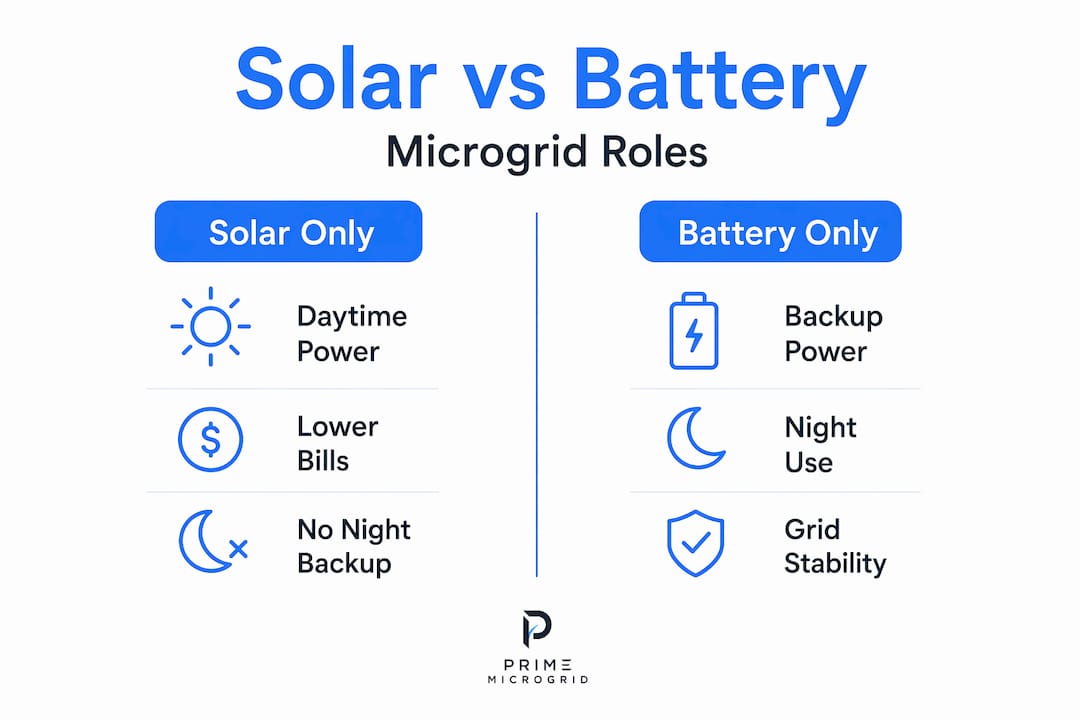
Batteries minimize operational costs by peak shaving and voltage regulation while solar covers daytime generation, reducing system losses and feeder loading. In practical terms, that means your system earns its keep in multiple ways simultaneously.
| Factor | Solar alone | Battery alone | Solar plus battery microgrid |
|---|---|---|---|
| Daytime power cost savings | High | None | High |
| Nighttime power supply | None | Limited by charge | Full, recharged daily |
| Outage protection | None (GFL) or limited | Hours only | Days, with daily solar recharge |
| Peak rate avoidance | Partial | Moderate | Maximum |
| Diesel generator reduction | Partial | None | Significant |
| Grid independence | Daytime only | Short-term only | Practical daily independence |
One counterintuitive finding from real-world microgrid operations: interconnected minigrids can reduce battery size by 30 to 60 percent by purchasing grid power at night when rates are low, rather than sizing batteries to cover every nighttime load. For homeowners with time-of-use utility rates, this coordination between grid purchasing and battery dispatch is where energy management gets genuinely interesting.
The key is the energy management system, or EMS. A well-configured EMS monitors solar output, battery state of charge, grid pricing, and household demand in real time. It makes dispatch decisions automatically, deciding whether to charge the battery, export to the grid, or run loads directly from solar based on current conditions and your priorities. Without that coordination layer, you are leaving savings on the table even with good hardware.
You can compare microgrid vs generator vs solar approaches to see how the economics shift depending on your outage risk, utility rates, and load priorities.
Having seen economic advantages, let's examine real-world examples of solar and battery microgrids enhancing backup power and resilience.
Real-world microgrid examples showcasing the solar and battery synergy
The performance gap between theory and reality often disappoints in energy technology. Solar and battery microgrids are a notable exception. Documented deployments consistently deliver on the promise of extended resilience.
"Solar-powered microgrids with batteries provide power for up to six months during outages, reducing diesel generator use and maintaining critical services." — U.S. Department of Energy
That figure comes from community microgrid deployments, not laboratory testing. Consider the range of proven applications:
- Puerto Rico hurricane recovery: Solar and battery microgrids kept hospitals, community centers, and residences operational for extended periods after grid infrastructure was destroyed. These systems demonstrated that backup power for large homes and facilities is achievable without diesel dependency.
- School-based emergency shelters: Schools equipped with solar-battery microgrids in California and Texas have doubled as community emergency shelters during wildfires and winter storms, maintaining lighting, communications, and climate control for multiple days without grid power.
- Remote community deployments: Villages in Alaska and rural Africa rely on solar-battery microgrids as their primary grid infrastructure, not as backup. Diesel use in some of these communities has dropped by 50 to 80 percent after microgrid installation.
- Military installations: Forward operating bases and domestic facilities use solar-battery microgrids to eliminate single points of failure. The resilience requirements here are about as serious as it gets.
The thread connecting all these examples is the same: solar provides the renewable generation, batteries provide the dispatchable storage, and together they create a system that neither component could build alone. Pairing these with sustainable site infrastructure, including eco-friendly roofing that supports solar panel installation, maximizes the long-term value of the whole system.
Our perspective: solar and batteries are not competing choices
Here is something the industry rarely says plainly: the "solar vs battery" framing is a false choice, and it leads homeowners to make suboptimal decisions.
We see homeowners go one of two ways. Some load up on solar panels expecting resilience and discover during their first outage that their GFL inverters shut down with the grid. Others invest in a battery system and don't connect it to solar, which means they're burning grid power to charge a battery that was supposed to save them money. Both approaches miss the point.
The real insight is about roles. Solar is a generation asset. It produces energy from a free fuel source and does it reliably for 25 or more years. But it cannot dispatch power on demand, regulate voltage, or store anything. Batteries are dispatchable assets. They respond in milliseconds, hold energy across time, and provide the stability that makes islanded operation possible. But without a charging source, they are a finite reserve that depletes and leaves you no better off than before.
What actually changes a homeowner's energy situation is the combination, sized correctly and managed by a system that knows what to prioritize. We have seen 3 kW solar arrays paired with modestly sized batteries outperform much larger standalone solar systems during multi-day outages, simply because the design accounted for how the two technologies complement each other.
The homeowners who get the most out of their systems are the ones who stop asking "solar or battery?" and start asking "how do I want my system to behave at 2 a.m. on the third day of an outage?" That question leads to the right answer every time.
Build your solar and battery microgrid with Prime Microgrid
You now understand what solar does, what batteries do, and why the two work better together than either does alone. The next step is figuring out what that combination looks like for your specific home, your utility rates, your outage risks, and your budget.
At Prime Microgrid, we design customer-sited energy systems that include solar, battery storage, smart controls, and energy management tailored to your actual needs. We don't sell packages. We build systems sized for your loads, your location, and your goals, whether that means covering critical circuits for 48 hours or running your whole property off-grid for a week. If you're ready to move from confusion to a concrete plan, explore our microgrid solutions and see what a well-designed system looks like for properties like yours.
Frequently asked questions
Why can't I rely on solar panels alone for my home microgrid backup?
Solar panels generate electricity only when the sun is shining, leaving your home without power at night and during cloudy periods. Solar PV requires batteries for nighttime and cloudy conditions to ensure continuous power supply in a microgrid.
How do batteries help improve power reliability during outages?
Batteries store excess solar energy and release it when solar output drops or the grid fails, keeping voltage and frequency stable. This is what separates a true backup system from one that only works when conditions are ideal, as batteries dispatch stored energy to prevent blackouts and maintain grid stability.
What is the difference between grid-forming and grid-following inverters in solar microgrids?
Grid-forming inverters create their own voltage and frequency reference, enabling your system to operate independently during a grid outage. Grid-following inverters need the utility grid as a reference and will typically shut down when it fails. Grid-forming battery inverters stabilize microgrids during rapid solar drops, making them essential for reliable backup.
Can microgrids with solar and batteries reduce my energy costs?
Yes. By storing surplus solar energy and deploying it during high-rate utility hours, a properly configured microgrid cuts your reliance on expensive peak grid power. Batteries minimize costs through peak shaving while solar handles daytime generation, reducing both system losses and your monthly bill.