
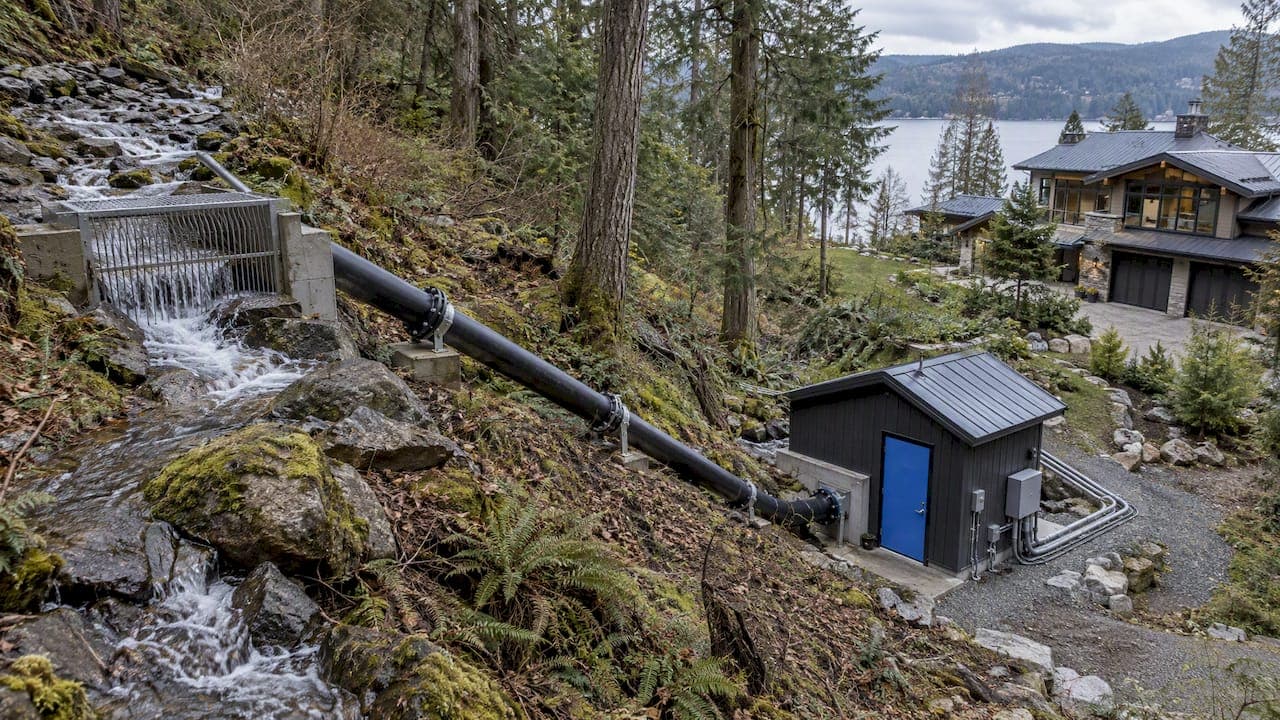
Microhydro generation turns the flow of a stream or spring into electricity at a scale a single property can use. In the United States, a micro hydropower system is one with an installed capacity under 100 kW, which covers homes, farms and small remote facilities. Whether it works for you comes down to three things: the vertical drop you can capture, the water you can reliably divert, and the permits your site requires. This guide walks through each, then covers how a turbine fits into a complete private power system.
TL;DR
- Output depends on net head (drop after pipe friction losses) and flow. A first-cut estimate is P (kW) = 0.051 x flow (cfs) x head (ft).
- Hydro runs around the clock, so it often needs far less battery than solar. It does need a way to dump excess power, because you cannot switch a turbine off like a panel.
- Permitting and water rights are usually the hardest part. Talk to regulators before you buy equipment.
- Most homes with a stream still benefit from a hybrid design: hydro for baseload, batteries for surges, and a generator for the rare dry spell or equipment outage.
Table of Contents
- How microhydro generation works
- Head and flow: the two numbers that decide everything
- What microhydro generation costs
- Permits and water rights
- How microhydro compares with solar and generators
- Batteries and load control with hydro
- Where a hybrid microgrid makes sense
- Our perspective
- Building a hydro-ready power system with us
- A step-by-step path for a homeowner
- Key takeaways
- FAQ
- Sources
How microhydro generation works
A micro-hydro system diverts part of a stream through an intake that screens out debris. Water travels down a pipe, called a penstock, to a turbine. The turbine spins a generator, and the electricity moves through controls to your home, a battery bank, or the grid. The water then returns to the stream. The DOE Microhydropower Handbook covers these components in detail.
Most residential systems are "run of the river." They do not need a dam or a large reservoir. That is what keeps them low-impact, and it is also why they are limited by whatever the stream gives you in the driest part of the year.
The core components:
- Intake and screen: diverts water and keeps out leaves, gravel and fish.
- Penstock: the pressurized pipe that creates the head at the turbine.
- Turbine and generator: the type depends on your head and flow.
- Controller and dump load: regulates output and diverts excess power.
- Inverter, battery and transfer equipment: conditions power for household use. The DOE describes this balance-of-system equipment as needed whether you connect to the grid or not.
Head and flow: the two numbers that decide everything
Head is the vertical drop between your intake and your turbine. Flow is the volume of water, measured in cubic feet per second (cfs) or gallons per minute (gpm). Both matter equally for power. But DOE guidance notes that high-head sites generally need smaller, cheaper equipment than low-head sites moving the same volume of water.
The back-of-envelope formula
The handbook gives P (kW) = (flow x head) / 11.81 x efficiency. With an assumed 60% efficiency, this simplifies to roughly 0.051 x flow x head, with flow in cfs and head in feet.
A worked example
Say a stream delivers 2 cfs (about 900 gpm) to a site with a 50-foot vertical drop.
- Gross estimate: 0.051 x 2 x 50 = 5.1 kW.
- Now account for friction. If the penstock and intake eat 10% of the head, net head is 45 feet: 0.051 x 2 x 45 = about 4.6 kW.
- Running continuously, 4.6 kW is roughly 110 kWh per day (4.6 x 24).
That arithmetic is a screening estimate, not a design. Real output depends on turbine type, seasonal flow and how much water you are allowed to take.
Gross head versus net head
This is the mistake we see most often. Homeowners measure the pool-to-pool drop and design around it. Turbine performance depends on net head, which is what remains after friction losses in the penstock and intake. Longer, narrower or rougher pipe means bigger losses. A larger-diameter penstock costs more up front but can recover a meaningful share of your output.
Pro tip: measure flow in the driest month you can, not after spring rain. A system sized for peak flow will underperform for much of the year.
Is your site viable at all?
Extension guidance on micro-hydro says a drop of as little as three feet can be used, but a viable system generally needs either a high flow or at least 10 feet of head. The same guide notes that the closer your load is to the water, the lower the cost and the higher the efficiency, since long transmission lines add expense and losses.
What microhydro generation costs
Costs swing widely, and any figure you see online is a range, not a quote. Small kit turbines are sold at low price points, but they are typically sub-kilowatt units. A whole-property system adds civil work, a penstock, electrical gear and engineering, and those often cost more than the turbine itself.
What drives the total:
- Distance from intake to powerhouse, which sets penstock length and diameter.
- Civil works: intake structure, trenching, powerhouse and tailrace.
- Distance to your home or load, which sets cable size and cost.
- Permitting, studies and water-rights work.
- Controls and storage: dump loads, inverters, batteries.
We do not publish prices for custom systems, because the site determines the scope. What we can say honestly is that a design built around measured head and flow is cheaper than one built around guesses and then corrected in the field.
Permits and water rights
For many property owners this is the real project. The DOE's Hydropower RAPID Toolkit advises engaging federal and state regulators early, before substantial civil engineering or equipment purchasing, because water rights and environmental compliance are complex.
Federal oversight
Do not assume a stream on your land is outside federal jurisdiction. Under the Federal Power Act, a project that is on a navigable waterway, occupies federal land, or uses surplus water from a federal dam needs a FERC license or exemption. If you are unsure of your site's status, you can file a Declaration of Intention with FERC for a formal determination, at no cost.
Where a license is needed, simplified paths exist. FERC describes conduit exemptions and 10-MW exemptions for projects at existing non-federal dams or in man-made conduits not primarily used for power. Those are distinct from full licensing.
State and local rules
Water rights, diversion limits, fish passage, stream-alteration permits and interconnection rules vary by state and sometimes by county. We cannot summarize them for all 50 states. Your state water resources agency, your utility and your county permitting office are the three first calls.
How microhydro compares with solar and generators
Hydro and solar are both renewable, but they behave differently. Hydropower provides a steady, predictable baseload, while solar is intermittent and relies on storage for nights and cloudy days. For a property with a good stream, that can shrink the battery bank considerably.
| Microhydro | Solar + battery | Standby generator | |
|---|---|---|---|
| Output pattern | Steady, day and night | Daytime only, seasonal | On demand |
| Fuel | Water | Sunlight | Propane, natural gas or diesel |
| Storage need | Low to moderate | High for overnight use | None |
| Site requirement | Stream with usable head and flow | Roof or ground area | Fuel supply and pad |
| Main risk | Low summer flow, ice, permits | Long cloudy spells | Fuel supply, mechanical failure |
If you are weighing outage coverage more broadly, the right mix depends on how long outages last in your area. This piece on generator versus battery backup shows how outage length changes the answer. For a deeper look at the options, see our guide to how to evaluate home backup power options.
Batteries and load control with hydro
Because hydro is constant, batteries serve a different job than they do with solar. They cover short surges, such as a well pump or HVAC compressor starting, and they smooth the gap when demand exceeds turbine output.
The less obvious point is the opposite problem. You cannot simply shut off a running turbine the way you can disconnect panels. When the battery is full and the house is not using the power, the energy needs somewhere to go. That is the job of smart load control: diverting the excess to a secondary load such as a water heater element, a heated shop or a pool heater. Without it, you risk damaging equipment.
If you already have storage or are planning it, our pages on residential battery storage and home battery backup explain how we size batteries around real loads.

Where a hybrid microgrid makes sense
A stream rarely does everything. Low flow in late summer, a frozen intake in winter, or a blocked screen after a storm can interrupt generation. A standby generator and battery storage make those events invisible to the household.
A hybrid design typically combines:
- Hydro as the baseload source.
- Solar where the site allows it, covering daytime peaks.
- Batteries for surges and short interruptions.
- A generator as the last line of defense.
- A controller that coordinates all of it, including the dump load.
This is the same logic behind our off-grid home power work, and our overview of critical home systems to power off-grid lists what should stay on the protected circuit.
Our perspective
My honest take: microhydro is the best private power source a property can have, and also the one most often misjudged. When the stream is real, the head is measured and the permits are in order, nothing else produces steady power so cheaply per kWh over the years. When any one of those three is uncertain, the project stalls or underdelivers.

We design every system around the property's actual electrical demand and site conditions, not from generic packages. For a hydro site, that means we start with the load: what your home, well, pool, guest house and shop draw, and when. Then we test the water against it. If the stream covers most of the load, the rest of the design is about protecting it with storage, controls and a generator. If it does not, we say so, and a solar, battery and generator microgrid may be the better answer.
Every design is reviewed by engineers, and we keep client information private. We do not sell it.
— Prime Microgrid
Building a hydro-ready power system with us
If you own a property with moving water and want a resilient, whole-property system, we handle system design, equipment integration, installation and commissioning as one project. Our estate microgrid systems integrate generation, battery storage, generators and controls into a single design. You can see the full range on our systems page. We are not a source of consumer-grade kits or DIY turbines. We build custom, engineered systems for properties with real loads.
A step-by-step path for a homeowner
- Measure the drop and the flow. Use a surveyor's level or GPS for head and a timed bucket or weir for flow, in the driest season.
- Run the numbers. Apply the 0.051 formula with realistic net head.
- List your loads. Add up average kWh per day and peak kW.
- Check jurisdiction. Call your state water agency, and use FERC's free Declaration of Intention if status is unclear.
- Design for the worst month, then add storage and backup around it.
- Engage an engineer before buying a turbine.
Key takeaways
- Net head and dry-season flow decide output, not the nameplate on a turbine.
- Hydro reduces storage needs but demands a dump load.
- Permits come first, equipment second.
- A hybrid with batteries and a generator protects against the failures a stream alone cannot.
FAQ
What is a micro hydroelectric system?
It is a small hydropower installation, under 100 kW in the United States, that uses a stream's flow and drop to power a home, farm or small facility. Most are run-of-the-river designs without a dam.
How much electricity can a small stream generate?
A first-cut estimate is 0.051 x flow in cfs x head in feet, in kW. A 2 cfs stream with 45 feet of net head gives about 4.6 kW. Seasonal flow variation and equipment losses will change the real figure.
Can I build a DIY hydro turbine?
Small experiments are possible, but a property-scale system involves pressurized piping, electrical safety, regulatory review and controls. We design engineered systems rather than DIY builds, and we recommend a licensed professional for any connection to your home wiring or the grid.
Do I need a permit for a stream on my own land?
Possibly. State water rights and permits apply in most places, and federal rules apply if the stream is navigable or the project touches federal land or dams. FERC's guidance explains when a license or exemption is required.
Sources
- DOE Office of Indian Energy: Hydroelectric foundational course
- Microhydropower Handbook, Volume 1, Part 1
- Microhydropower Handbook, net head guidance
- Micro-hydropower for the Home, Farm, or Ranch (extension guide)
- DOE Hydropower RAPID Toolkit
- FERC: Do I need approval?
- FERC: Types of projects
- Hydropower Vision, Chapter 2