
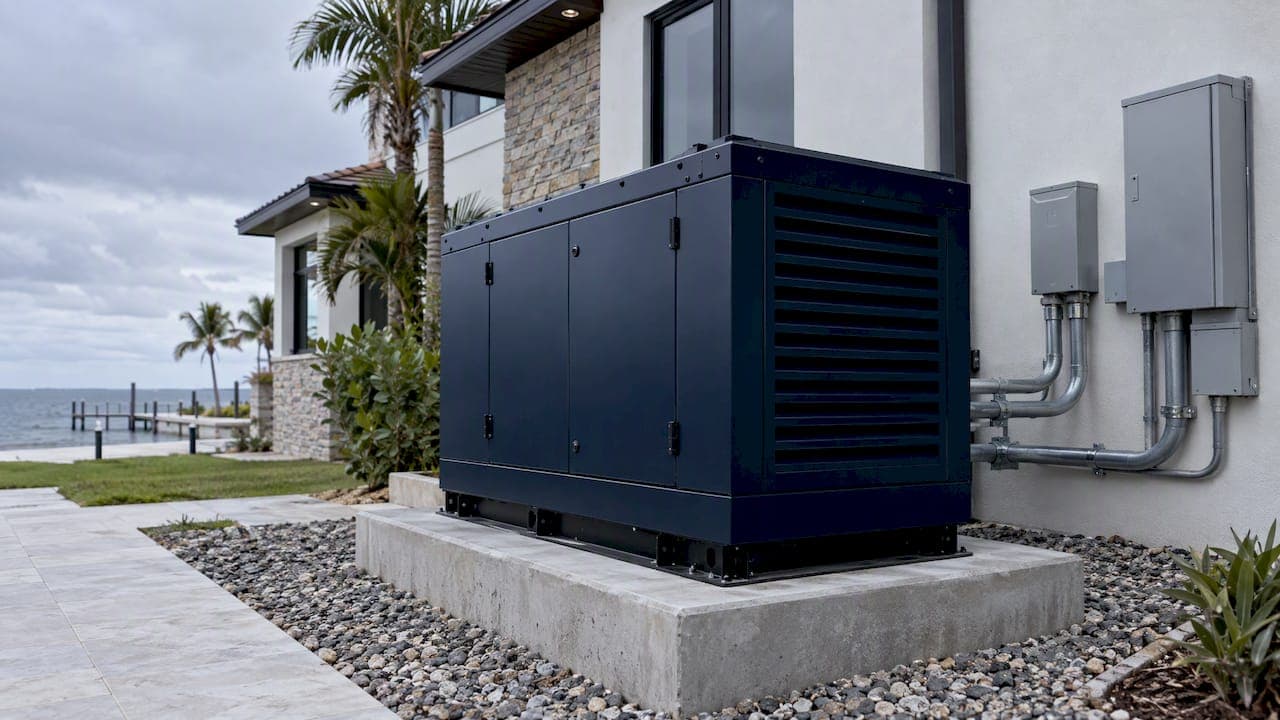
A hurricane rated generator enclosure is one proven to meet wind and debris impact test protocols such as TAS 201, 202, and 203, or designed to an equivalent ICC 500 standard for the site's hazard level. Before buying or installing one, confirm the manufacturer's test reports, a PE stamp on the installation design, any applicable product approval number, and a flood and anchoring plan matched to your site. Get those documents in hand, then bring them to your local building authority or a licensed engineer before you commit.
TL;DR:
- Require the manufacturer's TAS 201, 202, and 203 reports or equivalent ICC 500 documentation, including evidence for louvers, doors, exhaust openings, and cyclic wind loads.
- If elevation above mapped flood levels is impractical, use a sealed vault rated for submersion and show flood levels and anchoring together on stamped drawings.
- Some High Velocity Hurricane Zone jurisdictions require Florida product approval or a Notice of Acceptance, while other authorities set their own documentation rules.
- Run the generator monthly under load and inspect screens, seals, fasteners, and anchors before storm season; maintain 20 feet from doors, windows, and vents.
Table of Contents
- What tests and certifications should you require?
- Why wind rating and impact resistance are not the same thing
- How flood risk and site elevation change your enclosure plan
- Comparing factory enclosures, concrete vaults, and custom builds
- What paperwork do you need before permitting?
- Installation and site prep checklist
- Keeping the enclosure and generator storm-ready
- How we approach specifying hurricane-rated enclosures
- Why tested enclosures are worth the extra planning
- How we help you plan and install a hurricane-rated system
- FAQ
- Sources
What tests and certifications should you require?
Enclosure certification in hurricane zones rests on three Florida Building Code test protocols, and understanding what each one actually measures helps you read a manufacturer's spec sheet instead of just trusting the label.
- TAS 201 tests large missile impact resistance, simulating wind-borne debris striking the enclosure at speed.
- TAS 202 measures uniform static air pressure, essentially how much steady wind load a wall or panel can withstand before failing.
- TAS 203 applies cyclic wind pressure, repeatedly loading and unloading a surface the way gusts do during a real storm.
Enclosures that pass these protocols, combined with ICC 500 large missile impact criteria, can carry wind ratings up to 250 mph. In Florida's High-Velocity Hurricane Zone (HVHZ), including key coastal counties, this testing is typically mandatory, and installers often need Miami-Dade or Florida product approval before a permit is issued. Outside HVHZ, local code and your Authority Having Jurisdiction (AHJ) still determine what evidence they will accept.
Why wind rating and impact resistance are not the same thing
A panel rated for high wind pressure can still fail catastrophically from a single piece of flying debris, and a debris-resistant panel is not automatically built to hold under sustained wind load. These are two separate failure modes, and an enclosure needs proof against both.
- A breached intake louver can let wind-driven rain flood the generator compartment even when the walls hold.
- A roof panel rated only for static pressure, not cyclic loading, can lift and separate during a prolonged event.
- Access doors and exhaust penetrations are common weak points because they interrupt the tested wall assembly.
Insist on full-enclosure test reports, or engineered details that specifically address intakes, exhaust routing, and doors, rather than a rating that only covers flat wall sections.
How flood risk and site elevation change your enclosure plan
Wind resistance solves one problem; standing water solves another. FEMA floodproofing guidance recommends elevating critical equipment to mapped flood elevations whenever possible, and when elevation is not feasible, using a watertight, reinforced vault instead. For critical facilities, FEMA's guidance favors these two approaches because both reduce the risk of a generator going offline exactly when it is needed.
- Elevate the pad or platform above the base flood elevation shown on your flood insurance rate map.
- Where elevation is not practical, specify a sealed, watertight vault rated for submersion exposure.
- Anchor the enclosure with corrosion-resistant fasteners suited to coastal and Zone V conditions.
- Route fuel lines and tanks above projected flood elevation, not alongside the lowest point of the site.
- Add drainage and erosion controls around the foundation to limit scour during heavy rain events.
Pro Tip: Ask your engineer to show flood elevation and anchoring details on the same stamped drawing. AHJs frequently reject permits when these two items are shown separately.
Comparing factory enclosures, concrete vaults, and custom builds
Three practical paths cover most hurricane zone installations, and the right one depends on your flood exposure, budget, and how fast you need the system operational.
Factory-built, hurricane-rated enclosures arrive pre-tested to TAS standards and install faster than custom alternatives, though in flood-prone zones they usually still need an elevated foundation to meet FEMA's siting guidance. Concrete vaults and modular concrete enclosures offer strong flood and impact resistance in one package, at a higher cost and with more limited service access for maintenance crews. Custom engineered enclosures sit between the two, letting you match wind and impact ratings to an unusual site while adding design and permitting time.
- Louver protection should carry its own impact rating, not rely on the main wall assembly alone.
- Gaskets and seals need UV and salt-air resistance for coastal durability.
- Fasteners should be stainless steel or hot-dip galvanized to resist corrosion near the coast.
- Service access panels should be sized for routine maintenance without breaking the weather seal.
What paperwork do you need before permitting?
Permitting goes faster when you arrive with the right documents instead of discovering gaps during inspection.
- TAS 201/202/203 test reports from the manufacturer, or equivalent ICC 500 documentation.
- A PE stamp certifying the installation design matches the tested or engineered configuration.
- Florida product approval or a Miami-Dade Notice of Acceptance (NOA) where the jurisdiction requires it.
- Stamped site elevation diagrams showing foundation height relative to base flood elevation.
Florida Building Code commission guidance confirms that AHJs retain discretion over product approval, and a manufacturer-hardened generator unit can sometimes change what enclosure rating is actually required. Engaging your AHJ early, with a pre-submittal review, tends to catch these variables before they delay a project.
Installation and site prep checklist
Walking into contractor bids with this sequence settled saves rework later.
- Pour a concrete pad sized and elevated per your site's flood and soil conditions.
- Install drainage and erosion controls, including silt fencing during excavation, consistent with FEMA's generator site prep guidance.
- Anchor the enclosure using a pattern matched to its tested wind load, with corrosion-resistant hardware.
- Route fuel and conduit lines above flood elevation and away from erosion-prone soil.
- Install the transfer switch to NEC requirements, with remote monitoring and exhaust clearances confirmed before final inspection.
Keeping the enclosure and generator storm-ready
Certification only matters if the enclosure and generator stay in working condition between storms.
- Keep generators at least 20 feet from doors, windows, and vents to prevent carbon monoxide buildup, per NFPA generator safety guidance.
- Store fuel away from ignition sources and refuel only when the unit is off and cooled.
- Run the generator under load on a monthly schedule to confirm starting and transfer performance.
- Before storm season, check intake screens, gasket condition, fastener torque, and anchor integrity.
Pro Tip: Log each seasonal inspection with a date and photo. That record speeds up insurance claims and warranty service if a storm does cause damage.
How we approach specifying hurricane-rated enclosures
We scope every backup power project around the property's actual electrical load, not a generic package, which determines whether a hurricane-rated enclosure stands alone or pairs with battery storage to reduce runtime fuel dependency. Pairing the two also simplifies fuel siting, since a smaller generator running fewer hours needs less on-site fuel storage near flood-prone areas.
A typical engineering package we deliver includes:
- A site survey covering flood elevation, soil conditions, and wind exposure.
- PE-stamped drawings for foundation, anchoring, and enclosure specification.
- Permitting support, including documentation prepared for AHJ review.
- Commissioning and verification once installation is complete.
Owners considering a project can request a site assessment to understand how these elements apply to their property.
Why tested enclosures are worth the extra planning
An untested enclosure might look identical to a certified one right up until the first major storm, and that is precisely the gap that matters. The cost difference between a generic shed and a TAS-tested, properly anchored enclosure is small compared to the cost of losing backup power during a multi-day outage.
We think the real value of certified, engineered enclosures shows up in how they integrate with the rest of a property's power system, not just in whether they survive a single storm. A generator enclosure that fails independently of the rest of your backup design defeats the purpose of having backup power at all.
— Prime Microgrid
How we help you plan and install a hurricane-rated system
We design backup power systems around your property's real exposure, not a one-size template, which means your enclosure, generator, and any battery storage get engineered as one coordinated system instead of separate purchases.

Our relevant services include system design covering load analysis, site survey, and enclosure specification, installation and commissioning including foundation, anchoring, and electrical hookup, as well as integrated generation and battery storage solutions suitable for a range of property sizes and power needs.
Before reaching out, have your property's electrical panel information, recent utility bills, and any known flood zone designation ready. From there, we review your site and outline what an engineered, code-ready system looks like for your property. Explore our Estate Microgrid Systems, Battery Retrofit Systems, and Hybrid Generator Systems to see what fits, or start with our hurricane power protection resources to plan your next step.

FAQ
What is the best generator to use during hurricane season?
The right choice depends on your property's load and fuel access rather than a single model, but a unit paired with a tested, hurricane-rated enclosure and a properly installed transfer switch performs most reliably through sustained outages. Standby units sized to your actual electrical demand, not just peak wattage, tend to hold up better than oversized or undersized portable units.
Can you leave a portable generator outside in the rain?
A portable generator should never run uncovered in the rain, and it should stay at least 20 feet from doors, windows, and vents per NFPA safety guidance to avoid carbon monoxide exposure. A vented, weather-rated enclosure designed for the unit is the safer long-term solution.
How much does a generator enclosure cost?
Published pricing for hurricane-rated enclosures is not publicly listed, since cost depends heavily on wind rating, flood zone requirements, and whether the design uses a factory enclosure, concrete vault, or custom build. Property owners working with Prime Microgrid can request a site assessment to get project-specific figures through our systems page.
How much do hurricane-resistant prefab homes typically cost?
Pricing for hurricane-resistant prefab homes is not something we track or publish, since that market sits outside generator enclosure and backup power systems. Readers researching that topic should consult builders or sources specific to storm-resistant residential construction.
Sources
- Debris impact standards (Florida Disaster / TAS overview)
- Generators: Information required for environmental review (FEMA job aid)
- FEMA: floodproofing glossary / guidance
- Generator safety tips (NFPA)