
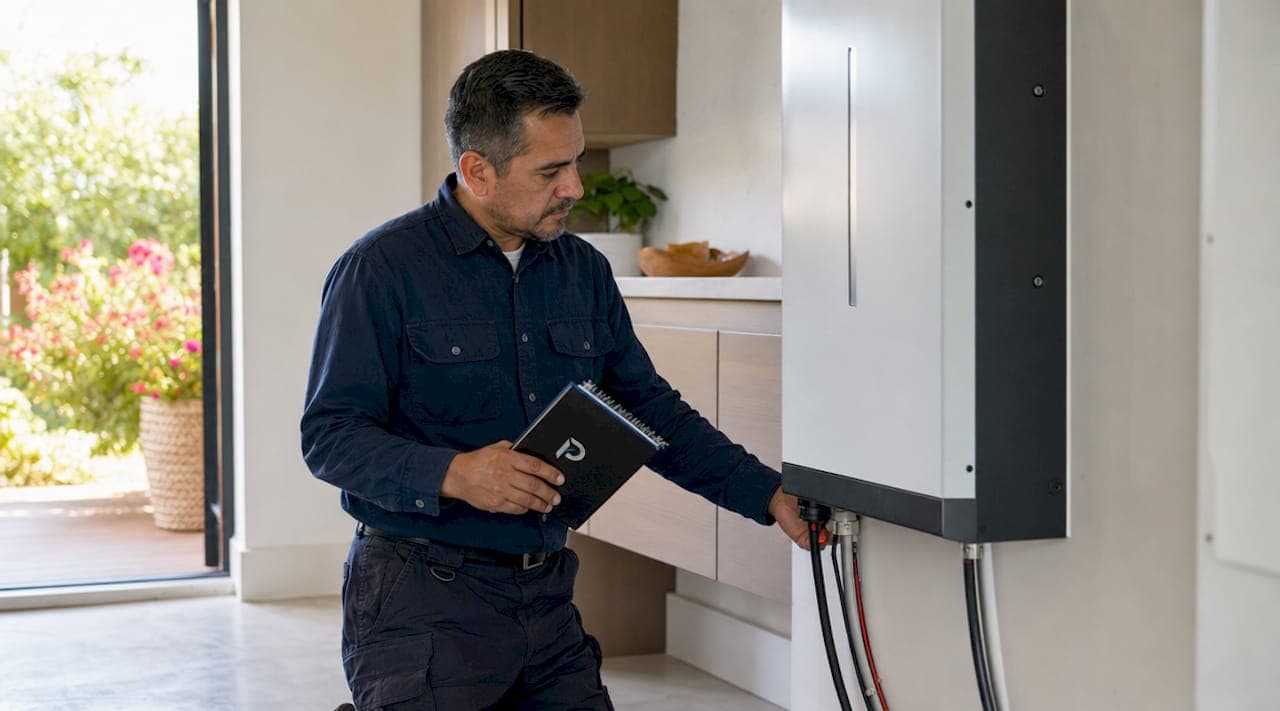
Battery storage is the backbone of effective hurricane preparedness, giving homes the power to run refrigeration, medical devices, lighting, and communication when the grid goes dark. Coastal states like Florida, Texas, Louisiana, North Carolina, and South Carolina account for roughly 70% of all US weather-related power outages. That number tells you everything about why the role of battery storage in hurricane prep has shifted from optional upgrade to practical necessity. Modern lithium iron phosphate (LFP) battery systems, paired with solar panels and grid-forming inverters, now give homeowners a real alternative to gas generators and the fuel supply problems that come with them.
How does battery storage provide backup power during hurricanes?
Battery storage captures electricity from the grid or from solar panels and holds it until you need it. When the grid fails during a hurricane, a properly configured system switches to islanded mode, cutting the connection to the utility and running your home from stored energy. That switch happens automatically in well-designed systems, often in milliseconds, so your refrigerator never loses power and your CPAP machine keeps running through the night.
The distinction between portable and whole-home systems matters a great deal for hurricane energy resilience:
- Portable battery stations (1 to 3 kWh) handle phone charging, a fan, a small refrigerator, and basic lighting for 8 to 24 hours. Brands like EcoFlow and Jackery make popular units in this category.
- Whole-home battery systems (10 to 27 kWh) power critical circuits or entire homes for 12 to 48 hours. Products like the Tesla Powerwall 3 and Enphase IQ Battery 5P fall into this tier.
- Solar-plus-storage systems add a recharge source during extended outages, provided sunlight is available after the storm passes.
One technical detail that surprises many homeowners: grid-tied solar panels shut off automatically during an outage for safety reasons unless the system includes a battery and a grid-forming inverter configured for islanded operation. Without that configuration, your rooftop solar produces nothing during the exact event you bought it for. Whole-home systems from Primemicrogrid are designed with this in mind, using smart controls and proper inverter configuration to keep power flowing when the grid cannot.
What types of battery storage systems work best for hurricane prep?
Choosing the right system depends on your property type, budget, and how long you realistically need to run critical loads. The table below breaks down the core options.

| System type | Capacity | Typical cost | Best for |
|---|---|---|---|
| Portable power station | 1 to 3 kWh | $400 to $1,500 | Renters, apartments, essential devices only |
| Whole-home battery | 10 to 27 kWh | $9,000 to $25,000 | Single-family homes, medical equipment, full-circuit coverage |
| Solar plus battery | 10 to 27 kWh + solar | $15,000 to $40,000+ | Homeowners wanting recharge capability and long-term cost savings |
| Battery plus generator hybrid | Variable | Variable | Properties needing multi-day resilience regardless of weather |
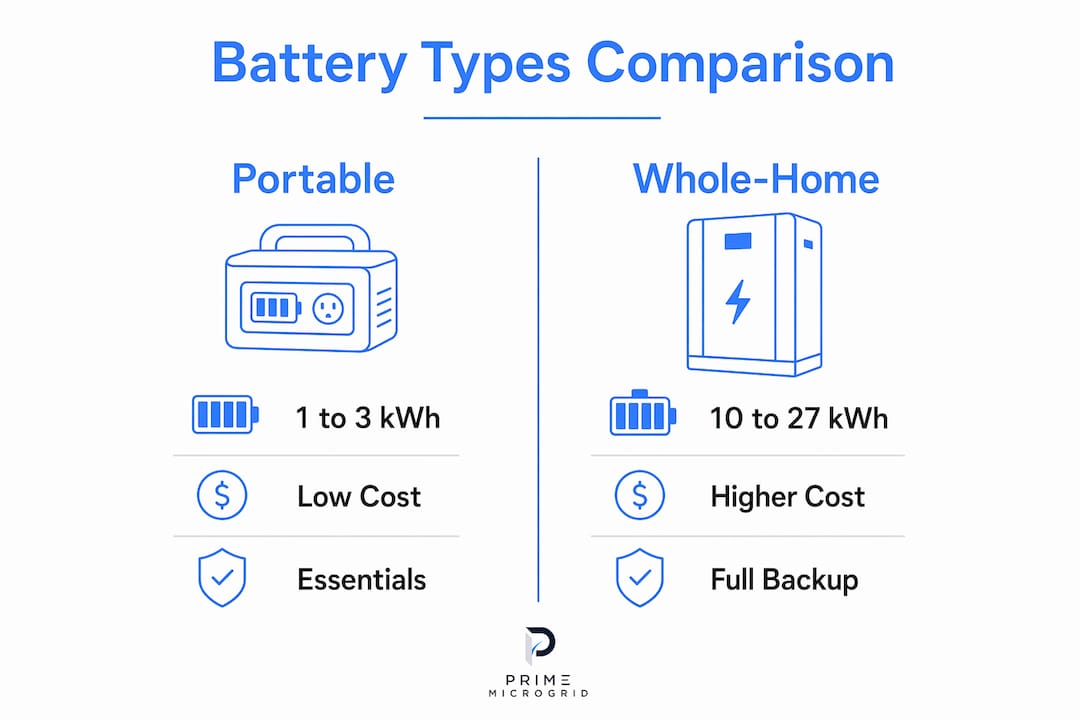
Portable units cover essentials but cannot sustain a full household through a multi-day outage. For a single-family home in Florida or Texas, a whole-home battery system is the more practical investment. The 30% federal IRA tax credit applies to qualifying residential battery storage systems, which meaningfully reduces the net cost of a $15,000 to $25,000 installation.
Gas generators remain a common backup choice, but they carry real drawbacks: fuel storage requirements, carbon monoxide risk, noise, and the logistical problem of finding gasoline when every station in a storm corridor runs dry. A solar and battery backup setup eliminates the fuel dependency entirely. For properties that need sustained power beyond what batteries alone can provide, combining a battery system with a propane or natural gas generator gives you the best of both approaches. Primemicrogrid designs exactly these kinds of layered systems, integrating batteries, generators, and smart load management into a single coordinated solution. You can explore how the options stack up on the microgrid vs generator vs solar comparison page.
Pro Tip: If you qualify for the 30% IRA tax credit, apply it to a whole-home battery system rather than a portable unit. The per-dollar resilience you get from a 13 kWh system far exceeds what a 2 kWh portable station delivers during a Category 3 event.
What preparation steps maximize battery performance before a storm?
Preparation is where most homeowners lose the advantage their battery system should give them. Follow these steps in the 48 to 72 hours before a forecasted hurricane landfall:
- Charge your battery to 100%. Pre-charging at least 48 hours before landfall is the single most important step. Modern LFP batteries hold a full charge safely for one to two weeks, so there is no risk in topping up early.
- Run a failover test. Manually disconnect from the grid and confirm your system switches to islanded mode correctly. This is not the time to discover a firmware issue.
- Update firmware. Routine firmware updates keep automatic switching reliable. Skipping updates is one of the most common reasons battery systems fail at critical moments.
- Pre-cool your refrigerator and freezer. Packing freezers with water bottles or ice increases thermal mass, extending food safety for hours beyond what an empty freezer can manage.
- Fill water containers if you are on well water. Well pumps draw significant power. Storing water in advance reduces the load your battery needs to carry.
- Identify a community cooling or charging center. For outages lasting more than three days, knowing the nearest public resource extends your effective resilience window.
- Secure or angle solar panels per manufacturer guidance. High winds can damage panels not rated for hurricane conditions. Check your installation's wind rating before the season starts.
Pro Tip: Set a calendar reminder for June 1st, the official start of Atlantic hurricane season, to run your annual failover test and firmware check. Catching a configuration problem in May beats discovering it during a Category 4 landfall.
Backup power is not a buy-it-and-forget-it investment. The systems that fail during storms are almost always the ones that have not been tested or updated since installation. Treat your battery system the way you treat your smoke detectors: check it on a schedule, not just when you think about it.
What are the real limitations of battery storage during hurricane outages?
Battery storage for storms is powerful, but it has boundaries every homeowner needs to understand before the storm arrives.
- Central air conditioning is the biggest load problem. A 3-ton central AC unit draws 3 to 5 kW continuously. A 13.5 kWh battery system running only the AC would last roughly two to four hours. Mini-split systems are far more efficient and a better pairing with battery storage.
- Solar recharge is unreliable during and immediately after a storm. Heavy cloud cover and debris on panels can reduce solar output to near zero for 24 to 48 hours after landfall. Do not plan your energy budget around solar recharge during the storm window itself.
- Cold weather reduces battery output. This matters less in Florida than in the Carolinas, but cold temperatures can degrade battery performance in systems without thermal management. Quality engineering and monitoring software prevent this from becoming a crisis.
- Multi-day outages exceed most residential battery capacity. After Hurricane Ian in 2022, some Florida communities went without power for two weeks. No residential battery system alone covers that scenario.
Battery backup is best understood as a bridge, not a full grid replacement. Run your critical loads efficiently, and plan for generator or community support if the outage extends beyond 48 hours.
The practical answer to these limitations is load prioritization. Identify your non-negotiables: the refrigerator, medical devices, a few lights, phone charging, and a single window AC unit or fan. Everything else goes off. A whole-home battery system paired with smart load management controls makes this automatic, cycling power to priority circuits and protecting your stored energy for what matters most. For properties that need multi-day coverage, combining battery storage with a backup generator creates a layered system that handles extended outages without the single-point failure risk of relying on either technology alone.
Key takeaways
Battery storage provides reliable hurricane backup power when systems are properly sized, configured, and maintained before the storm season begins.
| Point | Details |
|---|---|
| Coastal states face the highest risk | Florida, Texas, Louisiana, North Carolina, and South Carolina account for 70% of US weather-related outages. |
| System size determines what you can run | Portable units (1 to 3 kWh) cover essentials; whole-home systems (10 to 27 kWh) protect critical circuits for 12 to 48 hours. |
| Pre-storm prep is non-negotiable | Charge to 100% at least 48 hours before landfall and run a failover test every season. |
| Solar recharge has storm-window limits | Plan your energy budget without solar input for the first 24 to 48 hours after landfall. |
| Layered systems outperform single solutions | Combining battery storage with a generator and smart controls handles multi-day outages that batteries alone cannot. |
What I've learned after years of designing storm-ready energy systems
Most homeowners I talk to think about battery storage the wrong way. They treat it as a product purchase rather than a system design problem. They buy a single battery, connect it to their existing solar setup, and assume they are covered. Then a storm hits, the solar shuts off because the inverter was never configured for islanded mode, and the battery drains in six hours because nobody turned off the pool pump.
The grid-forming inverter question is the one I wish more homeowners asked before they bought anything. It is the difference between a system that actually works during an outage and one that looks good on paper. Texas learned this at the grid scale: the state's battery fleet reached nearly 17 GW in early 2026, and those systems respond to grid disruptions in milliseconds precisely because they are engineered for that purpose. Residential systems need the same intentional design.
The other thing I have observed consistently: the homeowners who fare best during extended outages are not the ones with the biggest batteries. They are the ones who know their loads, have tested their systems, and have a plan for day three. Battery storage is one layer of a resilient home. Smart controls, load management, and sometimes a generator are the other layers. Build the full picture, not just the most visible component.
— David
How Primemicrogrid helps you prepare for hurricane season

Primemicrogrid designs residential battery storage and microgrid systems built specifically for the reliability demands of hurricane-prone properties. Every system is customized around your home's actual loads, your local grid conditions, and your budget. That means proper inverter configuration, smart load management, and integration with solar or generators where it makes sense for your situation. Primemicrogrid also supports ongoing monitoring and maintenance so your system is ready when the season starts, not just when it was installed. If you are in a coastal state and want a system designed for real-world storm conditions, explore the residential microgrid options built for exactly that purpose.
FAQ
What is the role of battery storage in hurricane prep?
Battery storage captures electricity before a storm and delivers it to critical home circuits when the grid fails. It powers refrigeration, medical devices, lighting, and communication without fuel, noise, or carbon monoxide risk.
How long does a home battery last during a hurricane outage?
Whole-home battery systems ranging from 10 to 27 kWh typically sustain critical loads for 12 to 48 hours. Runtime depends on which appliances are running, with central AC being the largest drain on stored capacity.
Does solar still work during a hurricane outage?
Grid-tied solar shuts off automatically during outages unless the system includes a battery and a grid-forming inverter configured for islanded operation. Even with that setup, solar recharge is unreliable for the first 24 to 48 hours after landfall due to cloud cover and debris.
What is the best battery system for hurricane preparedness?
Whole-home LFP battery systems in the 10 to 27 kWh range offer the best balance of capacity and safety for single-family homes. Pairing one with a generator covers multi-day outages that batteries alone cannot handle.
Is there a federal tax credit for residential battery storage?
The 30% federal IRA tax credit applies to qualifying residential battery storage systems, significantly reducing the net cost of a whole-home installation. Consult a tax professional to confirm eligibility for your specific system and installation year.