
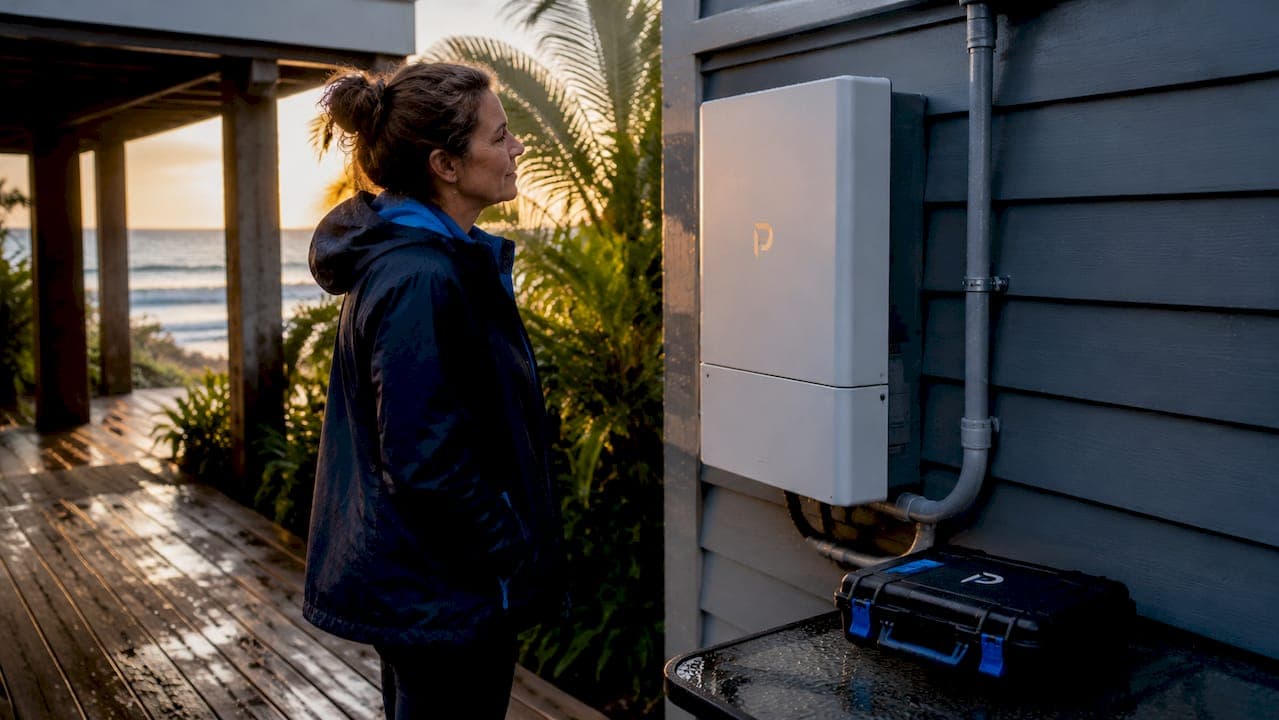
Backup power is the single most effective defense coastal homeowners have against the cascading damage that follows a flood-related outage. When a storm surge cuts grid power, your sump pump stops, your refrigerator warms, and any medical equipment on the circuit goes dark. The role of backup power in coastal flooding goes far beyond keeping the lights on. It protects your structure, your health, and your financial investment. The U.S. residential battery storage market expanded 64% in 2024, reaching roughly 500,000 households by early 2026, a clear sign that coastal homeowners are treating backup power as mandatory infrastructure rather than a luxury upgrade.
What backup power options work best for coastal flooding?
Three main technologies define the backup power market for coastal flood preparedness: battery storage systems, standby generators, and solar-plus-storage configurations. Each has a distinct performance profile in a salt-air, high-humidity environment.
Battery backup systems are sealed, solid-state units that switch to backup power automatically, often within milliseconds of a grid outage. They operate silently, produce zero emissions, and require far less maintenance than combustion equipment. Sealed battery systems are more resilient to salt air corrosion than generators with fuel lines and filters. That matters enormously on the coast, where exposed metal components degrade faster than inland installations.
Gas and diesel standby generators deliver high power output and long runtime as long as fuel is available. The trade-off is real: fuel storage is a logistical challenge during evacuations, and salt air corrodes carburetors, fuel lines, and exhaust systems faster than most homeowners expect. A generator that sat idle through a mild spring can fail on the first cold start of hurricane season.
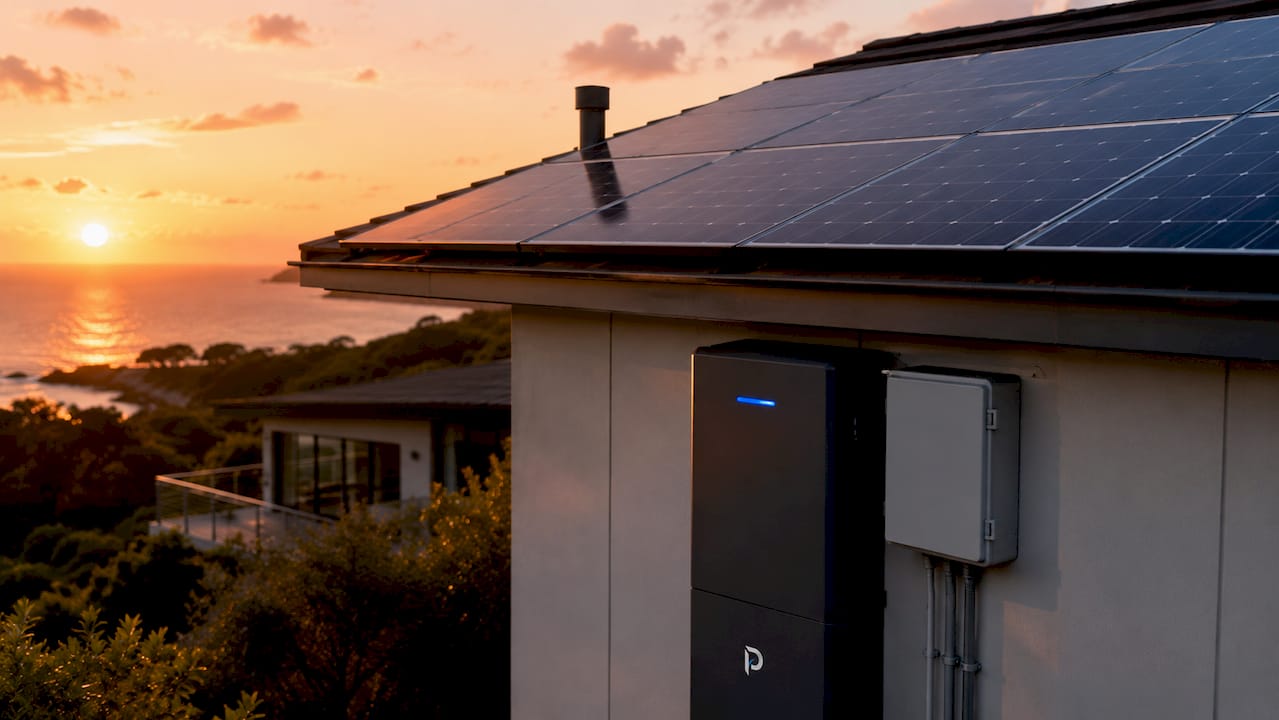
Solar-plus-storage pairs rooftop panels with a battery bank to create a system that recharges itself during daylight hours. This is the strongest option for multi-day outages because it does not depend on a finite fuel supply. Solar panel benefits for coastal homes include continuous recharging during post-storm clearing skies, which extends effective runtime well beyond what a standalone battery can deliver.
| System Type | Typical Cost | Runtime | Salt-Air Resilience | Auto Switchover |
|---|---|---|---|---|
| Battery backup (standard) | $10,000–$25,000 | 7–12 hours continuous | High | Yes |
| Whole-home battery | $25,000–$50,000 | 1–3 days with cycling | High | Yes |
| Standby generator | $5,000–$15,000 | Unlimited (fuel-dependent) | Low | Yes |
| Solar + battery storage | $20,000–$45,000 | Multi-day (recharging) | High | Yes |
Cost figures reflect standard installation pricing for 20–40 kWh whole-home configurations. Your actual cost depends on home size, load requirements, and local permitting.
Pro Tip: When comparing systems, ask your installer for the inverter's surge rating, not just the battery capacity. A battery with 20 kWh of storage paired with an undersized inverter will still fail when your sump pump starts up.
How does flooding damage backup power equipment?
Flooding creates two distinct threats to backup power hardware: direct water intrusion and long-term salt corrosion. Understanding both helps you design a system that survives the event it was built for.
Water intrusion is the obvious risk. A generator or battery unit installed at ground level in a flood zone can be submerged within minutes of a surge. Once water reaches electrical components, the damage is often total. The fix is straightforward: mount all backup hardware at least 12 inches above your property's base flood elevation, as defined by your FEMA flood zone designation.
Salt corrosion is slower but equally destructive. Coastal air carries microscopic salt particles that settle on terminals, connectors, and ventilation screens. Over months, this accelerates oxidation on any exposed metal. Battery backups require less maintenance than generators precisely because they have fewer exposed metal components and no fuel system to corrode.
Three design factors directly improve flood resilience:
- Elevated installation: Mount units on raised platforms or wall brackets above flood elevation.
- Waterproof enclosures: Use NEMA 3R or NEMA 4X rated enclosures for any outdoor components.
- Surge-rated inverters: Inverter surge capacity must handle startup currents from HVAC systems and sump pumps, which can run 3–7 times the normal operating wattage.
Smart load shedding software automatically disconnects non-essential appliances to extend battery life during outages. This is the feature most homeowners overlook when shopping for a system. A battery that would last 8 hours running everything in your house might last 24 hours if the software drops the water heater, dryer circuit, and secondary HVAC zones automatically.
Pro Tip: Schedule a salt-air inspection every fall before storm season. Check terminal connections for white oxidation deposits and clean them with a contact cleaner rated for marine environments.
How do you size a backup system for coastal flood preparedness?
Sizing a backup power system for coastal flood preparedness starts with your critical loads, not your total home consumption. Critical loads are the appliances that protect your property and health during an outage.
Follow this process to size your system accurately:
- List your critical loads. Sump pump, refrigerator, lighting, internet router, medical devices, and one HVAC zone are the standard starting point for most coastal homes.
- Calculate running watts. Add up the continuous wattage of every device on your critical load list. A typical sump pump runs at 800–1,200 watts. A refrigerator runs at 150–400 watts. A single HVAC zone runs at 1,500–3,500 watts.
- Identify your largest motor load. Whole-home backup sizing requires matching inverter surge ratings to the largest motor load, not just total battery capacity. Your central air conditioner or sump pump is almost always the determining factor.
- Choose your autonomy target. For a region with storms that knock out power for 1–3 days, target at least 20 kWh of usable battery capacity with load cycling. Backup systems with cycling modes can extend runtime to 2–3 days, which covers most coastal storm recovery windows.
- Add a 20% capacity buffer. Battery capacity degrades over time. Building in a buffer keeps your system performing at spec years after installation.
| Home Size | Critical Load (watts) | Recommended Battery Capacity | Target Autonomy |
|---|---|---|---|
| Under 1,500 sq ft | 3,000–5,000 W | 10–15 kWh | 1–2 days |
| 1,500–3,000 sq ft | 5,000–9,000 W | 15–25 kWh | 1–2 days |
| Over 3,000 sq ft | 9,000–15,000 W | 25–40 kWh | 2–3 days |
Modular battery systems let you add capacity later without replacing the entire installation. If your budget limits you today, start with critical-load coverage and expand as needed. Read the whole home backup power guide for a detailed walkthrough of inverter sizing and load calculations.
How should you maintain backup power in a coastal flood zone?
A backup power system that has not been tested is a backup power system you cannot trust. Coastal environments accelerate component wear, so maintenance schedules that work inland are not sufficient here.
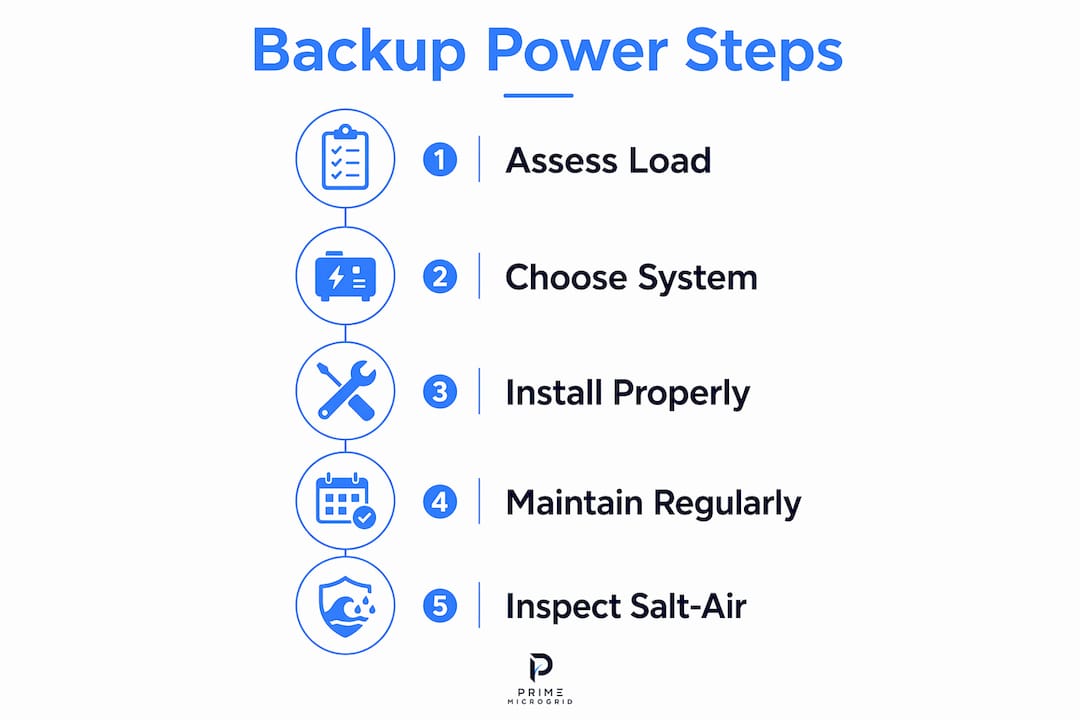
Core maintenance practices for coastal installations:
- Run a monthly load test. Manually trigger your system to run on battery for 30–60 minutes. This confirms the inverter, battery, and transfer switch all function under real load.
- Inspect for corrosion quarterly. Check all external terminals, conduit connections, and enclosure seals. Salt air works fast, and a corroded terminal can prevent your system from switching over during an actual outage.
- Replace sump pump batteries on schedule. Sump pump battery backups degrade every 3–5 years in coastal climates due to heat and humidity. A battery that tests as charged may still lack the startup amps to run the pump under load.
- Use remote monitoring. Smart monitoring platforms send alerts when battery state of charge drops below a threshold or when a component reports a fault. You want to know about a problem in October, not during the next storm.
- Store generator fuel safely. If your system includes a generator, rotate fuel every 6–12 months and use a fuel stabilizer. Stale gasoline is the leading cause of generator failure at startup.
Pro Tip: Keep a maintenance log with dates, test results, and any parts replaced. If you ever file a flood insurance claim, documented system maintenance strengthens your case that the equipment was properly maintained.
What else strengthens coastal flood preparedness beyond backup power?
Backup power systems work best as part of a broader flood resilience strategy. Power continuity matters less if water is already inside your walls.
The most effective complementary measures include:
- Sump pump with battery backup: A battery-backed sump pump continues operating during outages and is your first line of defense against basement flooding. Size it to handle your worst-case groundwater infiltration rate, not your average.
- Flood barriers and door seals: Products like AquaFence and removable flood panels can block surge water from entering at ground level. Pair these with waterproof sealant on foundation cracks and utility penetrations.
- Drainage improvements: French drains, graded landscaping, and extended downspouts reduce the volume of water reaching your foundation during heavy rain events.
- Emergency preparedness plan: Document your critical load priorities, system shutdown procedures, and evacuation triggers. Share the plan with everyone in your household.
- Flood insurance review: Battery storage is increasingly viewed as essential infrastructure in coastal regions, and some insurers now factor resilient power infrastructure into property valuations and premium calculations.
- Community coordination: Know your local utility's storm restoration priority map. Properties with documented backup power systems sometimes qualify for expedited reconnection programs in certain municipalities.
The combination of backup power, physical flood barriers, and a written emergency plan covers the three failure modes that cause the most damage: power loss, water intrusion, and human error under stress.
Key takeaways
Backup power is the foundation of coastal flood preparedness, and its effectiveness depends entirely on system design, proper sizing, and consistent maintenance.
| Point | Details |
|---|---|
| Battery systems outperform generators on the coast | Sealed battery units resist salt corrosion and switch over automatically without fuel logistics. |
| Inverter surge rating is the critical sizing factor | Size your inverter to handle 3–7x the running watts of your largest motor load, not just total battery capacity. |
| Coastal maintenance schedules must be more frequent | Replace sump pump batteries every 3–5 years and inspect terminals quarterly for salt corrosion. |
| Solar-plus-storage extends multi-day autonomy | Pairing panels with battery storage removes the fuel dependency that limits standalone generators. |
| Backup power integrates with broader flood resilience | Combine battery backup with sump pumps, flood barriers, and a written emergency plan for full protection. |
What i've learned after years of coastal energy system design
The shift from generators to battery-backed systems is not just a technology trend. It reflects a hard lesson that coastal homeowners keep relearning. Generators fail precisely when you need them most, not because they are bad products, but because salt air, stale fuel, and deferred maintenance compound in ways that are invisible until a storm arrives.
The feature I see undervalued most often is automated load shedding. Homeowners focus on battery capacity in kilowatt-hours, which is the right instinct, but the software that manages which loads run and when is what actually determines how long your system lasts through a three-day outage. A 20 kWh battery with smart load management will outlast a 30 kWh battery running everything indiscriminately.
The other mistake I see consistently is treating inverter sizing as secondary. Surge current from a central air conditioner or a sump pump starting under load will trip an undersized inverter instantly. The battery can be fully charged and the system will still fail. Professional system design that accounts for inrush current is not optional for whole-home backup. It is the difference between a system that works and one that looks like it should work.
My honest recommendation: invest in a professionally designed system early, before the next named storm is on the forecast. The homeowners who call after a storm are the ones who discovered their generator would not start or their battery was undersized. The ones who planned ahead are the ones who rode out the outage with their sump pump running and their food cold.
— David
How Primemicrogrid designs backup power for coastal homes
Coastal flood preparedness requires a backup power system built around your specific property, not a catalog item pulled off a shelf. Primemicrogrid designs residential microgrid solutions that integrate battery storage, smart load management, and optional solar generation into a single system engineered for your flood zone, load profile, and autonomy requirements.

Every Primemicrogrid system includes automated load shedding controls and inverter sizing matched to your largest motor loads, the two factors that determine real-world performance during a coastal storm. If you are comparing your options, the microgrid vs. generator breakdown shows exactly where battery-based systems outperform combustion alternatives in coastal environments. Contact Primemicrogrid to get a system design built around your property's actual flood risk and power needs.
FAQ
What is the role of backup power in coastal flooding?
Backup power maintains electricity to critical systems like sump pumps, HVAC, and medical devices when coastal storms knock out grid power. Without it, flood damage escalates rapidly as water removal and climate control systems go offline.
How long can a battery backup system run during a flood outage?
Battery backup systems typically provide 7–12 hours of continuous runtime, and up to 2–3 days when paired with smart load cycling or solar recharging. Whole-home configurations with 20–40 kWh capacity cover most coastal storm recovery windows.
Are battery systems better than generators for coastal flood zones?
Battery systems outperform generators in coastal environments because sealed solid-state designs resist salt air corrosion and require no fuel storage or combustion maintenance. Generators remain useful for extended outages but carry higher failure risk in humid, salt-air conditions.
How often should i replace my sump pump battery backup?
Sump pump battery backups require replacement every 3–5 years in coastal climates. Heat and humidity accelerate chemical degradation, and a battery that tests as charged may still fail to deliver the startup amps needed to run the pump under load.
What size backup system does a coastal home need?
A home under 1,500 square feet typically needs 10–15 kWh of battery capacity for 1–2 days of critical load coverage. Homes over 3,000 square feet with central HVAC and sump pumps should target 25–40 kWh to maintain 2–3 days of autonomy during extended outages.