
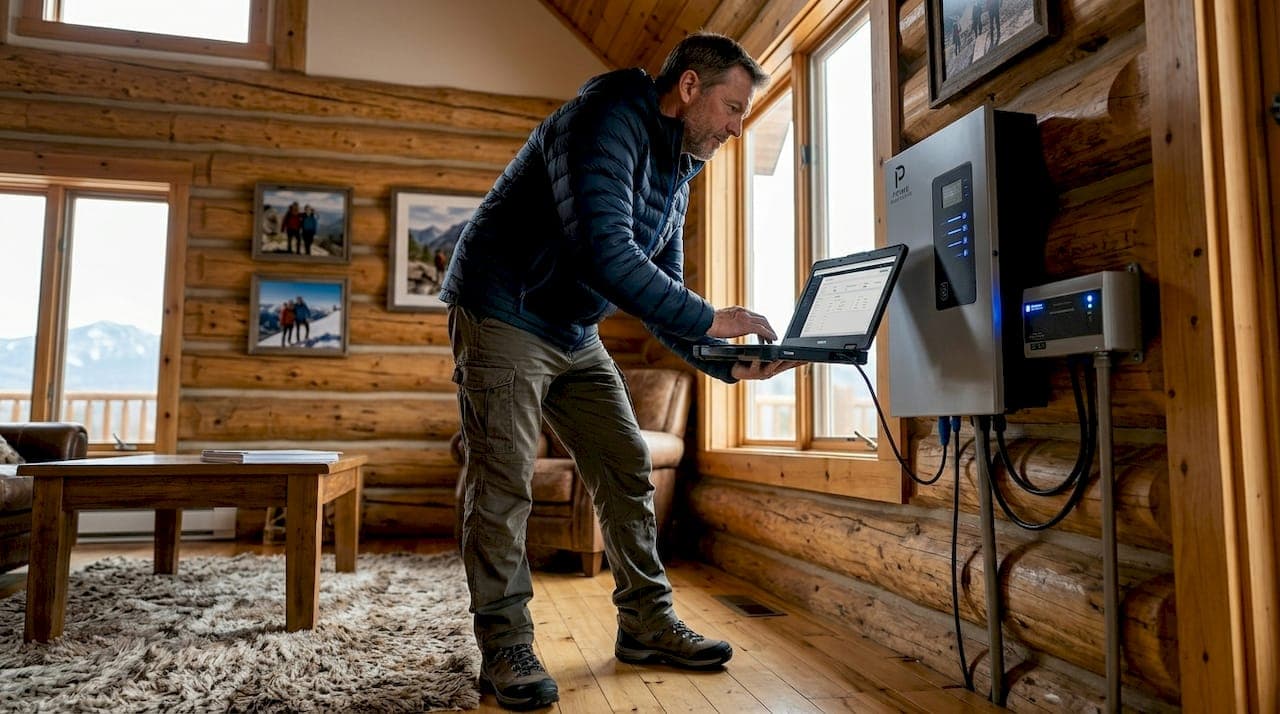
Power outages at vacation properties aren't just inconvenient. They can freeze pipes, spoil food, trigger guest complaints, and leave rental income on the line. Choosing from the available vacation property backup power options is more complicated than it looks because the system has to work reliably even when you're hundreds of miles away. Backup power for remote properties, what the industry calls distributed energy and standby generation, demands a different evaluation than a primary residence. This article breaks down every major solution, the real trade-offs, and how to match a system to your property's specific situation.
Table of Contents
- Key Takeaways
- 1. The core criteria for evaluating vacation property backup power options
- 2. Standby generator options for vacation properties
- 3. Solar plus battery storage as backup power
- 4. Portable power stations and hybrid setups
- 5. Comparing and selecting the right solution for your property
- My take on what most vacation property owners get wrong
- How Primemicrogrid helps vacation property owners get this right
- FAQ
Key Takeaways
| Point | Details |
|---|---|
| Start with a load calculation | Knowing your essential circuits is the critical first step before sizing any backup system. |
| Automation matters most for remote use | Automatic transfer switches and autostart generators prevent outages from becoming crises when no one is on-site. |
| Target 2-3 days battery autonomy | Sizing battery storage for 2-3 days of essential loads covers most multi-day outage and low-sun scenarios. |
| Hybrid systems reduce cost and risk | Pairing solar and battery storage with a generator backup minimizes fuel use while maximizing outage coverage. |
| Battery care during vacancies is non-negotiable | Fully charging batteries before departure prevents deep discharge damage that ruins backup performance. |
1. The core criteria for evaluating vacation property backup power options
Before comparing products, you need a framework. The right emergency power setup for a rental property in coastal North Carolina looks nothing like the right setup for a remote mountain cabin in Colorado. Four factors separate a system that works from one that fails you at the worst moment.
Load priority and circuit shedding. Backup power at vacation properties typically targets essential loads rather than full whole-home coverage, because battery energy limitations make powering everything simultaneously impractical. Identify your critical circuits upfront: refrigerator, sump pump, well pump, security system, a few lights, and possibly a heating or cooling unit. Circuit-level load shedding can extend battery backup runtime by up to 42%.
Automation level. A generator you have to manually start is useless if you're three states away. Automatic transfer switches (ATS) and autostart generators are the baseline for any unattended property. The transfer switch is actually the most regulated part of the system because it physically isolates your property from the utility grid, protecting both your equipment and utility workers.
Energy autonomy. How many days can your system run without utility power or generator fuel? Planning for 2-3 days of battery autonomy is the standard for vacation properties dealing with multi-day low-generation periods.
Remote monitoring and maintenance. Can you see system status from your phone? Can the system self-correct or at least alert you before a failure? For vacation properties, remote management capability isn't a luxury.
Pro Tip: Start every system design with a load calculation, not a product search. Starting with load calculation is the critical first step in correctly sizing any backup or off-grid system. Getting this wrong means either wasting money on oversized equipment or getting stranded with undersized backup.
2. Standby generator options for vacation properties
Standby generators are the traditional answer to emergency power for rental properties, and for good reason. When properly installed, they work automatically, run on a stable fuel supply, and can power a whole property for as long as fuel holds out.
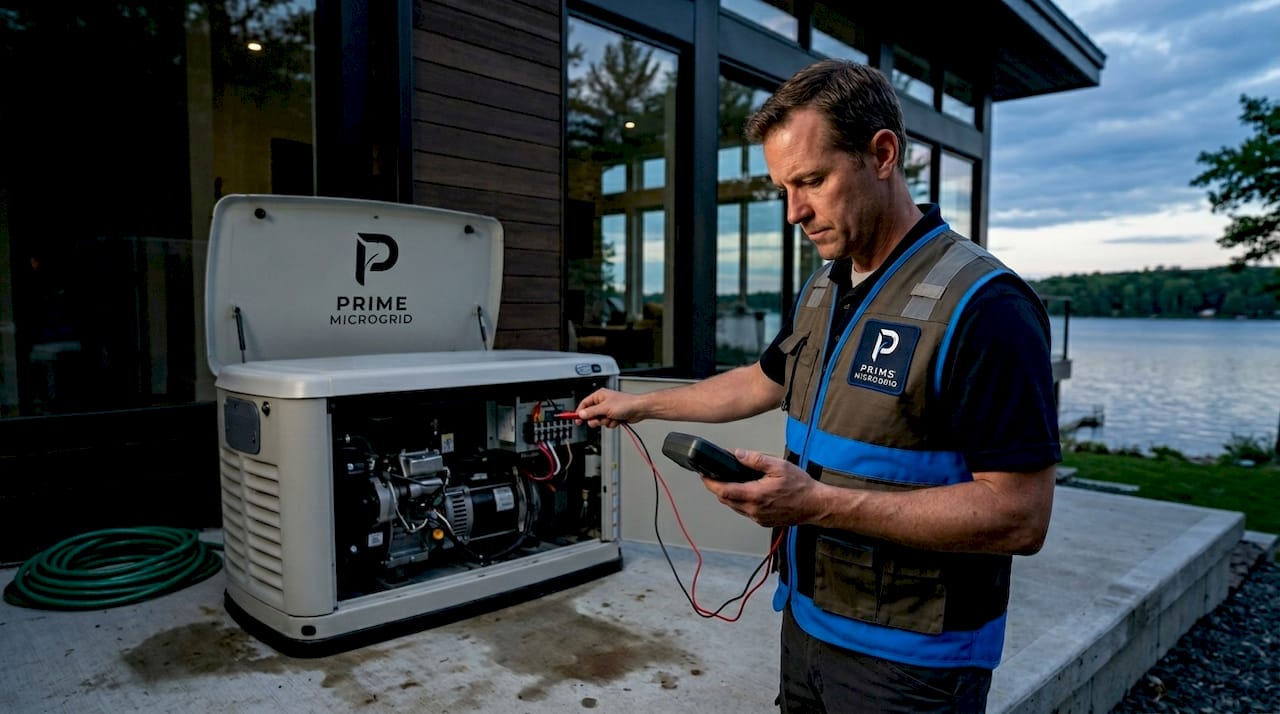
The best generators for vacation properties are air-cooled or liquid-cooled standby units that connect to a permanent fuel source: natural gas, propane, or diesel. Natural gas is lowest maintenance because fuel supply is unlimited and storage isn't required. Propane works well where natural gas isn't available, though you'll need a properly sized tank and a monitoring plan to avoid running dry during a long outage. Diesel generators produce more power per unit of fuel but require on-site fuel storage and regular maintenance to prevent fuel degradation.
Here's what every generator installation for a vacation property needs:
- An automatic transfer switch (ATS) that prevents backfeed to utility lines, as required by NEC Article 702
- A permit and inspection in virtually every U.S. jurisdiction
- Weekly or bi-weekly automatic exercise cycles to keep the engine ready
- Carbon monoxide detectors inside the property as a mandatory safety measure
- Proper clearance from windows, doors, and air intakes per manufacturer specs
Pro Tip: Don't skip the load test during installation. Have the installer run your generator under actual load for at least 30 minutes to confirm it handles startup surges from pumps and HVAC equipment. Many generator failures happen on first use during an actual outage.
Portable generators are the low-cost alternative, but they're a poor fit for unattended vacation properties. They require manual setup, produce exhaust that creates carbon monoxide risk if improperly positioned, and can't autostart. If a storm knocks out power while no one is at the property, a portable generator sitting in a storage shed does nothing. Learn more about how whole-home generators work before deciding between standby and portable.
3. Solar plus battery storage as backup power
Solar combined with battery storage is increasingly the preferred approach for vacation homes seeking off-grid power options, especially properties that prioritize quiet operation, reduced fuel logistics, and long-term cost efficiency. This is where the industry term "distributed energy resource" or DER becomes relevant. You're not just installing a backup device. You're building a small power plant on-site.
A properly sized solar-plus-battery system includes:
- Solar panels sized to meet average daily loads with seasonal adjustment
- A charge controller or hybrid inverter managing charge flow
- Battery storage, ideally lithium iron phosphate (LiFePO4) for its cycle life and thermal stability
- An inverter capable of supporting essential circuits at 120V or 240V
- A transfer switch or integrated ATS
Battery autonomy sizing should target 2-3 days for most vacation properties. Adding extra autonomy days increases battery costs by 30-50%, so most owners find the sweet spot by pairing 2-day battery storage with a generator that bridges extended cloudy periods rather than sizing the battery bank for worst-case scenarios alone.
| Battery Type | Cycle Life | Depth of Discharge | Best For |
|---|---|---|---|
| LiFePO4 | 3,000-6,000+ cycles | 80-90% | Long-term vacation property use |
| AGM Lead-Acid | 400-700 cycles | 50% | Lower upfront cost, higher replacement frequency |
| NMC Lithium | 1,000-2,000 cycles | 80% | High energy density, moderate cost |
The biggest risk specific to vacation properties is battery deep discharge during extended vacancies. Fully charged batteries can hold their charge for one to two months. Batteries left in a discharged state risk permanent capacity loss that directly undermines your backup reliability. Set your inverter to storage or vacation mode before leaving. It's a three-minute step that protects a significant investment.
Pro Tip: The role of battery storage in remote properties goes beyond simple backup. When paired with solar, batteries reduce grid dependency over time, which matters for properties in areas with aging utility infrastructure.
4. Portable power stations and hybrid setups
Portable power stations like the Anker Solix F3800 Plus have changed the conversation about backup power for shorter stays and supplemental use. These units deliver up to 6,000W continuous output with rapid transfer switching under 20 milliseconds, making them capable of supporting most essential loads in a vacation home.
They work best in specific situations:
- Short-term rental properties where guests need emergency coverage for one to two days
- Properties that already have partial solar and need supplemental storage
- Vacation homes near the grid where outages are infrequent but disruptive
The real power of portable units comes in hybrid configurations. A hybrid system layers the grid connection, a solar array, battery storage, and a generator into a coordinated system managed by smart controls. Generators in hybrid setups run sparingly, activating only when batteries drop below a set threshold during extended low solar production. This reduces fuel consumption dramatically compared to running a generator as the primary source.
The limitation is cost and complexity. A full hybrid system with smart controls, grid tie-in, and multiple energy sources requires professional design and installation. It's the right answer for luxury vacation homes or high-occupancy rentals where downtime is measured in lost revenue, but it's overkill for a two-bedroom cabin that sees four guests a year.
5. Comparing and selecting the right solution for your property
Every vacation property owner weighs this decision differently based on budget, tolerance for complexity, and how much downtime they can accept.
| System Type | Automation | Upfront Cost | Fuel Needed | Best Use Case |
|---|---|---|---|---|
| Standby Generator | Full auto with ATS | $5,000-$15,000+ | Yes (gas/propane/diesel) | Whole-home coverage, any climate |
| Solar + Battery | Full auto | $15,000-$40,000+ | No (grid optional) | Remote properties, eco-conscious owners |
| Portable Power Station | Manual | $1,000-$5,000 | No | Short stays, supplemental backup |
| Hybrid Microgrid | Full auto + smart | $20,000-$60,000+ | Generator for backup | High-value rentals, extended autonomy |
For an unattended remote cabin, the priority is automation and low maintenance. A propane standby generator with ATS and remote monitoring covers most scenarios. If the property has good sun exposure, adding a modest solar-battery system lets the generator stay dormant most of the time and only kick in for extended cloudy stretches.
For a rental property with moderate occupancy, the equation shifts toward guest experience. Renters expect seamless power. A standby generator covers short outages automatically, while solar-plus-battery reduces operating costs over time. Pairing the two gives you backup power for larger homes with multiple circuits and diverse loads.
For a luxury vacation home, downtime is simply not acceptable. A fully integrated microgrid with solar, batteries, a generator, and smart load controls gives you layered protection, energy cost savings, and the ability to monitor and adjust everything remotely.
Pro Tip: Never size a backup system around peak load. Size it around your priority circuits only and let non-essential loads stay off during outages. This single decision can cut your required battery capacity and generator size significantly, saving thousands on the initial install.
My take on what most vacation property owners get wrong
I've worked with enough vacation property owners to recognize the patterns. The most common mistake isn't choosing the wrong technology. It's under-sizing the autonomy window and ignoring what happens to the system during the months the property sits empty.
People pick a generator or a battery system, feel confident it'll handle things, and never think about what three months of vacancy does to a lithium battery that wasn't charged before they left. Or they install a modest solar-battery system but never set up circuit prioritization, so a two-day outage drains everything within twelve hours because the HVAC is running full blast with no one home.
My view is that automatic transfer and remote monitoring aren't optional for vacation properties. They're the minimum viable setup. The rest of the system design can vary based on budget and location, but if you can't see system status from your phone and the system can't respond to an outage without you being there, you've built a false sense of security.
The second thing I'd push back on is the instinct to build the biggest battery bank possible to avoid generator noise or fuel logistics. Choosing the right autonomy days is a balance between cost and reliability. Two days of battery paired with a well-maintained generator is almost always more practical and more resilient than a massive battery bank with no backup generation. Bigger isn't always safer. It's often just more expensive.
Safety and code compliance always come before any technology preference. A transfer switch that isn't properly installed and inspected isn't just a code violation. It's a real hazard to utility workers and to the property itself.
— David
How Primemicrogrid helps vacation property owners get this right
If you've read this far, you already understand that the right backup solution for a vacation property isn't a one-size product. It's a system designed around your specific loads, location, fuel access, occupancy pattern, and budget.
Primemicrogrid specializes in exactly this kind of design work. Their team builds customized distributed energy systems that can include battery storage, standby generators, solar, smart load controls, and remote monitoring. Whether you're looking at a residential microgrid in the Mid-Atlantic or need to understand how microgrids compare against standalone generators and solar setups, Primemicrogrid can walk you through the options with engineering behind every recommendation. No guesswork. No oversized systems sold on fear. Just reliable power designed around your property's actual needs.
FAQ
What is the most reliable backup power option for a vacation home?
Standby generators with automatic transfer switches are the most reliable option for whole-home coverage. For properties with solar access, a solar-plus-battery system paired with a generator backup offers the best combination of automation and fuel independence.
How do transfer switches protect vacation properties?
Transfer switches physically isolate the property from the utility grid when the generator activates, preventing backfeed that could endanger utility workers and damage equipment. NEC Article 702 requires them for residential standby systems.
How long should a battery backup last at a vacation property?
Target 2-3 days of essential load coverage as a baseline. Two days of battery autonomy paired with generator backup covers the vast majority of outage and low-sun scenarios without requiring an oversized and costly battery bank.
Can I monitor a vacation property backup system remotely?
Yes. Modern standby generators, solar inverters, and battery systems all offer app-based remote monitoring. This lets you check system status, receive outage alerts, and adjust settings without traveling to the property.
What should I do with my battery system before leaving the property vacant?
Fully charge your batteries and activate your inverter's storage or vacation mode before departing. Batteries left discharged during extended vacancies risk permanent capacity damage, which directly reduces backup performance when you need it most.