
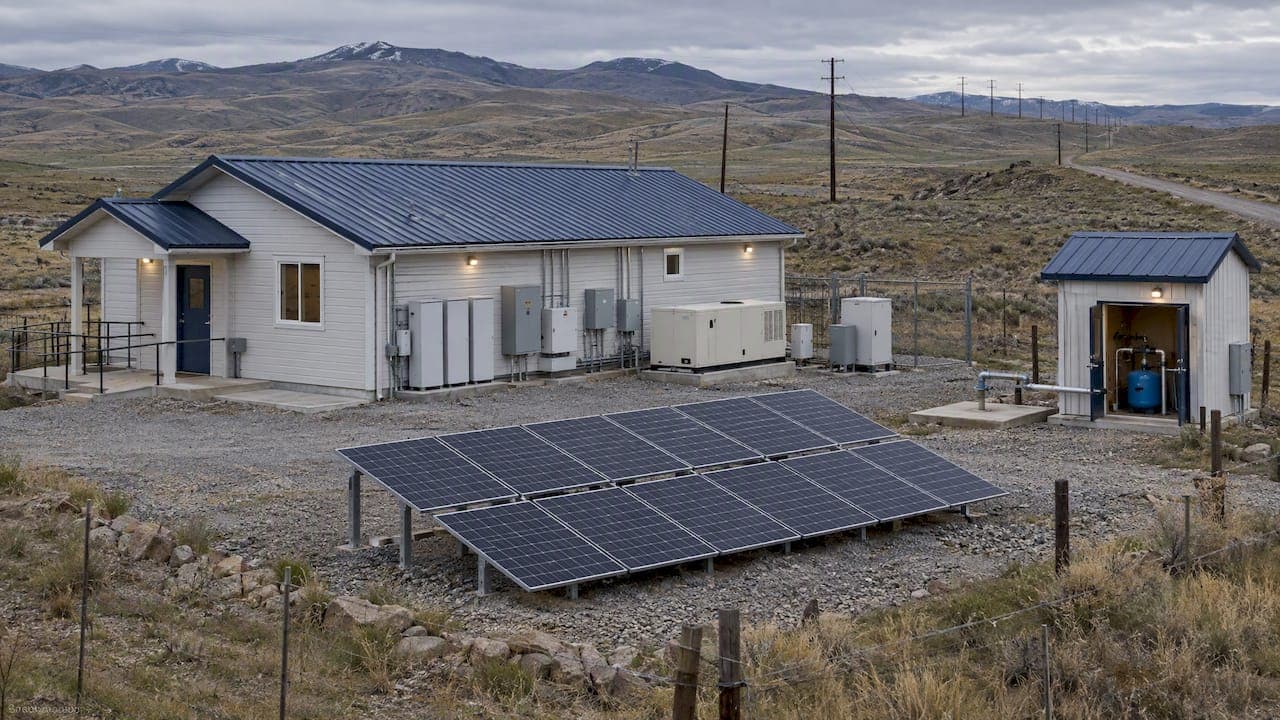
A rural microgrid is a controllable group of loads and local generation inside defined electrical boundaries that can disconnect from the main grid and keep critical community loads running. That reliability is why communities build them. Below, we cover components, planning, costs, regulation, governance, case studies, and the first steps to take.
TL;DR:
- Grid connected designs can lean on utility supply, but islanded systems must cover full demand; start with interval data and prioritize critical loads.
- Development has historically cost $2 million–$5 million per megawatt; specific studies found outage, health, and job benefits lifted net present value to $10 million–$19 million.
- Hybrid systems pair solar and batteries with backup generation; renewable only designs need more storage for multiday outages, while diesel brings ongoing fuel risk.
- Contact the utility early about interconnection studies, upgrades, and operating agreements; state rules vary, and systems serving multiple customers may face utility regulation.
- Choose a cooperative, municipality, or nonprofit to own the system, assign tariff and maintenance duties, train local operators, and fund future battery replacement through rates.
Table of Contents
- What a rural microgrid is and how it operates
- Why rural communities build microgrids
- How to plan and size a rural microgrid
- Technology choices: diesel, hybrid, renewable-heavy, and DC
- Costs, financing, and funding
- Regulatory and utility coordination
- Community governance and long-term operations
- Case studies and lessons from rural deployments
- Practical next steps to start a project
- How we approach community microgrids
- How we can help your community
- FAQ
- Sources
What a rural microgrid is and how it operates
The DOE and IEEE definition describes a group of interconnected loads and distributed energy resources acting as a single controllable entity that can connect to and disconnect from the utility grid. Three attributes matter: grid-controllability, the ability to use local energy resources, and an intelligent control system that balances load and supply.
The core pieces work together:
- Generation: solar, wind, or a diesel or gas generator.
- Battery energy storage system (BESS): covers gaps and smooths output.
- Controller or energy management system (EMS): decides when to island and how to dispatch resources.
- Distribution, SCADA, and metering: the wires, monitoring, and billing layer.
Sizing differs by mode. A grid-connected design can lean on the utility, while an islanded or off-grid design must carry the full load alone.
Why rural communities build microgrids
Resilience comes first. When the main line fails, a microgrid islands and keeps water pumps, clinics, and communications running. Most rural feeders are long and exposed, so an outage can last days.
Energy justice changes the math too. An OSTI study found that counting avoided outage costs, public health benefits, and job creation can lift project net present value into the $10 million–$19 million range in specific feasibility studies.
What this means in practice:
- Bill savings alone rarely tell the whole story.
- Hybrid designs often win because they balance reliability and emissions.
- Valuing critical services strengthens grant and financing applications.
How to plan and size a rural microgrid
Good sizing starts with data, not equipment catalogs. Here is the sequence we follow:
- Collect interval load data from meters or utility records.
- Separate must-run critical loads from deferrable ones.
- Model both islanded and grid-connected operation with a tool such as HOMER Pro, following the modeling recommendations in the DOE laboratory study.
- Phase the build so the first stage covers critical loads and later stages add capacity.
- Choose controllers and architectures that accept new generation or storage without a redesign.
Pro Tip: Sizing storage to critical loads first keeps you from over-investing. You can always add deferrable loads later.
Our post on custom microgrid design considerations walks through the same trade-offs at property scale.
Technology choices: diesel, hybrid, renewable-heavy, and DC
Each architecture trades capital cost against fuel exposure and emissions.
- Diesel-only: low upfront cost, but fuel logistics and fuel price risk fall on you every year.
- Hybrid (solar, storage, and a generator): the most common rural choice, since the generator backs up long cloudy stretches while solar and batteries cut fuel use.
- Renewable-only: lowest operating cost and emissions, with the highest storage requirement for multi-day outages.
- DC microgrids: IEEE research on DC solar microgrids proposes them for remote villages where long-distance distribution is impractical, because they avoid some conversion steps.
The microgrid controller ties it together. It runs the islanding logic, dispatches resources, and talks to SCADA. For a technical look at fast transitions, see our note on millisecond islanding in a neighborhood microgrid.
Terrain matters as well. Long, hilly distribution runs raise line losses and repair times, which favors generation sited close to the load.

Costs, financing, and funding
Cost follows size and complexity. The main drivers are generation capacity, BESS size, controls, and any distribution upgrades. DOE materials note that continental U.S. microgrids have historically cost roughly $2 million–$5 million per megawatt to develop. Our microgrid cost guide covers the same drivers in more detail.
Economics shift once you count resilience and community value, as the OSTI work above shows. Funding avenues to pursue:
- DOE C-MAP: the Community Microgrid Assistance Partnership funds planning and offers technical assistance on designs and financial assessments for remote communities, Tribes, and nonprofits.
- State and local grants for resilience or clean energy.
- Cooperative or municipal financing tied to a long-term tariff.
Regulatory and utility coordination
Rules differ widely by state. The DOE laboratory synthesis found that only a handful of states have microgrid-specific regulations, and those differences strongly shape design and business models.
Engage the utility early. Interconnection studies, possible line upgrades, and operating agreements all take time. A checklist:
- Ask which interconnection process and study fees apply.
- Confirm who owns and operates the distribution assets inside the boundary.
- Settle how you will handle crossing public rights-of-way.
- Map existing underground utilities before trenching; utility conflict analysis at the design stage helps avoid costly surprises.
Friction usually appears where a community-owned system serves multiple customers, since that can trigger utility-style regulation.
Community governance and long-term operations
Technology fails quietly without an owner. Decide early whether a cooperative, municipality, or nonprofit will own the system, and write down tariffs, metering, and O&M responsibilities.
Plan for people, not just parts:
- Train local operators, using vendor or national lab programs where available.
- Sign a multi-year O&M contract that covers batteries, inverters, and controls.
- Set up monitoring and data sharing so problems surface early.
- Apply basic cybersecurity: segmented networks, access controls, and firmware updates.
Pro Tip: Put a reserve for battery replacement into the tariff from day one. Teams that skip it may face a funding gap when battery replacement is due.
Case studies and lessons from rural deployments
Real projects show which decisions matter.
- Red Feather Lakes: the Poudre Valley Rural Electric Association hybrid microgrid combined solar, storage, and generation with Sandia modeling support, an example of a cooperative using lab expertise to size a design.
- Alaska and the Arctic: DOE program experience notes more than 1,500 remote circumpolar communities use microgrids, and decades of Alaskan work point to the value of standardization and institutional support.
The takeaways are consistent:
- Start with critical loads.
- Model before you buy.
- Plan governance alongside engineering.
- Use DOE technical assistance.
Practical next steps to start a project
- Gather load data and list your critical assets.
- Contact your utility about interconnection requirements.
- Apply for technical assistance such as C-MAP.
- Commission a conceptual design with a feasibility and financial analysis.
- Write an RFP that requires modular architecture and includes O&M.
Hire engineering help once you have load data and a funding path. Expect a feasibility study, a conceptual design, and a financial analysis as deliverables.
How we approach community microgrids
We believe a microgrid should be engineered around the actual site, not pulled from a package. Our work covers system design and installation. A client typically moves from load review to concept design, then to installation and commissioning. We keep client information private. If your community wants a feasibility discussion, we welcome it.
— Prime Microgrid
How we can help your community

We offer System Design, Installation & Commissioning, Estate Microgrid Systems, Battery Retrofit Systems, Hybrid Generator Systems, and Off-Grid Systems. If you are weighing a rural project, we can assess your site, size the system around your critical loads, and talk through funding options. Current pricing details are on our website. Explore our microgrid systems or contact us to start a site-level feasibility conversation.
FAQ
What is the IEEE definition of a microgrid?
A microgrid is a group of interconnected loads and distributed energy resources within clearly defined electrical boundaries that acts as a single controllable entity. It can connect to and disconnect from the utility grid, as the DOE overview describes.
What is a community microgrid?
It is a microgrid that serves several customers or critical facilities in one area, such as a village, with shared ownership or governance. Cooperatives, municipalities, and nonprofits commonly run them.
Are microgrids profitable?
It depends on how you count value. Bill savings alone often fall short, but including avoided outage costs and broader community benefits can make hybrid projects strongly positive, per the OSTI findings.
What help exists for funding a rural microgrid?
DOE offers planning funding and technical assistance through C-MAP. State and local grants can add to it.
Sources
- Microgrid Systems | Department of Energy
- Osti
- Networked Microgrid Optimal Design and Operations Tool: Regulatory and Business Environment Study